
 Worksheets
Properties of plumbing materials
Total questions: 54
Worksheet time: 27mins
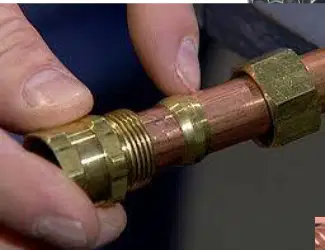
Which category is included among the properties of plumbing materials?
Alloys
Ceramics
Glass
Timber
Which of the following are pure metals gained straight from ore?
Copper
Aluminium
Lead
Zinc
Steel
Which statement best characterizes ferrous metals?
They contain iron, are magnetic, and will corrode easily if not treated.
They do not contain iron and therefore cannot rust.
They are always non‑magnetic and resistant to corrosion.
They are plastic-based compounds used for below ground drainage.
Which alloy is a mixture of copper and zinc?
Brass
Bronze
Gunmetal
Steel
Which alloy is described as copper and tin?
Bronze
Brass
Gunmetal
Steel
Which alloy is described as copper, tin and zinc?
Gunmetal
Brass
Bronze
Steel
Which material is described as iron and carbon?
Steel
Brass
Bronze
Gunmetal
Which definition of non‑ferrous metals is correct?
Any metal that does not contain iron
Any metal that contains iron and is magnetic
Any polymer resin used in guttering
Any alloy made only of copper and zinc
According to the definition of plastics, what happens to thermoplastics when frozen.
They become brittle
They dissolve in water
They expand and harden permanently
They cannot be re‑shaped when heated
From the thermoplastic description, which statement is accurate.
Made from polymer resin; can be heated and re‑shaped and are recyclable.
Made from ceramic powder; cannot be heated or re‑shaped and are non‑recyclable.
Made from metal alloys; only suitable for boilers.
Made from timber; used exclusively for guttering.
Which material is described as unplasticised polyvinyl chloride and noted as not suitable for hot water?
PVCu
MDPE
HDPE
What colour is specified for MDPE underground mains according to the Thermoplastics table?
Blue
Black
White
According to the Thermoplastics table, what colour is specified for HDPE underground mains?
Blue
Black
White
Which jointing method is listed as common to PVCu, MDPE, and HDPE in the Thermoplastics table?
Push fit
Solvent welded
Fusion welded
Compression
Which option correctly identifies the materials that are stated to degrade in sunlight in the Thermoplastics table?
PVCu only
MDPE only
HDPE only
MDPE and HDPE
Which material is described as feeling slightly greasy to the touch and not solvent welded in the Thermoplastics table?
Polypropylene
Polybutylene
ABS (Acrylonitrile Butadiene Styrene)
Which thermoplastic is listed for hot water and central heating applications?
Polybutylene
Polypropylene
ABS (Acrylonitrile Butadiene Styrene)
Which material in the Thermoplastics table is explicitly stated as solvent welded?
Polypropylene
Polybutylene
ABS (Acrylonitrile Butadiene Styrene)
Select all materials that are noted as degrading in sunlight in the Thermoplastics table.
Polypropylene
Polybutylene
ABS (Acrylonitrile Butadiene Styrene)
Thermosetting plastics are defined as rigid plastics that can cope with high temperatures but are not recyclable. Which statement aligns with this definition?
They withstand high temperatures and are not recyclable
They melt on heating and are easily recyclable
They cannot withstand high temperatures and are recyclable
They soften on heating and can be solvent welded
Which pair lists examples of thermosetting plastics?
Formica and bakelite
PVCu and MDPE
Polypropylene and ABS
HDPE and Polybutylene
Mass is an amount of substance measured in kilograms. Which statement correctly defines weight as presented?
Weight is the force of gravity pulling on a mass
Weight is the amount of substance measured in kilograms
Weight is a property of mass that stays constant everywhere
Weight equals mass divided by gravity
Which unit is stated for measuring weight?
Newtons
Kilograms
Litres
Pascals
What is the formula relating weight, mass, and gravity?
weight=mass×gravity
weight=mass÷gravity
weight=gravity÷mass
weight=mass+gravity
On earth, approximately what is the weight of a 1kg mass?
1N
9.81N
100N
10kg
Which quantity changes when you go to the moon, while the other stays the same?
Weight changes; mass stays the same
Mass changes; weight stays the same
Both mass and weight change
Neither mass nor weight changes
Which statement best defines gravity as presented?
Gravity is a force of attraction between masses
Gravity is the amount of substance in an object
Gravity is the tendency of plastics to degrade in sunlight
Gravity is measured in kilograms
Which statement about gravity and mass is correct?
The bigger the mass, the bigger the gravity
Gravity decreases as mass increases
Gravity is unrelated to mass
Mass is a force measured in newtons
What value is given for gravity on the moon compared with earth?
1.6N on the moon and 9.81N on earth
9.81N on the moon and 1.6N on earth
10N on both moon and earth
1N on the moon and 100N on earth
What is the correct formula for density?
density=volumemass
density=mass×volume
density=massvolume
density=mass−volume
Solid materials of the same size and shape can have different weight because their molecules are more tightly packed together. Which property is being described?
Density
Elasticity
Malleability
Durability
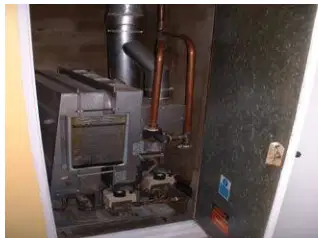
Heat transfer through differing materials can vary according to their density, like a heat exchanger. Which pairing is correctly associated?
Dry to wet — Boiler
Dry to wet — Radiator
Wet to dry — DHWC
Wet to wet — Warm air unit

Heated molecules pass on heat to the adjoining material, which in turn heats up. Which material is identified as a good conductor of heat?
Copper
Wood
Polythene
uPVC
Relative density is when we compare the mass of material. Water is said to have a density of 1 . What happens to a solid or liquid with a density greater than 1 in water?
It sinks
It floats
It mixes without sinking or rising
It evaporates
Air is said to have a density of 1 . What happens to a gas with a density less than 1 in air?
It rises
It sinks
It mixes without moving
It condenses

From the relative density table, which material will float in water?
Polythene (0.90)
uPVC (1.28)
Aluminium (2.70)
Copper (8.90)
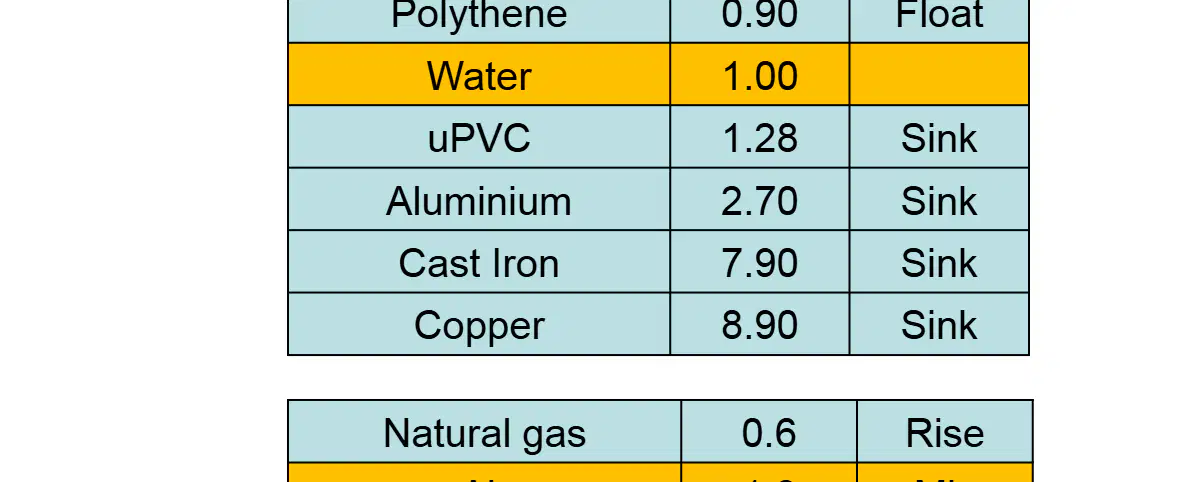
According to the table, which gas will rise in air?
Natural gas (0.6)
Air (1.0)
Propane (1.5)
Butane (2.0)
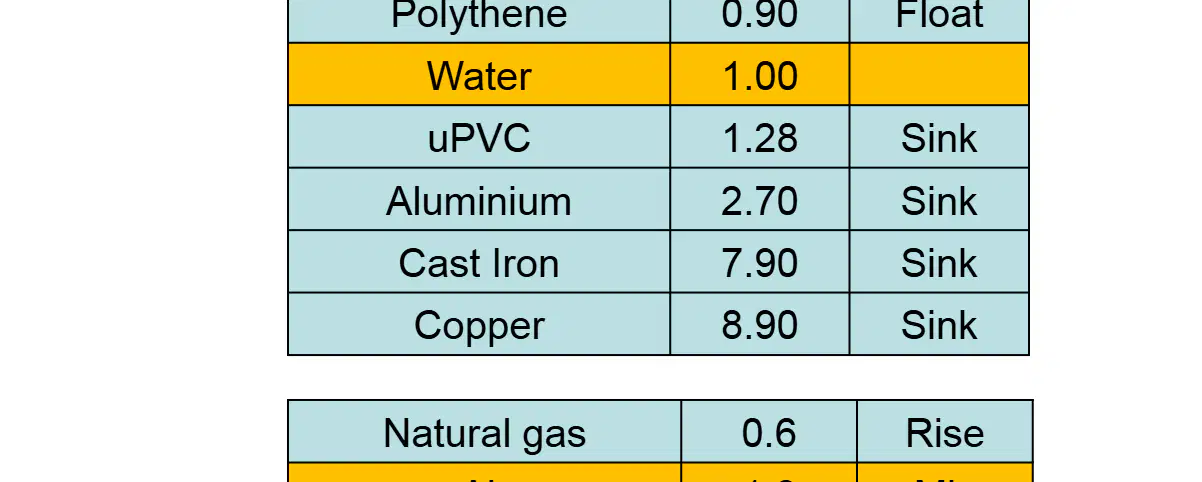
Based on the table, which materials will sink in water? Select all that apply.
uPVC (1.28)
Aluminium (2.70)
Cast iron (7.90)
Copper (8.90)
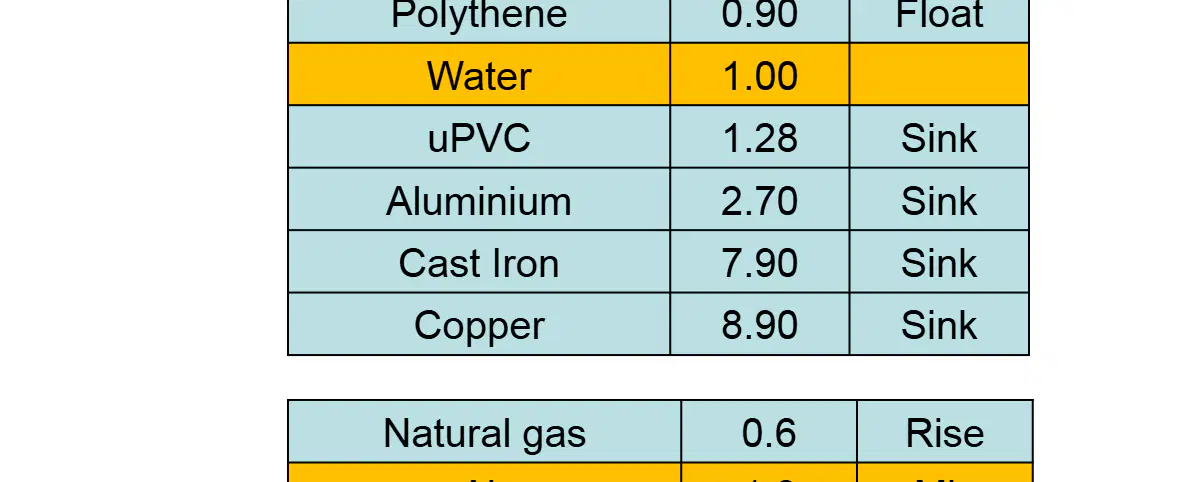
Which material in the table has the highest relative density among the listed solids?
Copper (8.90)
Cast iron (7.90)
Aluminium (2.70)
uPVC (1.28)
Which property refers to a material’s ability to be drawn into a wire?
Ductility
Malleability
Elasticity
Hardness
Which property refers to a material’s ability to be flattened or shaped into thin sheets?
Malleability
Ductility
Strength
Durability
Which property describes the change in a material’s dimensions when heated?
Thermal expansion
Conductivity
Elasticity
Strength
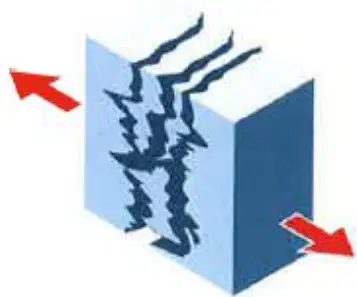
In the context of properties of plumbing materials, which property measures how strong a material is when it is stretched or pulled without breaking?
Tensile strength
Compressive strength
Shear strength
Malleability
According to the description of tensile strength, in what units is this strength measured?
N/m2 or pascals
Volts
Degrees Celsius
Ohms
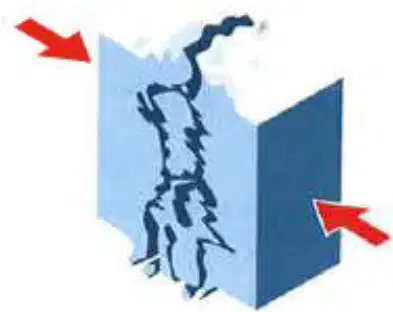
Which property measures how strong a material is when it is crushed, noting that some materials will shatter while others distort?
Compressive strength
Tensile strength
Shear strength
Ductility
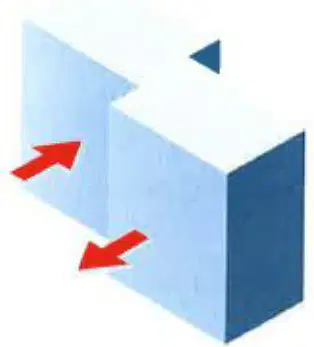
Which property describes how strong a material is when opposing forces act on it, such as with scissors or ripping apart?
Shear strength
Tensile strength
Compressive strength
Malleability

Which property, sometimes known as toughness, asks how much a material can be pulled, pushed or stretched without breaking?
Ductility
Brittleness
Malleability
Hardness

Which material is described as very ductile because it can be bent into shape as tubing?
Copper
Lead
Concrete
Glass
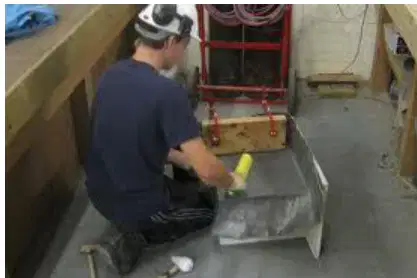
Which property asks how much a material can be compressed without fracturing and whether hammering or rolling will change its shape without cracking?
Malleability
Ductility
Tensile strength
Shear strength

Which material is noted as very malleable because it can be bossed into shape?
Lead
Copper
Steel
Plastic
Specific heat capacity: How much energy is required to heat something up? Choose the best definition.
The amount of heat required to raise 1 kg of a substance by 1°C
The maximum temperature a material can withstand before deforming
The heat needed to melt 1 kg of a substance
The energy required to raise 1 litre of water by 10°C
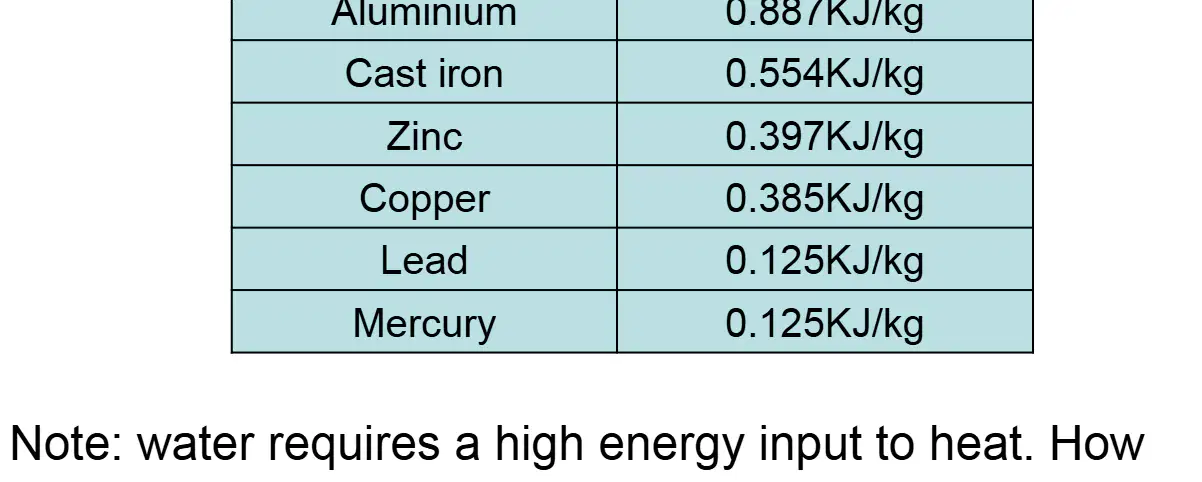
Specific heat capacity: Using the table of values (Water 4.186 KJ/kg), how much energy is required to raise 150 litres of water from 10°C to 50°C? Assume 1 litre of water has a mass of 1 kg.
25,116 kJ
15,000 kJ
6,279 kJ
40,000 kJ
Coefficient of linear expansion: How much does a piece of material expand by when heated? Select the best description.
The change in length of a material per degree of temperature increase
The total heat needed to increase a material’s temperature by 1°C
The rate at which a material conducts heat through itself
The energy stored in a material when it cools

Coefficient of linear expansion: Length of material × the temperature rise × the coefficient of expansion for that material. Using the table of coefficients (Plastic uPVC 0.00018; Lead 0.000029; Copper 0.000016; Steel 0.000011), how much will a 6 metre length of plastic guttering expand by, if the temperature rises by 10°C?
10.8 mm
1.8 mm
108 mm
0.18 mm

