
 Worksheets
Quarter 2 Review Questions
Total questions: 12
Worksheet time: 1hrs 4mins
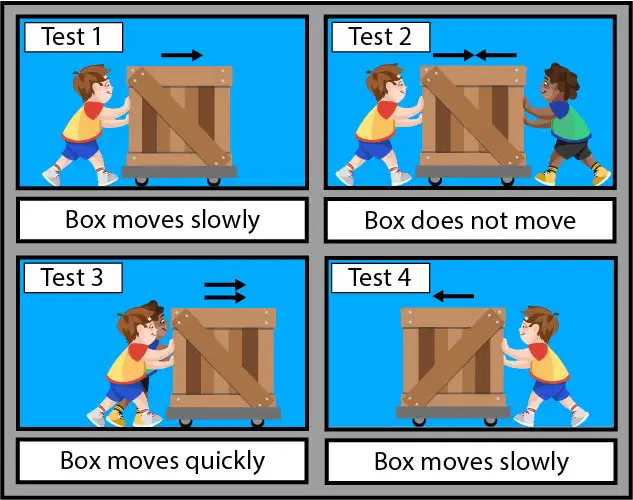
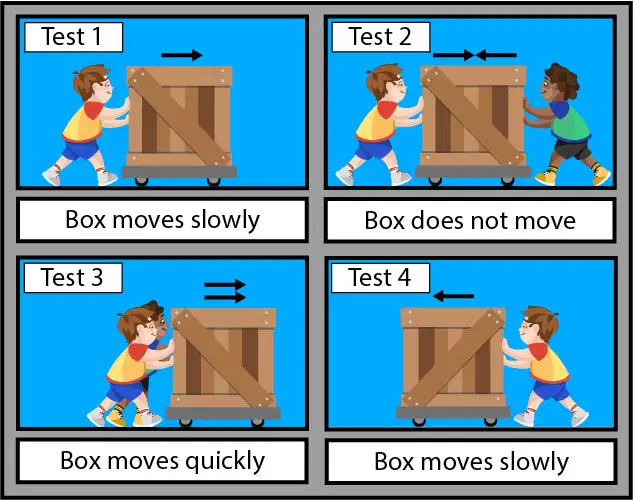
Passage: Box Pushing Experiment Two students experimented with pushing a big box. In the first test, one student pushed from the left, and the box moved to the right. In the second test, both students pushed on opposite sides of the box, and it did not move at all. In the third test, both students pushed from the left side of the box, and it moved to the right faster. In the fourth test, one student pushed from the right, and the box moved to the left. See the images below of the 4 different ways the students experimented with pushing on the box.
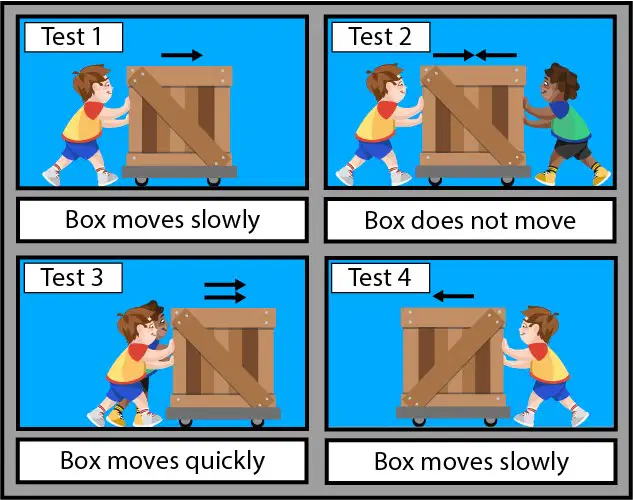
What question can be answered using Test 1 and Test 4?
How does a balanced force affect how the box moves?
How does the direction of the force affect how the box moves?
How does the number of forces affect the speed of the moving box?
How does strength of the force affect the direction of the moving box?
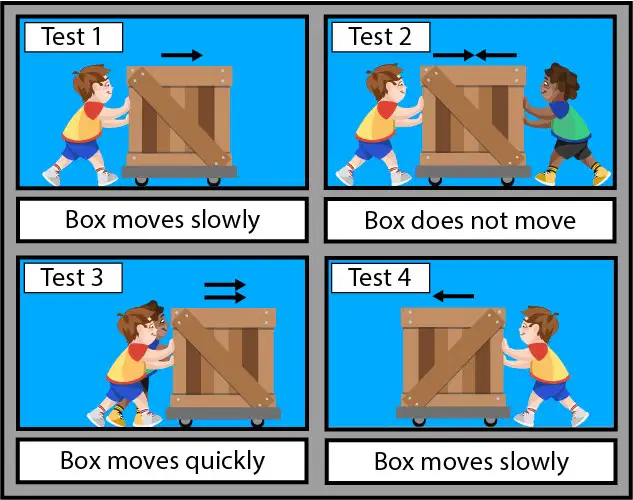
The box in Test 1 moves slowly, and the box in Test 3 moves quickly. Which statement BEST describes the box's change in speed?
The box's speed increases in Test 3 because a greater force is applied than in Test 1.
The box's speed decreases in Test 3 because a lesser force is applied than in Test 1.
The box's speed increases in Test 3 because an equal and opposite force is applied in Test 3 but not in Test 1.
The box's speed decreases in Test 3 because an equal and opposite force is applied in Test 3 but not in Test 1.
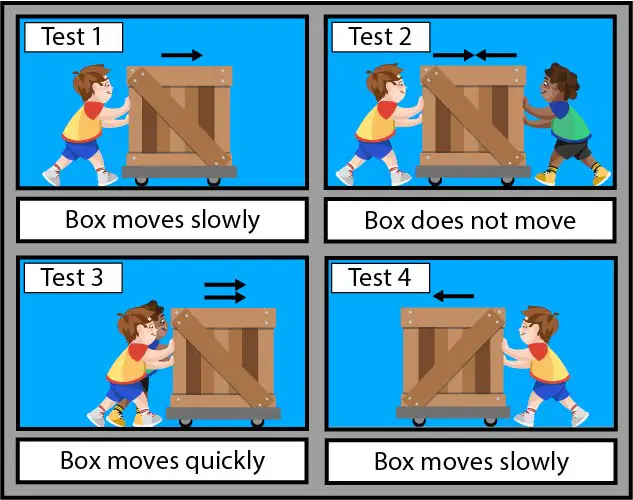
Multiple Choice Question The following question has two parts. First, answer Part A. Then, answer Part B. Part A: In which test were the forces pushing on the box balanced?
Test 3
Test 2
Test 4
Test 1
Multiple Choice Question Part B: What evidence supports the answer to Part A?
Two students pushed on the box in the same direction, and the box moved quickly.
One student pushed on the box to the left, and the box moved slowly.
One student pushed on the box to the right, and the box moved slowly.
Two students pushed on the box in opposite directions, and the box did not move.
Multiple Choice Question The following question has two parts. First, answer Part A. Then, answer Part B. Part A: In which test were the forces pushing on the box balanced?
Test 3
Test 2
Test 4
Test 1
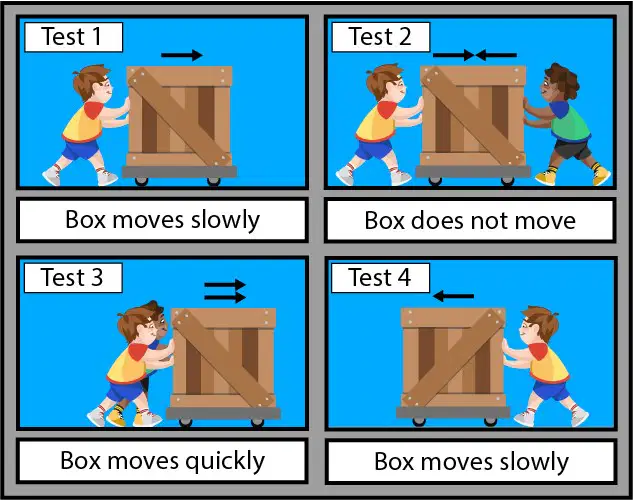
Multiple Choice Question Part B: What evidence supports the answer to Part A?
Two students pushed on the box in the same direction, and the box moved quickly.
One student pushed on the box to the left, and the box moved slowly.
One student pushed on the box to the right, and the box moved slowly.
Two students pushed on the box in opposite directions, and the box did not move.
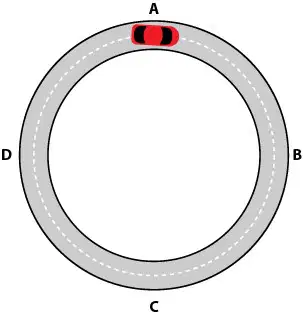
A student is studying the motion of a car on a circular track, as shown.
The table shows data on the car's position over a 25-second interval.
Time and position data:
0 seconds — A
5 seconds — B
10 seconds — C
15 seconds — D
20 seconds — A
25 seconds — B
Which TWO predictions show where the car will be if the pattern continues?
The car will reach position B in 30 seconds.
The car will reach position C in 30 seconds.
The car will reach position D in 35 seconds.
The car will reach position B in 40 seconds.
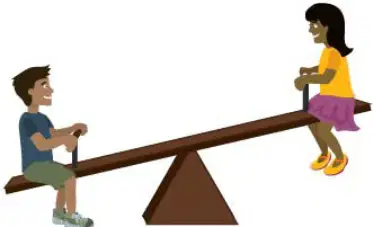
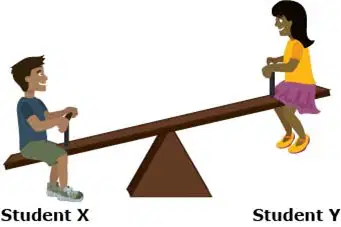
Passage: Seesaw Science. Two students sit on a seesaw. A drawing of the students is shown below. Monica is another student who is also at the playground. She watches the students on the seesaw. Monica makes a list of what she sees. The list is in order. Monica’s List 1. Student X pushes his feet against the ground, and then he moves up away from the ground. 2. When Student X moves up into the air, Student Y moves down toward the ground. 3. Student Y touches her feet on the ground, and then she pushes against the ground with her feet. 4. When Student Y moves up into the air, Student X moves down toward the ground.
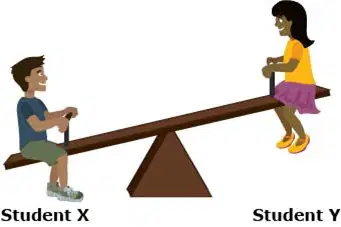
Student X now pushes against the ground. Using Monica’s list, which TWO statements BEST describe what will happen next?
Student X will move down.
Student X will move up.
Student Y will move up.
Student Y will move down.
Both Student X and Student Y will remain still.
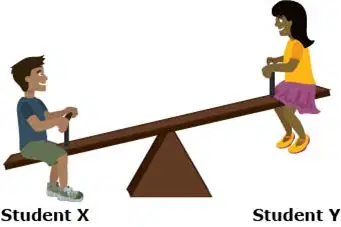
Look at Monica’s list. Which two sentences in the list compare the motion of the students?
Sentences 1 and 2
Sentences 1 and 3
Sentences 2 and 3
Sentences 2 and 4
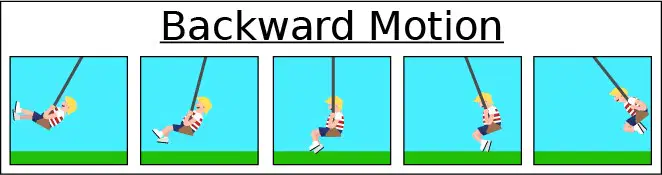
Which sentence best describes the person swinging on the swing?
Objects can move in a repeating pattern.
All objects move in a repeating pattern.
Objects can only move in one direction.
All objects move in the same direction.
What can the observations be used to predict?
The observations can be used to predict when the swing will stop.
The observations can be used to predict the future motion of the swing.
The observations can be used to predict how long the student will swing.
The observations can be used to predict which student will use the swing next.
Which statement about the brightness of stars as seen from Earth is true?Name
Color
Sirius appears brighter than the Sun because it is a brighter color.
The Sun appears brightest from Earth because it is much closer than the other stars.
Betelgeuse appears brightest from Earth because it is red.
Color alone determines apparent brightness; distance has no effect.
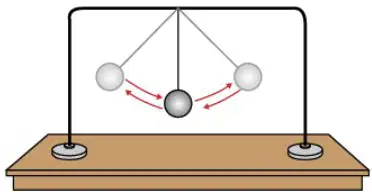
A pendulum is a weight at the end of a hanging string. The weight swings from side to side when it is pulled and released. The diagram shows a pendulum and its range of motion. A student is investigating patterns in a pendulum's motion. The student times how long the pendulum weight takes to swing from one side to the other and back again. The student observes that one back-and-forth motion takes 2 seconds. He wants to make the pendulum weight swing slower. What should the student change about the pendulum to make it swing slower?
The student should use a shorter string.
The student should use a longer string.
The student should use a smaller weight.
The student should use a heavier weight.
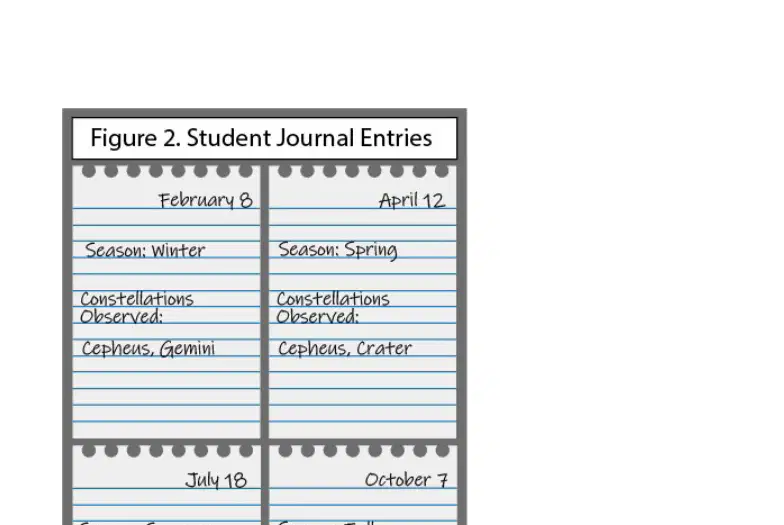
Using Figure 2: Student Journal Entries, which constellation is visible only during the spring?
Scorpius
Cepheus
Crater
Gemini
Why are some constellations visible all year round?
These constellations are the ones closest to Earth.
These constellations are never blocked by the Sun.
These constellations are never blocked by the Moon.
These constellations are the brightest ones in the sky.
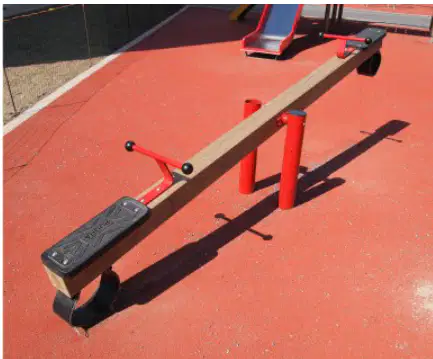
What will most likely happen to David and Delia on the seesaw?
David and Delia will move up and down because their forces are unbalanced.
David and Delia will move up and down because their forces are balanced.
David and Delia will not move because their forces are unbalanced.
David and Delia will not move because their forces are balanced.
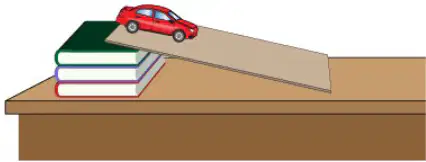
A student releases a toy car on a sloping track, as shown. The student observes that the toy car moves slowly. Which action will increase the toy car's speed?
adding a book to the stack
adding weight to the books
removing a book from the stack
changing the color of the books
Which statement BEST supports the choice in Part A?
The lower the slope, the faster the toy car will move.
The higher the slope, the faster the toy car will move.
The heavier the books, the faster the toy car will move.
The brighter the books, the faster the toy car will move.

