
 Worksheets
Tsunamis, Volcanoes, Earthquakes Quiz
Total questions: 20
Worksheet time: 14mins
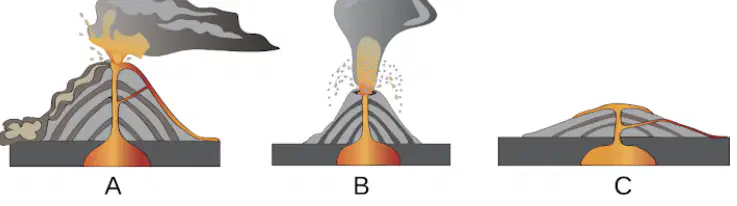
Match each image to the volcano type below.
Shield Volcano
C
Composite Volcano
A
Cinder-Cone Volcano
B
Match each volcano definition to the correct term below.
Active
A volcano that has erupted recently woul
Extinct
A volcano that once erupted, but is not
Dormant
A volcano that hasn't errupted in many y
Which sentence below best describes the difference between magma and lava?
Magma is hotter than lava and poses more of a risk to humans.
Lava is large in size and can cause great damage, while magma is much smaller.
Magma is located under the Earth's crust, while lava is located above the Earth's crust.
Lava oozes out of volcanoes, while magma explodes out of volcanoes.
If a scientists said that a lava sample had high viscosity, that would mean that the lava ___________.
was very thin and runny
contained many metals
moved very quickly
was very thick and slow moving
The Ring of Fire is around the _____________.
Pacific Plate
American Plate
Austrian Plate
Atlantic Plate
Which type of volcano tends to be the tallest and largest?
Cinder-Cone Volcanoes
Compositie Volcanoes
Shield Volcanoes
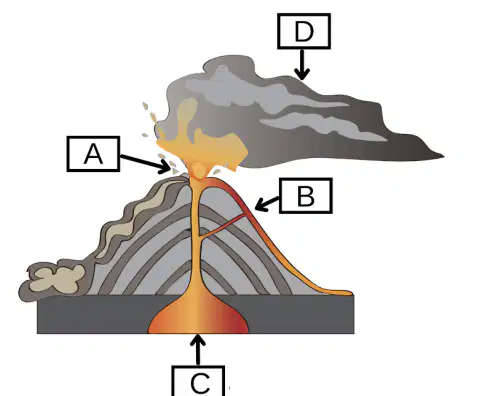
Match the term to the correct part of the image.
Ash
D
Vent
B
Magma Chamber
C
Crater
A
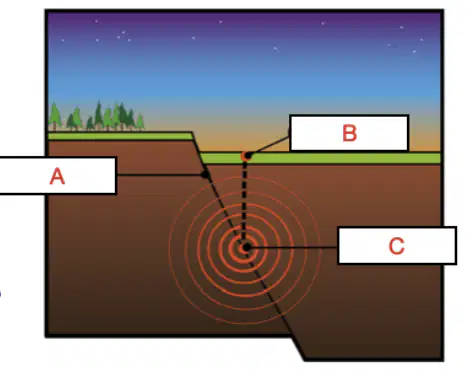
Match the term to the correct location on the image.
Epicenter
B
Focus
C
Fault
A
Which type of plate boundary is most common in California?
Convergent
Divergent
Transform
Which type of fault is most common in California?
Normal
Reverse
Strike Slip
Which description below describes a 3.2 earthquake?
Very heavy damage and buildings collapsed.
Light shaking with some dishes rattling.
Not noticed by many people, very mild.
Earthquakes are measured using the ________________.
Epicenter Degrees
Richter Scale
Fault Order
Wagner Steps
Which of the choices below are types of faults? (Click Three)
Reverse Fault
Richter Fault
Normal Fault
Plate Fault
Strike-Slip Fault

