
 Worksheets
Great Depression and New Deal Quiz
Total questions: 84
Worksheet time: 2hrs 8mins

The Civilian Conservation Corps (CCC)
The Agriculture Adjustment Act (AAA)
Public Works Administration
The Tennessee Valley Authority (TVA)
The Dust Bowl was a problem with farmland that happened during the Great Depression. What were the MAIN reasons the Dust Bowl happened?
What were some of the significant effects of the Great Depression on Americans?
National Recovery Administration
Glass-Steagall Act
Federal Deposit Insurance Corporation
Securities Exchange Act the purpose of the Works Progress Administration (WPA)?
Looking at New Deal Remedies, what does President Roosevelt say about the New Deal programs?
Looking at New Deal Remedies, what does President Roosevelt say about the New Deal programs?
The Great Plains suffered even more during the Great Depression due to severe
As a result, during the Great Depression, the Great Plains became known as the
As a result, during the Great Depression, the Great Plains became known as the
Many migrant workers traveled west from the Dust Bowl area; local residents viewed these workers as a threat because
What was President Hoover's response to the Great Depression?

In order to help farmers, the AAA (Agricultural Adjustment Agency)
did very little to help the farmers
created quotas and told all of the farmers what to grow
controlled the prices of all crops and forced Americans to buy them
paid farmers to reduce crop production


Financial Aid to farmers who were encouraged to burn crops and slaughter livestock to reduce supply and increase demand.
Agricultural Advancement Act
Tennessee Valley Authority
Agricultural Adjustment Act
Agricultural Authority Act

Why did farmers in the 1920s increase food production?
the demand in Europe increased because of the war
the price of crops were dropping so fast farmers were losing money
the US citizens demanded more food
because they couldn't afford stock
What philosophy did the New Deal follow?
Laissez-Faire policies should guide our economy
"rugged individualism" will get us through the Great Depression
the federal government should work to help Americans in poverty
capitalism is a natural cure for economic crisis
Which New Deal policy was aimed directly at aiding farmers and reducing crop surplus?
Civilian Conservation Corps (CCC)
Agricultural Adjustment Act (AAA)
Works Progress Administration (WPA)
National Industrial Recovery Act (NIRA)
This legislation was commonly referred to as what?
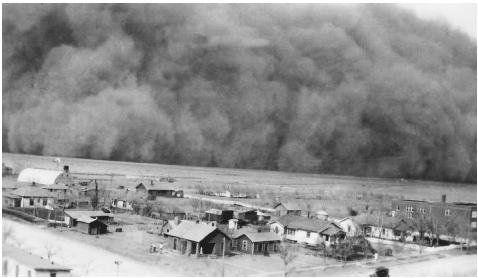

What was one factor that helped turn the Great Plains into the Dust Bowl in the 1930s?
Paying farmers to plant native grasses.
Increased demand for tobacco after World War I.
Numerous tornadoes occurring in the region.
Intense drought in the region.

Which image demonstrates the impact of the Dust Bowl


During the 1930s, poor land management and severe drought conditions across parts of the Midwest resulted in the
formation of the United States Department of Agriculture
creation of wheat surpluses
growth of the Populist movement
development of Dust Bowl conditions on the Great Plains
Poor land management and drought in the 1930s Midwest led to the
formation of the United States Department of Agriculture
creation of wheat surpluses
growth of the Populist movement
development of Dust Bowl conditions on the Great Plains
October 29, 1929; date of the worst stock-market crash in American history and beginning of the Great Depression.
Black Tuesday
Speculation
Stock Market Crash
Black Thursday
The plunge in the stock market prices. 1st event of the Great Depression.
dust bowl
new deal
buying on margin
crash of 1929
An area in the Mid West where farms were damaged by a severe drought.
Black Blizzard
Dust Bowl
White Out
Rain storm
Roosevelt's programs to fight the Depression.
Old Deal
Bank Holiday
Trickle Down
New Deal
Government funded projects that built public resources such as roads and dams.
Public Works Agencies
Private Works Agengies
Alphabet soup agencies
FDIC
Name given to Roosevelts many agencies created during the Great Depression.
Cream of Mushroom Soup Agencies
Vegtable Soup Agencies
Chicken Noodle Soup Agencies
Alphabet Soup Agencies
How long did the Great Depression last?
more than 20 years.
more than 10 years
5 years
Where did the Great Depression start?
In England
In Italy
In the United States.
Did the Great Depression spread to other countries?
Yes
No
On what date did the Great Depression start?
October 29, 1929
October 29, 1945
October 31, 1929
What is the stock market?
It is a place that you buy food
It is where people put their money to invest in businesses.
It is a place to buy dishes.
At the start of the Great Depression, factories were making...
…too many products and people couldn't afford to buy them.
…not enough products and people wanted to buy them
Why couldn't people buy products from factories during the Great Depression?
They didn't have enough money
They didn't like the products.
They had too many things.
Why didn't people have money during the Great Depression?
They did not save their money.
They did not have jobs.
They had a lot of money during the Great Depression
What was the Dust Bowl?
It was a bucket full of dirt used to plant crops.
It was a drought in the Midwest that kept the farmers from growing crops to eat because there was no rain.
It was a place where farmers grew crops and sold them.
What did President FDR promise the people in America?
He promised to give them money.
He promised to end the Great Depression.
He promised to make people rich.
What was the New Deal?
Pick four programs....
It was a program to build parks and schools
It was a program to build roads and bridges
It was a program to create jobs for Americans
It was a program to help people get jobs.
It was a program to help the rich make more money.
What really ended the Great Depression?
World War I
World War II
The Great Depression
Which tecnology helped with FDR's programs to combat the Great Depression that used government spending to stimulate the economy.
Airplane
Television
Automobiles
Radio
What is this?
Roosevelt was the first president to effectively use the radio to speak directly to the nation to help instill confidence in the government. He used this to explain to the American people in simply language the measures the government was taking to bring America out of the Great Depression.
"Fireside Chats"
"Buying on Margin"
"Banking Holiday"
"Daytime talks"
Herbert Hoover believed in a __________ or hands-off, approach to economic policy. The presidents before him used this approach. Hoover feared that if the government directly helped people in need, they would not want to work hard.
Laissez Faire
Do-Nothing Policy
Laisser Passer
Live and Let Live
The name given to many of the shantytowns that grew up around cities during the Great Depression. They were named after President Herbert Hoover because people blamed him for the economic situation.
Hooverville
Laissez Faire
The New Deal
Dust Bowl
The act established an independent government body responsible for regulating and insuring banks. Deposits at member banks were insured up to $5,000. If the bank should fail, the customers’ money would be refunded. This was an important step in helping Americans feel confident about banking again.
Social Security
The New Deal
Federal Deposit Insurance Corporation (FDIC)
Civilian Conservation Corps (CCC)
The purpose of __________ was to provide a pension for older Americans, many of whom had lost their jobs, homes, and life savings in the Great Depression. The program also paid benefits to laid-off and disabled workers and to underprivileged families with dependent children.
Social Security
Federal Deposit Insurance Corporation (FDIC)
The New Deal
Civilian Conservation Corps (CCC)
Employed young, unmarried men who worked to restore and protect the country’s natural resources. The projects they worked on included fighting forest fires, building flood barriers, planting trees, and maintaining forest roads and trails. Members were housed in military-style work camps where they slept, ate, and received medical care. Each man received a monthly cash allowance of $30, most of which was sent home to their families. This enabled them to purchase food, clothing, and other necessities
Civilian Conservation Corps (CCC)
The New Deal
Social Security
Federal Deposit Insurance Corporation (FDIC)
Veterans of this conflict were owed bonus pay for their service.
World War I
World War II
Gulf War
Civil War
Which of the following is NOT a cause of the Great Depression?
Overproduction and underconsumption
High tariffs restricting trade
buying stocks on the margin
high income taxes
What was President Herbert Hoover's response to the Great Depression?
He believed "rugged individualism" would solve the economy
He created mass welfare
He increased infrastructure to create jobs
He violated his policy of laissez-faire
Why did many midwestern farmers migrate from the Great Plains to California?
There was no unemployment on the West Coast
California was experiencing a gold rush
The Dust Bowl pushed farmers out of the Great Plains
The Stock Market crash led farmers to lose their homes on the Great Plains
A form of insurance where employers and workers would pay the tax to cover unemployment benefits, old age pensions, programs for the blind, and for children of workers who had died. It also helped provide pensions for retired workers, their spouses and helped people with disabilities.
Dust Bowl
Hoover
Stock Market
Social Security Act
The 1929 crash of this led to many people losing all their money.
Okies
World War II
Stock Market
Hoovervilles
How did the stock market crash mainly lead to bank runs?
People were upset they had lost money and went ot the bank to borrow more.
People were panicked they would lose their money the had invested in stocks.
People were panicked they would lose their money that they had invested in the banks.
People thought if they did not get their money out, then the government would take it.
Which of the following did NOT lead to the Dust Bowl?
There was a severe drought
Farmers used the soil for growing wheat.
Farmers used the land for cattle grazing.
The government planted several trees.
President Roosevelt’s works programs such as the WPA, TVA, and CCC were created with the purpose of helping which type of people?
Farmers
Government Workers
Okies
Unemployed Americans
Which of the following was NOT one of the causes of the Great Depression?
Stock Market Crash
Bank Runs
Easy Credit
Prohibition

What day does this article discuss?
Black Sunday
Black Wednesday
Black Friday
Black Tuesday

Which year had the highest rate of unemployment?
1929
1933
1937
1981
Shanty towns that were constructed all over America.
Hoover
Okies
Shantytowns
Hoovervilles
The main purpose of New Deal measures such as the Securities and Exchange Commission and the Federal Deposit Insurance Corporation was to —
provide immediate employment opportunities.
enable the federal government to take over failing industries.
assure a guaranteed income for American families.
develop rules to limit speculation and safeguard savings.
The Social Security Act of 1935 is considered an important program because it —
extended support to elderly citizens.
established a progressive income tax.
provided employment for those in need of a job.
brought about a quick end to the Great Depression.
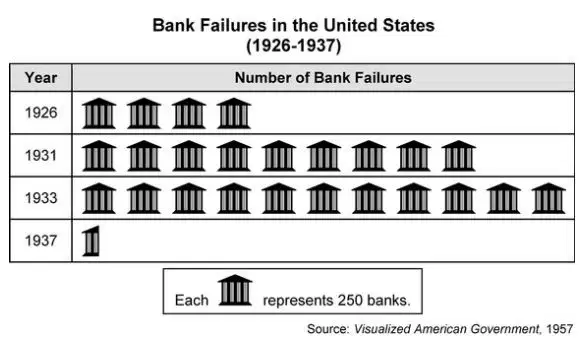
The chart shows bank failures during the 1930s. The major reason for the change in the number of bank failures between the early 1926 and 1937 is that by 1937 —
most Americans had transferred their savings to European banks.
new banking laws had restored public confidence in the nation's banks.
most people were too poor to have any savings.
the government had purchased and was operating the nation's banks.
The Social Security Act (1935) provided—
healthcare for children.
a tax exemption for families.
retirement benefits for seniors.
a stock portfolio.
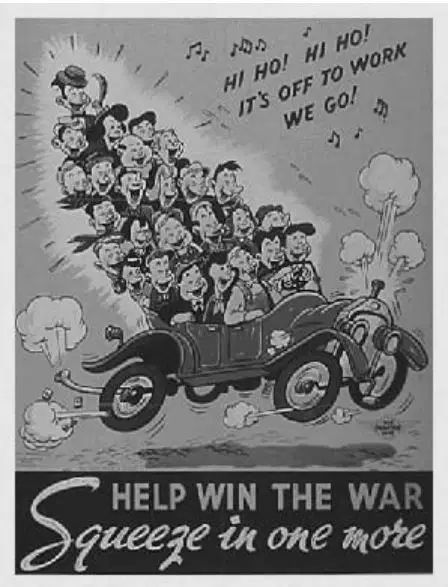
The poster below depicts a civilian activity during World War II. Which feature of life on the home front during World War II is most clearly illustrated by this poster?
Using public transportation
Conserving gasoline supplies
Rationing rubber tires
Sharing car ownership
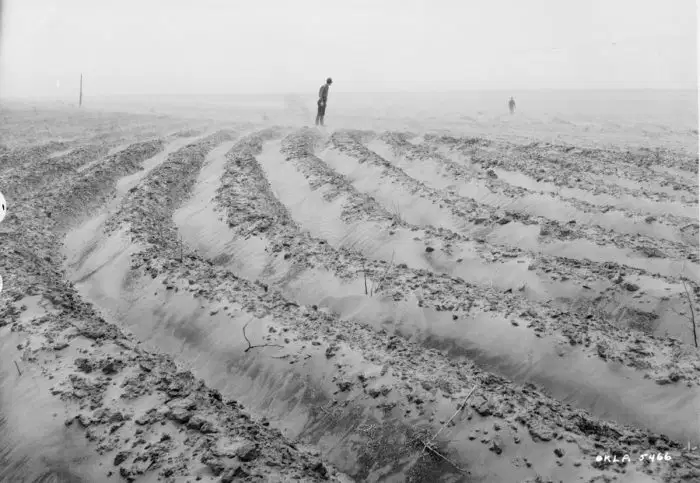
One of the effects of the Dust Bowl of the 1930s was the—
immediate migration of farmers to the American West.
implementation of new farming techniques.
over-cultivation of agricultural land.
start of the Great Depression.
Agencies Created During the New Deal Civilian Conservation Corps Works Progress Administration Farm Credit Administration Home Owners’ Loan Corporation The goals of these New Deal agencies support the conclusion that the New Deal —
gave the federal government a larger role in the day-to-day welfare of its citizens
forced citizens to participate in federal programs
gave preference to state-run agencies over federally run agencies
forced the federal government to adopt isolationist foreign policies

The graphic organizer identifies effects of a New Deal program from the 1930s. Which New Deal program best completes the graphic organizer?
Tennessee Valley Authority (TVA)
Work Projects Administration (WPA)
Civilian Conservation Corps (CCC)
Agricultural Adjustment Administration (AAA)

Which New Deal agency was created to specifically serve this population?
Federal housing Administration
Securities and Exchange Commission
Federal Deposit Insurance Corporation
Social Security Administration

This photograph shows a 1934 painting by an artist with the Public Works of Art Project during the Great Depression.
What is the MOST LIKELY reason the Public Works of Art Project commissioned this painting?
To promote optimism for US economic progress during the Great Depression
To demand federal worker safety laws during the Great Depression
To encourage competition for US technological superiority during the Great Depression
To question the success of nationalizing industries during the Great Depression

True or False: During the 1920s, the wealth gap between the rich and the poor increased
True
False

This political cartoon to the right illustrates one way in which the New Deal tried to solve the problems created by the Great Depression. What was is being suggested to solve these problems?
To provide federal aid to the economy despite growing costs
Reduce taxes on big businesses in hopes it would stimulate job growth
Lower federal spending to maintain a balanced budget
Decrease foreign competition in the economy

