
Font size
 Worksheets
Haudenosaunee in North America
Total questions: 37
Worksheet time: 26mins
Which statement best describes the Haudenosaunee Confederacy?
A trade network without governance
A temporary alliance for wartime only
A cooperative group of member communities
A single nation with one leader
What does matrilineal mean in the Haudenosaunee clan system?
Inheritance through the father’s family line
Equal descent through both parents
Leadership chosen by the eldest male
Descent and clan identity through the mother’s line
Who was traditionally the head of the longhouse family among the Haudenosaunee?
Clan Mother leading the household
Traveling traders supervising families
War Chief overseeing daily chores
Eldest son managing supplies
What did the longhouse symbolize for Haudenosaunee culture?
Togetherness and cooperation among families and clans
Individual achievement and status
Military strength and conquest
Trade wealth and market power
What is the main governing document of the Haudenosaunee called?
Confederacy Charter of Nations
Treaty of the Great Lakes
Great Law of Peace (Kaianere’ko:wa)
Code of the Longhouse
Which skill shared by Indigenous Peoples most directly helped settlers travel long distances in snowy regions?
Birchbark canoe construction techniques
Snowshoe design and usage methods
Beaver hunting tracking strategies
Spruce gum waterproofing recipes
Why were beaver pelts highly sought by Europeans during early settlement?
They were needed for metalworking
They served as currency in Canada
They were fashionable in Europe
They were used for canoe frames
Which statement best shows how trade benefited Europeans more than Indigenous hunters?
Beaver hunting took several easy hours
Europeans learned to avoid all local plants
Pelts were traded for small amounts of sugar or lead
Knives and pots were exchanged for free
Which items did Europeans commonly trade to obtain beaver fur pelts?
Spruce gum, woven baskets, and grain
Maps, books, and clothing
Canoes, snowshoes, and tents
Knives, saws, axes, and pans
What navigation help did Indigenous Peoples give settlers in the Canadian landscape?
Charting desert caravan paths
Locating underground tunnels
Finding routes through rivers and passes
Reading ocean tides only
Which invention made crossing rough snowy land more efficient for Europeans?
Ice skates
Logsleds
Snowshoes
Wagon wheels
Which statement best describes Canada’s multicultural identity today?
Many cultures live across Canada
Only English settlers live nationwide
One language is spoken in Toronto
Only French speakers live in Québec
Who lived in Canada before European explorers arrived?
British officials
Indigenous peoples
Chinese immigrants
Irish settlers
Which sequence shows early European settlement in Canada?
British settlers, French settlers, Indigenous peoples
Indigenous peoples, British settlers, French settlers
Indigenous peoples, French settlers, British settlers
French settlers, Indigenous peoples, British settlers
Why did the government want more people to move to Western Canada during development?
To start luxury tourism
To build coastal lighthouses
To open art museums
To build railroads and canals
Which groups were invited to help with labour shortages in Western Canada?
Spanish explorers
Chinese communities
Irish migrants
Ukrainian settlers
During which years did many Chinese immigrants first arrive for railway work?
Between 1881 and 1884
Between 1776 and 1779
Between 1900 and 1903
Between 1812 and 1815
What major project hired about 17,000 Chinese men in British Columbia?
The Hudson’s Bay trade
A national highway system
The St. Lawrence Seaway
The transcontinental railway
About how many Chinese railroad employees died during construction?
Exactly 6 workers
Fewer than 60 workers
At least 600 workers
Over 6,000 workers
Beyond laying tracks, what additional tasks did Chinese workers perform?
Cleared trees and brush
Built drainage systems
Mined for coal
Operated city ferries
Which statement shows systemic racism faced by Chinese workers?
Guaranteed promotions every year
Free meals from the company
Extra vacation days each month
Lower pay than others for same jobs
Which event led to a major wave of Irish immigration to Canada between 1846 and 1851?
Great Irish Potato Famine
Industrial Revolution in Ireland
Rideau Canal opening
Gold Rush in Australia
Why did many Irish immigrants initially choose British North America over the United States or Australia?
Free land for all arrivals
Cheaper transportation costs
War was happening there
Better climate year-round
What immediate action did officials take with new Irish immigrants due to disease and logistics concerns?
Assigned them to canal work
Moved them to northern forests
Quarantined for exams and interviews
Sent them back to Ireland
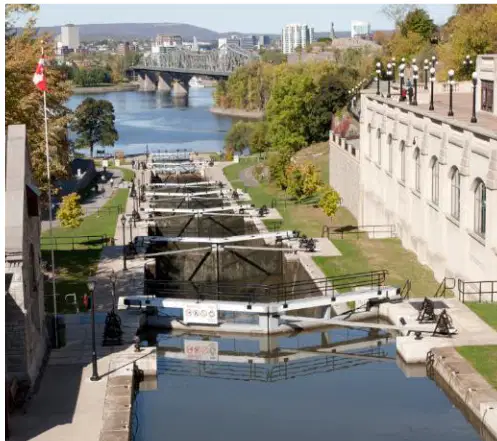
Which Canadian waterway connected the Ottawa River to Lake Ontario and relied on Irish labor?
Rideau Canal
Trent–Severn Waterway
Welland Canal
St. Lawrence Seaway
Who led the construction of the Rideau Canal and hired about 2,000 Irish workers?
Sir John A. Macdonald
Colonel By
William Lyon Mackenzie
Samuel de Champlain
Which risk faced workers cutting the Rideau Canal through forests?
Malaria causing illness and death
Volcanic eruptions nearby
Shark attacks in waterways
Avalanches in the Rockies
After finishing the Rideau Canal, what did many Irish workers do?
Returned to Ireland immediately
Moved to the United States
Settled in the Ottawa area
Became lighthouse keepers
Ukrainian immigrants were especially important to which region’s farming development in Canada?
Northern mining camps
Prairie provinces agriculture
Ontario fruit orchards
Atlantic coastal fisheries
Which challenge made traditional farming methods difficult in the Prairies for new settlers?
Low mountain elevation
Soil content and precipitation levels
Too many large forests
Frequent earthquakes
How did Ukrainian farmers help crops thrive in the Canadian Prairies?
Invented irrigation canals
Switched to rice cultivation
Imported hardy wheat seeds from Ukraine
Used only livestock manure
What was the result of planting the hardy Ukrainian wheat strain in the Prairies?
Wheat attracted pests and died
The crop failed repeatedly
The crop thrived and farmers prospered
Fields flooded every spring
Which benefit did Canadians across the country gain from Ukrainian wheat farming?
Cheaper imported sugar
Greater availability of a staple food
More fur trade posts opened
New gold mining towns formed
Select all statements that describe impacts of Irish immigration on transportation in Canada.
Made rivers disappear in the region
Stopped all trade routes in Eastern Ontario
Helped build canal systems near the Great Lakes
Were crucial to Rideau Canal construction
Choose the statements that correctly compare the two immigration stories.
Both groups arrived due to the Gold Rush
Neither group stayed in Canada after their projects
Each group solved local challenges with labor or crops
Irish workers improved waterways; Ukrainian farmers improved prairies
Question 1: Cultural Symbols and Governance
The longhouse was not only a physical home for the Haudenosaunee but also a "important symbol" for their culture. Based on the text, explain how the physical structure of the longhouse reflected the Haudenosaunee's values regarding family and government.
Question 2: Indigenous Peoples and various immigrant groups (such as the Chinese, Irish, and Ukrainians) all contributed to the development of early Canada. Choose one immigrant group and one way the Indigenous Peoples assisted settlers, and describe how their specific knowledge or labor helped the country grow.

