
 Worksheets
Banking, Patents, and Social Class in Britain
Total questions: 20
Worksheet time: 10mins
Which feature made savings banks significant in early 19th‑century Britain?
They replaced all licensed and unlicensed banks
They offered free accounts without regulation
They pooled small deposits to earn interest
They provided large business loans instantly
In response to the crises of 1825–1826, what action did the Bank of England take?
Created regional branches to stabilize banking
Required factories to hold bank reserves
Eliminated patents to fund banks and merchants
Raised interest on all checking and savings accounts
How did patents support British industrial growth?
They limited creativity to government projects
They banned incentives for new mechanisms
They allowed inventors to control and sell rights
They forced inventors to share designs freely
Why did industrialization widen social class gaps in Britain?
Patents removed profits from inventors
Rural farms paid higher wages than cities
Savings banks excluded wealthy clients
New factory employment paid low wages
Which policy move most directly supported France’s industrial growth under Napoleon?
Creation of the Bank of France to fund projects
Privatization of all canals and waterways
Abolition of tariffs on imported luxury goods
Elimination of military spending to save funds
What was a key way British technology influenced France in the 1830s?
Discovery of vast southern coal reserves
Invention of the internal combustion engine
Adoption of multi-spindle looms in weaving
Replacement of canals with paved highways
In early French railroad development, what change in 1832 signaled broader public use?
Switch from iron rails to steel rails
Addition of passenger cars to existing lines
Construction of an 18-mile freight-only route
Completion of the first all-French locomotive
Which geographic factor slowed France’s early industrialization compared with Britain?
Harsh climate preventing year-round production
Abundant farmland reducing urban labor supply
Scarcity of navigable rivers throughout the country
Limited coal and iron concentrated in the north
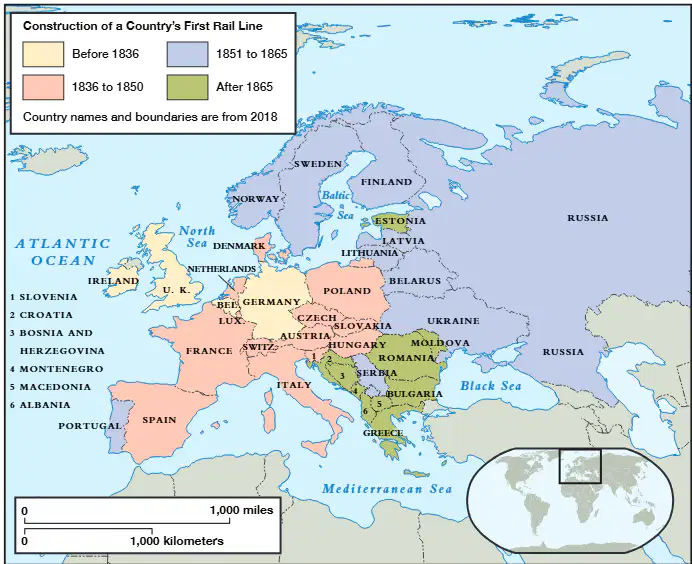
Using the map of European rail spread, which region generally built first rail lines before 1836?
Spain and Portugal
Southern Italy and the Balkans
Britain and northeastern France
Scandinavia and the Baltic states
Which factor most limited industrialization in Southern and Eastern Europe during the 19th century?
Strong urban networks tied to global markets
Widespread peasant landownership and prosperity
Heavy reliance on agriculture with few alternatives
Abundant coal reserves and rail investment
What immediate agricultural cause triggered the Irish Potato Famine around 1846?
Locust swarms across rural counties
Potato blight destroying staple crops
Drought reducing wheat harvests
Flooding of major river valleys in Europe
Why did food shortages in Ireland escalate despite local cultivation of grain and dairy?
Exports to England by absentee landlords
Protective tariffs kept imports affordable
State purchase programs for the poor
Military blockades halted coastal trade
Which policy shift in Britain was associated with the "Hungry '40s" and rising grain prices?
Expansion of the Freycinet Plan to Ireland
Repeal of the Corn Laws moving to free trade
Creation of new workhouses across counties
Imposition of higher tariffs on potatoes
Which demographic effect best characterizes Ireland between 1841 and 1851?
Life expectancy increased after blight
Birth rates rose despite emigration
Urbanization surged in industrial towns reaching nearly 2%
Population fell by about 20 percent overall
Which reform did Tsar Alexander II issue to begin abolishing serfdom in Russia?
Treaty of Brest-Litovsk
Corn Laws Repeal of 1846
Emancipation Edict of 1861
October Manifesto of 1905
What was a major economic consequence of the Emancipation Edict for many peasants?
Universal access to higher education
Mass migration to urban factories overnight
Continued renting small plots on estates
Immediate land ownership and wealth
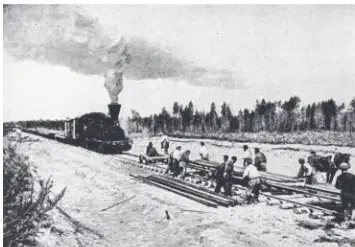
Which railway linked Moscow with the Pacific and supported Russia’s industrial growth?
Trans-Orient Express line to Paris
Trans-Siberian Railroad route
Danube–Black Sea line
Trans-Baltic Corridor track
By 1900, which industry rank did Russia achieve due to railways and heavy industry expansion?
Largest textile exporter in Europe
Second-largest coal miner globally
Top steel producer worldwide
Fourth-largest steel-producing nation
Why did Russia increase grain exports during industrialization, even when domestic shortages loomed?
To appease peasant uprisings immediately
To earn capital for railways and factories
To reduce tariffs imposed by Britain
To comply with the Great Exhibition rules
Which factor commonly slowed industrial development in Southern Europe during the 19th century?
Abundant coal deposits and eager investors
Landowners sponsoring extensive railroads
Agrarian economies with limited cash use
Mass-produced goods transforming rural labor

