
NEW
Font size
 Worksheets
Outline steps in problem-solving
Total questions: 30
Worksheet time: 15mins
Which statement best defines a problem in IT?
A mismatch between available data and required information
Any task that needs a computer program to run
An issue that can be fixed without using data
A difference between software versions on devices
Which example best represents a simple problem in IT?
Calculating the tax payable on a single item
Determining the orbit of an artificial satellite
Forecasting regional weather for the next week
Generating a complete list of prime numbers
What distinguishes complex problems from simple problems in computing contexts?
They cannot be expressed using algorithms at all
They require many more instructions to transform input to output
They are always impossible to solve efficiently
They do not use input data and produce no output
What is an algorithm in the context of problem-solving?
A sequence of instructions that rigorously defines a solution
A programming language used to build applications
A database used for storing and querying large datasets
A diagram that shows team responsibilities and roles
Which statement accurately describes a solution in IT problem-solving?
A list of possible tools that could be purchased
A visual mock-up of the final user interface only
A guess about how data might be processed in the future
A set of ordered instructions that produce the required information
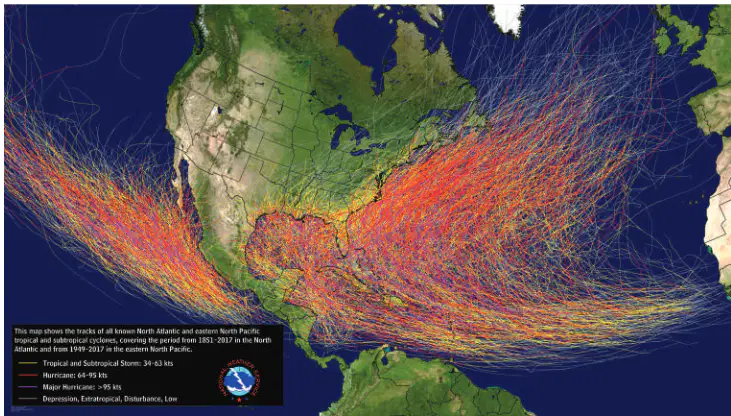
You are asked to transform thousands of sensor readings into a storm forecast. How should this task be classified and why?
Simple problem, because it uses only small input data
Simple problem, because it has one straightforward formula
Complex problem, because no algorithm can describe it
Complex problem, because it needs many processing steps
Which sequence shows a sound high-level approach to problem-solving in IT?
Collect random data, choose a tool, hope for correct outputs
Pick a solution first, then try to understand the problem
Define the problem, design the algorithm, execute to produce information
Write code immediately, test later, define goals after deployment
Which step in the problem-solving process focuses on describing the problem using Input-Process-Output (IPO) to clarify needs?
Propose and evaluate solutions using alternatives
Define the problem using an IPO breakdown
Develop the algorithm in structured steps
Test and validate with selected data
What is the primary purpose of pseudocode in algorithm design?
Provide a pictorial model with symbols
Offer English-like steps without syntax rules
Compile directly to machine instructions
Store test data for validation phases
Flowcharts are best described as which of the following?
Executable scripts for automation
Pictorial representations using standard shapes
Tabular listings of test cases
Textual outlines using natural language
After proposing and evaluating solutions, what is the next appropriate step?
Determine the best solution to pursue
Represent the algorithm as a flowchart
Define the problem in narrative form
Test and validate the chosen design
Which activity most directly supports the step 'Test and validate the solution'?
Use a trace table with selected test data
Interview users to capture requirements
Sketch alternate solution approaches
Rewrite the problem as an IPO narrative

You must choose between two correct algorithms: one is faster but skips validation, the other includes checks and is user-friendly. Which choice aligns with the guideline to 'choose the best solution' rather than only the most efficient?
Select the faster option without validation steps
Adopt both options and merge them later
Pick the option balancing correctness and usability
Delay the choice until coding is complete
During 'Define the problem', which question is most critical to answer before moving on?
How many symbols will the flowchart use?
What inputs and outputs are required?
Which programming language compiles fastest?
Which IDE theme improves readability?
Which statement best defines the divide-and-conquer approach in problem solving?
Assign every step to a different person immediately
Increase computing power to process the whole task
Try multiple solutions randomly until one works
Repeatedly split a large problem into smaller parts
When finding the average of a set of numbers, which step comes immediately before calculating average = sum ÷ count?
Read the numbers carefully
Write out the average value
Add the numbers together
Count the number of numbers

Which sequence correctly applies divide-and-conquer to frying an egg?
Heat pan, cook, add oil, plate, crack egg, enjoy
Add oil, plate, heat pan, cook, crack egg, enjoy
Crack egg, heat pan, add oil, cook, plate, enjoy
Heat pan, add oil, crack egg, cook, plate, enjoy
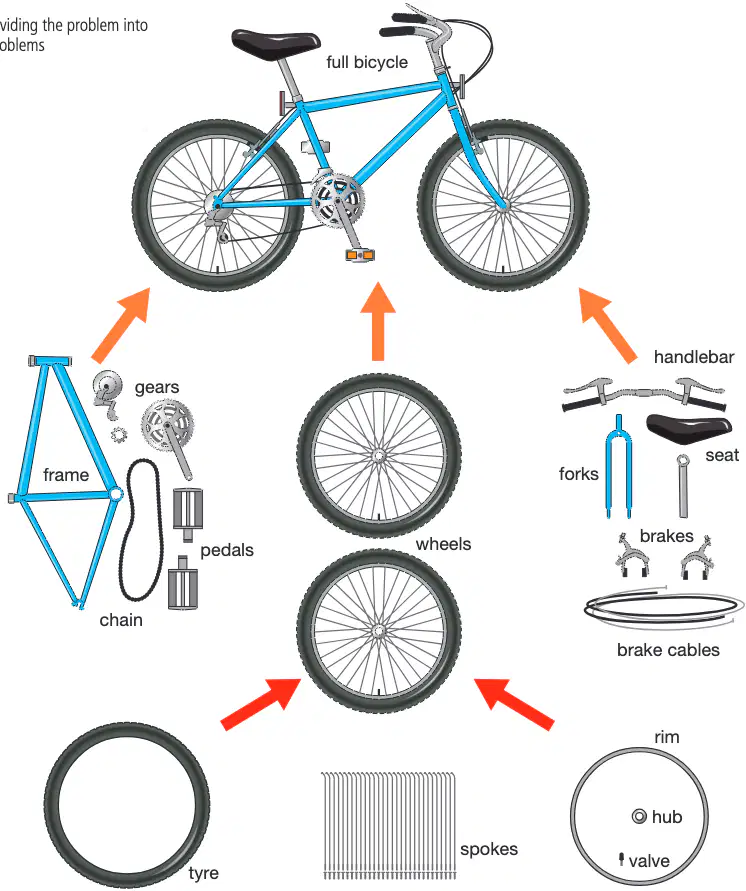
In decomposing the task of building a bicycle, which is the most appropriate top-level set of sub-problems?
Buy a completed bicycle, remove parts, repaint components, reassemble randomly
Choose paint color, pick rider outfit, inflate tyres, ring bell, test ride, post on social media
Order tyres only, then try to fit them to any available frame
Get frame, build wheels and tyres, make brakes and cables, make chain and cogs, get handlebars, assemble bicycle
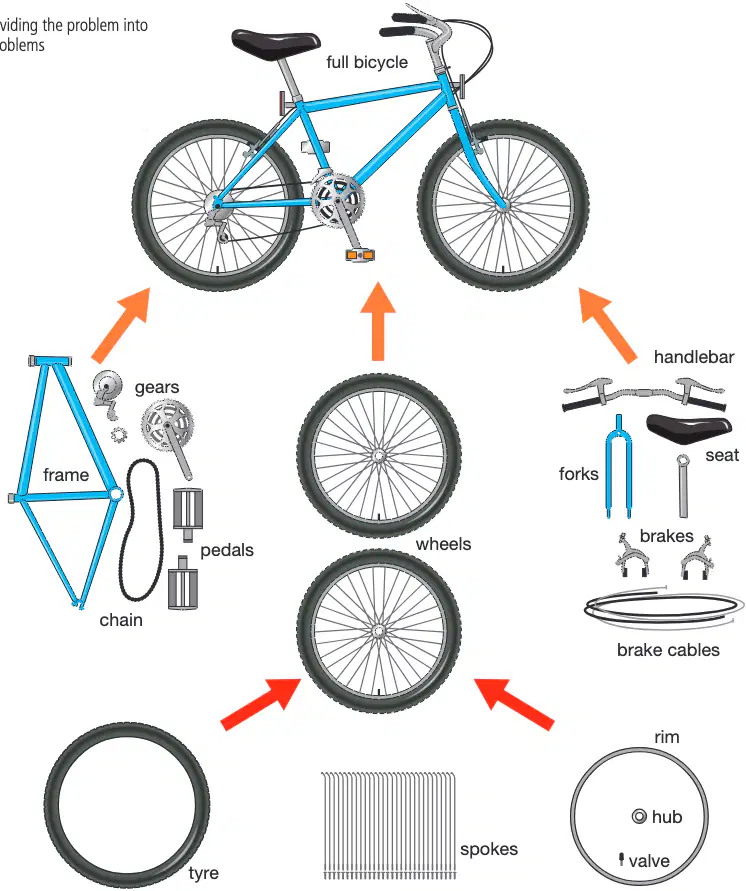
Which step shows further decomposition of the wheel-and-tyre sub-problem into simpler actions?
Ship bicycle; write receipt; schedule delivery; file documents
Measure road length; compute cadence; design helmet; export report
Select paint; polish frame; photograph parts; publish advert
Get hubs, spokes, rim, tyres; assemble hub, spokes, rim; fit tyres
What principle determines when to stop decomposing a problem in divide-and-conquer?
Stop when all parts are ordered from the same supplier
Stop when only simple actions remain that can be executed
Stop after exactly three decomposition levels
Stop when the diagram looks balanced visually
A company needs to compute tax payable after buying and then selling an item. Which first decomposition is most suitable?
Identify purchase details, identify sale details, compute profit, apply tax rules
Design website, choose logo, write invoice, hire courier
List employee names, assign cubicles, order stationery, host party
Install antivirus, defragment drives, replace keyboards, change chairs
Why is divide-and-conquer helpful for complex tasks compared to tackling the whole problem at once?
It eliminates the need to plan or document steps entirely
It ensures one person can finish without any collaboration
It reduces complexity by handling manageable sub-problems sequentially
It guarantees faster internet and better hardware automatically
Which sequence best represents the three core parts of an IPO chart?
Document variables, compute outputs, visualize inputs
Collect inputs, perform processing, display outputs
Design outputs, verify processing, gather inputs
Validate inputs, compile program, export outputs
List processes, estimate effort, publish results
In an IPO chart for adding two numbers, which item belongs in the Processing column?
second number
first number
store total in variable c
display total to the user
total = first number + second number
What is the primary purpose of decomposing a problem before creating an IPO chart?
To eliminate the need for user inputs entirely
To break a complex task into solvable sub-problems
To replace variables with constant literals
To ensure outputs are always numeric values
To avoid writing any algorithmic steps
Which step correctly applies variable use in the simple addition example?
Store total in input variable a to save memory
Keep inputs unnamed and compute total mentally
Write both inputs into variable a, overwrite with total
Assign first input to variable a, second to b, total to c
Convert both inputs to strings before summing
You are designing logic for a mobile top‑up bonus: 20% if amount > 100and≤ 200; 30% if > 200and≤ 500; 40% if > $500. Which Processing sequence is correct?
If amount>500 bonus=0.5*amount; else if amount>200 bonus=0.3*amount; else bonus=0.1*amount
If amount≤100 bonus=0; else if amount≤200 bonus=0.2*amount; else if amount≤500 bonus=0.3*amount; else bonus=0.4*amount
If amount>100 bonus=0.2*amount; else if amount>200 bonus=0.3*amount; else if amount>500 bonus=0.4*amount; else bonus=0
If amount>500 bonus=0.4*amount; else if amount>200 bonus=0.3*amount; else if amount>100 bonus=0.2*amount; else bonus=0
If amount≥100 bonus=0.2*amount; else if amount≥200 bonus=0.3*amount; else if amount≥500 bonus=0.4*amount; else bonus=0
Which statement best describes a natural language algorithm derived from an IPO chart?
A flowchart without decision branches or loops
An informal story describing user motivations
An ordered list of clear, single‑action instructions
A graphical user interface mockup for inputs
A database schema describing variable types only
Given an IPO chart with Input: phone number, credit amount; Processing: compute bonus, add to credit; Output: phone number, total credit. Which Output is essential to show the computation result?
credit amount
phone number
bonus rate
processing steps
total credit
Which action exemplifies algorithmic refinement after initial decomposition?
Expanding 'compute bonus' into tiered conditional steps
Renaming variables from a, b, c to x, y, z
Rewriting outputs as uppercase strings
Drawing a logo for the bus company
Switching from addition to multiplication

