wayground logo

Free Printable Worksheets

Font size

S
M
L
XL
Worksheets

Sem.1 Review

Total questions: 207

Worksheet time: 2hrs 28mins

Name
Class
Date
1.
1.) The study of external features such as bony projections that serve as landmarks to locate deeper structures, is:
a)
Systemic anatomy
b)
Regional anatomy
c)
Surface anatomy
d)
Physiology
e)
Anatomic imaging
2.
2.) The study of the body's organization by systems (the approach used in most schools) is:
a)
Systemic anatomy
b)
Regional anatomy
c)
Surface anatomy
d)
Physiology
e)
Anatomic imaging
3.
3.) Which of the following organ systems would be involved in transporting and/or exchange of gases (oxygen and carbon dioxide) in the body?
a)
Endocrine
b)
Cardiovascular
c)
Respiratory
d)
Urinary (excretory)
4.
4.) The organ system that consists of the skin, hair, and nails, and protects the body and prevents water loss is the:
a)
Skeletal system
b)
Digestive system
c)
Integumentary system
d)
Endocrine system
e)
Lymphatic system
5.
5.) The organ system that maintains tissue fluid balance, absorbs fats, and combats disease is the:
a)
Cardiovascular system
b)
Endocrine system
c)
Lymphatic system
d)
Respiratory system
e)
Urinary (excretory) system
6.
6.) Arrange the structures in the correct order from smallest to largest:
a)
Chemical, Cell, Tissue, Organ, Organ System, Organism
b)
Chemical, Organ, Organ System, Cell, Tissue, Organism
c)
Chemical, Organ, Cell, Tissue, Organ System
d)
Chemical, Cell, Tissue, Organism, Organ System, Organ
e)
None of the above
7.
7.) A group of cells with similar structure and function plus the extracellular substances located among them describes
a)
Organelles
b)
Organs
c)
Organisms
d)
Organ systems
e)
Tissues
8.
8.) Which of the following would help maintain homeostasis?
a)
As body temperature rises, sweating occurs.
b)
When a person drinks large quantities of water, kidneys produce more urine.
c)
When a person's pH drops (becomes acidic), weak bases in our blood help neutralize it.
d)
When blood pressure decreases, heart rate increases.
e)
All of the above.
9.
9.) Which of the following statements is true of negative feedback?
a)
Negative feedback is important for maintaining homeostasis in the body.
b)
Negative feedback makes any deviation from a normal value larger.
c)
An example of negative feedback occurs when the uterus contracts during birth.
d)
Negative feedback is a very unusual control mechanism in the human body.
e)
Negative feedback will usually result in illness or other disturbances of normal.
10.
10.) The wrist is _________ to the elbow.
a)
Proximal
b)
Dorsal
c)
Distal
d)
Ventral
e)
Superior
11.
11.) A vertical plane that divide the body into equal right and left halves is a:
a)
Frontal plane
b)
Midsagittal plane
c)
Sagittal plane
d)
Transverse plane
12.
12.) In which of the following cavities would the urinary bladder and internal reproductive organs be found?
a)
Thoracic
b)
Pleural
c)
Pelvic
d)
Abdominal
e)
Pericardial
13.
13.) The mediastinum:
a)
Is found in the pelvic cavity
b)
Contains the lungs, stomach, and liver
c)
Separates the thoracic cavity from the abdominal cavity
d)
Contains the esophagus, thymus gland, trachea, major blood vessels, and the pericardial cavity.
e)
None of the above
14.
14.) Increased carbon dioxide in the blood increases respiration (breathing rate). This will temporarily increase oxygen levels in the blood and eventually lower the carbon dioxide level. Which of the following statements would apply to this mechanism?
a)
This is a rare example of a positive feedback system in the body, because increased carbon dioxide increases respiration rate.
b)
This is positive feedback, because an increased respiration rate increases oxygen in the blood.
c)
This is negative feedback because increased respiration rate decreases carbon dioxide in the blood.
d)
This is negative feedback because a deviation from normal is increased.
15.
15.) Which of the following is NOT one of the four basic tissue types?
a)
Gland
b)
Connective
c)
Muscle
d)
Epithelium
e)
Nervous
16.
16.) Epithelial cells:
a)
Cover body surfaces or form glands.
b)
Usually have a free surface which is not in contact with other cells.
c)
Have a basement membrane which attaches to underlying tissue.
d)
Have a rich supply of blood vessels.
e)
The first, second, and third options are all correct.
17.
17.) Epithelial cells that appear cuboidal, or columnar near the basement membrane and become more squamous shaped as you move towards the free surface would be considered:
a)
Simple columnar
b)
Pseudostratified epithelium
c)
Stratified squamous epithelium
d)
Transitional epithelium
e)
Simple squamous epithelium
18.
18.) Epithelial cells that appear cube- or "blob"-like when an organ is relaxed and flattened when the organ is stretched are called:
a)
Simple columnar epithelium
b)
Pseudostratified epithelium
c)
Stratified squamous epithelium
d)
Transitional epithelium
e)
Simple squamous epithelium
19.
19.) Epithelium that consists of a single layer of cells, but appears as though there are several layers due to some that reach the free surface and some that don't is called:
a)
Simple columnar epithelium
b)
Pseudostratified epithelium
c)
Stratified squamous epithelium
d)
Transitional epithelium
e)
Simple squamous epithelium
20.
20.) Which of the following epithelial types is correctly matched with its major function?
a)
Simple squamous epithelium --> absorption/secretion, or providing a slippery surface
b)
Stratified squamous epithelium --> protection from abrasion
c)
Simple cuboidal --> secretion and/or absorption
d)
Transitional --> ability to be stretched
e)
All of the above are correctly paired.
21.
21.) What is the purpose of cilia on epithelial tissue?
a)
Decreases friction
b)
Moves a cell from place to place
c)
Traps dirt/foreign substances
d)
Provides warmth to the underlying cells in the winter time.
e)
All of the above
22.
22.) Exocrine glands:
a)
Have ducts
b)
Secrete hormones
c)
Secrete substances onto a surface or into an organ.
d)
All of the above.
e)
Both the first and third options are correct.
23.
23.) Connective tissue:
a)
Joins together cells and tissues and transports substances.
b)
Provides supporting framework for the body.
c)
Is characterized by large amounts of extracellular matrix.
d)
Provides storage for energy reserves.
e)
All of the above.
24.
24.) Which of the following connective tissue cells is NOT correctly matched with its function?
a)
Fibroblast cells --> maintain connective tissue fibers
b)
Adipocytes --> contain fat droplet, provide cushion/insulation
c)
Mast cells --> release chemicals that inhibit inflammation
d)
Macrophage --> move about and ingest foreign substances
25.
25.) Which of the following is NOT a characteristic of cardiac muscle?
a)
Striated
b)
Branching
c)
Found in the heart
d)
Under involuntary control
e)
Many nuclei per cell
26.
26.) Which of the following comparisons between smooth muscle and skeletal muscle is NOT correct?
a)
Smooth muscle cells are tapered at each end; skeletal muscle cells are long and cylindrical
b)
Smooth muscle cells are under voluntary control; skeletal muscle is involuntary.
c)
Smooth muscle forms the walls of hollow organs; skeletal muscle attaches to the skeleton.
d)
Smooth muscle cells have a single nucleus; skeletal muscle cells have many nuclei.
e)
Smooth muscle cells have not striations; skeletal muscle cells have striations.
27.
27.) The restoration of homeostasis after an injury involves two related processes, which are:
a)
Necrosis and fibrosis
b)
Infection and immunization
c)
Inflammation and regeneration
d)
Isolation and reconstruction
28.
28.) In the second phase of repair following injury (after inflammation), damaged tissues are replaced to restore normal function through the process of:
a)
Cloning
b)
Regeneration
c)
Fibrosis
d)
None of the above
29.
29.) Inflammation is the first evidence of:
a)
Connective tissue fragility
b)
Thinner and less resilient tissue due to injury
c)
Deterioration in membrane function
d)
The tissue repair process
30.
30.) The speed and efficiency of tissue repair decrease with age due to:
a)
Slower rate of energy consumption (metabolism).
b)
Hormonal alterations
c)
Reduced physical activity
d)
All of the above
e)
None of the above
31.
31.) The primary tissue(s) comprising the epidermis are:
a)
Epithelial
b)
Transitional epithelium and connective
c)
Hyaline cartilage and cuboidal epithelium
d)
Areolar and adipose
32.
32.) The hypodermis:
a)
Could be used to help estimate the total amount of body fat
b)
Is an important part of the integumentary system
c)
Is a layer of dense connective tissue
d)
Is a layer between the dermis and epidermis
e)
All of the above
33.
33.) An important function of the hypodermis is to:
a)
Stabilize the position of the skin in relation to underlying tissues
b)
Provide sensation of pain and temperature
c)
Adjust gland secretion rates
d)
Monitor sensory receptors
e)
None of the above
34.
34.) Cleave or tension lines:
a)
Are produced when there are more collagen fibers running in one direction than another
b)
Are lines along which the skin is most resistant to stretch
c)
Should be considered when making an incision in the skin
d)
All of the above
35.
35.) The dermal papillae which make up the papillary layer of the dermis
a)
Help to increase the surface area of the basement membrane of the epidermis
b)
Strengthens the attachment between the epidermis and the dermis
c)
Contain no blood vessels
d)
The first and second option only
e)
All of the above
36.
36.) Fingerprints are produced by projections into the epidermis called
a)
Cleavage lines
b)
Reticular layer
c)
Subcutaneous tissue
d)
Dermal papillae
37.
37.) Stem (basal) cells and melanocytes dominate the stratum basale (stratum germinativum), making it the layer where
a)
New cells are generated and skin colors are synthesized
b)
The protein keratin produces keratinized cells
c)
Dead epithelial cells accumulate in large amounts
d)
The cells are flattened, densely packed, and filled with keratin
38.
38.) The stratum corneum of the epidermis:
a)
Consists of continuously dividing new cells
b)
Can become thickened to form a callus
c)
Has cells that are continuously moving toward the stratum germinativum
d)
All of the above
e)
Both the first and second options are correct
39.
39.) The ultimate determiner of skin and hair color among individuals is due to
a)
Number of melanocytes
b)
Amount of orange-colored vegetables you eat
c)
Levels of melanin synthesis
d)
Ultraviolet light
e)
None of the above
40.
40.) Which of the following would not be a benefit of suturing (stitching) large wounds together?
a)
More rapid healing
b)
Less chance of infection
c)
More wound contracture
d)
Less scar tissue forming
41.
41.) Which of the following statements about glands of the skin is (are) true?
a)
Sebaceous glands produce an oily substance rich in lipids
b)
Sebum is important in cooling the body
c)
Apocrine sweat glands are more numerous than merocrine (eccrine) sweat glands
d)
Merocrine (eccrine) sweat glands produce a thick secretion rich in organic substances
e)
All of the above are correct
42.
42.) Which of the following is NOT a function of the integumentary system that provides physical protection for the body?
a)
Absorption of ultraviolet light by melanin
b)
Resistance to abrasion by sloughing cells from the epidermis
c)
Physical barrier to foreign particles and microorganisms
d)
Allows water loss to primarily get rid of waste products, such as salts
e)
Hair acts as a heat insulator, and prevents entry of foreign particles into the eyes and nose
43.
43.) UV light can have both helpful and detrimental effects on our integument. Which of the following is a helpful contribution of UV light?
a)
It gives us a healthy glow in the summer time
b)
It helps us produce sweat which, in turn, cools our bodies
c)
It helps us produce melanocytes
d)
It helps us synthesize vitamin D
44.
44.) Malignant melanoma
a)
Is the most dangerous type of skin cancer
b)
Usually arises from melanocytes in a pre-existing mole
c)
Rarely spreads
d)
Is the most common type of skin cancer
e)
Both the first and second options are correct
45.
45.) One type of experimental contraceptive device is a skin patch that contains a chemical that can be absorbed through the skin. Knowing that your skin is quite waterproof due to sebum and basic properties of chemistry (i.e. "like dissolves like"), which of the following substances would most likely be the type of chemical involved in the patch?
a)
A protein
b)
A substance dissolved in water
c)
A steroid (lipid or fat soluble)
d)
A water-soluble carbohydrate
46.
46.) When new, viable cells of a different type (usually connective tissue) replace dead cells, this process is called:
a)
Replacement
b)
Regeneration
c)
Reunification
d)
Renumeration
e)
Both the first and second options are correct
47.
47.) Sagging and wrinkling of the integument results from
a)
A decline of basal cell activity in the epidermis
b)
A decrease in the elastic fiber network of the dermis
c)
A decrease in vitamin D production
d)
Deactivation of sweat glands
48.
48.) The function(s) of the skeletal system is/are:
a)
A storage area for calcium and lipids.
b)
Red blood cell formation.
c)
Provides structural support for the entire body.
d)
Serves as protection for various internal organs.
e)
All of the above.
49.
49.) During growth of a long bone, the site of growth in length is the:
a)
Medullary cavity
b)
Marrow
c)
Epiphyseal plate
d)
Endosteum
e)
Periosteum
50.
50.) The outer surface of bone is covered by a connective tissue layer called the:
a)
Lamellae
b)
Periosteum
c)
Endosteum
d)
Epiphysis
e)
Diaphysis
51.
51.) Compact bone consists of cells called osteocytes located within spaces in the matrix called:
a)
Lamellae
b)
Haversian canals
c)
Canaliculi
d)
Lacunae
e)
Medullary cavities
52.
52.) In compact bone, a haversian canal, with the lamellae and osteocytes surrounding it are called:
a)
Lacunae
b)
Osteons (haversian systems)
c)
Canaliculi
d)
Cancellous bone
e)
Medullary cavities
53.
53.) The interconnecting rods or plates of bone in spongy bone are called:
a)
Osteocytes
b)
Trabeculae
c)
Haversian canals
d)
Haversian system
e)
Epiphyses
54.
54.) After ______________ (bone forming cells) become completely surrounded by bone matrix, they are called ________________ (mature bone cells).
a)
Osteocytes, osteoblasts
b)
Osteoblasts, osteoclasts
c)
Osteoclasts, osteoblasts
d)
Osteoblasts, osteocytes
e)
Osteocytes, osteoclasts
55.
55.) Which of the following statements about bone growth is NOT correct?
a)
Bone growth can occur by either endochondral ossification or appositional growth.
b)
Appositional growth is responsible for the increase in length of long bones.
c)
There are two types of ossification- intramembranous and endochondral
d)
Ossification occurs when other tissue, such as cartilage is replaced by bone.
e)
All of the above are correct.
56.
56.) Which of the following statements about bone remodeling and repair is (are) correct?
a)
Bone remodeling involves removal of old bone by osteoblasts.
b)
As a long bone increases in diameter, the size of the marrow cavity decreases.
c)
Bone is the major storage site for calcium in the body.
d)
The zone of tissue repair between two bone fragments is called a callus.
e)
Both the 3rd and 4th options are correct.
57.
57.) Which of the following anatomical terms for bone features is NOT correctly matched with its description?
a)
Condyle --> smooth, rounded end of bone where it forms a joint with another bone.
b)
Tubercle or tuberosity --> knob or enlargement
c)
Process --> prominent indentation
d)
Head --> enlarged (often rounded) end
e)
Facet --> small, flattened articular surface
58.
58.) Which of the following bones is NOT a part of the axial skeleton?
a)
Skull
b)
Ribs
c)
Sternum
d)
Clavicle
e)
Hyoid
59.
59.) Which two bones contribute to the pectoral girdle?
a)
Sternum and scapula
b)
Scapula and true ribs
c)
Scapula and thoracic vertebrae
d)
Scapula and clavicle
60.
60.) Parathyroid hormone, one of the hormones required for bone maintenance and repair:
a)
Increases calcium absorption by the intestines
b)
Inhibits osteoclast activity.
c)
Decreases calcium excretion by the kidneys.
d)
Both the 1st and 3rd options are correct
e)
All of the above.
61.
61.) Which of the following sections of the vertebral column curve posteriorly?
a)
Cervical and lumbar
b)
Thoracic and cervical
c)
Thoracic and lumbar
d)
Lumbar and sacral
e)
Thoracic and sacral
62.
62.) Which of the following vertebrae is NOT correctly matched with its (their) identifying characteristics.
a)
Thoracic vertebrae --> contain articular facets for ribs.
b)
Lumbar vertebrae --> contain transverse foramina in transverse processes.
c)
Atlas --> articulates with occipital condyles.
d)
Axis --> allows motion as in shaking head "no".
e)
Sacrum --> has sacral crest and sacral promontory.
63.
63.) The correct arrangement for the following parts of the sternum, from superior to inferior would be:
a)
Body, jugular notch, manubrium, xiphoid process.
b)
Jugular notch, body, manubrium, xiphoid process.
c)
Manubrium, jugular notch, body, xiphoid process.
d)
Jugular notch, manubrium, body, xiphoid process.
e)
Xiphoid process, jugular notch, manubrium, body.
64.
64.) Which of the following statements concerning the upper limbs is true?
a)
The hand is composed of 5 metacarpals.
b)
Each digit is composed of 4 phalanges.
c)
The wrist is composed of 10 carpal bones.
d)
The head of the ulna is closer to the thumb than is the distal end of the radius.
e)
Epicondyles on the radius and ulna provide attachment sites for forearm muscles.
65.
65.) Which of the following statements about synovial joints is (are) correct?
a)
Articular cartilage covers articular surfaces of bones.
b)
Synovial joints contain synovial fluid.
c)
The synovial membrane may extend as a pocket or sac, called a bursa.
d)
The joint cavity is enclosed by a joint capsule.
e)
All of the above statements are correct.
66.
66.) Which of the following is NOT a function of muscle tissue?
a)
Produce movement
b)
Maintain body temperature
c)
Guard entrances and exits
d)
Support soft tissues
e)
All of these are functions of muscle tissue
67.
67.) Connective tissue that surrounds each muscle fiber or cell is called:
a)
Perimysium
b)
Endomysium
c)
Fascia
d)
Fasciculi
e)
Microfibrils
68.
68.) Muscle myofibrils:
a)
Contain actin and myosin myofilaments
b)
Extend from one end of the muscle fiber to the other
c)
Contain sarcomeres joined end to end
d)
All of the above
e)
None of the above
69.
69.) The basic structural and contractile unit of a muscle cell/fiber is:
a)
The fasciculus
b)
The muscle fiber
c)
The myofibril
d)
The sarcomere
e)
The actin myofilament
70.
70.) Actin myofilaments
a)
Resemble bundles of tiny golf clubs
b)
Are attached to Z lines
c)
Form from the myosin filaments
d)
Form the epimysium
e)
All of the above
71.
71.) Tendons are bundles of collagen fibers at the end of a skeletal muscle that:
a)
Attach bone to bone
b)
Allow blood vessels and nerves to innervate muscle tissue
c)
Attach muscle to bone
d)
None of the above statements are correct
72.
72.) A single motor neuron and all the skeletal muscle fibers it attaches to is called a:
a)
Neuromuscular junction
b)
Synaptic cleft
c)
Motor unit
d)
Synapse
e)
Presynaptic cleft
73.
73.) In a neuromuscular junction
a)
The presynaptic terminal contains vesicles filled with sodium ions.
b)
The presynaptic terminal contains receptor molecules for the neurotransmitter.
c)
The presynaptic terminal is separated from the postsynaptic terminal by the synaptic cleft.
d)
The neurotransmitter causes an action potential in the presynaptic terminal.
e)
All of the above
74.
74.) Calcium ions
a)
Activate the actin myofilaments by binding to troponin
b)
Are actively transported back into the sarcoplasmic reticulum by pumps for future use.
c)
Are released from the golgi body
d)
Provide the energy for muscle contraction
e)
Both the first and second options are correct
75.
75.) The types of muscle fibers that produce powerful contractions but fatigue rapidly are:
a)
Slow twitch fibers
b)
Fast twitch fibers
c)
Pink muscle fibers
d)
Red muscle fibers
e)
None of the above
76.
76.) The condition that occurs post-mortem in which a body stiffens due to no more ATP generation:
a)
The all-or-none response
b)
Tetanus
c)
Recruitment of motor units
d)
Anaerobic respiration/metabolism
e)
Rigor mortis
77.
77.) Which of the following statements about energy requirements for muscle contraction is correct?
a)
ATP synthesis occurs mostly by aerobic respiration/metabolism
b)
Anaerobic respiration/metabolism is a very efficient mechanism for ATP production.
c)
Aerobic exercise is mainly limited by the buildup of lactic acid.
d)
All of the above
78.
78.) Slow-twitch muscle fibers
a)
Contract very quickly, averaging about 0.01 seconds.
b)
Would be used for high endurance activities such as long distance running.
c)
Fatigue more easily than fast-twitch fibers.
d)
All of the above
79.
79.) The type of muscle tissue that lacks myofibrils, sarcomeres, and therefore striations is:
a)
Cardiac muscle
b)
Skeletal muscle
c)
Voluntary muscle tissue
d)
Smooth muscle tissue
80.
80.) The biceps brachii muscle and the triceps brachii muscle
a)
Are synergists
b)
Are antagonists
c)
Are prime movers
d)
All of the above
81.

Select the Oil gland.

82.
This gland releases an oil known as sebum.
a)
Sebacious gland
b)
Apocrine Gland
c)
Eccrine Gland
d)
All of the above
83.

The skin has 4 main types of glands

a)

True

b)

False

84.

The sweat glands found all over the body are called

a)

endocrine glands.

b)

sebaceous glands.

c)

eccrine glands.

d)

apocrine glands.

85.

Select the Adipose.

86.

Label the structures of the skin.

87.

Select the Sweat duct.

88.

Select the Epidermis

89.

Identify the Dermal Papilla

90.

Which of the following is a pigment that colors the skin?

a)

Vitamin D

b)

Melanin

c)

Chlorophyll

d)

Follicle

91.
I make proteins for the cell. What am I?
a)
ribosome
b)
mitochondria
c)
chloroplast
d)
lysosome
92.
The two kinds of cells are Prokaryotes and Eukaryotes. How are they different?
a)
Prokaryotes have a nucleus.
b)
Eukaryotes have a nucleus.
c)
Prokaryotes are plant cells.
d)
There is no difference.
93.
This organelle takes food and turns it into ENERGY for plant and animal cells.
a)
Chloroplast
b)
Mitochondria
c)
Lysosome
d)
Ribosome
94.
This small structures break down materials in the cell.
a)
Cholorplasts
b)
Ribosomes
c)
Lysosomes
d)
Golgi Body
95.

command center, direct's the cell's activities

a)

nucleus

b)

lysosome

c)

mitochondria

d)

endoplasmic reticulum

96.

Which organelle is colored in this picture?

a)

Endoplasmic reticulum

b)

Gogli body

c)

Lysosomes

d)

Cell mebrane

97.

Which part is colored in the picture? (Look closely--it's the little dots!)

a)

Nucleus

b)

Mitochondria

c)

Vacuole

d)

Ribosomes

98.
The smooth ER does which of the following
a)
DNA Replication
b)
Protein Synthesis
c)
Lipid Synthesis
d)
RNA Transcription
99.
I am the outer most layer of an animal cell.
a)
cell wall
b)
nucleus
c)
cell membrane
d)
cell skin
100.
What organelle uses enzymes to help with digestion?
a)
lysosomes
b)
ribosomes
c)
endoplasmic reticulum
d)
vacuoles
101.

Examine the animal cell, what does number 8 represent?

a)

Smooth ER

b)

Rough ER

c)

Nucleus

d)

Golgi Apparatus

e)

Mitochondria

102.

The general location of translation in the cell. See diagram.

a)

2

b)

10

c)

9

d)

5

e)

6

103.

This organelle is responsible for structure and support of the cell. It can also assist with transportation.

a)

Endoplasmic reticulum

b)

Cytoskeleton

c)

Lysozome

d)

Mitochondria

e)

Nucleolus

104.

receives proteins and materials from the ER, packages them, & distributes them

a)

endoplasmic reticulum

b)

nucleus

c)

golgi apparatus

d)

mitochondria

105.

assembles amino acids to create proteins

a)

ribosome

b)

vacuole

c)

lysosome

d)

cytoplasm

106.

found inside the nucleus and produces ribosomes

a)

cytoplasm

b)

mitochondria

c)

golgi apparatus

d)

nucleolus

107.

gel-like fluid where the organelles are found

a)

nucleus

b)

cytoplasm

c)

mitochondria

d)

cell membrane

108.

has passageways that carry proteins and other materials from one part of the cell to another

a)

prokaryotic cell

b)

golgi apparatus

c)

endoplasmic reticulum

d)

chloroplast

109.

stores food, water, wastes, and other materials

a)

vacuole

b)

lysosome

c)

nucleus

d)

golgi apparatus

110.

cylinder-shaped organelles made of short microtubules arranged in a circle

a)

vesicle

b)

centriole

c)

vacuole

d)

chromatin

111.

tiny strands inside the nucleus that contain the instructions for directing the cell's functions

a)

organelle

b)

cytoskeleton

c)

chromatin

d)

centriole

112.

idea that all living things are composed of cells, cells are the basic units of structure and function in living things, and new cells are produced from existing cells

a)

organelle

b)

prokaryotic cell

c)

cytoskeleton

d)

cell theory

113.

a tiny cell structure that carries out a specific function within the cell

a)

organelle

b)

chromatin

c)

chloroplast

d)

lysosome

114.

Which of the following describes homeostasis?

a)

keeps variables exactly at the set point

b)

organism's ability to maintain steady(stable) internal conditions

c)

acts to keep values outside of a desired range

d)

operates through positive feedback

115.

Which correctly identifies all steps involved in negative feedback?

a)

initiation event, stimulus, positive feedback, response, effector, control center, receptor

b)

termination event, stimulus, reply, effector, control center, and receptor

c)

initiation event, response, stimulus, effector, command center

d)

initiation event, stimulus, receptor, control center, effector and response

116.

What part of the negative feedback loop is what happens inside of the organism, as the result of the effector?

a)

Initiation event

b)

Response

c)

Receptor

d)

Effector

117.

This part of the negative feedback loop causes a change in the environment, a disruption to homeostasis.

a)

initiation event

b)

control center

c)

effector

d)

receptor

118.

A change inside of the organism caused by the initiation event is the ...

a)

response

b)

effector

c)

control center

d)

stimulus

119.

Which part of the feedback loop is a body part that makes a change to bring the system back to homeostasis?

a)

Effector

b)

control center

c)

response

d)

receptor

120.

What detects that the system is outside of homeostasis and adjustments need to be made?

a)

effector

b)

response

c)

control center

d)

stimulus

121.

Identify the initiation event.


Scenario: A person begins to exercise which causes their body temperature to increase. The temperature change is noticed and the person begins to sweat and their body temperature decreases.

a)

temperature change is noticed

b)

person begins to sweat

c)

body temperature decreases

d)

person begins to exercise

122.

Identify the stimulus event.


Scenario: A person begins to exercise which causes their body temperature to increase. The temperature change is noticed and the person begins to sweat and their body temperature decreases.

a)

body temperature increases

b)

person begins to sweat

c)

temperature change is noticed

d)

person begins to exercise

123.

During child birth a woman's body over produces a hormone called oxytocin until the baby is born. What kind of feedback loop would this be?

a)

Negative Feedback Loop

b)

Positive Feedback Loop

c)

Neutral Feedback Loop

d)

Linear Feedback Loop

124.

When you are hot, your body sweats to cool you down. This means your temperature went above normal and your body sweats to counteract that change to bring you back to normal. What kind of feedback loop would this be?

a)

Negative Feedback Loop

b)

Positive Feedback Loop

c)

Neutral Feedback Loop

d)

Linear Feedback Loop

125.

Positive Feedback loops are...

a)

Counteract changes that move above or below set values.

b)

more common

c)

regulate body temp

d)

Purposeful pushes above normal set values.

126.

What is an example of a positive feedback mechanism?

a)
b)
127.
When you get cut, your skin cells release hormones that signal platelets to come and stop the bleeding. Platelets then release more hormones that signal even more platelets to help stop bleeding. The hormone signals continue until the cut is closed.
a)
Positive Feedback Response
b)
Negative Feedback Loop 
128.
When you are cold, you shiver and your blood vessels contract, which warms you up. When you are hot, you sweat and your blood vessels expand, which cools you down.  
a)
Positive Feedback Response
b)
Negative Feedback Loop 
129.

Which part of the homeostatic mechanism is responsible for determining the setpoint for a variable? (Ex: my body temperature is 97.8, lower than the 'typical' 98.6. Which part set this value for me?)

a)

stimulus

b)

receptor

c)

control center

d)

effector

130.

What are four things that cells can do to maintain homeostasis?

a)

make new cells

b)

exchange materials

c)

rest

d)

eliminate wastes

e)

obtain and use energy

131.

Organisms can respond to changes in their environment in order to maintain a balance, called homeostasis. What does a tree do to maintain homeostasis during the winter months?

a)

shivers

b)

hibernates

c)

absorbs sun

d)

loses leaves

132.

Cell membranes are semi-permeable because they allow only certain particles to cross into or out of the cell.

a)

True

b)

False

133.

The movement of particles across a cell membrane without the use of energy by the cell is called?

a)

Active Transport

b)

Passive Transport

c)

Endocytosis

d)

Exocytosis

134.

______ is the movement of molecules from high concentrations to low concentrations.

a)

Diffusion

b)

Endocytosis

c)

Exocytosis

d)

Osmosis

135.

When particles are enclosed in a vesicle and released from a cell, the process is called _____?

a)

diffusion

b)

endocytosis

c)

exocytosis

d)

osmosis

136.

_____ is the diffusion of water through a semi-permeable membrane.

a)

Diffusion

b)

Endocytosis

c)

Exocytosis

d)

Osmosis

137.

The movement of materials across the cell membrane from areas of low concentration into areas of higher concentration and requires the cell to use energy.

a)

Passive Transport

b)

Active Transport

c)

Osmosis

d)

Diffusion

138.

Diffusion and osmosis are what type of transport?

a)

Active transport

b)

Passive transport

139.

The process by which a cell uses energy to surround a particle and enclose the particle in a vesicle to bring the particle into the cell is called ______?

a)

diffusion

b)

endocyctosis

c)

exocytosis

d)

osmosis

140.

Endocytosis and exocytosis are forms of active transport?

a)

True

b)

False

141.

The process by which cells use oxygen to produce energy from food

a)

photosynthesis

b)

cellular respiration

142.

What is the movement of particles with the concentration gradient using protein "helpers"?

a)

diffusion

b)

facilitated diffusion

c)

active transport

d)

enzymatic reactions

143.
What is the function of ATP in living things?
a)
provides energy for cells
b)
stores genetic information
c)
provides structure in the nucleus
144.

Which of the following is not a type of tissue?

a)

connective

b)

embryonic

c)

epithelial

d)

nervous

e)

muscle

145.
Which tissue covers the body’s surface and lines body cavities and many organs?
a)
Epithelial
b)
Connective
c)
Nervous
d)
Muscular
146.
Which of the following is a type of muscle tissue
a)
Skeletal 
b)
Cardiac
c)
Smooth
d)
All of the above
147.
Blood is an example of what type of tissue?
a)
muscle
b)
epithelial
c)
nervous
d)
connective
148.
Which of the following types of tissue is responsible for body movement
a)
epithelial
b)
connective
c)
muscular
d)
nervous
149.

This type of tissue relays messages

a)

epithelial

b)

connective

c)

muscular

d)

nervous

150.

encloses the lungs

a)

pleura

b)

pericardium

c)

peritoneum

151.

encloses the heart

a)

pleura

b)

pericardium

c)

peritoneum

152.

clings to the organs external surface, inside layer

a)

serous

b)

visceral

c)

parietal

153.

Which one of the following places in the body would you expect to find mucous membranes?

a)

covering the heart

b)

surrounding the spinal cord

c)

respiratory tract

d)

around your knee

154.

Which of the following is NOT a type of epithelial tissue?

a)

columnar

b)

cuboidal

c)

circular

d)

squamous

155.

Connective tissues do all of the following EXCEPT...

a)

protect.

b)

support.

c)

bind together.

d)

secrete.

156.

Which of the following connect bone to bone at joints?

a)

tendons

b)

ligaments

c)

cartilage

d)

neuroglia

157.

What do adipose cells do?

a)

store fat

b)

store genetic material

c)

store water

d)

store protein

158.

Which of the following is NOT connective tissue?

a)

Skeletal Muscle

b)

Blood

c)

Cartilage

d)

Bone

159.

Structures composed of specialized tissues designed to perform specific functions in plants and animals are:

a)

organs

b)

hormones

c)

neurons

d)

cells

160.

Collection of similar cells that perform a particular function

a)

tissue

b)

organ

c)

nucleus

d)

neuron

161.

This type of epithelial tissue is found in the bladder.

a)

simple squamous

b)

stratified squamous

c)

transitional

d)

pseudostratified columnar

162.

Which of the following are NOT true of Epithelial tissue?

a)

attaches to connective tissues via a basement membrane

b)

has a rich blood supply

c)

has a high rate of cell division

d)

has little extracellular space between cells

163.

How many layers are found in pseudostratified columnar epithelium?

a)

1

b)

2

c)

more than 2

d)

it varies

164.

What function does the basement membrane serve?

a)

provide blood to the epithelial tissue

b)

hold cartilage to bone

c)

anchor epithelial tissues to underlying connective tissue

d)

secretes the matrix.

165.

What is the difference between exocrine and endocrine functions?

a)

Exocrine cells secrete fluids to the outside of the body; endocrine cells secrete fluids into the inside of the body

b)

They are synonymous

c)

Exocrine cells secrete fluids into ducts; endocrine cells secrete fluids into the blood stream

d)

Exocrine cells secrete clear fluids; endocrine cells secrete opaque fluids

166.
Flattened cells
a)
Squamous
b)
Cuboidal
c)
Columnar
167.
Used in places needing protection from scrapes and abrasions such as the skin and esophagus
a)
Cuboidal
b)
Pseudostratified
c)
Simple Squamous
d)
Stratified Squamous
168.
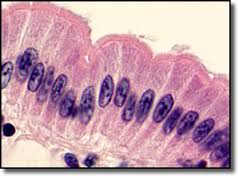
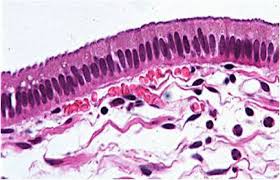
Name the tissue
a)
Areolar
b)
Smooth Muscle
c)
Transitional
d)
Simple Squamous
169.
Name the tissue
a)
Columnar
b)
Cuboidal
c)
Transitional
d)
Simple Squamous
170.
Name the tissue
a)
Smooth Muscle
b)
Columnar
c)
Transitional
d)
Pseudostratified
171.
Name the tissue
a)
Pseudostratified
b)
Smooth Muscle
c)
Transitional
d)
Stratified Squamous
172.

What are the 3 basic shapes of Epithelial Cells? (Select all that apply)

a)

Cuboidal

b)

Columnar

c)

Orbital

d)

Squamous

173.

Identify the image:

a)

Cuboidal

b)

Columnar

c)

Squamous

174.

Epithelial tissue regenerate really quickly

a)

True

b)

False

175.

Not having direct blood flow is called

a)

Vascular

b)

Avascular

c)

Tendonitis

d)

Arthritis

176.
Identify:
a)
Columnar
b)
Cuboidal
c)
Pseudostratified
d)
Transitional
177.
Identify:
a)
Smooth Muscle
b)
Columnar
c)
Transitional
d)
Pseudostratified
178.

Name the type of epithelium

a)

simple squamous

b)

stratified squamous

c)

simple cuboidal

d)

simple columnar

179.

What physiological functions are enhanced by epithlial cells bearing microvilli and cilia?

a)

increased surface area for absorption & capturing debris

b)

decreased surface area for absorption & capturing debris

c)

increased surface area for absorption of oxygen

d)

decreased surface area for absorption of oxygen

180.
The epidermis of the skin is
a)
simple squamous keratinized
b)
stratified squamous keratinized
c)
simple squamous nonkeratinized
d)
stratified squamous nonkeratinized
181.

What type of tissue is used for cushioning around organs?

a)

Skeletal muscle

b)

Simple squamous epithelium

c)

Pseudostratified columnar epithelium

d)

Adipose tissue

182.

Name this tissue.

a)

Skeletal muscle

b)

Cardiac muscle

c)

Smooth muscle

183.

This type of muscle tissue is found only in the heart

a)

Skeletal muscle

b)

Cardiac muscle

c)

Smooth muscle

184.

Label the muscle type from left to right.

a)

cardiac smooth skeletal

b)

skeletal cardiac smooth

c)

skeletal smooth cardiac

d)

cardiac skeletal smooth

185.

Which of the following is the correct order for the layers of skin from superficial to deep?

a)

hypodermis, epidermis, dermis

b)

epidermis, dermis, hypodermis

c)

epidermis, hypodermis, dermis

d)

dermis, epidermis, hypodermis

186.

Which of the following is NOT a function of skin?

a)

sensation

b)

excretion of waste

c)

production of vitamins

d)

secretion of hormones

187.

Which of the following epidermal layers is constantly being shed during your daily activities?

a)

stratum lucidum

b)

stratum granulosum

c)

stratum corneum

d)

stratum basale

188.

Which of the following epidermal layers is only found in thick skin like that on the palms of your hands?

a)

stratum lucidum

b)

stratum granulosum

c)

stratum corneum

d)

stratum basale

189.

The dermis is composed of 2 layers: the ____________ layer, which is made of loose connective tissue and the ___________ layer, which is made of densely-packed fibrous tissue.

a)

cleavage, papillary

b)

papillary, reticular

c)

cleavage, subcutaneous

d)

reticular, papillary

190.

The sudoriferous glands found primarily in the armpits and groin responsible for body odor are known as

a)

apocrine glands

b)

eccrine glands

c)

sebaceous glands

d)

sudoriferous glands

191.

What is found between the dermis and epidermis?

a)

Hypodermis

b)

Dermal papillae

c)

Blood vessels

d)

Melanocytes

192.

Beginning at the basal lamina and traveling toward the free surface, the epidermis includes the following layers

a)

corneum, lucidum, granulosum, spinosum, germinativum

b)

granulosum, lucidum, spinosum, germinativum, corneum

c)

germinativum, spinosum, granulosum, lucidum, corneum

d)

lucidum, grandulosum, spinosum, germinativum, corneum

193.

The protein that permits stretch and recoil of the skin is

a)

collagen

b)

melanin

c)

keratin

d)

elastin

194.

What is the muscle that creates "goosebumps"?

a)

Arrector Pilli muscle

b)

Erector Pilli muscle

c)

Facial muscle

d)

Deltoid muscle

195.

Stratum Basale is where

a)

epidermal layer with flattened and dead cells

b)

dermal layer where receptors are

c)

epidermal layer where mitosis occurs

d)

Hypodermal layer is

196.

Bones are the structural support for our body. They provide the framework for __________.

a)

Muscle attachments

b)

Joints

c)

Muscle

d)

Tendons

197.

How many bones are in an average adult?

a)

405

b)

353

c)

206

d)

59

198.

These stimulate the breakdown of bones.

a)

Osteoblasts

b)

Osteoclasts

c)

Carbohydrates

d)

Calcium

199.

Muscle attachments offer protection for vital organs like the __________.

a)

The brain

b)

Skin and vessels

c)

Skin

d)

Heart and lungs

200.

This stimulates the creation of bones.

a)

Osteoclasts

b)

Osteoblasts

c)

Iron

d)

Calcium

201.

The tibia and Radius bone are considered ____________.

a)

Long bones

b)

Short bones

c)

Flat bones

d)

Irregular bones

202.

Carpals and Tarsals are considered __________.

a)

Long bones

b)

Short bones

c)

Flat bones

d)

Irregular bones

203.

Cranial bones and Thoracic bones are considered __________.

a)

Long bones

b)

Short bones

c)

Flat bones

d)

Irregular bones

204.

Pelvic bones and Vertebra are considered __________.

a)

Flat bones

b)

Short bones

c)

Flat bones

d)

Irregular bones

205.

Match the following types of bone cells.

a)

Osteoblasts

1.

immature cells which build the bone matrix

b)

Osteoclasts

2.

breaks done the bone matrix to release minerals we need

c)

Osteocytes

3.

mature bone cells that are surrounded by the bone matrix

206.

Match the following types of bones with the correct description.

a)

Long bones

1.

are longer than they are wide

b)

Short bones

2.

typically cube-like in shape

c)

Flat bones

3.

are typically bones that protect internal organs

d)

Irregular bones

4.

Complex shapes that may perform various functions

e)

Sesamoid bones

5.

bones that are entirely embedded in a tendon.

207.

Match the following types of bones with the correct examples.

a)

Long bones

1.

femur, humerus, ulna, radius, tibia, fibula

b)

Short bones

2.

carpals and tarsals

c)

Flat bones

3.

Frontal bone, parietal bone, occipital bone, sternum, ribs, ilium of the pelvis

d)

Irregular bones

4.

vertebral bones, facial bones

e)

Sesamoid bones

5.

patella