
 Worksheets
Catalytic Quiz - Plant Reproduction
Total questions: 10
Worksheet time: 6mins

Each of the flowers of this American elm tree have both a stamen and a pistil. How can we BEST classify these flowers?
Complete: the flowers are already pollinated, so they are complete flowers
Incomplete: the flowers not yet turned into seeds, so they are incomplete
Complete: with both male and female parts, these flowers are complete
Incomplete: with only male parts, these flowers are incomplete

Which process must occur for a complete flower to undergo self pollination?
A grain of pollen moves from the anther to the stigma
The ovule is pollination and produces fertilized seeds
The sepals detach from the flower and form a cotyledon
The tarrasque uses a mythic action to transmute the abjuration

Sideoats grama (Bouteloua curtipendula) is a bunch grass of the open plains, and the state grass of Texas.
Its flower structures include anthers, filaments, styles, and ovules. Given these parts, how could the flower be best classified?
Male flower
Female flower
Complete flower
Though many factors contribute to the flowering of plants, the process can only be initiated by sending hormones to the tissues where flowers will grow and blossom.
How are these hormones transported to the buds where flowers will bloom?
Hormones are created in the roots and travel up the xylem to the leaves and flowers
Hormones are created at the site of flower blossoming, to be used in the same tissues
Hormones travel through the phloem to signal the processes for flowering, in response to environmental change
Flower begin growing as a result of environmental factors, like temperature, precipitation, and photoperiod
Which of the following are examples of pollination?
Native bee species sleeping in flowers overnight, spreading pollen as they go
Wind sweeping through a prairie, moving male gametes from one plant to another
Sudden rain sweeps seeds up from bunchgrasses in an arid land, carrying them to far locations
Plants create pigments in order of their value to photosynthesis, prioritizing chlorophyll

A seed stuck beneath the paint of a brick wall senses the presence of light and suddenly begins sprouting from its original coat. The seedling continues to grow through the paint and up the wall, sending growth hormones toward the tissues in which it sense light.
Which processes are described in the scenario above?
Gravitropism
&
Dissemination
Thigmotropism
&
Germination
Phototropism
&
Germination
Thigmotropism
&
Pollination

Water escapes from the open stomata on the underside of leaves as a gaseous vapor.
What two processes must first occur for this water to escape the plant?
The water must be transpirated upward through the xylem to the leaves
The chloroplasts must create glucose from the CO2 that they draw in through the stomata
The plant's roots must absorb water from the soil around them
The plant must receive fixated nitrogen in water from mycorrhizal fungus

Volunteers in a local community garden try spraying fungicide (a chemical which kills fungus) on their tomato plants, where the chemicals gather on the leaves and drip into the soil.
However, the more fungicide they use, the less the plants appear to grow. Why might this be happening?
The fungicide is blocking up the roots, so that they cannot absorb water from the soil
The soils are too dry to absorb the water which the plants need to transpirate and survive
The fungicide is coating the leaves, reducing their rates of photosynthesis by blocking light
The fungicide is falling into the soil, where it is killing the fungi which help the plant grow
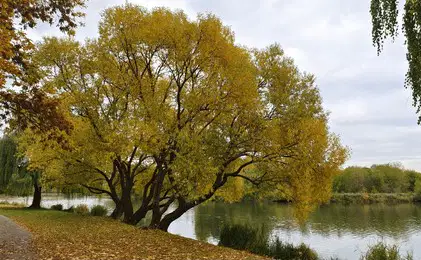
A heavy rainfall increases water flow into a local pond, sweeping away some of the dirt which held up a tree growing from the edge nearby.
Over the next few years the tree's branches begin growing at a new angle, moving further away from the ground below them. Why did the branches begin growing in a new direction?
Growth hormones are sent to specific tissues in response to the new directional stimulus of gravity
The plant grows further away from the water which it absorbs from the pond below
The tree diverts energy from its roots to focus on growing its canopy of branches and leaves
Which of the following are examples of plants adapting to compensate for an insufficient quantity of nutrients in the soils in which they grow?
A plant begins blossoming its flowers unseasonably early in response to an early winter
A plant offers carbohydrates to mycorrhizae which in turn provide nitrogen to the plant
A plant captures and digests insects to absorb their proteins which it cannot easily produce
A plant drops fruit more quickly when in proximity to other fruiting plants

