
 Worksheets
Credit Card- Advantages & Disadvantages Assignment
Total questions: 20
Worksheet time: 10mins
Which statement best defines how a credit card functions compared to a debit card?
It transfers money between your savings and checking
It spends the cash you previously loaded onto the card
It withdraws money directly from your checking balance
It uses borrowed funds that must be repaid with interest
Match each card type to its primary characteristic.
Credit card
Borrowed money, repay later, interest may apply
Debit card
Own funds pulled from checking at purchase
Prepaid card
Spend only the money loaded onto the card
You forget to track purchases and pay late. What is the most likely consequence?
Statement hides the late payment from credit bureaus
Rewards increase to offset missed payment
Automatic payment forgiveness for the month
Extra fees and interest, potential credit damage
Which statement best distinguishes a secured credit card from an unsecured credit card?
Lets you spend beyond your limit without penalties
Has no minimum payment requirement each month
Offers rewards points without any annual fee
Requires a security deposit that sets the credit line
Match each credit term to its correct description.
APR
Interest rate charged on carried balance
Grace period
Time allowed to pay before interest applies
Credit limit
Maximum amount you can charge
Late fee
Charge assessed for missing due date
A card advertises a very low APR for the first three months, then raises it sharply. What is the most prudent action before applying?
Compare offers and review terms carefully
Ignore the change and apply immediately
Max out the card during the low period
Assume the rate will stay low permanently
You carry a balance and miss your due date once. Which consequence is most likely according to typical card terms?
Penalty rate increase after a late payment
Automatic forgiveness of all accrued interest
Higher credit limit as a courtesy
Waiver of future late fees permanently
In the disclosure table, which term describes the interest charged on purchases after an introductory offer ends?
Penalty APR rate
Standard Purchase APR
Cash Advance APR
Balance Transfer APR
Match each fee type to how it is commonly applied in the disclosure table.
Purchases transaction fee
Either $10 or 4% per transaction
Balance transfer fee
Either $10 or 4% per transfer
Foreign transaction fee
3% of the U.S. dollar amount
Late payment penalty
Up to $35 per occurrence
A card has an introductory 0% APR for the first 15 statement cycles. What happens to the interest rate for purchases after that period?
It is waived if minimum interest is charged
It switches to the penalty APR automatically
It stays at 0% indefinitely
It becomes a standard APR near 10.99%
The table states your due date is at least 25 days after the close of each billing cycle. What is this period called, and why is it important?
Statement window; dispute unauthorized charges
Intro period; qualify for balance transfer offers
Billing cycle; calculate minimum payment due
Grace period; avoid interest by paying in time
Which source is generally the best option for obtaining a credit card when you want guidance on choosing features?
Mail offers sent to households nationwide
Department or chain store card programs
Online ads from random issuers
Financial institutions like credit unions and banks
Match each action with the appropriate category for wise credit card use.
Pay your bills on time
Do
Spend more than your limit
Don't
Apply for few credit cards
Do
Keep a high balance
Don't
Your credit card application was denied because of limited credit history and unstable income. What is the most effective plan to become approval-ready within a year?
Open many store cards to build history fast
Use a secured credit card and seek financial counseling
Apply repeatedly to different issuers weekly
Ignore credit use until income increases someday
Which initial step most effectively starts a plan to exit credit card debt?
Consolidate with any lender quickly
Ignore late fees until income rises
Open a new rewards credit card
Pause nonessential spending immediately
Match each statement with the accurate clarification.
I don’t need a credit card; I never had one
Useful for building U.S. credit history and reservations
No one will approve me, so I won’t apply
Starter limits exist; secured cards help begin credit
A credit card guarantees uncontrolled spending
Monthly statements and budgeting support control
A credit card equals a mountain of debt
Pay in full monthly to avoid debt

A mailed loan check arrives with a 32% interest offer. What is the safest action to prevent identity theft and costly debt?
Decline the offer and consult your bank
Sign blank receipts to speed processing
Cash the check and repay quickly
Share your card number to verify identity
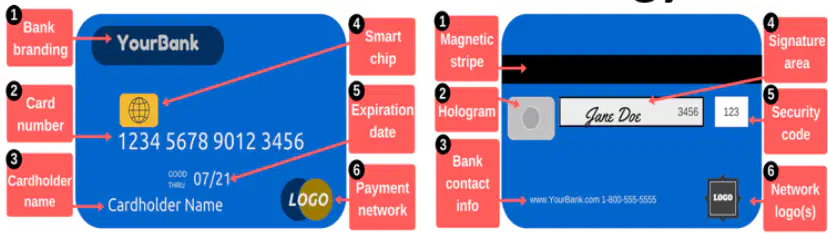
Which component on a credit card stores encrypted data to reduce counterfeit fraud?
Embossed card number panel
Magnetic stripe on the back
EMV smart chip on the front
Printed cardholder name line
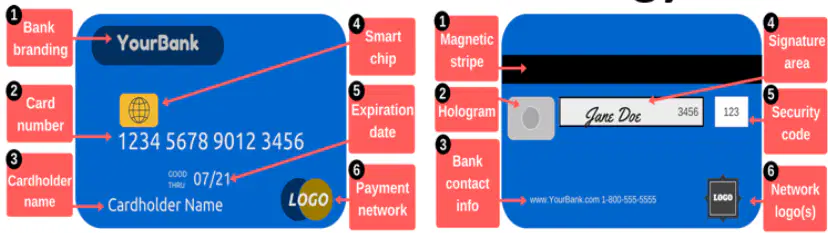
Match each credit card feature to its primary purpose.
CVV/Security code
Card-not-present verification
Signature area
Handwritten authorization reference
Magnetic stripe
Legacy swipe data storage
Network logo
Payment network identification
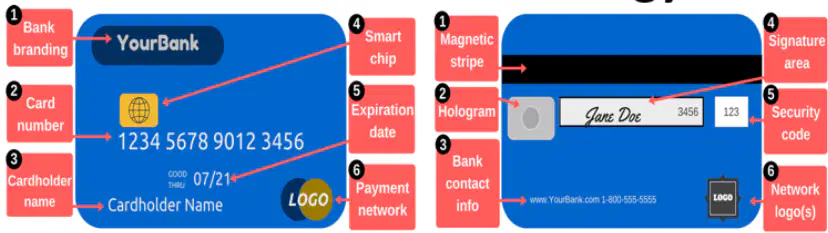
You are shopping online and the site asks for a three-digit code not embossed on the card. Which feature is being requested and why?
CVV for card-not-present security
Expiration date for fraud alerts
Hologram for physical authenticity
Bank contact info for verification

