
 Worksheets
Page 1
Total questions: 107
Worksheet time: 54mins
According to the infographic titled The Three Pillars of Sustainable Procurement, sustainable procurement integrates three key dimensions: best value for money, environmental aspects, and social aspects.
True
False

In Best Value for Money, which factor is explicitly included beyond price?
Quality and performance
Celebrity endorsements
Brand prestige alone
Tax incentives only

Which specific cost is listed under Best Value for Money?
Running and maintenance costs
Advertising costs
Import tariffs
Executive salaries

What claim does the infographic make about a product with a higher purchase price?
It may be cheaper over its lifetime.
It is always more expensive overall.
It cannot offer environmental benefits.
It must have lower quality.

Environmental Aspects focus on reducing environmental impacts across what scope?
Across the entire life cycle
Only at the point of sale
Only during distribution
Only during recycling

Which stage is named under Environmental Aspects?
Raw material extraction
Employee performance reviews
Retail merchandising
Shareholder reporting

Which end-of-life consideration is listed under Environmental Aspects?
End-of-life disposal or recycling
Warranty extension services
After-sale promotions
Loyalty program enrollment

According to the Environmental Aspects section, the aim is to reduce which of the following?
Emissions, waste, pollution, and resource depletion
Production lead times and paperwork
Retail prices and marketing costs
Supplier contract length

Social Aspects address how procurement affects people and communities. Which example is explicitly listed?
Support for local communities and suppliers
Celebrity partnerships
Share price growth
Luxury branding

Which item under Social Aspects relates directly to worker protections?
Fair and legal labor conditions
Executive compensation packages
Customer loyalty incentives
Product bundling strategies

Which principle is named in the Social Aspects section?
Respect for human rights
Maximizing shareholder dividends
Exclusive brand positioning
Zero advertising policy

What sourcing practice is highlighted under Social Aspects?
Use of fair-trade and ethically sourced products
Aggressive price undercutting regardless of origin
Single-sourcing based solely on lowest bid
Ignoring supplier audits to cut costs

Which broader outcomes are identified in the Social Aspects section?
Contribution to poverty reduction and social equity
Higher advertising reach and market share
Faster product launches and trends
Greater warehouse space utilization

According to the infographic, procurement becomes a tool for what?
Social responsibility
Speculative investment
Price deregulation
Brand exclusivity

According to the infographic titled What Is Green Public Procurement (GPP)?, GPP is described as a specific component of sustainable procurement with which primary focus?
Operational efficiency
Strong environmental focus
Cost minimization only
Supplier relationship management

As defined in the infographic, the European Commission describes Green Public Procurement (GPP) as a process whereby public authorities procure goods, services, and works with what distinguishing characteristic?
Guaranteed lowest price at purchase
Reduced environmental impact throughout their life cycle
Shortest delivery time
Highest social benefit regardless of cost

In the infographic’s Key Difference section, which statement correctly identifies Sustainable Procurement?
Primarily environmental focus
Economic and social focus only
Economic, environmental, and social focus
Only economic focus

In the Key Difference bullets of the infographic, which option correctly identifies Green Public Procurement (GPP)?
Primarily environmental focus
Primarily economic focus
Primarily social focus
Balanced economic, environmental, and social focus

According to the European Commission definition shown in the infographic, the reduced environmental impact of purchases is assessed relative to what?
The organization’s previous year purchases
Alternatives serving the same function
Industry averages across all sectors
International trade standards

Per the infographic’s definition, which set best lists what public authorities procure under GPP?
Goods only
Goods and services only
Goods, services, and works
Works only
According to the slide, how do many companies now treat sustainability, as noted by the United States Environmental Protection Agency (EPA)?
As a key strategic objective
As a minor public-relations topic
As only an environmental issue
As a short-term marketing trend
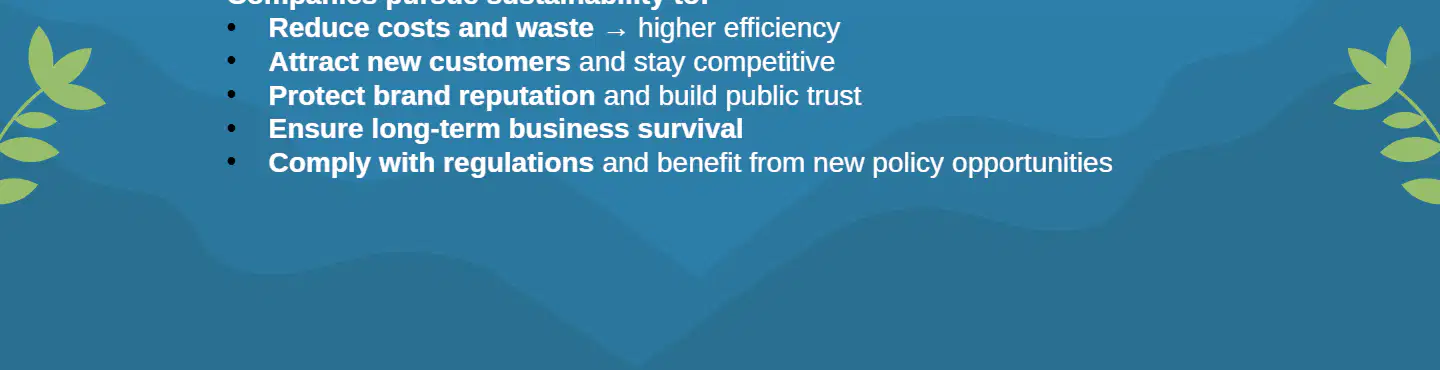
Which reason on the slide explicitly links reducing costs and waste to an outcome?
Higher efficiency
Lower efficiency
Brand dilution
Reduced need for any compliance
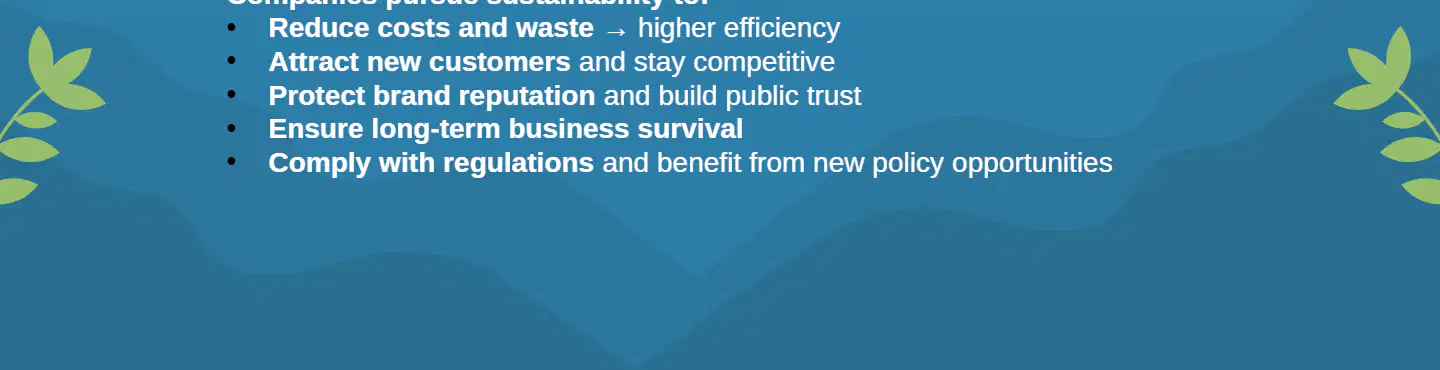
Which item is NOT listed on the slide as a reason companies pursue sustainability?
Reduce costs and waste
Attract new customers
Increase short-term pollution
Ensure long-term business survival
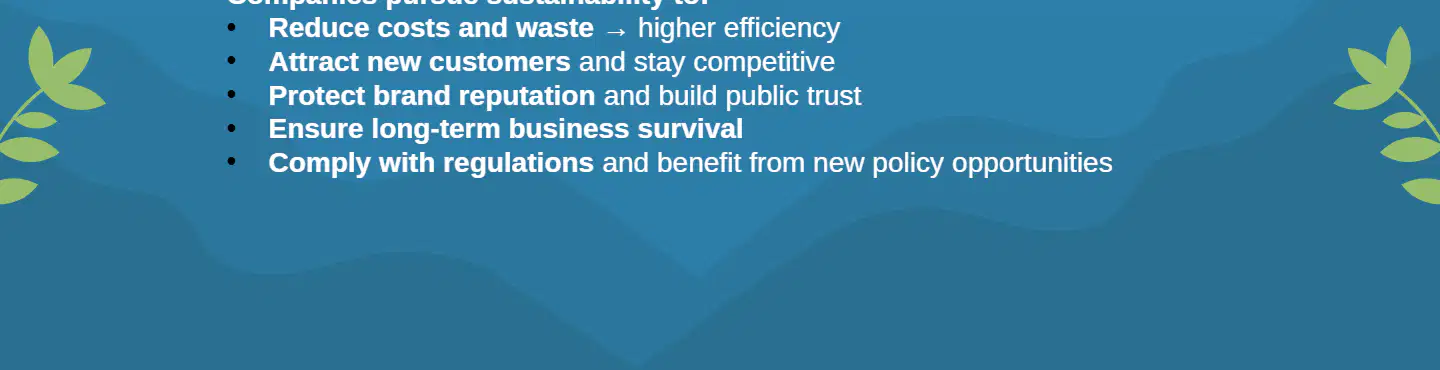
Which reason on the slide specifically mentions building public trust?
Protect brand reputation
Reduce costs and waste
Ensure long-term business survival
Attract new customers
According to the slide, companies pursue sustainability to comply with regulations and what related benefit?
Benefit from new policy opportunities
Avoid all laws entirely
Delay compliance indefinitely
Ignore industry standards
Select all reasons the slide lists for why companies pursue sustainability.
Attract new customers
Comply with regulations
Increase operational waste
Ensure long-term business survival
According to the slide titled Sustainable Procurement Policy, which company is provided as the example?
Willmott Dixon Holdings Ltd
GreenBuild UK PLC
Northshore Engineering Group
Cityline Property Partners
According to the slide, what type of business is Willmott Dixon Holdings Ltd?
A large UK construction and property company
A multinational retail and logistics company
A government transport authority
A renewable energy equipment manufacturer
The slide states that because construction uses many natural resources, procurement choices strongly affect which of the following? Select all that apply.
People
Communities
The environment
Financial markets
The slide asks What is their Sustainable Procurement Policy? Based on the explanation provided, what does the policy do?
It explains how the company and its suppliers choose goods, works, and services
It sets building height limits for urban projects
It outlines tax incentives for foreign suppliers
It specifies staff training hours for site workers
According to the slide, which outcomes are aims of how the company and its suppliers choose goods, works, and services? Select all that apply.
Get value for money
Use fewer natural resources
Reduce environmental damage
Create healthier buildings and communities
Increase project duration
The slide states their policy follows which standard for best procurement practice?
BS 8903
ISO 14001
BS 8001
EN 1090
According to the Sustainable Procurement Guide — Thales Group Supplier Checklist, which action is listed under Energy & Emissions?
Reduce energy use
Increase standby power consumption
Ignore greenhouse gas reporting
Expand fossil fuel dependence
Under Energy & Emissions in the Sustainable Procurement Guide, which environmental metric are suppliers instructed to cut?
CO2 emissions
Ozone concentration
Ambient humidity
Soil salinity

Which Water practice is included in the Sustainable Procurement Guide — Thales Group Supplier Checklist?
Good water management
Increase process water discharge
Rely solely on bottled water
Eliminate all cooling water systems

In the Waste section of the Sustainable Procurement Guide, which recommendation is given to suppliers?
Use recyclable packaging
Rely on single-use plastics for durability
Send all scrap to landfill
Delay waste segregation until year-end

What cost perspective are suppliers asked to consider in the Waste section of the Sustainable Procurement Guide?
Life-cycle costs
Purchase price only
Disposal fees only
Labor cost only

Which practice is specified under Resource Stewardship in the Sustainable Procurement Guide — Thales Group Supplier Checklist?
Buy certified timber (FSC/PEFC)
Prefer uncertified hardwoods for flexibility
Avoid documentation for material sourcing
Use only virgin materials

According to the Economic Sustainability section, which action is expected from suppliers?
Pay fair and on time
Delay payments to improve cash flow
Set wages below local standards
Outsource payments to avoid accountability

Which priority from the Economic Sustainability section focuses on community impact?
Support local economies
Centralize all purchasing overseas
Eliminate local hiring
Limit supplier diversity

What requirement is highlighted under Trade Compliance in the Sustainable Procurement Guide — Thales Group Supplier Checklist?
Follow export laws
Ignore customs documentation for speed
Use informal channels to avoid duties
Prioritize sales over regulatory compliance

Which goal is named under Biodiversity in the Sustainable Procurement Guide?
Protect ecosystems
Replace native species with monocultures
Focus only on urban development
Disregard habitat conservation
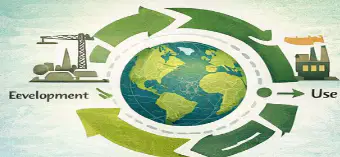
According to the infographic titled "ISO 14001:2015 Environmental Management Systems," which earlier standard was replaced by ISO 14001:2015?
ISO 14001:2004
ISO 9001:2008
ISO 26000:2010
BS 8903:2010
In the "ISO 14001:2015 Environmental Management Systems" panel, what does the infographic state about certification?
Certification is NOT mandatory.
Certification is mandatory for all organizations.
Certification is required only for manufacturers.
Certification is mandated by national law in most countries.
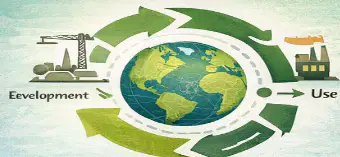
Which item is listed under "Key Improvements" for ISO 14001:2015 in the infographic?
Life-cycle thinking (development to disposal)
Mandatory third-party audits every quarter
Outsourcing of procurement functions
Product price control requirements
Which benefit is shown under "Benefits of ISO 14001" in the infographic?
Achieve efficiencies and reduce costs
Guarantee zero emissions
Eliminate the need for leadership involvement
Increase product prices to cover compliance
According to the right-hand panel titled "BS ISO 20400:2017 Sustainable Procurement," which earlier standard did it replace?
BS 8903:2010
ISO 14001:2004
ISO 9001:2015
SA 8000:2014
In the "Policy & Strategy" section of BS ISO 20400:2017 on the infographic, which element is explicitly listed?
Commitment
Price fixing
Outsourcing approvals
Export licensing

Within the "Applying Sustainability in Procurement" section (BS ISO 20400:2017) shown on the infographic, which activity is included?
Supplier selection
Tax auditing
Product advertising
Patent filing

Business for Social Responsibility (BSR) published an important paper in 2018 explaining that sustainable procurement is evolving. According to this statement, what is identified as evolving?
Sustainable procurement
Corporate philanthropy
Product pricing strategies
Digital marketing

The slide lists an old approach (past 20 years) to sustainable procurement that includes codes of conduct, supplier audits, and compliance checks. Which of the following belongs to this old approach?
Codes of conduct
Strategic engagement with suppliers
Transparency across the whole supply chain
Innovation and long-term value creation

The slide contrasts an old approach with a new approach (today) in sustainable procurement. Which item is listed as part of the new approach?
Strategic engagement with suppliers
Supplier audits
Compliance checks
Codes of conduct

According to the slide’s key idea, procurement is no longer just about control. What is it about?
Partnership and impact
Cost cutting and speed
Regulation and oversight
Contracts and penalties
Based on the slide titled Real Sustainability Achievements in Public Procurement, which location made sustainability criteria mandatory in major public contracts?
Barcelona
Stockholm
Luxembourg
Germany (Interior Ministry)
According to the example from Stockholm on the slide Real Sustainability Achievements in Public Procurement, what was the emissions outcome of the joint purchase of electric vehicles compared to petrol vehicles?
95% reduction
50% reduction
No measurable change
20% increase
From the Stockholm example shown on the slide Real Sustainability Achievements in Public Procurement, how much CO2 was saved by the joint purchase of electric vehicles?
34 tonnes
29,000 tonnes
3,500 tonnes
58.7 tonnes
Which initiative on the slide Real Sustainability Achievements in Public Procurement supports 3,500 procurement professionals with tools and best practices?
PIANOo (Netherlands)
Barcelona
Germany (Interior Ministry)
Luxembourg
According to the Germany (Interior Ministry) example on the slide Real Sustainability Achievements in Public Procurement, what amount of electricity was saved by energy-efficient IT systems?
58.7 million kWh
3,500 kWh
34 million kWh
95 million kWh
As shown in the Germany (Interior Ministry) example on the slide Real Sustainability Achievements in Public Procurement, how much CO2 was reduced by energy-efficient IT systems?
29,000 tonnes
34 tonnes
58.7 tonnes
9,500 tonnes
What change to cleaning contracts is highlighted for Luxembourg on the slide Real Sustainability Achievements in Public Procurement?
Banned harmful chemicals
Switched to petrol vehicles
Mandated a 95% emissions reduction in all fleets
Created a program supporting 3,500 professionals

The slide’s title Real Sustainability Achievements in Public Procurement indicates the examples concern which domain?
Public procurement
Private investment
Residential recycling
Agricultural subsidies

Based on the infographic titled “It applies to two markets,” which market is described as involving hotels as borrowers?
Consumer Market
Producer Market
Capital Market
Secondary Market

According to the Consumer Market example in the infographic, which item is specifically mentioned as a use for green loans?
Energy-efficient retrofits
Coal power plant expansion
Single-use plastic production
Advertising campaigns for hotels

Which goal is listed under the Consumer Market section of the infographic?
Reduce emissions
Increase water consumption
Raise operating costs
Eliminate all taxes

In the Producer Market section, what do financial institutions aim to do according to the infographic?
Favor sustainable projects
Encourage environmentally harmful activities
Prohibit renewable energy installations
Eliminate all lending to hotels

What is one action banks may take in the Producer Market, as shown in the infographic?
Offer special green loans
Ban hotels from installing efficient systems
Fund only fossil-fuel-based projects
Replace all taxes with subsidies

According to the infographic, which measures have many industrialized countries introduced? (Select all that apply.)
Incentives for sustainable construction
Eco-taxes and carbon taxes to discourage fossil fuel use
Subsidies to increase fossil fuel consumption
Requirements to finance environmentally harmful activities
Based on the slide text: "Sustainability or green investments are financial investments made in companies or projects that reduce environmental damage, improve resource efficiency, support renewable energy, and show strong environmental responsibility." Which option best describes what sustainability or green investments are?
Financial investments that fund initiatives with environmental benefits and responsibility
Charitable donations to any nonprofit organizations
New consumer products marketed as eco-friendly regardless of impact
Government taxes collected for environmental programs
According to the slide, which of the following goals are explicitly listed for sustainability or green investments? Select all that apply from the quoted list: "Reduce environmental damage; Improve resource efficiency; Support renewable energy; Show strong environmental responsibility."
Reduce environmental damage
Improve resource efficiency
Support renewable energy
Show strong environmental responsibility
Maximize short-term profits regardless of environmental impact
The slide states: "These investments can include: Stocks; Investment funds; Green loans; Sustainability-linked loans." Which of the following are included? Select all that apply.
Stocks
Investment funds
Green loans
Sustainability-linked loans
Cryptocurrencies
Which company type is specifically mentioned on the slide as an example relevant to sustainability or green investments?
Renewable energy developers such as solar and wind companies
Manufacturers focused on expanding single-use plastics
Firms prioritizing fossil fuel extraction growth
Businesses that market environmentally themed products without operational changes

According to the slide’s examples, which companies are cited as relevant to sustainability or green investments? Select all that apply.
Renewable energy developers (solar, wind)
Hospitality businesses with strong environmental performance
Traditional companies expanding into greener operations to attract environmentally conscious customers
Tobacco companies seeking market share through aggressive advertising
According to the slide titled Sustainability Performance of Small & Medium Hospitality Businesses, small and medium-sized hotels are not listed on what?
global indices
regional tourism boards
local business registries
environmental certification catalogs
Based on the slide, which sources must small and medium-sized hotels rely on to assess sustainability performance? Select all that apply.
internal sustainability audits
industry benchmarks
financial evaluation tools
global indices
Which of the following are listed as common tools used by small and medium-sized hotels to evaluate sustainability investments? Select all that apply.
Payback Period
Return on Investment (ROI)
Internal Rate of Return (IRR)
Carbon Tax Score
According to the slide, what do these financial tools help managers do?
make informed sustainability investment decisions
increase guest satisfaction through marketing
comply with global index listing requirements
reduce payroll expenses
According to the slide, the payback period answers one simple question: How long does it take to recover what?
The total lifetime profit
The initial investment
The operating expenses
The interest on the loan
Using the simple example shown (Restaurant Freezer): Investment €4,000; Annual energy savings €1,000. What is the payback period?
2 years
3 years
4 years
5 years

In the example provided, what happens to all savings after the payback period has been reached?
They are taxed at a higher rate
They are reinvested automatically
They become profit
They reduce the initial investment further
A hotel considers installing photovoltaic panels. The gross initial investment cost before any government support is stated as what amount?
€4,900
€2,100
€7,000
€80
Which items are explicitly included in the initial investment cost for the photovoltaic system? Select all that apply.
Solar panels
Installation
Planning and connection costs
Monthly electricity bill
Battery replacement
The government offers a 30% tax credit on the gross cost. If the gross cost is €7,000 , what is the tax credit amount?
€1,400
€2,100
€2,900
€4,900
After applying the 30% tax credit to the gross cost of €7,000 , what net cost does the business actually pay?
€7,000
€2,100
€4,900
€80
The system is expected to produce how much electricity per month for on-site use?
200 kWh
300 kWh
400 kWh
600 kWh
The electricity price used for calculating savings is what value per kWh?
€0.10 per kWh
€0.15 per kWh
€0.20 per kWh
€0.25 per kWh
Using 400 kWh per month at €0.20 per kWh, what are the monthly savings from the photovoltaic system?
€40 per month
€60 per month
€80 per month
€100 per month
What best describes the meaning of the payback period in this context?
The time until the panels need replacement
The time it takes for savings to recover the investment
The time the panels generate electricity each day
The number of months in a billing cycle
Given a total investment after tax credit of €4,900 and monthly savings of €80 , approximately how many months are needed to break even?
36–37 months
48–49 months
61–62 months
72–73 months
With monthly savings of €80 and an investment of €4,900 , the payback period is approximately how many years?
3 years
4 years
5 years
6 years

Based on the Payback Period Considerations timeline, which timeframe corresponds to Short Term initiatives?
0–2 years
3–5 years
5–8 years
6–15 years

According to the Quick Wins/Operational Improvements list under Short Term, which of the following is included?
LED Lighting
Heat Recovery Systems
Solar Panels
HVAC Upgrades

Which item is listed under Medium Term efficiency through equipment upgrades?
Compressors
Solar Panels
Insulation of Boilers & Pipes
Motion & Key Card Sensors

Which option is categorized under Long Term strategic sustainability investments?
Thermal Insulation
Preventive Maintenance
Staff Training
Motion & Key Card Sensors

Which characteristic is explicitly associated with Short Term initiatives in the infographic?
Low Cost
High Investment
Long Lifespan
Major Savings

Which benefit is explicitly indicated for Medium Term investments?
Operational Efficiency
Low Risk
Long Lifespan
Fast Savings

According to the infographic, Long Term investments are associated with which attribute?
High Investment
Moderate Investment
Low Cost
Fast Savings

Which pairing correctly matches an example with its timeline category?
Chillers — Medium Term 5–8 years
LED Lighting — Long Term 6–15 years
Solar Panels — Short Term 0–2 years
Preventive Maintenance — Medium Term 5–8 years

Case Study 1: Healthy Food Vending Machine. The listed costs are Vending machine: €5,000 and Products for one year: €1,000. What is the initial investment?
€5,000
€6,000
€2,400
€400
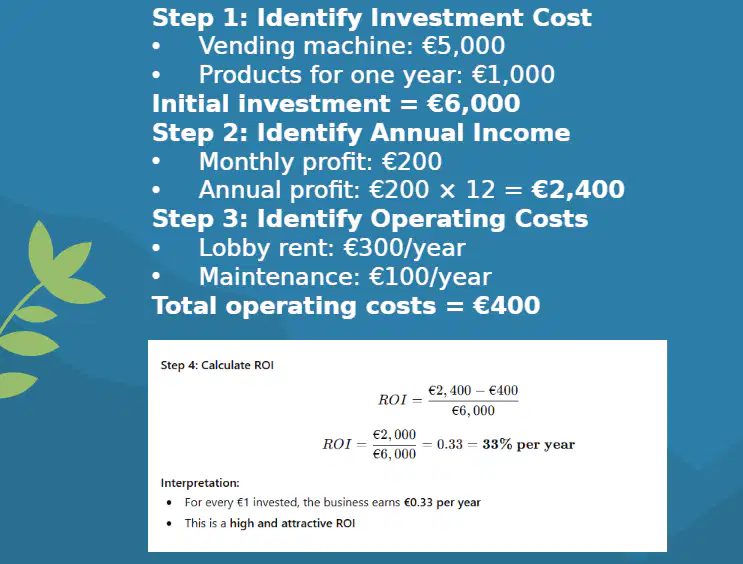
Case Study 1: Healthy Food Vending Machine. Monthly profit is €200. What is the annual profit shown?
€200
€2,400
€400
€6,000
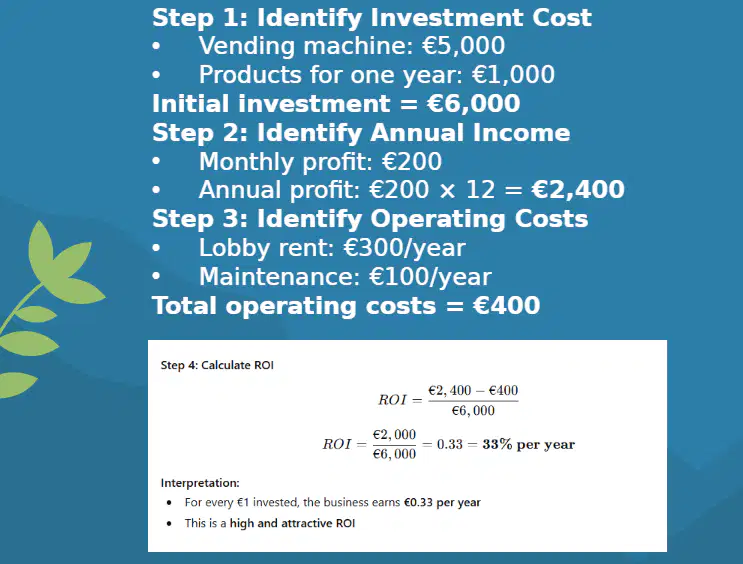
Case Study 1: Healthy Food Vending Machine. Lobby rent is €300/year and maintenance is €100/year. What are the total operating costs per year?
€100
€300
€400
€2,000
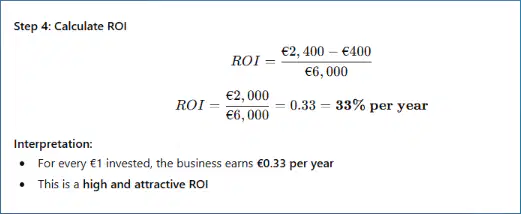
Case Study 1: Healthy Food Vending Machine. Using the figures annual profit €2,400, operating costs €400, and initial investment €6,000, what annual ROI is shown?
20%
25%
33%
40%
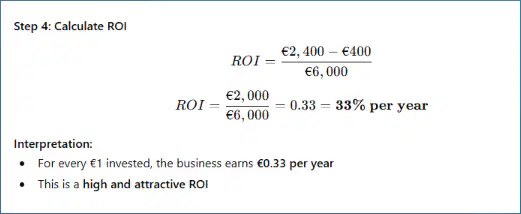
Case Study 1: Healthy Food Vending Machine. According to the interpretation, for every €1 invested, how much does the business earn per year?
€0.20
€0.25
€0.33
€1.00

Case Study 2: Energy-Efficient Walk-In Freezer. This investment produces which type of benefit?
Energy savings
Rent income
Sales revenue from products
Interest income

Case Study 2: Energy-Efficient Walk-In Freezer. With an initial investment of €4,000 and annual energy savings of €1,000, what ROI is shown?
10%
20%
25%
40%
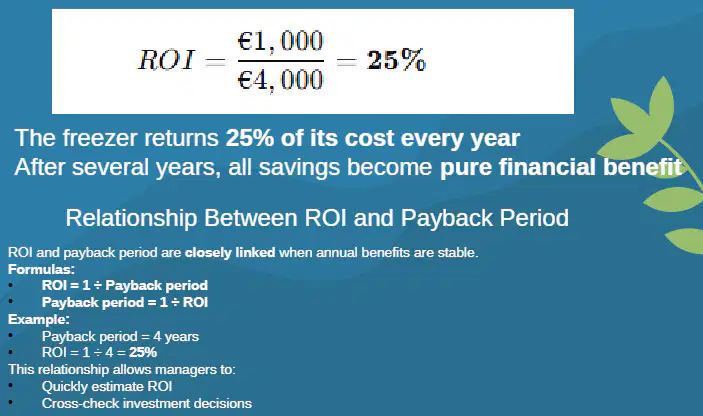
Relationship Between ROI and Payback Period. Which formula is given for ROI when annual benefits are stable?
ROI = Payback period × 1
ROI = 1 ÷ Payback period
ROI = Payback period ÷ 1
ROI = 1 + Payback period
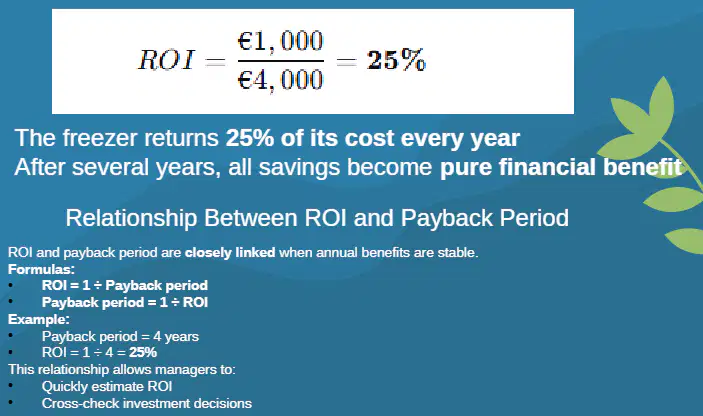
Relationship Between ROI and Payback Period. If the ROI is 25%, what payback period is implied by the provided formulas?
2 years
3 years
4 years
5 years
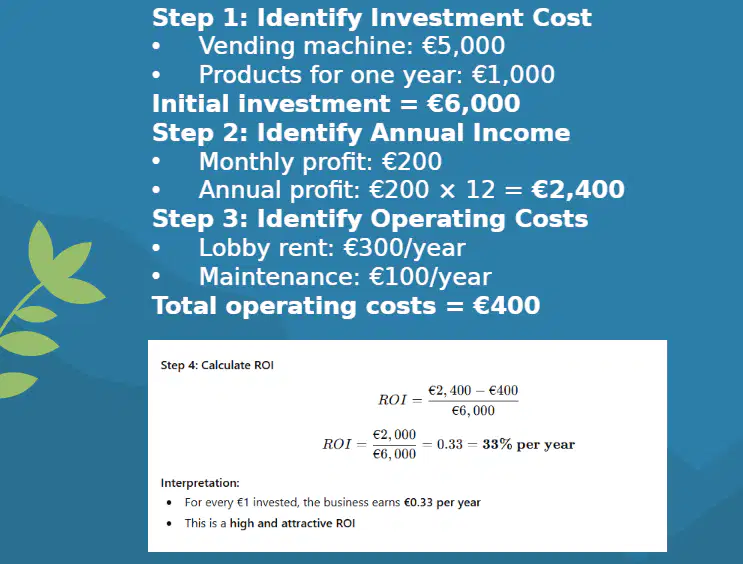
Case Study 1: Healthy Food Vending Machine. Which items are included among the operating costs listed? Select all that apply.
Lobby rent
Maintenance
Vending machine purchase
Products for one year

