
Font size
 Worksheets
5SW12 A New Nation
Total questions: 46
Worksheet time: 23mins
Match each Founding Father with his description. Which description best matches Benjamin Franklin?
inventor and scientist
Commander-in-Chief of the Continental Army
lawyer and diplomat
author of the Declaration of Independence
Match each Founding Father with his description. Which description best matches George Washington?
inventor and scientist
Commander-in-Chief of the Continental Army
lawyer and diplomat
author of the Declaration of Independence
Match each Founding Father with his description. Which description best matches John Adams?
inventor and scientist
Commander-in-Chief of the Continental Army
lawyer and diplomat
author of the Declaration of Independence
Match each Founding Father with his description. Which description best matches Thomas Jefferson?
inventor and scientist
Commander-in-Chief of the Continental Army
lawyer and diplomat
author of the Declaration of Independence
Choose the option that correctly names a Founding Father and a reason he is considered one.
George Washington led the Continental Army and helped establish the new nation
Benjamin Franklin served as a 20th-century president
Alexander Hamilton opposed the Constitution entirely
Patrick Henry wrote the Treaty of Paris
Study this list: • served under Washington in the Revolutionary War • wrote the Federalist Papers in support of the Constitution • served as Washington’s secretary of the treasury. Who made these contributions?
John Adams
George Mason
Thomas Jefferson
Alexander Hamilton
Which of the following was NOT a problem with the Articles of Confederation?
Congress had no power to collect taxes
States, not a national government, held most of the power
Congress could regulate trade freely among the states
The national government lacked supremacy over the states
The Articles of Confederation were most likely written to ________.
establish trade with American Indians
establish a government for a new nation
express the colonial desire for independence
express colonial grievances with Great Britain
Which of the following was NOT a Founding Father behind the creation of the Constitution?
James Madison
George Mason
Paul Revere
George Washington
Think of the differences in the Virginia and New Jersey Plans and how they came together to become the Constitution. Which statement below does NOT describe the compromise and protection of rights?
A two-house Congress balanced representation of large and small states
The Great Compromise combined parts of both plans
Individual rights were protected later by the Bill of Rights
The Constitution gave all lawmaking power to the president
How would life in America be different today if the rights to “life, liberty, and the pursuit of happiness” were not protected? Choose the best answer.
People would have fewer protections for freedom and equality under the law
Everyone would have exactly the same job and income
The United States would have no government at all
Only local governments would exist
How did the Founding Fathers collaborate to create the government in the United States? Choose the best example.
They met in Philadelphia to debate ideas and write the Constitution
They each wrote separate state constitutions with no meetings
They fought each other in battles until one side won
They avoided any discussions with one another
What should we learn from slavery in American history?
We should understand its injustices and work to prevent them
It shows that forced labor is sometimes necessary
It is unrelated to civil rights
It had no impact on American society
What can be done to eradicate slavery and injustices based on race? Choose the best action.
Support equal rights, learn history, and speak up against discrimination
Ignore unfair treatment and avoid hard topics
Assume problems will solve themselves without action
Limit education about civil rights
Which document was the first governing document of the United States and did not prove to be effective, leading to creation of the Constitution?
Articles of Confederation
Declaration of Independence
Bill of Rights
Treaty of Paris
James Madison is known as the “Father of the _______.”
Constitution
Bill of Rights
Declaration of Independence
Proclamation of 1763
George Mason is best known for __________.
negotiating the Treaty of Paris
writing the Preamble to the Constitution
drafting the Declaration of Independence
including a Bill of Rights in the Constitution
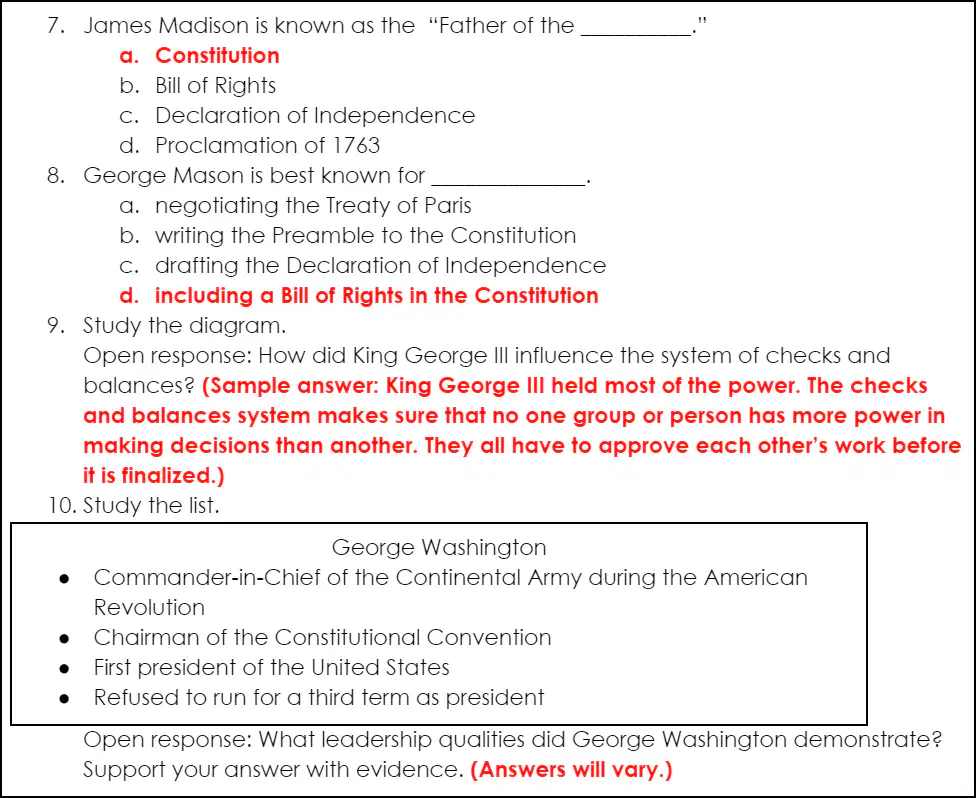
Study the diagram. How did King George III influence the system of checks and balances?
He held most of the power, so checks and balances were created to prevent one person or group from controlling decisions.
He wrote the Declaration of Independence, which directly formed the checks and balances system.
He established the three branches of government before the Constitution was written.
He had no effect on the development of checks and balances.

Study the list of actions: Commander-in-Chief of the Continental Army during the American Revolution; Chairman of the Constitutional Convention; First president of the United States; Refused to run for a third term as president. Based on this list, what leadership qualities did George Washington demonstrate?
Selflessness and respect for limits on power
Desire for unlimited power and lifelong rule
Indifference toward civic duty and public service
Avoidance of military leadership and national responsibility
What was the document that created the first government after the colonies declared independence?
the Constitution
the Declaration of Independence
the Articles of Confederation
the Bill of Rights
In what way was the government of the United States changed in 1787?
by the sound of guns
by voice of the people
by the stroke of a pen
by the pounding of a gavel
What did each state have the authority to do?
regulate trade and taxes on imports and exports
regulate the production of goods and services
regulate the price of newspapers
regulate the settlement of Florida
What was the Great Compromise?
to have two houses of Congress
to give small states more senators
to join Virginia and New Jersey
to compromise on taxes
What was one of the greatest challenges of the Constitutional Convention?
deciding between a king and a president
deciding how to count the population of indentured servants
the fights between the Federalists and the Anti-Federalists
dividing the power between the federal and state governments
The debate and compromise about each enslaved African American being counted as three-fifths of a person was because of ________.
taxation purposes
representation purposes
Constitution purposes
voting purposes
What was Washington’s role in the Constitutional Convention?
He was chairman.
He was secretary of war.
He wrote the Constitution.
He wasn’t there because he was fighting.
What has George Washington been called?
Nation’s Grandfather
Father of our Country
Big Brother of the Nation
Uncle of the Constitution
Why did Washington only serve two terms as president?
He was voted out by the electoral college.
He resigned at the request of Congress.
He died from old war injuries.
He felt two terms were enough for any president.
What was the first thing Hamilton did that showed he was a patriot?
He was elected to help write the Constitution.
He was made secretary of the treasury.
He helped write the Federalist Papers.
He wrote an article supporting American independence.
Which state did Hamilton represent at the Constitutional Convention?
Massachusetts
Pennsylvania
New York
Virginia
What does the article say Hamilton accomplished as secretary of the treasury?
He collected taxes to pay for the war debt.
He paid the national debts.
He established the monetary system we still use today.
He wrote letters and kept records for Washington.
Who was George Mason’s friend and neighbor?
George Washington
Ben Franklin
Thomas Jefferson
Alexander Hamilton
What document was influenced by Mason’s Virginia Declaration of Rights?
the Bill of Rights
the Constitution
the Declaration of Independence
the Mayflower Compact
George Mason believed states’ rights should be greater than the federal government’s. What did this belief make him?
a Federalist
an Anti-Federalist
a Whig
a Democratic Republican
Why was James Madison called the “Father of the Constitution”?
He was the oldest member of the convention.
He was the chairman of the convention.
He had many children.
Many of the ideas in the Constitution were introduced by him.
How did James Madison support ratification of the Constitution?
He campaigned in every state.
He wrote some of the Federalist Papers.
He made speeches.
He wrote letters to the delegates.
What were the Federalist Papers?
a series of essays that supported the new government
a series of newspapers in Philadelphia
a series of letters sent from the federal government
a series of letters sent to King George
Where was Thomas Jefferson during the Constitutional Convention?
in the front seat as chairman
in the back seat as the secretary
in France as ambassador
in Mt. Vernon
Jefferson agreed that any power not given to the federal government belonged to whom?
businessmen or merchants
the states or the people
farmers or plantation owners
the educated or the wealthy
What offices in the new government did Jefferson hold?
secretary of state, vice president, and president
representative from Virginia, senator, and Speaker of the House
ambassador to France, Great Britain, and Spain
secretary of the treasury, commander in chief, and Speaker of the House
What was Alexander Hamilton’s idea for the national financial system?
to establish a government transportation system
to pay all war debt from the states
to pay for highways and canals
to establish an embargo and tariffs for trade
What political party was John Adams part of?
Federalist
Anti-Federalist
Democratic-Republican
no party
What happened in the presidential election of 1800?
Five men were tied for President.
The Supreme Court had to decide the winner.
Aaron Burr was in a duel with Alexander Hamilton.
The House of Representatives voted to break the tie.
The purpose of the Supreme Court is to ________.
balance the legislative branch
review laws to decide if they are constitutional
settle conflicts the president causes
check the lower court judges for conduct
Why is John Marshall important in the history of the Supreme Court?
He was a long-serving justice.
He was the oldest justice appointed.
He was the youngest justice appointed.
He was the first justice impeached.
How long is the term of a justice, according to the Constitution?
two terms
six years
25 years
life

