
 Worksheets
Machine Learning and Neural Networks
Total questions: 50
Worksheet time: 25mins
What is a feature in machine learning?
A program that runs the dataset
A characteristic that describes an object
A rule that controls the computer
A picture that shows the results
In a tabular dataset, what does each column represent?
A place to store images only
A particular feature of the data
A single example in the dataset
A step in a computer program
In a table of a dataset, what does each row correspond to?
A computer hardware part
An example in the dataset
A random number generator
A feature name list

In the ML4K pipeline, what is the first step shown in the diagram?
Use the model
Test the model
Train a classifier
Collect your data

Which step comes immediately after you label each item to a class in the ML4K pipeline?
Use the model in a system
Design a feature set
Train a classifier
Collect your data

A team has collected pictures and chosen features like body type and fin color. What should they do next to build the dataset, according to the diagram?
Skip straight to training
Use the model in a game
Immediately test the model
Code the data using the feature set
Which source is a valid way to collect data shown in the image?
Stories remembered without checking
Random numbers made by guessing
Opinions guessed without asking
Sensors in a car tracking speed
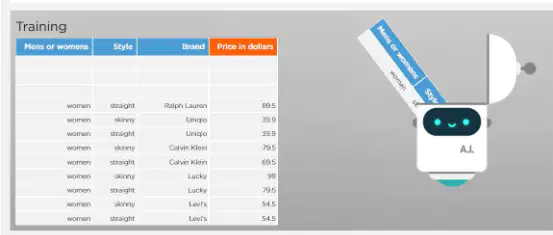
A dataset is split into two parts before training a model. Which pair correctly names these parts and shows their typical sizes?
Training set ninety percent, test set ten percent
Training set ten percent, test set ninety percent
Training set half, test set half
Training set seventy percent, test set thirty percent
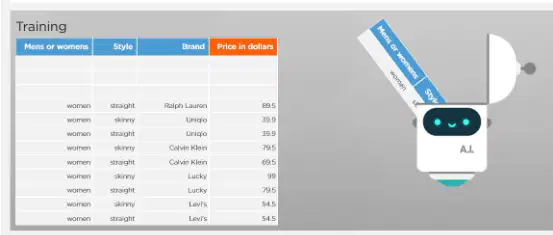
What does the algorithm do with the training data during model building?
Finds patterns called statistical correlations
Randomly guesses without using features
Deletes half of the examples to simplify
Changes labels to match the features
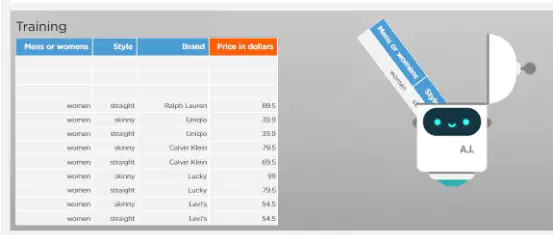
After a model is trained, what is the next step to check how well it works?
Test the model using the test set for accuracy
Add more features without checking results
Split the training set again into two sets
Ignore testing because training is enough
Which AI tool helps with talking and listening tasks?
Face detection at a party
License plate readers for cars
Self-driving car dashboard view
Intelligent assistants like smart speakers
Why do neural networks often work better for hard problems like understanding images?
They need very little data always
They create their own helpful features
They only explain decisions clearly
They use simple yes-or-no rules
What is one advantage of decision trees?
They require less data to train
They drive cars by themselves
They detect faces in pictures
They build their own features
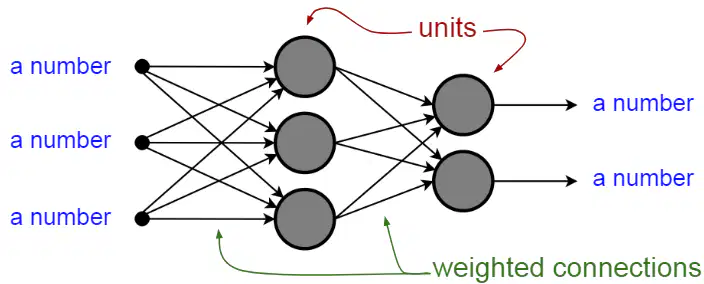
Look at the diagram showing circles connected by arrows. What are the circles called in a neural network?
units or neurons
inputs or outputs
weights or biases
links or cables
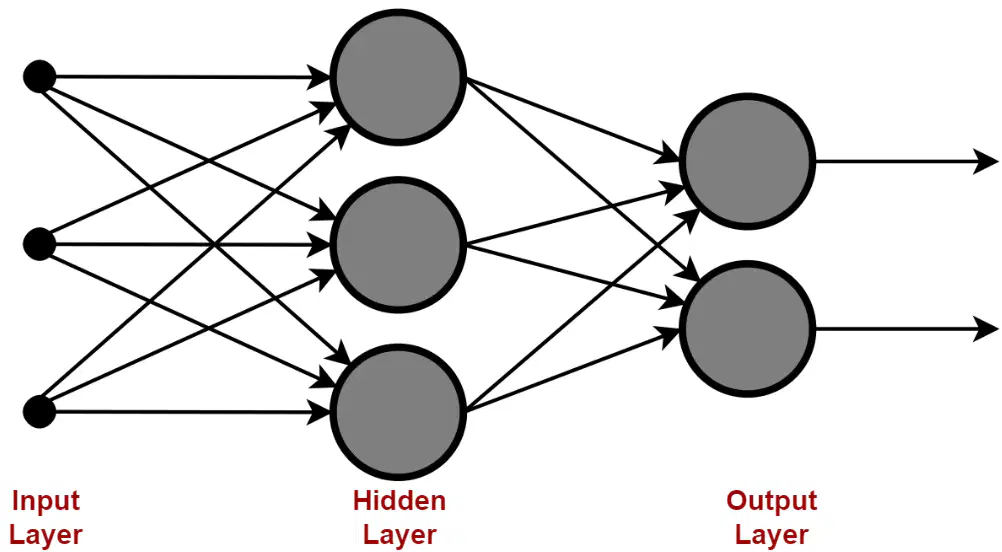
In the layered diagram, which layer sends the final numbers out of the network?
Output layer
Input layer
Starter layer
Middle layer
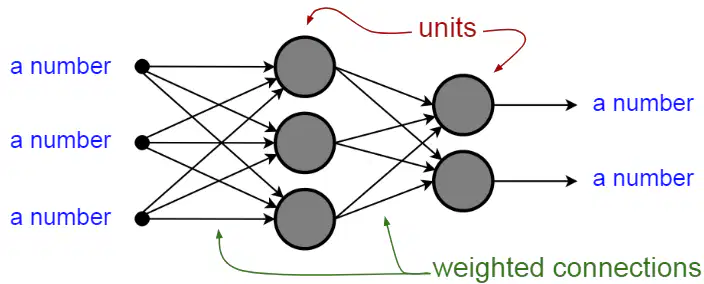
A unit takes several numbers and makes one number. Which part controls how strongly each input affects that unit?
Input dots
Weighted connections
Output arrows
Hidden circles
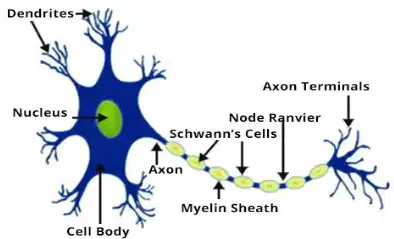
Look at the two diagrams: one shows a biological neuron with parts like dendrites and axon, and the other shows an artificial neuron with inputs X1, X2, X3 leading to an output. What idea do both diagrams share?
Both pass signals from inputs to outputs
Both store pictures in memory forever
Both decide using only random guessing
Both work without any connections at all
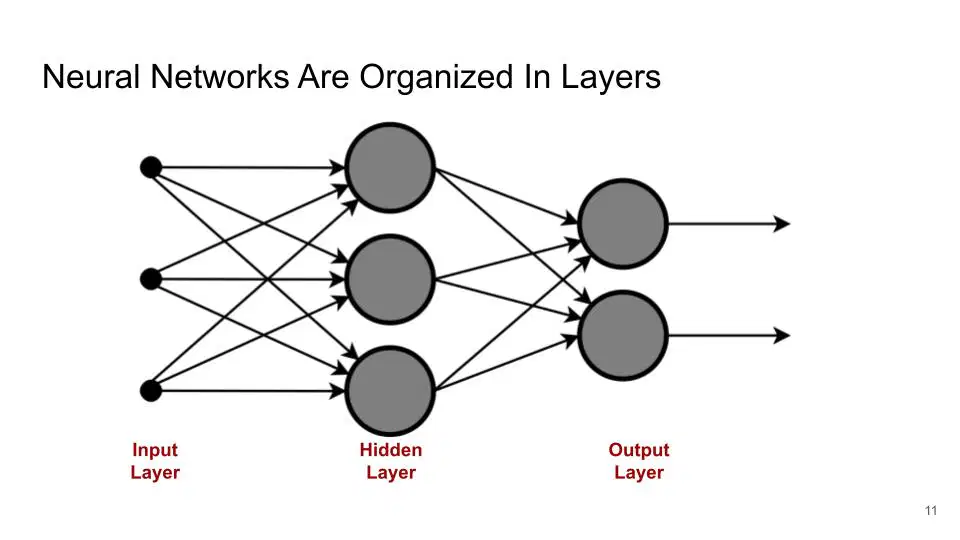
In the network diagram with an input layer, three hidden layers, and an output layer, what makes it a deep neural network?
It uses one giant output neuron
It has many connected hidden layers
It removes the input layer completely
It has no wires between any layers
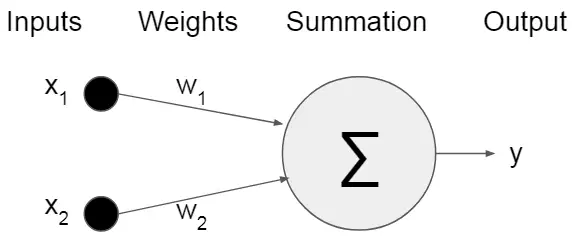
In a simple linear unit, what happens to each input before the results are added?
It is turned into a binary number
It is ignored by the summation circle
It is multiplied by the weight value
It is divided by the weight value

Which formula shows the summation for two inputs and two weights?
x1 × x2 + w1 × w2 = y
x1 × w1 + x2 × w2 = y
x1 + w1 + x2 + w2 = y
x1 − w1 + x2 − w2 = y
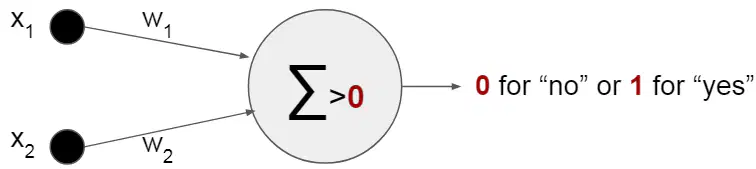
A linear threshold unit gives a binary output. What does binary mean here?
Three choices, 0, 1, or 2
Two choices, either 0 or 1
Many choices from zero to nine
Only one choice, always 1
What does a learning algorithm change in a neural network to help it perform better?
The weights connecting inputs
The size of the classroom
The colors of the graphs
The number of school subjects
Which best describes a feature vector in simple terms?
A schedule of homework
A picture of a robot
A single final answer
A list of input features
Why do many AI apps use artificial neural networks?
They stop cars from moving
They work only with one neuron
They erase all memories
They can learn from data
Which statement best shows the meaning of inclusive OR in everyday language?
You choose a or b, possibly both
You choose a or b, but not both
You must choose both a and b together
You cannot choose a or b at any time
In a PBJ sandwich rule "peanut butter AND jelly," when is the rule true?
True if you have peanut butter only
True if you have jelly only
True if you have both peanut butter and jelly
True if you have neither ingredient
Which situation matches an OR rule from the image?
Joe likes ketchup and mustard on his hamburger
A car needs both headlights and brake lights
I should wear my boots if it’s raining or snowing
A PBJ sandwich requires peanut butter and jelly
If Luisa wants to get a cat OR a dog, which choice makes the OR statement true?
She gets only a cat as her pet
She gets both a cat and a dog
She gets neither pet at all
She gets only a fish as her pet
There are three fundamental operations in Boolean Algebra: ______
Addition, Subtraction and Multiplication
NOT, AND, and OR
IF, AND, and BUT
IF, ELSE, and ELSE IF
A NOT takes a single Boolean value, either true or false, and ______
makes it true
makes it false
negates it
keeps it the same
For the AND Boolean operation, the output is only true if _____
one input is true
one input is false
both inputs are true
both inputs are false

What is A.I?
Intelligence demonstrated by machines
Smart robots
Anthony Ian
I don't know

How does A.i work?
Combining large amounts of data with fast processing and intelligent algorithms, allowing the software to learn automatically from patterns or features in the data.
The computation, mostly on computers, of antiderivatives and definite integrals in term of formulas
It just works you know??
Another super duper long answer to fool you guys to prove that not all longest answers are the correct ones, how is my quiz going anyway, i hope it is good, hope it is not too long though, thank you for not clicking

What is this?
artificial intelligence
algorithm
neural network
Which one of these is not an area of AI?
computer vision/image recognition
voice recognition
web design
robotics

How many images would you need of a cat, for example, to train a neural network ?
about 10
a few hundred
thousands
It is an application of artificial intelligence (AI) that provides systems the ability to automatically learn and improve from experience without being explicitly programmed
Artificial Intelligence
Decision Tree
Machine Learning
Linear Regression
Which is the correct structure of a Neural Network?
Output, Hidden Layer, Input
Hidden Layer, Input, Output
Input, Hidden Layer, Output
This is where we insert the initial data for the neural network.
Input
Hidden Layer
Output
This is an intermediate layer between input and output layer and place where all the computation is done.
Input
Hidden Layer
Output
It produces the result for given inputs.
Input
Hidden Layer
Output

from the picture, what kind of programming is it?
Traditional Programming
Modern Programming
Machine Learning
Traditional Learning

from the picture, what kind of programming is it?
Traditional Programming
Machine Learning
Modern Programming
Traditional Learning

The modern Turing test to tell computers and humans apart, is commonly abbreviated as ___
APTCHA
PACTCHA
CAPTCHA
CACPHAT

What do you call the feature that checks you are not a robot / hacking program?
Captcha
Proover
Tester
Grabber
Most advanced form of Artificial Intelligence is:
Deep Learning is the most advanced form of Artificial Intelligence.
Artificial Intelligence covers all the concepts and algorithms which, in some way or the other mimic human intelligence.
Machine learning is the most advanced form of Artificial Intelligence.
What is Deep learning?
A variation of neural networks where many layers are used in the network to solve a problem
When a computer is especially intelligent.
Tiny little cells in our brain are
Neurans
Neurons
Neurens
Neuruns

Algorithm
The use of two or more processors, (cores, computers) in combination to solve a single problem.
A step-by-step process to complete a task.
Being correct and precise.
Important to the matter at hand.
This is a system of Programs and Data-Structures that mimics the operation of the human brain:
a. Intelligent Network
b. Decision Support System
c. Neural Network
d. Genetic Programming

