
 Worksheets
Evolution and Adaptation Concepts
Total questions: 18
Worksheet time: 9mins
Evolution can be defined as:
The change in an individual over time
The change in a populations environment
The change in a population over time
The change in an individuals environment
What is an adaption?
Migration of individuals to an environment best suited for their needs
A trait that is favorable to an organisms survival in its environment
A change in a population over time
Change in allele frequency over time
If a mutation introduces a new fur color in a bear population, which factor might determine whether the frequency of the new allele will increase?
how many alleles are present
how many phenotypes are present
if the mutation makes some bears more fit for the environment than others
if the mutation was caused by nature or humans
Traces of dead organisms such as the shells, animal skeletons, and other signs of past life are all-
fossils
homologous structures
embryos
vestigal structures
periods of slow change interrupted by periods of rapid change with few, if any transitional fossils, best describes the theory of-
natural selection
genetic drift
gradualism
punctuated equilibrium
Embryos of several types of animals look very similar and develop in almost the same manner, especially in the early stages. What do these physical similarities indicate?
organisms have similar adaptations
organisms have analogous structures
organisms have a common ancestor
organisms don't evolve much
What happens to the individuals that are best suited for their environment?
They survive and reproduce
They only survive
They decrease in population size
Nothing
Match the example with the correct mechanism of evolution: A strong storm blows a group of birds to a new island where they interbreed with the local bird population, introducing new alleles to the gene pool.
Genetic Drift
Mutation
Gene Flow
Natural Selection
Structures that perform a similar function (but do not show common ancestry) are called _____ structures.
homologous
analogous
vestigial
heterologous
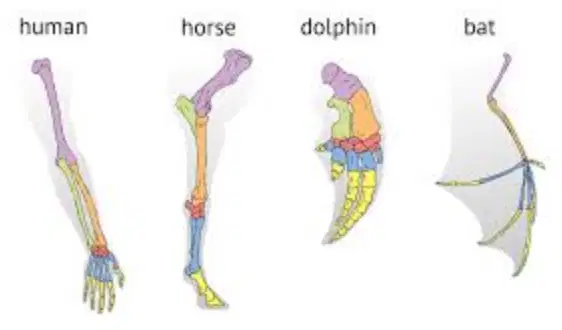
The structures in the image below provide evidence that the organisms in the image share a -
parent
fossil
none of the answers are correct
common ancestor
Individuals that can breed and produce fertile offspring are considered to be the same?
species
individual
Which mechanism of evolution is the following example: Female frogs prefer mating with males that produce lower-pitched croaks, leading to a skewed gene distribution in the population.
genetic drift
natural selection
gene flow
non-random mating
Because of natural selection, favorable alleles will _________ in a population.
decrease
stay the same
increase
The following is an example of: In a grassland with frequent fires, plants with thicker bark survive and reproduce more successfully than those with thin bark.
mutation
natural selection
non-random mating
gene flow
The following is an example of: In a forest, a lightning strike kills most of a squirrel population, leaving only a few individuals whose traits become more common in the population during the years following.
Genetic Drift
Natural Selection
Non-Random Mating
Gene Flow
Something that allows an organism to survive is called (a)n-
homologous structure
allele
adaptation
ancestor
The following is an example of: A random change in a rabbit's DNA causes it to grow slightly longer ears than its parents. Many generations later, there is greater variation in ear length of the rabbit population.
mutation
genetic drift
natural selection
gene flow
The following scenario is an example: A bacterium develops resistance to an antibiotic due to a single alteration in its genetic code. The change is transmitted to offspring, rapidly spreading the antibiotic resistant trait throughout the population of bacteria.
non-random mating
genetic drift
gene flow
mutation

