
 Worksheets
Patho wk 1
Total questions: 30
Worksheet time: 15mins
A patient opens their eyes only to painful stimuli, speaks incomprehensible words, and withdraws from pain. Which alteration in arousal is most accurate?
Lethargy
Obtundation
Stupor
Coma
Which finding best differentiates lethargy from obtundation?
Ability to follow commands
Degree of sleepiness and response time
Presence of pupillary reflexes
Motor strength
A patient with increased intracranial pressure develops a pattern of deep, rapid respirations. How should this finding be interpreted?
Normal respiratory compensation
Cheyne-Stokes respirations
Kussmaul respirations
Ataxic respirations
Which breathing pattern is most concerning for brainstem dysfunction?
Cheyne-Stokes respirations
Kussmaul respirations
Apneustic breathing
Irregular, unpredictable respirations
Which assessment finding is an early sign of increased intracranial pressure?
Bradycardia
Decreased level of consciousness
Widened pulse pressure
Abnormal posturing
Which assessment finding indicates late increased ICP?
Restlessness
Headache
Decorticate posturing
Mild confusion
A patient experiences a brief loss of consciousness after a head injury, followed by a lucid period, then rapid neurologic decline. Which injury pattern does this describe?
Subdural hematoma
Epidural hematoma
Concussion
Diffuse axonal injury
Which patient is at highest risk for a subdural hematoma?
Young adult with sports injury
Middle-aged patient with migraine
Older adult with cerebral atrophy
Child with viral illness
Which finding most strongly suggests an ischemic stroke rather than a hemorrhagic stroke?
Sudden severe headache
Loss of consciousness at onset
Gradual onset of neurologic deficits
Elevated blood pressure
Which nursing assessment is the priority for a patient with suspected acute stroke?
Pain level
Level of consciousness
Intake and output
Skin integrity
Which finding is consistent with brain death?
Absent pupillary response with spontaneous respirations
No cerebral activity but intact brainstem reflexes
Absence of brainstem reflexes
Periodic eye opening
A patient has no purposeful movement but retains gag and pupillary reflexes. How should this be interpreted?
Brain death
Cerebral death
Coma
Persistent vegetative state
The nurse assesses unequal pupils in a patient with a head injury. This finding most directly suggests:
Normal aging changes
Increased intracranial pressure
Peripheral nerve injury
Hypoglycemia
Which pupillary finding is most concerning in a neurologic assessment?
Sluggish but equal pupils
Pupils reactive to light
Fixed and dilated pupils
Pupils that constrict slowly
A patient demonstrates abnormal flexion of the arms toward the chest in response to pain. How should this finding be interpreted?
Decerebrate posturing
Normal withdrawal
Decorticate posturing
Flaccid paralysis
Which posturing pattern indicates more severe neurologic injury?
Decorticate posturing
Purposeful movement
Withdrawal from pain
Decerebrate posturing
Hydrocephalus causes increased intracranial pressure primarily due to:
Increased blood volume in the brain
Obstruction of cerebrospinal fluid flow
Breakdown of the blood–brain barrier
Decreased cerebral perfusion
Which assessment finding is most consistent with acute hydrocephalus?
Slow cognitive decline
Sudden headache and vomiting
Long-term memory loss
Unilateral weakness
A patient arrives with slurred speech and unilateral weakness. What is the nurse’s priority action?
Obtain a detailed medication history
Perform a full head-to-toe assessment
Conduct a focused neurologic assessment
Provide pain medication
Which finding most strongly suggests hemorrhagic stroke rather than ischemic stroke?
Gradual onset of weakness
History of atrial fibrillation
Sudden severe headache
Mild confusion
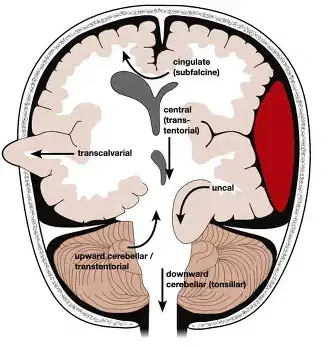
A herniation is occurring where brain tissue is displaced beneath the falx cerebri toward the opposite hemisphere. Which type of herniation does the image depict?
Central (transtentorial)
Uncal
Cingulate (subfalcine)
Tonsillar
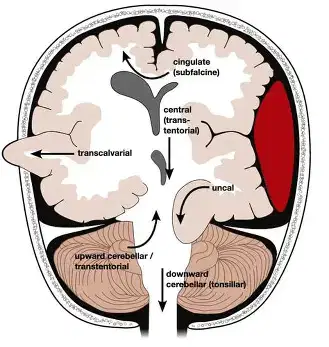
Which herniation shown in the image involves downward movement of the brain through the tentorial notch?
Transcalvarial
Central (transtentorial)
Cingulate (subfalcine)
Upward cerebellar
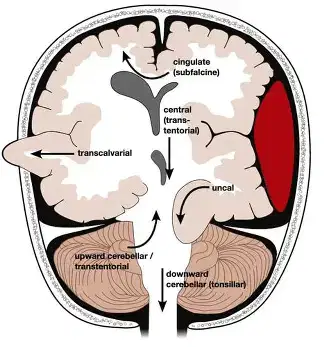
The image shows a portion of the temporal lobe being displaced medially and downward toward the brainstem. Which herniation is this?
Tonsillar
Central
Uncal
Subfalcine
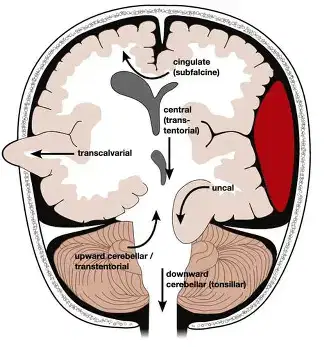
Which herniation depicted in the image occurs when brain tissue moves downward through the foramen magnum?
Upward cerebellar
Transcalvarial
Tonsillar
Central
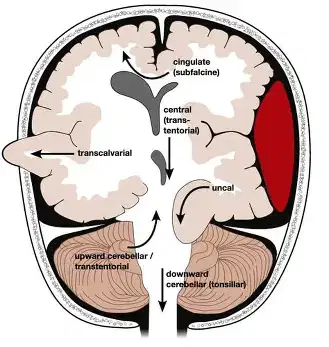
A herniation is occurring in which brain tissue moves upward from the cerebellum through the tentorium. Based on the image, this is classified as:
Central
Uncal
Upward cerebellar (transtentorial)
Cingulate
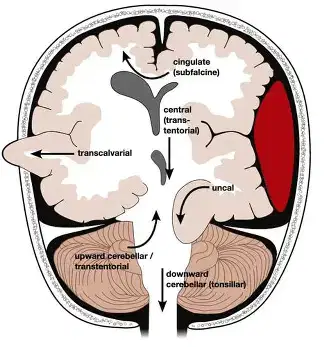
Which herniation shown involves brain tissue protruding outward through the skull?
Central
Transcalvarial
Tonsillar
Uncal
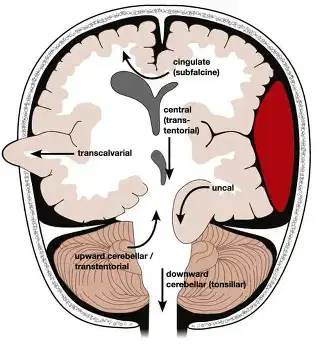
Based on the image, which herniation type is lateral in direction rather than vertical?
Central
Tonsillar
Cingulate (subfalcine)
Upward cerebellar
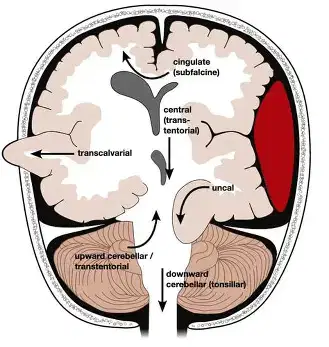
Which herniation types in the image involve movement across or through the tentorium? (Select all that apply)
Central (transtentorial)
Uncal
Cingulate (subfalcine)
Upward cerebellar
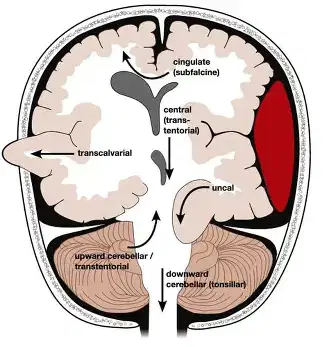
A nurse reviewing the image identifies two herniation types involving downward displacement. Which are they?
Central and tonsillar
Uncal and cingulate
Transcalvarial and upward cerebellar
Cingulate and central
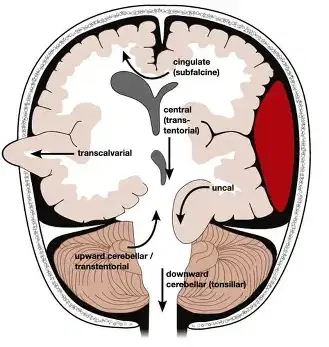
Which herniation depicted is most inferior in location on the image?
Uncal
Central
Tonsillar
Cingulate

