
 Worksheets
Cell Membrane and Transport Quiz
Total questions: 14
Worksheet time: 2hrs 20mins
Which of the following is NOT a major part of the cell membrane?
proteins
nucleic acids
carbohydrates
phospholipids
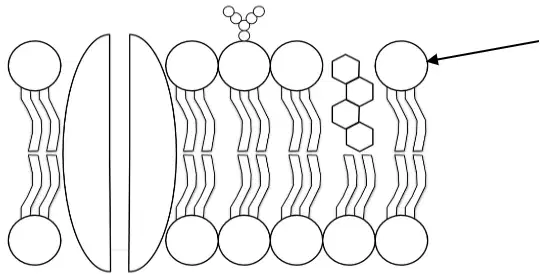
Directions: Read each question carefully and choose the best answer. What structure is the arrow pointing to in the image below?
cholesterol
protein
phospholipid
glucose
Directions: Read each question carefully and choose the best answer. The cell membrane maintains _________ by controlling what enters and leaves cells.
homeostasis
temperature
structure
reproduction
Directions: Read each question carefully and choose the best answer. What is the function of cholesterol in the cell membrane?
It forms the lipid bilayer.
It works in cell identification.
It allows certain molecules to pass through.
It helps maintain the fluidity of the membrane.
Directions: Read each question carefully and choose the best answer. Some molecules pass through the cell membrane easily whereas other molecules cannot. What is the name of this property of the cell membrane?
impermeable
semipermeable
permeable
resistance
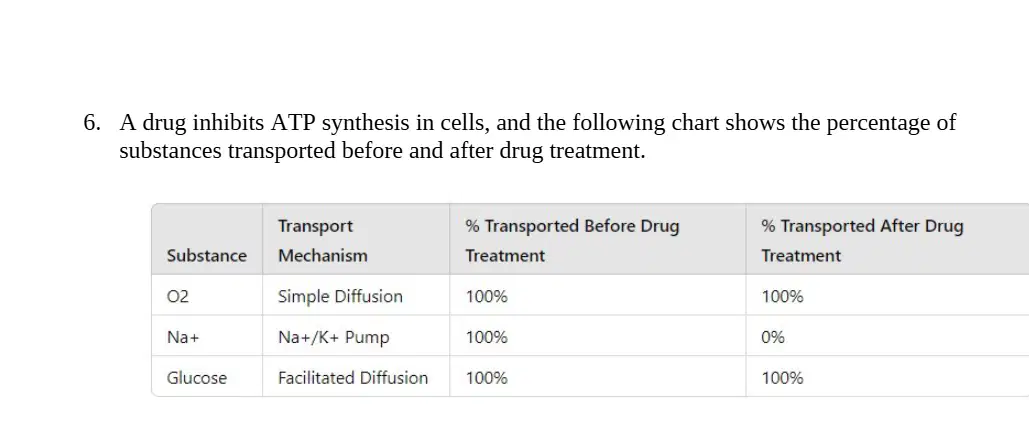
Directions: Read each question carefully and choose the best answer. A drug inhibits ATP synthesis in cells, and the following chart shows the percentage of substances transported before and after drug treatment: O2 transported by simple diffusion is 100% before and 100% after treatment; Na+ transported by the Na+/K+ pump is 100% before and 0% after treatment; Glucose transported by facilitated diffusion is 100% before and 100% after treatment. Based on the data, which conclusion can you draw about the types of transport affected by the drug?
Only passive transport is affected by the drug since Na+ transport stops.
Active transport is affected by the drug because the Na+/K+ pump requires ATP.
Facilitated diffusion is the only transport mechanism affected by the drug.
The drug impacts all forms of transport, stopping both passive and active mechanisms.
Directions: Read each question carefully and choose the best answer. Which of the following correctly compares passive and active transport? CHOOSE ALL THAT APPLY!!!
Passive transport requires energy, while active transport does not.
Active transport moves molecules down their concentration gradient, while passive transport moves molecules against their concentration gradient.
Passive transport moves molecules from high to low concentration, while active transport moves molecules from low to high concentration.
Active transport requires energy, while passive transport does not.
Directions: Read each question carefully and choose the best answer. Oxygen and carbon dioxide move into and out of the cell using _______.
exocytosis
protein pumps
diffusion
osmosis
Directions: Read each question carefully and choose the best answer. A molecule moves into the cell using a channel protein. The molecule has moved from a higher concentration to a lower concentration. What type of transport is this?
osmosis
facilitated diffusion
protein pump
exocytosis
Directions: Read each question carefully and choose the best answer. A cell transports a very large molecule into the cell using energy. What type of transport is this?
protein pump
diffusion
facilitated diffusion
endocytosis
Directions: Read each question carefully and choose the best answer. If a cell is placed in a hypertonic solution, what will happen?
The cell will lose water and shrivel.
The cell will gain water and swell.
The cell will remain the same.
None of the above
Directions: Read each question carefully and choose the best answer. A red blood cell is placed in three different solutions: hypertonic, hypotonic, and isotonic. The results of each environment are as follows: hypertonic—cell shrinks; hypotonic—cell swells; isotonic—no change. Based on this data, what happens to the red blood cell in a hypertonic solution, and why?
The cell shrinks because water leaves the cell.
The cell shrinks because water enters the cell.
The cell swells because water leaves the cell.
The cell stays the same because water moves in and out equally.
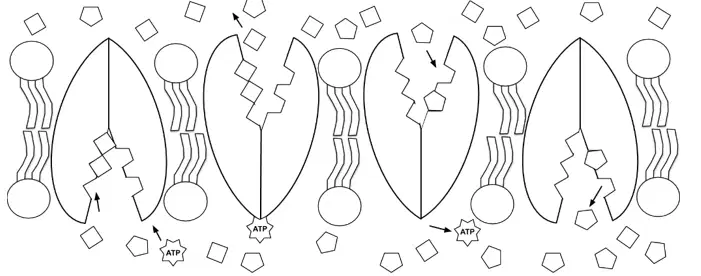
Directions: Read each question carefully and choose the best answer. What type of transport is pictured below?
facilitated diffusion
exocytosis
osmosis
protein pump

Directions: Read each question carefully and choose the best answer. Below is a beaker with a cell inside. Look at the concentrations of solute in the cell and the surrounding solution. What type of solution is the cell in?
hypotonic
hypertonic
isotonic
mesotonic

