
 Worksheets
World War II Economic and Social Transformations
Total questions: 25
Worksheet time: 13mins
What was one of the most significant transformations in the American economy during World War II?
The shift from wartime production to consumer goods manufacturing.
The conversion of the economy to wartime production, manufacturing tanks, airplanes, and ammunition.
The reduction of industrial output to conserve resources.
The elimination of rationing systems for goods like sugar and gasoline.
What was the purpose of ration books distributed by the government during World War II?
To encourage hoarding of essential goods.
To allow families to purchase unlimited quantities of goods.
To ensure fair distribution of scarce resources like sugar, coffee, and gasoline.
To promote the sale of war bonds.
What were Victory Gardens, and why were they significant during World War II?
Public parks used for military training.
Gardens where families grew their own fruits and vegetables to supplement rations.
Government-owned farms that produced food for soldiers.
Areas where propaganda posters were displayed.
How did war bond drives contribute to the war effort during World War II?
By encouraging citizens to hoard resources.
By raising funds for the war and fostering a sense of national unity.
By promoting the rationing system.
By reducing industrial output.
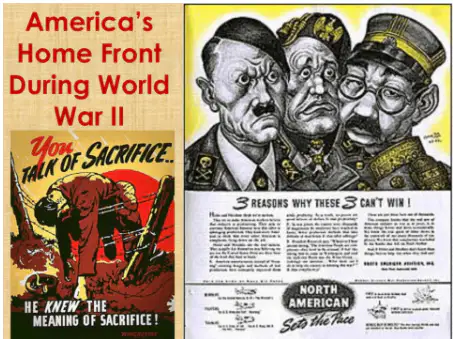
What role did propaganda play during World War II?
It discouraged enlistment and demonized the enemy.
It promoted patriotism, encouraged enlistment, and emphasized unity.
It focused solely on the contributions of soldiers.
It eliminated the need for war bond drives.
Who was "Rosie the Riveter," and what did she symbolize during World War II?
A fictional character representing the enemy.
A symbol of the contributions of women in the workforce during the war.
A government official who led rationing efforts.
A celebrity who promoted war bond drives.
What was the primary reason for the Second Great Migration of African Americans during World War II?
To escape racial discrimination in rural areas
To seek better economic prospects and employment in war-related industries
To join the military forces
To establish agricultural communities in the South
What was the purpose of the Bracero Program established between the United States and Mexico during World War II?
To provide military training to Mexican laborers
To allow Mexican laborers to work temporarily in agriculture and essential industries in the U.S.
To promote cultural exchange between the two countries
To establish permanent residency for Mexican workers in the U.S.
What was the role of prisoner of war (POW) camps in Tennessee during World War II?
They housed American soldiers returning from the war
They served as training grounds for new recruits
They housed captured enemy soldiers who worked in agriculture and other industries
They were used for storing military equipment
How did World War II impact the American home front?
It led to the decline of industrial production
It transformed the economy, social structures, and national identity
It caused widespread unemployment
It reduced the role of America on the world stage
What was one of the major impacts of World War II on the U.S. economy?
Factories stopped producing goods and focused on agriculture.
Factories began manufacturing military equipment, leading to shortages of consumer goods.
The government reduced spending on war industries.
The economy shifted entirely to international trade.
How did the government encourage citizens to support the war effort during World War II?
By reducing taxes for war-related industries.
By launching war bond drives and propaganda campaigns.
By providing free goods to families.
By banning all forms of media communication.
What was the purpose of Victory Gardens during World War II?
To provide food for soldiers overseas.
To supplement family rations during shortages of resources.
To promote urbanization and industrial growth.
To replace agricultural production with factory work.
What demographic shift occurred in the U.S. during World War II?
Millions of Americans moved to rural areas for farming jobs.
Millions of Americans migrated to urban centers for war-related jobs.
The population decreased due to war casualties.
Americans moved to other countries to escape the war.
What was the Bracero Program during World War II?
A program to train American soldiers for combat.
A program to bring Mexican laborers to the U.S. for agricultural work.
A program to provide free education to war refugees.
A program to relocate American families to rural areas.
How did prisoner of war (POW) camps in Tennessee contribute to the war effort?
They trained soldiers for combat.
They housed enemy soldiers who were employed in various industries.
They served as centers for war bond drives.
They provided free resources to local communities.
What lasting impact did World War II have on the American home front?
It led to the complete collapse of the economy.
It transformed the nation's economy, social structures, and sense of national identity.
It caused widespread migration to other countries.
It resulted in the end of industrialization in America.
What does the term "mobilized" mean?
To move resources from one place to another without preparation.
To organize or prepare resources for action, especially for military purposes.
To conserve resources by using them carefully.
To distribute resources during a time of emergency.
What is the meaning of "rationing"?
A system of distributing scarce resources during a time of emergency or war.
The act of conserving resources by using them carefully.
The movement of people or goods from one place to another.
Information used to promote a political cause or point of view.
Which of the following best describes "conserve"?
To protect something from harm or destruction and prevent waste.
To organize resources for military purposes.
To distribute scarce resources during emergencies.
To express devotion to one's country.
What does "patriotic" mean?
Having devotion and vigorous support for one's country.
Using resources carefully to prevent waste.
Distributing resources during emergencies.
Promoting biased information for political purposes.
What is "propaganda"?
Information used to promote a political cause or point of view, often biased or misleading.
A system of distributing scarce resources during emergencies.
Movement from one part of something to another.
Expressing devotion to one's country.
What does "migration" refer to?
Movement from one part of something to another.
Organizing resources for military purposes.
Distributing scarce resources during emergencies.
Promoting biased information for political purposes.
What is the definition of the word "laborers"?
A person doing skilled manual work for wages.
A person doing unskilled manual work for wages.
A person managing a team of workers.
A person working in a professional office setting.
Which sentence correctly uses the word "laborers" in context?
The laborers designed a new software program for the company.
The laborers were hired to help with the harvest on the farm.
The laborers conducted a scientific experiment in the lab.
The laborers managed the finances of the organization.

