
 Worksheets
Africa History
Total questions: 40
Worksheet time: 22mins

What does partitioning mean?
to divide up
to take over
to cause conflict
to teach
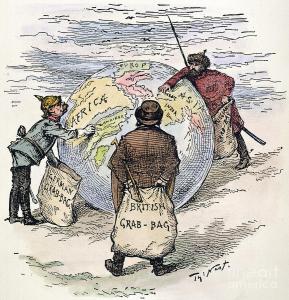
What is Imperialism?
when one nation is able to control other, usually smaller or weaker, nations
loyalty and devotion to a nation especially as expressed in a glorifying of one nation above all others
shared or governmental ownership and administration of the means of production and distribution of goods

(select all that apply) Why did Europeans set up colonies in Africa?
No country wanted to be without colonies (considered “weak”)
They wanted to solve ethnic and tribal disputes
To build ports along the trade route between Europe and Asia
They wanted raw materials found in Africa

(select all that apply)
The European division of Africa caused:
Tribal conflicts
Civil war
Desire for independence
Economic inequality
Long-lasting peace

The modern day political boundaries, civil wars, and conflicts found in Africa can often be traced back to which of the following event?
European partitioning and colonization
Ancient African trading empires
European cooperation in the late 1800s
Asian invasions in the 1800s
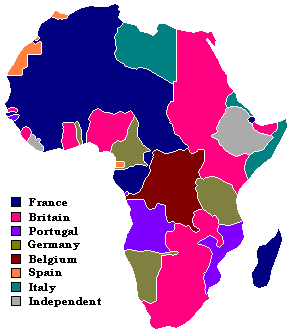

True or False?: European countries failed to consider differences in ethnic groups, cultures, and political traditions when making artificial political borders in Africa.
True
False

In 1963, Kenya gained independence from:
Great Britain
France
Germany
Belgium

What two European countries gained the most land in Africa during the time of Imperialism?
Spain and Germany
Great Britain and France
United States and Great Britain
China and Japan

Which phrase below best describes the following statement: "European nations took control of almost all African territory"?
Discovering the New World
The Age of Exploration
Scramble for Africa
Assimilating Africans to European Culture

The purpose of the Berlin Conference was to discuss:
World issues and conflicts
The best trade routes from Germany
America’s independence from Britain
The partitioning of Africa

How many African countries were invited to the Berlin Conference?
0
1
5
30
Why didn't the Europeans just sail completely around Africa for their trade routes?
Too many sea monsters
Pirates
It was a long journey and they needed to re-supply their ships
they didn't have ships that were able to make the long journey
The idea that peoples of African descent have common interests and should be unified is known as:
Nationalism
Imperialism
Pan-Africanism
Communism
The feelings of affection and pride that people have for their country is known as
Pan-Africanism
Imperialism
Democracy
Nationalism
Which country gained independence from Great Britain by creating political parties and electing their own government?
Kenya
Nigeria
Ethiopia
Liberia
Which country used violent attacks on colonists and colonial supporters to gain independence from Great Britain?
Nigeria
Kenya
Liberia
Ethiopia
Africans were able to make an impact in their fight against colonial powers
after World War I
after World War II
after Vietnam War
after 1990
The Mau Mau were
a group of pacifists from Kenya
a group of rebel fighters from Kenya
a group of rebel fighters from Nigeria
A group of pacifists from Nigeria
African nations struggled after independence because African economies were dependent on the European country that colonized them.
True
False
African nations struggled after independence because violence broke out between rival ethnic and religious groups living together.
True
False
African nations struggled after independence because many new leaders lacked experience in running a new country.
True
False
African countries were able to gain independence from European colonizers...
by using only violence
by using only non-violence
by using a mixture of violence and non-violence
they did not gain independence
War within a country or regions
Nationalism
Civil War
Pan-African movement
Independence movement
Seeks to be free from outside (foreign) control is ____________?
Nationalism
Civil War
Pan-African movement
Independence movement
Nigeria's independence from Britain was _______________, whereas, Kenya's was ______________.
Violent, peaceful
Peaceful, violent
Quick, slow
Slow, quick
________________________ movements occur because people in a country seek independence from another power.
Pan-Africanist
Nationalist
Imperialist
Colonial
The main goal of Pan-Africanism was to...
End any support for the African National Congress
Immediately overthrow all the ruling governments in Africa.
Get all Africans to become members of the United Nations.
Get Africans to think of themselves as one people and work together.
One purpose of the Pan-African movement in Africa to
Develop a unified region
Create one African language
Create one African religion.
Develop a unified political identity.
Kenya and Nigeria were both colonized by the ___________ and gained their independence in ______________.
Belgians; the 1960s
British; the 1950s
British; the 1960s
French; the 1960s
The only independent countries after the Berlin Conference were:
Ghana & Nigeria
Ethiopia & Liberia
Liberia & Ghana
Ethiopia & Kenya
The Mau Mau were...
A group that believe force was the only way to win Kenyan rights and independence from the British.
A group of students that believed peace was the only way to win Kenyan rights and independence from the British
A group that believed force was the only way to win Nigerian rights and independence from the British.
A group of students that believed peace was the only way to win Nigerian rights and independence from the British
What is the apartheid system?
A democratic government system
A system that brought equality to all races
A system of laws that segrated the races in South Africa
A dictator type of government system
Which group of people held the power during apartheid?
Asians
White South Africans
Non whites of South Africa
Black South Africans
Who was arrested and went to jail for leading protest against apartheid law?
F.W. deKlerk
Gandhi
Martin Luther King
Nelson Mandela
What organization was formed to gain equal right for black Africans in South Africa?
African National Congress
The African Union
United Nations
League of Nations
How did the United States react to Nelson Mandela's conviction in 1964?
They restricted trade with South Africa.
They promoted South African goods
They supported the conviction
What year did South Africa have it's first free election open to all races?
2012
1999
1994
2002
Which president in South Africa brought apartheid to an end?
Nelson Mandela
Jomo Kenyatta
F.W. deKlerk
JF Kennedy
Nelson Mandela was elected the first black president of South Africa.
True
False

