wayground logo

Free Printable Worksheets

NEW

Font size

S
M
L
XL
Worksheets

Unit 1 Atoms and Nuclear Reactions

Total questions: 45

Worksheet time: 1hrs 4mins

Name
Class
Date
1.

Which scientist discovered the electrons?

a)

Dalton

b)

Thomson

c)

Atristotle

d)

Bohr

2.

What is a particle with one negative charge called?

a)

electron

b)

proton

c)

quark

d)

neutron

3.

Bohr discovered that electrons are located in

a)

the nucleus

b)

inside protons

c)

electron cloud

d)

circular orbits around the nucleus

4.

What is a particle with one positive charge called?

a)

proton

b)

electron

c)

neutron

d)

quark

5.

What is the center of an atom called?

a)

nucleus

b)

electron cloud

c)

proton center

d)

photon center

6.

What is the neutral particle found in the nucleus called?

a)

proton

b)

neutron

c)

electron

d)

quark

7.
In Dalton's Atomic Theory, all elements consist of __________ that cannot be divided.
a)
Atoms
b)
Parts
c)
Molecules
d)
Hydrogen
8.

Who was the Greek philosopher who called the smallest particle of matter an "atom"?

a)

Democritus

b)

Aristotle

c)

J.J Thompson

d)

Einstein

9.

Which of the following is/are conclusions based on Rutherford’s gold foil experiment?

a)

Atom is mostly empty space

b)

The nucleus is positively charged

c)

The atom has a small dense nucleus

d)

All answers are correct

10.
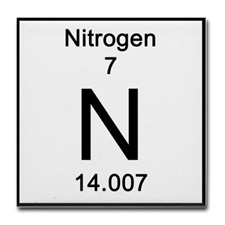
What is the number of protons that the element in this image contain?
a)
14
b)
7
c)
15
d)
18
11.
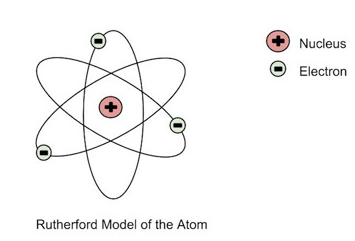
What number indicates the nucleus?
a)
1
b)
2
c)
3
d)
4
12.
Rutherford's gold foil experiment provided evidence that...
a)
negative and positive charges are spread evenly throughout the atom.
b)
alpha particles have a positive charge.
c)
gold is not a dense as previously thought.
d)

there is a dense positively charged nucleus at the center of a mostly empty space atom.

13.
J.J. Thomson provided evidence that an atom...
a)
is the smallest particle of matter
b)
contains negatively charged particles
c)
has an overall negative charge
d)
has an overall positive charge
14.

The majority of an atom's mass exists where?

a)

In the nucleus

b)

In the electron cloud

c)

In the space between the nucleus and the electrons

d)

In the neutrons

15.
What did James Chadwick discover?
a)
neutrons
b)
electrons
c)
the atomic theory
d)
protons
16.
What subatomic particles would you find in the nucleus of an atom?
a)
Protons only
b)
Protons and Neutrons
c)
Neutrons and Electrons
d)
Protons and Electrons 
17.
Protons and Electrons balance the charge of an atom.
a)
True
b)
False
18.
If an atom has 12 positively charged subatomic particles, which of the following must it also have to be considered a neutral atom?
a)
12 neutrons
b)
12 electrons
c)
12 protons
d)
24 protons and neutrons
19.
An atom has 10 protons, 15 neutrons and 10 electrons what is its mass number.
a)
20
b)
10
c)
5
d)
25
20.
An element with a mass number of 11 and an atomic number of 5 has how many neutrons?
a)
11
b)
5
c)
6
d)
16
21.
What is the atomic number of the atom pictured? 
a)
9
b)
10
c)
18
d)
19
22.
Which scientist conducted experiments using alpha particles and thin gold foil, which later helped him develop his model for the atom? 
a)
Ernest Rutherford
b)
Kneels Bore
c)
Niels Bohr
d)
Earnest Rutherfraud
23.
Alpha particles.....
a)
a) are positively charged.
b)
b) consist of two protons and four neutrons.
c)
c) can penetrate any thickness of matter
d)
d) All of the above 
24.
The process of nuclear change in an atom of radioactive material is called... 
a)
nuclear decay
b)
nuclear mass
c)
isotopes
d)
radon
25.
The process of the production of lighter nuclei from heavier nuclei is called
a)
mass energy
b)
magneticism
c)
fusion
d)
fission
26.
Radioactive materials have unstable...
a)
electrons
b)
protons
c)
nuclei
d)
neutrons
27.
The type of radioactive particle that can be stopped by a sheet of paper is the ____.
a)
alpha particle
b)
beta particle
c)
gamma ray
d)
uranium
28.
The most penetrating type of radiation is the ____.  
a)
alpha particle
b)
gamma ray
c)
beta particle
d)
uranium
29.
A helium nucleus with two protons and two neutrons is called a(n) ____.  
a)
alpha particle
b)
electroscope
c)
beta particle
d)
gamma ray
30.
Negatively charged particles emitted from a nucleus at a high speed are ____.  
a)
alpha particle
b)
gamma rays
c)
beta particles
d)
X rays
31.
The three types of nuclear radiation in increasing order of penetrating power are ____.  
a)
  alpha, beta, gamma 
b)
X ray, beta, gamma
c)
alpha, gamma, beta 
d)
X ray, gamma, beta 
32.
The process by which nuclei having low masses are united to form nuclei with larger masses is ____.  
a)
a chain reaction 
b)
fission
c)
a chemical reaction 
d)
fusion 
33.
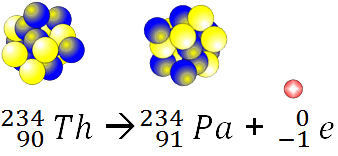
Which type of nuclear radiation is being emitted here?
a)
Alpha
b)
beta
c)
gamma 
d)
none
34.

24094Pu —› ____ + 42He

a)

23692U

b)

24796Cm

c)

24493Np

d)

24295Am

35.

This is an example of

a)

Nuclear Fission

b)

Nuclear Fusion

c)

No reaction

36.
What type of decay is shown here
a)
alpha decay
b)
beta decay
c)
gamma decay
37.

The three main types of nuclear radiation are alpha, beta, and gamma. Which of the following lists these types of radiation from highest ionization power to lowest ionization power?

a)

alpha, beta, gamma

b)

beta, alpha, gamma

c)

beta, gamma, alpha

d)

gamma, beta, alpha

38.

How many protons does this element have?

a)

20

b)

40

c)

8

d)

2

39.

How many electrons does this element have?

a)

11

b)

23

c)

12

d)

1

40.

How many neutrons does this element have?

a)

45

b)

80

c)

35

d)

7

41.

How many electrons on the 2nd energy level does this element have?

a)

20

b)

40

c)

8

d)

2

42.

What is the Atomic Mass of this element?

a)

45

b)

80

c)

35

d)

7

43.

How many protons does Chlroine Have?

a)

18

b)

17

c)

35

d)

34

44.

What element does this bohr model represent?

a)

Si

b)

S

c)

Ni

d)

H

45.

What element does this bohr model represent?

a)

Si

b)

S

c)

Ni

d)

H