
 Worksheets
Unit 7: Imperialism, WWI, & the Roaring 20s
Total questions: 70
Worksheet time: 50mins

A historian would most likely use this document to investigate events leading up to the
annexation of Alaska
Spanish American War
Open Door policy
Zimmerman Telegram

How did United States foreign policy change in the years immediately following this event?
The United States entered a period of overseas expansion (Imperialism).
The United States pursued a policy of containment.
The United States became more isolated.
The United States rejected the goal of Manifest Destiny.

What was a main reason for the movement of people as shown on this map?
Foreign food imports replaced domestic production of crops.
Northern states banned all forms of racial discrimination.
Abolitionists promised a means of escape from slavery.
Industrialization provided more employment opportunities.

What was one result of the migration shown on the map?
The South became the new destination for most European immigrants.
The Democratic Party declined in the northern half of the country
American culture was enriched by new forms of music and literature.
Segregated communities throughout the nation came to an end.

What does this map depict?
American Imperialism
The American System
Eisenhower Interstate System
The Great Migration
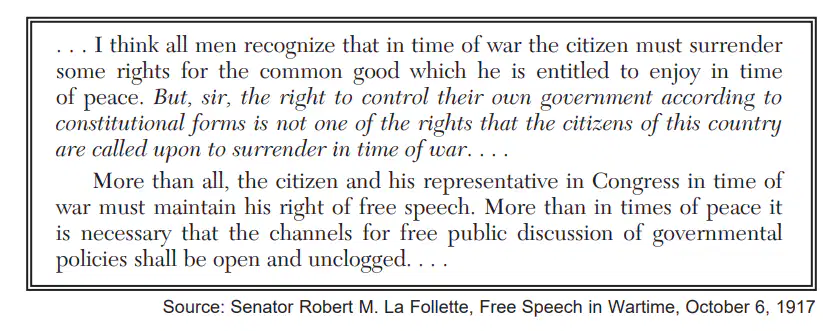
Which Supreme Court decision addresses the issue raised by Senator La Follette in this speech?
Wabash, St. Louis & Pacific R.R. v. Illinois
Plessy v. Ferguson
Northern Securities Co. v. United States
Schenck v. United States
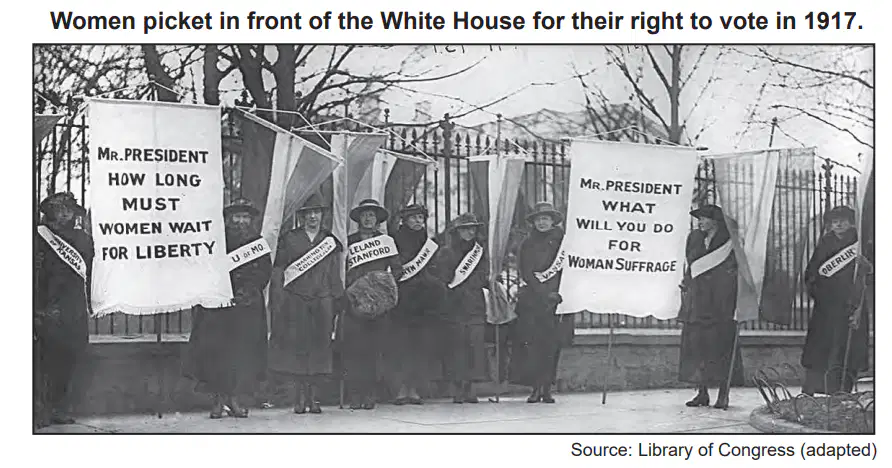
The main goal of the women’s rights movement in the early 20th century was to achieve
political equality
equal pay for equal work
improvements in living conditions
better job opportunities

What Amendment is this image connected to?
15th Amendment
17th Amendment
18th Amendment
19th Amendment

What concept is best illustrated in this 1924 poem written by Langston Hughes?
patriotism
racial pride
nationalism
passive resistance

This poem by Langston Hughes is an example of the cultural movement known as
The Great Awakening
Social Darwinism
The Lost Generation
the Harlem Renaissance
During World War I, what was President Woodrow Wilson’s purpose in outlining the Fourteen Points?
asking Congress for additional funding for the war effort
suggesting a peace plan to prevent future wars
proposing war crimes trials for leaders of enemy nations
calling for military alliances against aggressor nations
The Scopes trial and the Sacco and Vanzetti case both involved
disputes over the death penalty
clashes over cultural values in the 1920s
protests by temperance leaders
challenges to search and seizure protections
The prosperity of the United States in the mid1920s resulted in part from
increased demand for new consumer goods
high-wage contracts negotiated by labor unions
record-high farm prices
increased government regulation of the economy

These 1898 headlines are best understood as an example of
political advertising
public opinion polling
yellow journalism
isolationist policies
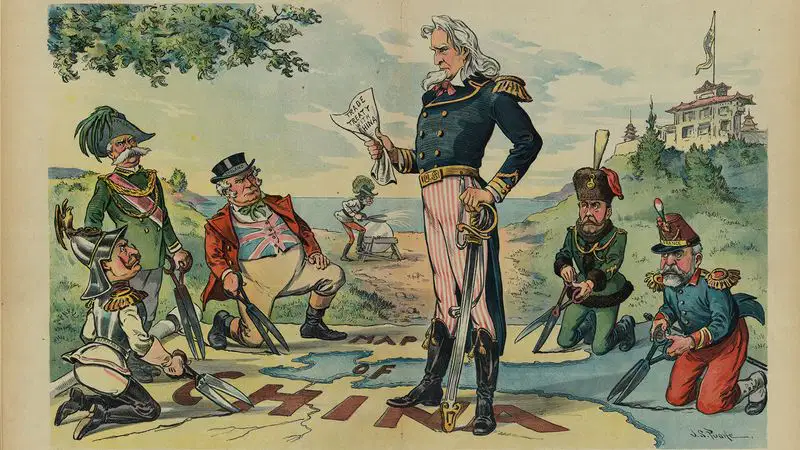
The establishment of the Open Door policy (1899–1900) and the response to the Boxer Rebellion (1900) showed that the United States wanted to
curb Russian expansion
gain access to Chinese markets
build factories in the Far East
limit Asian immigration to the United States
The Harlem Renaissance of the 1920s expanded the influence of African Americans by
financing the construction of apartments in New York City
gaining passage of civil rights legislation
helping elect African Americans to high political offices
promoting the artistic contributions of African Americans
Yellow journalism contributed to the start of the Spanish-American War (1898) by
portraying William McKinley as a pro-war president
inciting public outrage over conditions in Cuba
showing the need to acquire colonies in the Pacific
demanding the repeal of the Gentlemen’s Agreement
"I will build a motor car for the great multitude. It will be large enough for the family but small enough for the individual to run and care for. It will be constructed of the best materials, by the best men to be hired, after the simplest designs that modern engineering can devise. But it will be so low in price that no man making a good salary will be unable to own one— and enjoy with his family the blessing of hours of pleasure in God’s great open spaces." — Henry Ford, 1909
Which action is most closely associated with Henry Ford’s attempt to realize this vision?
providing cars in a variety of models
creating a business monopoly
downsizing the labor force
using the assembly line

The United States tried to avoid involvement in World War I by following a policy of
neutrality
collective security
economic boycotts
military preparedness
National attention was drawn to the Scopes trial of 1925 because the case
represented a conflict between science and religion
reversed a previous Supreme Court decision on free speech
upheld the right of veterans to protest in Washington, D. C.
revealed the extent of prejudice against immigrants
Henry Cabot Lodge and other senators opposed ratification of the Treaty of Versailles (1919) because they believed the treaty
failed to punish Germany for its involvement in World War I
excluded reparations for European allies
could draw the United States into future conflicts
placed blame for World War I on all the warring countries

Why did construction of the Panama Canal become more important to the United States after the Spanish-American War?
Congress realized that the key threat to national security came from South America.
Great Britain had plans to purchase the canal zone and colonize the territory.
Spain had regained control of its former colonies near the canal route.
The navy needed a faster way to move ships between the Atlantic and Pacific Oceans.
Which statement about the United States economy during the 1920s is true?
Federal regulation of business was strengthened.
The purchase of stocks steadily declined.
Mass production increased the supply of consumer goods.
Republican Party presidents supported unemployment insurance.
. . . It has been impossible in so short a space to review the entire menace of the internal revolution in this country as I know it, but this may serve to arouse the American citizen to its reality, its danger, and the great need of united effort to stamp it out, under our feet, if needs be. It is being done. The Department of Justice will pursue the attack of these “Reds” upon the Government of the United States with vigilance, and no alien, advocating the overthrow of existing law and order in this country, shall escape arrest and prompt deportation. . . ." — Attorney General A. Mitchell Palmer, “The Case Against the ‘Reds’,” 1920
Based on this passage, in 1920 the Attorney General of the United States advocated the deportation of
communist and anarchist immigrants
men who avoided the draft in World War I
citizens who criticized the government
wartime workers from Latin America
A major reason the United States entered World War I was to
maintain freedom of the seas
stop impressment of United States sailors
protect United States cities from foreign attacks
counter a German invasion of Latin America
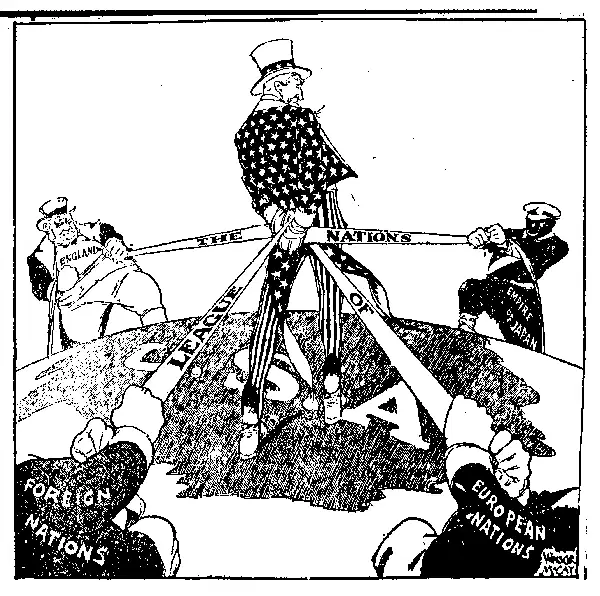
Isolationists in the Senate objected to the United States joining the League of Nations because they opposed
creation of the Security Council
colonialism in Africa and Asia
membership in the League by Germany
involvement in future foreign wars
At the end of the Spanish American War USA defeats the Spanish and expands their territory by gaining the
Philippines, Guam, and Puerto Rico
Philippines, Mexico, and Puerto Rico
Japan, Germany, and Puerto Rico
Texas, New Mexico and California
An economic and political domination of a strong nation over other weaker nations.
Colony
Imperialism
Annex
Empire
Which president said “speak softly and carry a big stick; you will go far.” The U.S. Navy is the “big stick” he is referring to.
Woodrow Wilson
William H. Taft
Teddy Roosevelt
William McKinley
All the following were reasons for US imperialism EXCEPT:
to develop closer relations with European nations
need for more natural resources
need for new markets to sell goods
fear of running out of land to settle
In 1919, Charles Schenck was charged with violating the Espionage Act. The Supreme Court ruled that Schenck's actions created a "clear and present danger." How did the decision in this case affect the rights of U.S. citizens?
by establishing restrictions on the right to vote
by protecting the freedoms of religious minorities
by placing limits on freedom of expression
by protecting the rights of accused person
The Fourteen Points reflected Woodrow Wilson's belief that -
intervention in the affairs of other nations was never justifiable
travel among nations should be regulated by an international organization
no country should be allowed to spend more on defense than any other country
cooperation among international leaders was essential to maintaining world peace

This poster could be used to support which assertion?
demand for labor in war industries helped increase employment
use of new war technologies required extensive training
conscription caused a shortage of laborers during wartime
standardization of parts helped streamline the production of munitions

This World War I-era poster was intended to persuade -
farmers to consume fewer scarce goods during the war
women to work producing war materials
people to save money during the war
people to help finance the war
Upon entering World War I, the U.S. enlarged its military by -
creating the Veterans' Administration
passing the Selective Service Act
enacting the GI Bill
establishing the Marine Corp
How did the Zimmerman telegram influence U.S. entry into World War I?
it announced the czar's overthrow in Russia
it revealed a proposed military alliance between Mexico and Germany & proposed Mexico to invade the U.S.
it contained orders for German u-boats to destroy British passenger ships
it described Romania's plan to abandon neutrality

Cartoons such as this one took the position that deportation was necessary because...
assimilation programs in the United States had been unsuccessful
economic decline had increased the competition for jobs
communists were infiltrating the United States
political machines had too much power in urban areas
The Roaring Twenties were characterized by...
internment camps, the rationing of goods, and the first use of an atomic bomb
bank failures, the New Deal, and breadlines
installment plans, Prohibition, and flappers
brinkmanship, McCarthyism, and a policy of containment
The establishment of speakeasies in the 1920s was an unintended consequence of which federal government action?
The taxation of imported luxury goods
The deportation of suspected communist sympathizers
The prohibition of the shale of alcoholic beverages
The implementation of immigration restrictions
Why did the "Return to Normalcy" agenda of US presidential candidate Warren G. Harding appeal to many voters in the 1920 election?
The public wanted to help rebuild war-torn countries
There were significant shortaes of military supplies.
There was a decrease in demand for consumer goods
The public wanted to concentrate on domestic economic issues

How does this excerpt reflect a significant turning point in American history?
It depicts the reaction to victory in the Spanish American War.
It portrays the changing social norms of the Jazz Age
It describes the experiences of immigrant workers during the Gilded Age
It details the industrial progress of the post-WWI era.
How might lower income tax rates for the middle class have contributed to the economic growth of the 1920s?
By allowing government to invest more money in infrastructure
By creating a real estate boom that grew housing prices
B allowing individuals to spend more money on consumer goods
By increasing the price of trade and luxury goods
Which of the following was a direct effect of the ratification of the 19th Amendment in the United States?
Slavery was abolished
Prohibition was repealed
Women gained the right to vote nationwide
Income tax was introduced
What was one reason the United States Senate refused to ratify the Treaty of Versailles after World War I?
It demanded reparations from the United States
It required the United States to join the League of Nations
It abolished tariffs on European goods
It expanded the power of the Supreme Court
Which development most contributed to the economic boom of the 1920s in the United States?
Widespread adoption of the assembly line in manufacturing
Increase in agricultural exports
Decline in consumer spending
Expansion of government regulation
What fear fueled the Red Scare?
Fundamentalism
Communism
Isolationism
Capitalism
What event attempted to protect Americans but failed to turn up evidence of any conspiracy and trampled civil rights?
Red Scare
Palmer Raids
Teapot Dome Scandal
Boston Police Strike

What does this 1921 political cartoon represent?
Immigration quotas
Nationalism
Gentleman's Agreement
The Dawes Plan

Which phrase best completes the diagram?
Prohibition
Isolationism
Red Scare
National Suffrage
What innovation, embraced by Henry Ford, made the production of automobiles more efficient (cheaper, faster, better)?
Bessemer Process
Just-In-Time Technology
Assembly Line
Time-Study Analysis
The division in public opinion over the Scopes trial and Prohibition demonstrates which characteristic of the 1920s?
clash of cultural values
discrimination against immigrants
fear of international communism
opposition to the Ku Klux Klan
Why did the economy experience a "boom" after WWI?
African Americans were moving back to the farms to grow cotton and soybeans
Consumers were preparing for a war and needed to bring extra supplies
New technologies and consumer goods were being developed and people wanted to buy them
Foreign trade grew after WWI
The economy grew in the 1920s in part due to consumers _________
Buying Goods on Credit
Investing Money in Government Bonds
Ignoring Advertisements
Conserving Electricity
What were some household products introduced during the 1920s?
Washing Machines
Refrigerators
Radios
All of the Above

This image shows that
Theodore Roosevelt was responsible for the construction of the Panama Canal
Theodore Roosevelt did not build the Panama Canal
Theodore Roosevelt built the Panama Canal all by himself.
The Panama Canal was built using American Military Force

Made it illegal to say anything disloyal about the government or war effort.
Sedition Act
Espionage Act
Disloyal Act
First Amendment Act
Made it illegal to spy, share information, or interfere with government foreign policy such as the military draft.
Espionage Act
Sedition Act
Selective Service Act
I Spy Act

What was the main focus of the War Industries Board (WIB)?
It determined who was qualified to work in important wartime factories
It coordinated the distribution of valuable resources and the production of weaponry
It wanted to increase the number of unionized workers in major US industries
It set the standards for which young men would be drafted into the military
It did all of the above
Please match the following WWI home front
This was a patriotic endeavor where Americans grew their own vegetables during the war.
Victory Gardens
These were loans to the US government to pay for the war, and the holder would be paid back later with interest.
Liberty (War) Bonds
Given a certain number of resources a home could use for a set period of time
Rationing
cars
telephones
radios
electrical appliances
airplanes
computers
telegraph
television
steam engines

How did the introduction of these new practices most benefit U.S. business?
By increasing production efficiency.
By preventing shortages of goods.
By increasing protective tariffs.
By decreasing exports.
American planters living in what area overthrew the local government and subsequently requested annexation to the United States?
Cuba
Nicaragua
Hawaii
Philippines
Which socialist activist was brought to justice under the laws preventing people from interfering with the WWI war effort?
Jane Addams
WEB DuBois
Eugene Debs
Woodrow Wilson
Match the following terms regarding American Imperialism to the correct definition
Roosevelt Corollary
Assertion that the U.S. would intervene in Latin America to maintain stability
Annexation of Hawaii
Process by which the U.S. took control of the Hawaiian Islands
Yellow Journalism
Exaggerated news reporting that stirred public opinion
USS Maine
U.S. naval ship that exploded in Havana Harbor
Open Door Policy
Policy aimed at ensuring equal trading rights in China

