
 Worksheets
Momentum and Collisions in Physics
Total questions: 8
Worksheet time: 20mins
A small research rocket is launched from a platform. To lift the rocket, the engine exerts a constant upward thrust (force) of 1,200 N. This thrust is applied for a "burn time" of 1.5 seconds before the first stage of the engine shuts off. What is the magnitude of the change in momentum of the rocket during this initial 1.5-second burn?
800 kgm/s
1,200 kgm/s
1,800 kgm/s
2,700 kgm/s
A 2.50 kg ball moving at 7.50 m/s is caught by a 70.0 kg man while the man is standing on ice.
What type of collision is this?
Elastic
Perfectly Inelastic
Explosion
A 2.50 kg ball moving at 7.50 m/s is caught by a 70.0 kg man while the man is standing on ice. How fast will the man / ball combination be moving after the ball is caught by the man?
0.26 m/s
3.87 m/s
0.27 m/s
3.73 m/s
During a 100-meter sprint, a 70 kg runner is already moving at a steady pace of 5 m/s. As they approach the finish line, they exert a powerful burst of force against the track, increasing their velocity to 9 m/s over a short interval. What is the magnitude of the impulse delivered to the runner to cause this increase in speed?
280 Kgm/s
350 kgm/s
630 kgm/s
980 kgm/s
A 0.15kg baseball moving at 26 m/s is slowed to a stop by a catcher who exerts a constant force of 390N. How long does it take for this force to stop the ball?
0.01s
1.5s
3.9s
0.67s
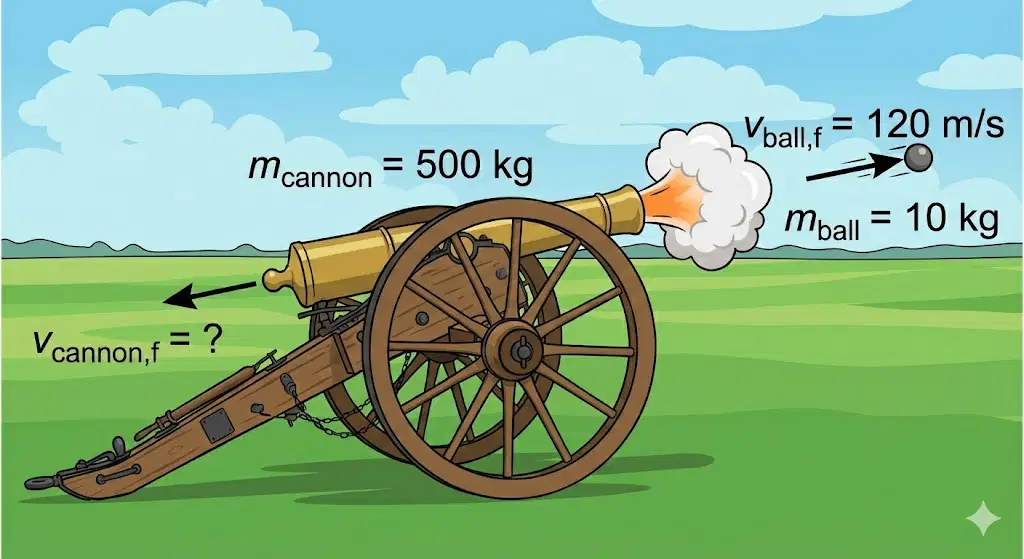
A 500 kg stationary cannon is loaded with a 10 kg cannonball. Both are initially at rest. When the cannon is fired, the cannonball is launched forward with a velocity of 120 m/s. What is the recoil velocity of the cannon immediately after it is fired?
A massive freight train with a total mass of 120,000 kg is traveling through a crossing at 30 m/s. The engineer applies the brakes, exerting a constant braking force of 90,000 N for a duration of 20 seconds. What is the final velocity of the freight train after the 20-second braking period?
12 m/s
25 m/s
15 m/s
45 m/s
According to the physics principles we've discussed regarding force and motion, which of the following statements is true regarding impulse?
Impulse is only present when an object is moving at a constant velocity
A small force applied over a long period of time can produce the same impulse as a large force applied over a short period of time
Impulse is a scalar quantity and does not depend on the direction of the applied force
If the time of contact during a collision increases, the impulse delivered to the object must always decrease

