
 Worksheets
Page 1
Total questions: 92
Worksheet time: 46mins

According to the diagram, every instruction of a program has to operate on what?
Data
An I/O port
A memory segment only
Processor flags

According to the diagram, what are addressing modes?
The different ways in which a source operand is denoted in an instruction
The set of hardware registers used by a program
The sequence of micro-operations executed by the control unit
The mapping between opcodes and machine cycles

In the diagram, Register Addressing belongs to which group? Choose from Group I (register and immediate), Group II (memory), Group III (I/O ports), Group IV (relative), Group V (implied).
Group I
Group II
Group III
Group IV
Group V

In the diagram, Immediate Addressing belongs to which group? Choose from Group I (register and immediate), Group II (memory), Group III (I/O ports), Group IV (relative), Group V (implied).
Group I
Group II
Group III
Group IV
Group V
In the diagram, Direct Addressing belongs to which group? Choose from Group I (register and immediate), Group II (memory), Group III (I/O ports), Group IV (relative), Group V (implied).
Group I
Group II
Group III
Group IV
Group V
In the diagram, Register Indirect Addressing belongs to which group? Choose from Group I (register and immediate), Group II (memory), Group III (I/O ports), Group IV (relative), Group V (implied).
Group I
Group II
Group III
Group IV
Group V
In the diagram, Based Addressing belongs to which group? Choose from Group I (register and immediate), Group II (memory), Group III (I/O ports), Group IV (relative), Group V (implied).
Group I
Group II
Group III
Group IV
Group V
In the diagram, Indexed Addressing belongs to which group? Choose from Group I (register and immediate), Group II (memory), Group III (I/O ports), Group IV (relative), Group V (implied).
Group I
Group II
Group III
Group IV
Group V
In the diagram, Based Index Addressing belongs to which group? Choose from Group I (register and immediate), Group II (memory), Group III (I/O ports), Group IV (relative), Group V (implied).
Group I
Group II
Group III
Group IV
Group V
In the diagram, String Addressing belongs to which group? Choose from Group I (register and immediate), Group II (memory), Group III (I/O ports), Group IV (relative), Group V (implied).
Group I
Group II
Group III
Group IV
Group V
In the diagram, Direct I/O port Addressing belongs to which group? Choose from Group I (register and immediate), Group II (memory), Group III (I/O ports), Group IV (relative), Group V (implied).
Group I
Group II
Group III
Group IV
Group V
In the diagram, Indirect I/O port Addressing belongs to which group? Choose from Group I (register and immediate), Group II (memory), Group III (I/O ports), Group IV (relative), Group V (implied).
Group I
Group II
Group III
Group IV
Group V
In the diagram, Relative Addressing belongs to which group? Choose from Group I (register and immediate), Group II (memory), Group III (I/O ports), Group IV (relative), Group V (implied).
Group I
Group II
Group III
Group IV
Group V
In the diagram, Implied Addressing belongs to which group? Choose from Group I (register and immediate), Group II (memory), Group III (I/O ports), Group IV (relative), Group V (implied).
Group I
Group II
Group III
Group IV
Group V
According to the statement "20 Address lines ⇒ 8086 can address up to memory", what total memory size is indicated by 220 ?
1M bytes
64K bytes
16M bytes
4G bytes
What is the size of the largest register in the 8086 as described?
8 bits
16 bits
20 bits
32 bits
How is a memory address represented in the 8086 according to the description?
Seg:Offset
Offset:Seg
Linear 32-bit address
Page:Frame
To form the 20-bit physical address, the processor shifts the segment register one hexadecimal place to the left (same as multiplying by 16 ). What is the next step stated to complete the address?
Add the required offset
Subtract the offset
XOR the segment with the offset
Ignore the offset
Using the example provided, what is the absolute physical address for the memory address 89AB:F012?
98AC2
89AC2
98AB2
97AC2
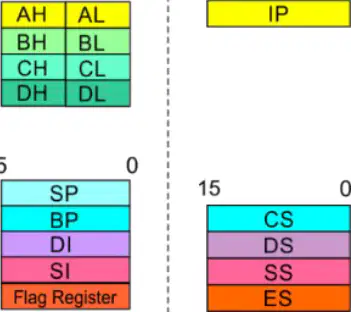
Which register shown belongs to the Bus Interface Unit (BIU)?
IP
AX
SP
SI
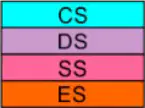
Which of the following is a segment register in the BIU as depicted?
CS
AX
BP
DI
In the example, shifting the segment value one hexadecimal place to the left changes 89AB to 89AB0. What multiplier corresponds to this shift?
2
10
16
256

According to the callout in the figure, what is the size of the contiguous memory block highlighted?
8 bytes
16 bytes
32 bytes
64 bytes
In 8086 direct addressing, the effective address of the memory location where the data operand is stored is described in the instruction. What is this effective address in this addressing mode?
A 16-bit number written directly in the instruction
An offset computed from base and index registers
An immediate constant used as the operand itself
An I/O port number mapped to memory

In the instruction MOV BX, [1354H] shown on the slide, what do the square brackets around 1354H indicate?
The contents of the memory location addressed
The physical address of the segment
A segment register designation
An immediate constant literal

When MOV BX, [1354H] is executed, what is copied into BX?
The contents of the memory location at address 1354H
The value 1354H itself
The current segment base
The instruction pointer value
This addressing mode is called direct because the displacement of the operand from the segment base is specified directly in the instruction. Which statement best explains why it is called direct?
The displacement (offset) is encoded explicitly in the instruction
It always uses both base and index registers
It treats immediate data as the operand without memory access
It selects an I/O port by number rather than a memory address

In the example MOV BL, [0400H] shown on the slide, which destination register receives the data read from memory?
BL
BX
IP
CS
In 8086 register indirect addressing, the instruction specifies the register that holds the effective address. According to the slide, which registers can be used to hold the effective address (EA)?
BX
BP
DI
SI
For register indirect addressing in 8086, the content of which segment register is used for base address calculation?
DS
CS
ES
SS

Consider the example instruction shown: MOV CX, [BX]. Based on the operations listed, what is the effective address?
EA=(BX)
EA=(CX)
EA=(DS)×1610
EA=(BP)
In the operations for register indirect addressing, how is the base address (BA) computed?
BA=(DS)×1610
BA=(ES)×1016
BA=(SS)+(BP)
BA=(CS)×1610
According to the operations listed, what is the formula for the physical memory address (MA)?
MA=BA+EA
MA=EA−BA
MA=DS+BX
MA=SS+BP

For the instruction MOV CX, [BX], how are the contents of CX loaded from memory according to the slide?
CL←(MA) and CH←(MA+1)
CX←(EA)
AX←(MA)
CH←(MA) and CL←(MA−1)

Which addressing mode described uses a register name in the instruction to specify the location that holds the effective address used to access memory data?
Register Indirect Addressing
Immediate Addressing
Direct Addressing
Implied Addressing
In Based Addressing, which registers can hold the base value for the effective address.
BX
BP
SI
DI
In Based Addressing with BX holding the base value of the effective address, which segment register is used to form the 20-bit physical address.
DS
SS
CS
ES
In Based Addressing with BP holding the base value of the effective address, which segment register is used to form the 20-bit physical address.
SS
DS
CS
ES
The displacement specified in Based Addressing can be which of the following sizes and types.
signed 8-bit
unsigned 16-bit
signed 16-bit
unsigned 8-bit
When an 8-bit displacement is used in Based Addressing, what is done to it before adding to the base value.
It is sign extended to 16-bit
It is zero extended to 32-bit
It is truncated to 4-bit
It is rotated right by 1

For the instruction MOV AX, [BX + 08H], which registers contribute to forming the 20-bit physical address.
BX and DS
BP and SS
SI and DS
BX and CS

In the operations for MOV AX, [BX + 08H], the displacement 08H is processed as which value before being added to BX.
0008H (sign extended)
0080H (shifted left)
0008H (zeroed by masking)
08H (unchanged)
When loading a 16-bit value into AX from memory address MA as shown, which memory locations are read.
MA and MA + 1
MA only
MA − 1 only
MA − 1 and MA
In 8086 indexed addressing, which register(s) hold the index value for memory data as described on the slide?
SI only
DI only
SI or DI
BX
According to the slide, how is the effective address (EA) obtained in indexed addressing?
Displacement is added to the base register value
Displacement is added to the index value in SI or DI
Displacement is subtracted from the index value
Index value is multiplied by the segment size
The slide states a rule for 8-bit displacement in indexed addressing. Which statement matches that rule?
It is zero-extended to 32-bit before use
It is sign extended to 16-bit before adding to the base value
It is truncated to 4-bit before addition
It is sign extended to 8-bit and then multiplied by 16

In the example "MOV CX, [SI + 0A2H]" shown on the slide, which register receives the data read from memory?
AX
BX
CX
DX
From the operation steps accompanying the example, which expression gives the base address (BA) derived from the data segment?
BA = (SS) × 16
BA = (ES) × 16
BA = (DS) × 16
BA = (CS) × 16
Based on the operation steps for the example, which description correctly reflects how bytes of CX may be loaded from memory?
(CL) ← (MA) and (CH) ← (MA + 1)
(CH) ← (MA) and (CL) ← (MA + 2)
(CL) ← (MA − 1) and (CH) ← (MA)
(CL) ← (MA + 1) and (CH) ← (MA)
In 8086 string addressing, the effective address of source data is stored in which register?
SI
DI
BX
AX
In 8086 string addressing, the segment register used to calculate the base address of destination data is which one?
ES
DS
CS
SS
For the source memory location in 8086 string addressing, which expression gives the base address?
BA=(DS)×1610
BA=(ES)×1610
BA=(CS)×16
BA=(SS)×8
In 8086 string addressing, which register holds the effective address of destination data?
DI
SI
BX
BP
In 8086 string addressing, the segment register used to calculate the base address of source data is which one?
DS
ES
CS
SS

Which statement reflects the operation of the MOVS BYTE instruction as shown?
MAE←MA
EA←EAE
MA←MAE
SI←DI
When the direction flag DF=1 in 8086 string addressing, how do SI and DI change after the operation?
Both decrement by 1
Both increment by 1
SI increments by 1 while DI decrements by 1
SI stays the same while DI decrements by 1
In direct port addressing mode for the 8086, what is specified within the instruction to access an I/O port?
An 8-bit port address
A 16-bit memory address
A register-indirect pointer
A segment base address
According to the example instruction IN AL, [09H], the content of the port at address 09H is moved to which destination?
AL register
AH register
IP register
SP register
Which instruction is shown as the example of direct port addressing mode for reading from an I/O port?
IN AL, [09H]
OUT [09H], AL
IN AX, [09H]
MOV AL, [PORT]
In the operation sequence for IN AL, [09H], what port address is assigned before the read takes place?
09H
0AH
90H
0FH
Which pair of addressing modes is highlighted as Group III for I/O ports on this page?
Direct I/O port addressing and Indirect I/O port addressing
Based addressing and Indexed addressing
Direct addressing and Immediate addressing
String addressing and Implied addressing

In the relative addressing mode of the 8086, the effective address of a program instruction is specified relative to the Instruction Pointer by an 8-bit signed displacement. Which phrase correctly completes this statement?
relative to the Instruction Pointer (IP)
relative to the Code Segment (CS)
relative to the Base Pointer (BP)
relative to an absolute 20-bit physical address
Which example instruction shown for the relative addressing mode uses an 8-bit signed displacement?
MOV AX, BX
JMP 1234H
JZ 0AH
CALL 0FFFH
According to the operations sequence, what is the first step performed on the displacement 0AH?
Add it to CS
Multiply CS by 1610
Sign extend 0AH to 000AH
Clear the Zero Flag
When ZF=1 , how is the effective address (EA) computed in this mode?
EA = (IP) − 000AH
EA = (IP) + 000AH
EA = (CS) × 1610
EA = (BA) + (MA)
In the operations shown, what does the base address (BA) equal?
BA = (IP) + 000AH
BA = (CS) × 1610
BA = (EA) − (CS)
BA = (MA) + (EA)
In the operations shown, how is the memory address (MA) obtained?
MA = BA − EA
MA = EA − BA
MA = BA + EA
MA = CS × 1610
What happens when ZF=1 during execution in this addressing mode?
The program control jumps to the new address calculated above
The program halts
The next instruction of the program is executed
The displacement is ignored
What happens when ZF=0 during execution in this addressing mode?
The program control jumps to the new address calculated above
The next instruction of the program is executed
The instruction is re-fetched
The processor clears the IP

In 8086, which addressing mode is described as having instructions with no operands, where the instruction itself specifies the data to be operated?
Register Addressing
Immediate Addressing
Implied Addressing
Indexed Addressing

According to the example provided for implied addressing, what operation does the instruction CLC perform?
Sets the carry flag to one
Clears the carry flag to zero
Complements all bits in the accumulator
Clears the zero flag

Which statement accurately characterizes the implied addressing mode in the 8086?
Operands are stored in registers explicitly named in the instruction
The instruction includes immediate data as an explicit operand
The instruction itself implies the operand and operates without explicit operands
Operands are accessed using an index register combined with a displacement
Refer to the slide titled Instruction Set. According to the slide, how many types of instructions does the 8086 support?
4
5
6
7
Refer to the slide titled Instruction Set. Which of the following appears in the list of 8086 instruction types?
Data Transfer Instructions
Floating-point Instructions
Graphical Instructions
Cache Control Instructions
Refer to the slide titled Instruction Set. Which instruction type name indicates operations such as addition or subtraction?
Arithmetic Instructions
Data Transfer Instructions
Control Transfer Instructions
String manipulation Instructions
Refer to the slide titled Instruction Set. Which instruction type name indicates Boolean operations such as AND or OR?
Logical Instructions
Process Control Instructions
Control Transfer Instructions
Data Transfer Instructions
Refer to the slide titled Instruction Set. Which of the following is not listed among the six 8086 instruction types on the slide?
Memory Management Instructions
String manipulation Instructions
Process Control Instructions
Control Transfer Instructions
Data Transfer Instructions are used to transfer data/address into registers, memory locations and I/O ports.
They transfer data/address into registers, memory locations and I/O ports.
They generate control signals for peripheral devices only.
They perform arithmetic operations on operands.
They control program flow through jumps and calls.
Data Transfer Instructions generally involve two operands: Source operand and Destination operand of the same size.
One operand with implicit destination
Two operands of the same size
Three operands: source, destination, and index
A variable number of operands depending on instruction
In Data Transfer Instructions, the Source can be a register or a memory location or an immediate data.
Register
Memory location
Immediate data
I/O port
In Data Transfer Instructions, the Destination is a register or a memory location.
Register
Memory location
Immediate data
I/O port
For Data Transfer Instructions, the size should be either a byte or a word.
A nibble or a byte
A byte or a word
A word or a doubleword
Any size is allowed
An 8-bit data can only be moved to 8-bit register/memory.
Only 8-bit register/memory
Only 16-bit register/memory
Either 8-bit or 16-bit register/memory
Only I/O ports
A 16-bit data can be moved to 16-bit register/memory.
Only 16-bit register/memory
Only 8-bit register/memory
Either 8-bit or 16-bit register/memory
It cannot be moved
According to the 8086 data transfer instructions chart, which mnemonics are explicitly listed under Data Transfer Instructions?
MOV
XCHG
PUSH
POP
IN
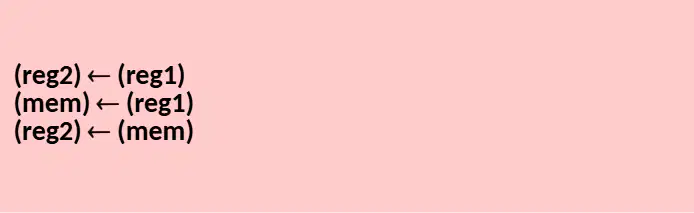
In the form MOV reg2, reg1, what is the effect on operands as shown in the chart?
(reg2) ← (reg1)
(reg1) ← (reg2)
(reg2) ↔ (reg1)
(mem) ← (reg1)
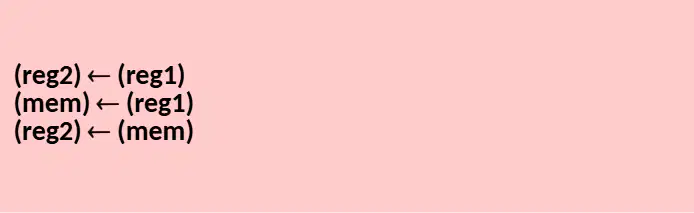
For the instruction form MOV mem, reg1, which operation is indicated?
(mem) ← (reg1)
(reg1) ← (mem)
(reg2) ← (reg1)
(reg2) ↔ (reg1)
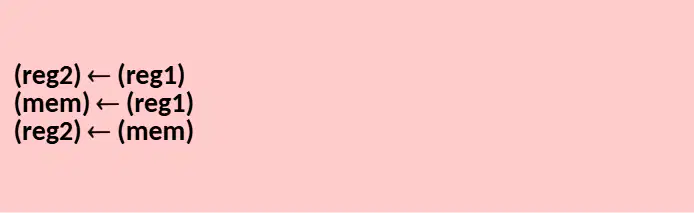
According to the chart, what does MOV reg2, mem accomplish?
(reg2) ← (mem)
(mem) ← (reg2)
(reg1) ← (mem)
(mem) ↔ (reg2)
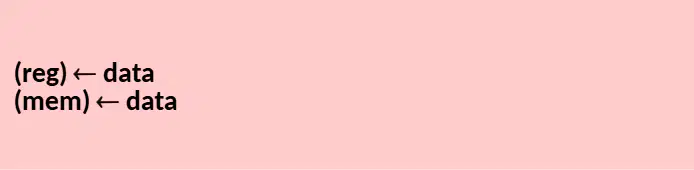
Which instruction form is used to load immediate data into a register, as shown?
MOV reg, data
MOV mem, data
XCHG reg2, reg1
PUSH reg
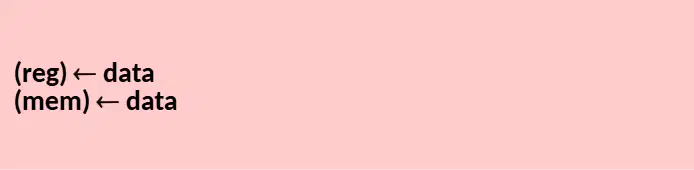
What is the effect of the form MOV mem, data in the chart?
(mem) ← data
data ← (mem)
(reg) ← data
(mem) ↔ data
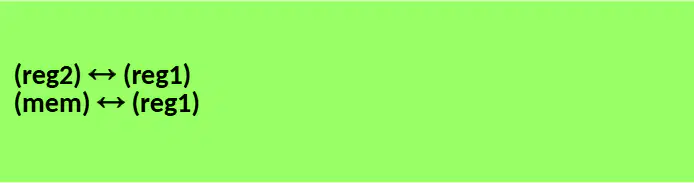
For XCHG reg2, reg1, what operation is depicted?
(reg2) ↔ (reg1)
(reg2) ← (reg1)
(reg1) ← (reg2)
(mem) ← (reg1)
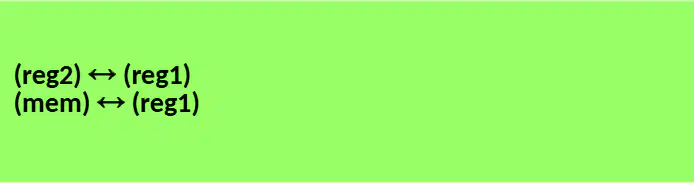
Which statement matches the form XCHG mem, reg1 shown in the chart?
(mem) ↔ (reg1)
(mem) ← (reg1)
(reg1) ← (mem)
(mem) ← data

