
 Worksheets
Argumentative Essay Quiz
Total questions: 25
Worksheet time: 50mins
What is the purpose of the "Hook" in the introduction of an argumentative essay?
To provide evidence supporting the claim
To grab the reader's attention
To summarize the strongest points
To present the opposing viewpoint
Which section of an argumentative essay includes evidence such as facts, data, or examples to support the claim?
Introduction
Body Paragraphs
Counterargument Section
Conclusion
What is the main goal of the counterargument section in an argumentative essay?
To restate the thesis in new words
To present and refute opposing viewpoints
To provide a hook to grab attention
To summarize the strongest points
What should the conclusion of an argumentative essay include?
A thesis statement with a clear position
A topic sentence stating the claim
A closing thought that leaves a lasting impression
Evidence supporting the opposing viewpoint
Which of the following is NOT part of the introduction in an argumentative essay?
Hook to grab attention
Background context to frame the issue
Evidence supporting the claim
Thesis statement with a clear position
What is the key to effective arguments and persuasion?
Knowing your audience
Using complex language
Ignoring the audience's preferences
Avoiding evidence
What should you choose to connect with your audience effectively?
Arguments and persuasion most likely to convince your audience
Arguments that are irrelevant to the audience
Persuasion techniques that are outdated
Random ideas without evidence
What is a counterclaim?
A supporting argument for a claim.
An opposing view to a claim.
A summary of the main idea.
A conclusion to an argument.
What does the author do when presenting a counterclaim?
Ignores the opposing view.
Considers the opposing view and provides reasons and evidence it is wrong.
Agrees with the opposing view without question.
Avoids discussing the opposing view entirely.
What does "Objective" mean in the context of argumentative writing?
Based on opinions, beliefs, feelings
Based on facts/data, able to prove
The main idea in one sentence
Convince using emotion
What is the definition of "Thesis" in argumentative writing?
Where information comes from
The main idea in one sentence
Convince using evidence
"Yeah, but..."
What does "Source" refer to in argumentative writing?
The main idea in one sentence
Where information comes from
Convince using emotion
Who you are trying to persuade
What is a "Counterclaim" in argumentative writing?
Convince using evidence
"Yeah, but..."
Based on facts/data, able to prove
The main idea in one sentence
Who is the "Audience" in argumentative writing?
The main idea in one sentence
Who you are trying to persuade
Where information comes from
Convince using evidence
What does "Persuade" mean in the context of argumentative writing?
Convince using emotion
Convince using evidence
Based on facts/data, able to prove
The main idea in one sentence
What does "Argue" mean in argumentative writing?
Convince using emotion
Convince using evidence
Based on opinions, beliefs, feelings
"Yeah, but..."
What does the "Research" step in the writing process involve?
Writing a one-sentence thesis
Outlining your notes
Taking notes on your topic
Writing the final draft
What is the basis of an objective statement?
Facts and data
Opinions and beliefs
Feelings and emotions
Personal preferences
What is the basis of a subjective statement?
Facts and data
Opinions, beliefs, and feelings
Scientific evidence
Logical reasoning
What does Mr. Stinson considered the most important thing in Reading and Writing?
Understanding
Connections
Creativity
Vocabulary
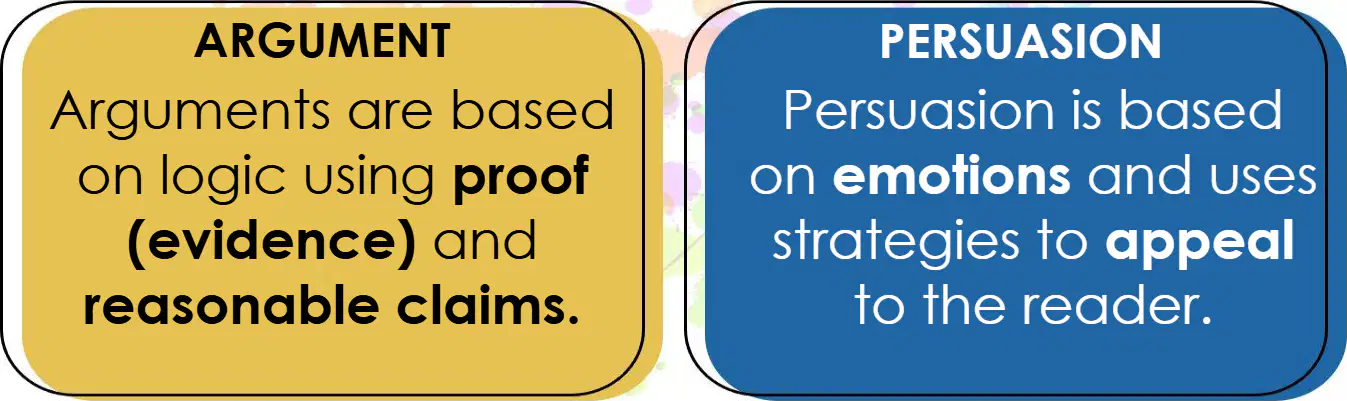
What is the primary difference between an argument and persuasion?
Arguments are based on emotions, while persuasion uses logic and evidence.
Arguments are based on logic and evidence, while persuasion uses emotions and appeals to the reader.
Arguments and persuasion are the same and have no differences.
Arguments use strategies to appeal to the reader, while persuasion relies on reasonable claims.
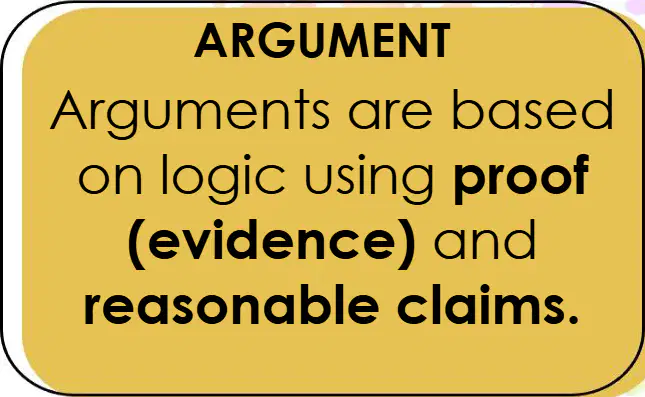
What is the basis of an argument?
Emotions and strategies to appeal to the reader.
Logic using proof (evidence) and reasonable claims.
Personal opinions and feelings.
Strategies to manipulate the audience.
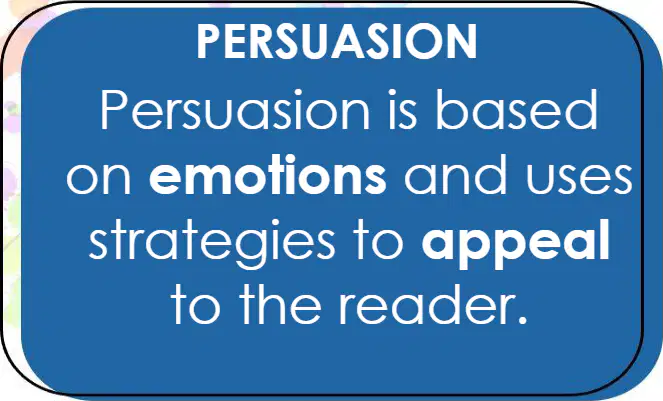
What does persuasion primarily rely on?
Logic and evidence.
Emotions and strategies to appeal to the reader.
Facts and reasonable claims.
Scientific proof and data.
What is the purpose of evidence in an argument?
To confuse the audience
To support an argument
To provide unrelated information
To create a story

What type of evidence is described as 'proven information'?
Statistics
Facts
Examples
Opinions

