
NEW
Font size
 Worksheets
Page 1
Total questions: 60
Worksheet time: 30mins
Which business function is primarily responsible for identifying potential suppliers and setting general evaluation criteria?
Finance department overseeing budgets and audits
Procurement department managing sourcing activities
Logistics unit planning transportation routes
Operations team scheduling production tasks
What is the main purpose of a supplier scoring model in procurement?
To forecast customer demand for new products
To negotiate exclusive distribution contracts
To calculate monthly inventory turnover ratios
To compare and choose among supplier alternatives
Which step comes first when applying a supplier scoring model?
Select evaluation criteria for assessment
Determine weights of all criteria
Invite suppliers to submit detailed bids
Compute the final total supplier score
In the supplier evaluation process, what do weights assigned to criteria represent?
Historical average delivery times
Fixed prices offered by each supplier
Relative importance of each criterion
Legal compliance thresholds for contracts
A company rates each supplier on a measurement scale for every criterion. What is the next typical step?
Eliminate the lowest-priced supplier immediately
Switch from electronic to paper-based bidding
Renegotiate the weights with stakeholders
Calculate the score per criterion for each supplier
Which activity completes the supplier evaluation cycle before awarding the order?
Year-end financial statement preparation
Market research on consumer preferences
Training staff on warehouse safety
Final selection based on computed scores
Electronic procurement mainly implements the procurement process using what?
Manual forms and in-person meetings
Unstructured emails and phone calls
Outsourced agents and third-party brokers
Practical methods and digital technologies
What realistic misconception might lead a team to skip defining criteria weights?
Weights are unnecessary because all criteria are equal
Weights reduce transparency in supplier selection
Weights conflict with logistics scheduling rules
Weights make suppliers increase their quoted prices
Which example best illustrates a criterion used in supplier evaluation?
Color of supplier’s company logo
On-time delivery performance rate
Number of employees in marketing
Location of consumer retail outlets
A procurement team finishes scoring each supplier across criteria and computes total scores. How should they use these results strategically?
Award the order to the highest total score
Discard results and negotiate only on price
Average scores without using weights
Delay decisions until consumer surveys finish
Which supplier criterion is classified with high significance in Dickson’s list?
Price competitiveness
Quality performance
Employee relations
Training provision
In supplier evaluation, which criterion typically holds medium significance rather than high?
Delivery reliability
Technical capability
Service support
Communication systems
Which factor is listed with low significance among supplier selection criteria?
Special agreements
Historical performance
Market reputation
Political assurances
A buyer demands strict adherence to their procedures. Which criterion best captures this requirement?
Compliance with customer processes
Installation capacities offered
Image and branding quality
Organizational management strength
Which criterion focuses on how a supplier treats the customer during interactions?
Behavior and attitude toward customer
Economic condition of supplier
Location of installations
Functional quality control systems
If a product is complex and demanding, what happens to the number of criteria needed for evaluation?
They usually increase
They become irrelevant
They remain unchanged
They usually decrease
Which criterion relates to the supplier’s capacity to meet packaging specifications?
Technical capability of teams
Satisfaction of packaging specifications
Political guarantees provided
Place of installation chosen
Which item deals primarily with the supplier’s presence and standing in the industry?
Experience over many years
Customer communication system
Organizational and management
Reputation and market position
A company prioritizes training its client’s staff. Which criterion covers this offering?
Economic condition stability
Services offered to customers
Provision of education and training
Experience in past projects
When choosing criteria for different products, what is the key implication?
Criteria depend only on price level
All products share the same criteria
Different products need different criteria
Criteria are fixed since 1966
Which criterion is assigned the highest weight when selecting suppliers in the table shown?
Historical performance record
Compliance with client processes
Quality-to-price ratio of product
Market reputation of supplier

What is the weight percentage for supplier reliability in delivery and distribution?
10 percent weight
15 percent weight
25 percent weight
20 percent weight
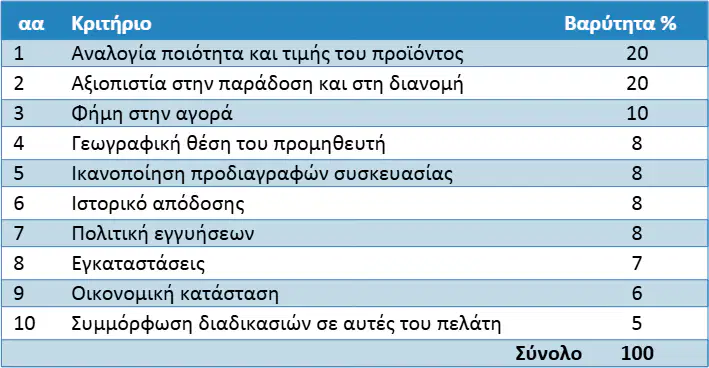
Which criterion is weighted at 10 percent according to the table?
Facilities and installations
Economic condition of supplier
Market reputation of supplier
Geographic location of supplier
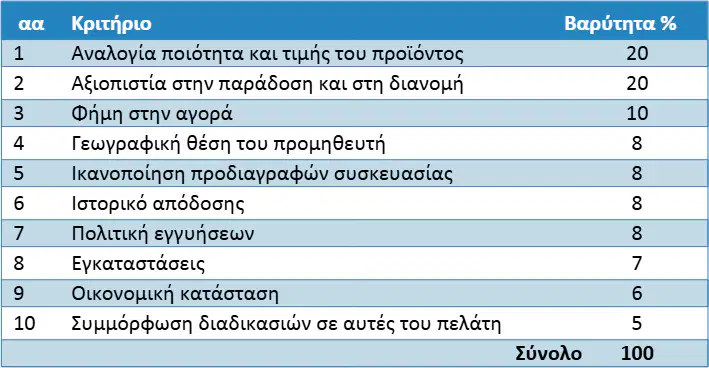
What is the combined weight of packaging specification compliance and geographic location of supplier?
16 percent total
18 percent total
14 percent total
12 percent total

Which of the following criteria has the lowest weight in the supplier selection table?
Compliance with client processes
Historical performance record
Economic condition of supplier
Facilities and installations
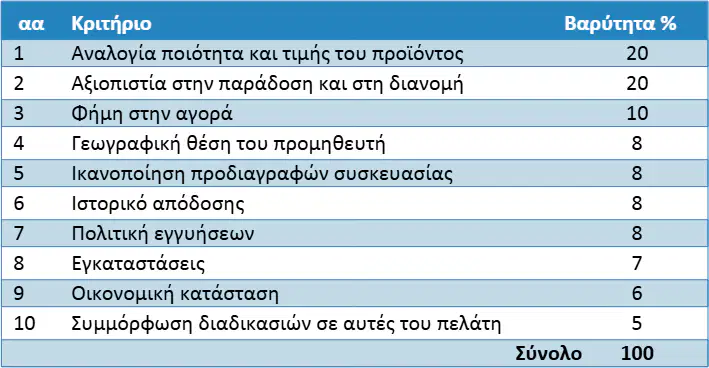
If a company prioritizes low price and high quality, which criteria most directly reflect this priority?
Historical performance record
Facilities and installations
Political guarantees and assurances
Quality-to-price ratio of product
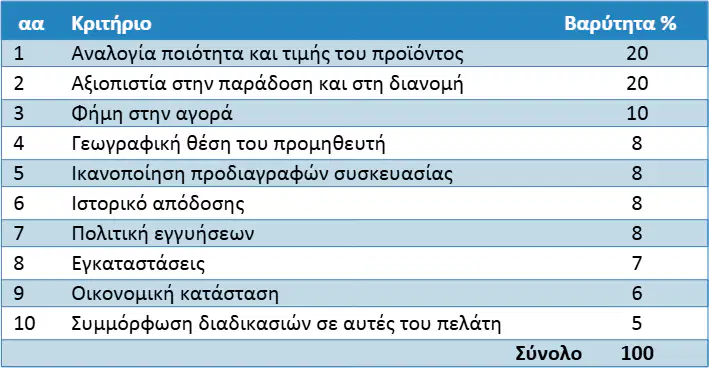
What is the total weight assigned to criteria marked at 8 percent each if there are four such criteria?
28 percent total
36 percent total
24 percent total
32 percent total
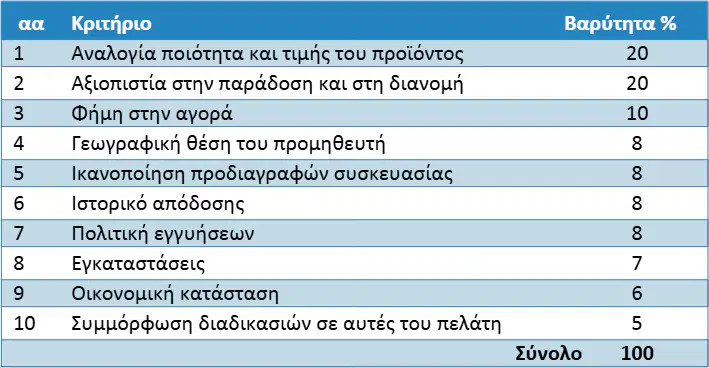
Which pair of criteria both carry a 20 percent weight?
Facilities and compliance processes
Delivery reliability and price-quality ratio
Market reputation and economic condition
Geographic location and packaging specs
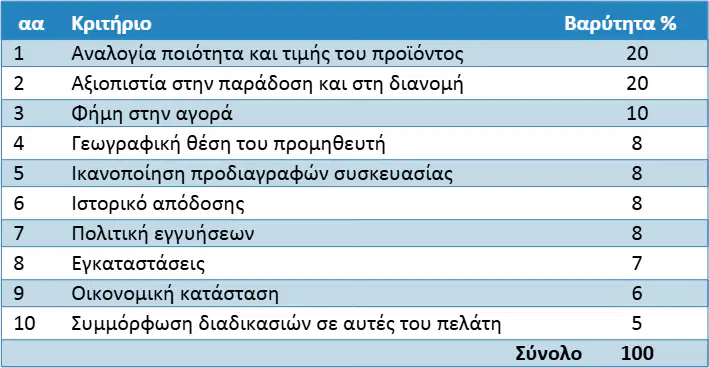
According to the table, which criterion assesses the supplier’s financial health?
Political guarantees and assurances
Economic condition of supplier
Historical performance record
Market reputation of supplier
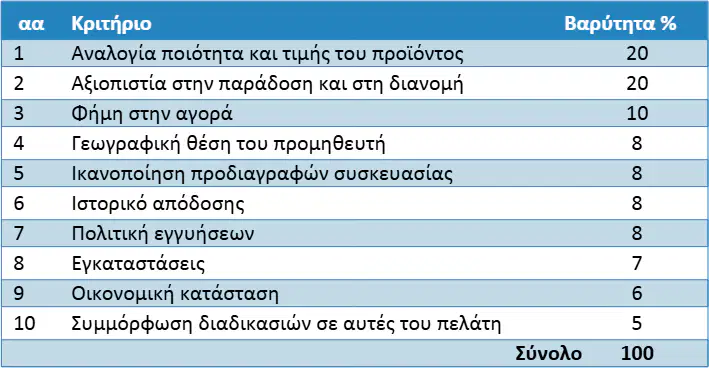
A supplier has strong market reputation (10%), good facilities (7%), and full client process compliance (5%). What is the combined weight of these strengths?
20 percent total
22 percent total
21 percent total
23 percent total
Which criterion carries the highest weight in the supplier evaluation table?
Geographical location of supplier, weight 8
Reputation in the market, weight 10
Packaging specification compliance, weight 8
Quality-to-price ratio, weight 20
What rating scale is used to assess each supplier on each criterion?
From 0 to 10, poor to excellent
From 1 to 5, low to high
From A to E, worst to best
From 1 to 3, low to high
If criterion weights must sum to 100, what is the combined weight of the top three criteria in the table?
40 out of 100 total
55 out of 100 total
45 out of 100 total
50 out of 100 total
On the most important criteria, which supplier scores higher overall according to the note under the table?
Supplier A on higher weights
Supplier B on top three
Both A and B tie overall
Supplier B on all criteria
Which criterion is associated with customer procedures compliance?
Political guarantees, code 7
Compliance with customer procedures, code 10
Historical performance, code 6
Economic condition, code 9
What is the weight assigned to ‘Reputation in the market’?
Weight equals 8
Weight equals 10
Weight equals 7
Weight equals 6
Supplier A scores 5 on ‘Historical performance’ while Supplier B scores 5. With weight 8, what is the weighted score difference between A and B for this criterion?
Difference equals ten points
Difference equals eight points
Difference equals five points
Difference equals zero points
Which pair of criteria both have a weight of 8 in the table?
Political guarantees and installations
Geographical location and political guarantees
Reputation and installations
Geographical location and specifications
If a company prioritizes ‘Quality-to-price ratio’ and ‘On-time delivery’, which combined weight will those two criteria contribute?
Total equals 35 weight
Total equals 38 weight
Total equals 40 weight
Total equals 45 weight
Which criterion has the lowest weight among those listed?
Compliance with procedures, weight five
Economic condition, weight six
Installations quality, weight seven
Reputation in market, weight ten
In a weighted scoring model for supplier evaluation, what is the correct procedure to compute a supplier’s score for a single criterion?
Divide rating by the weight then add
Average the weight and the rating
Multiply criterion weight by supplier rating
Add all ratings then subtract the weight
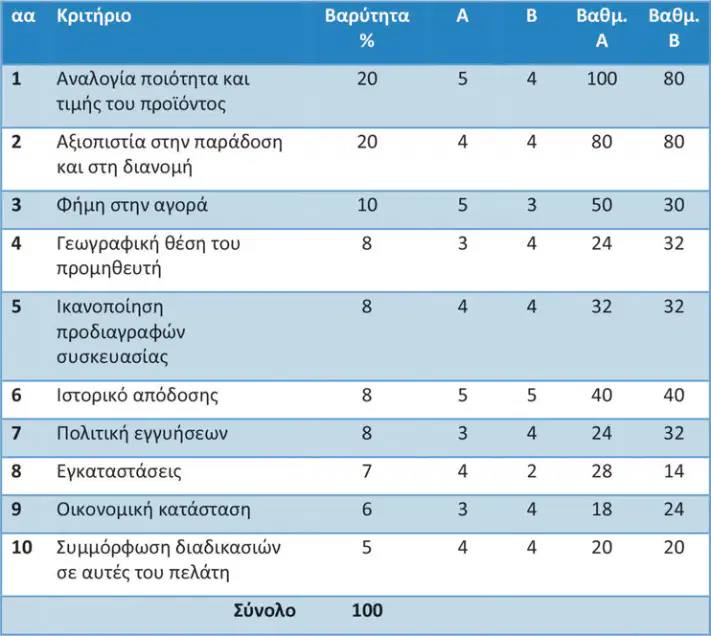
Which criterion has the highest weight in the supplier assessment shown?
Packaging specification satisfaction
Supplier’s geographic location
Reliability in delivery and distribution
Quality-to-price ratio of the product
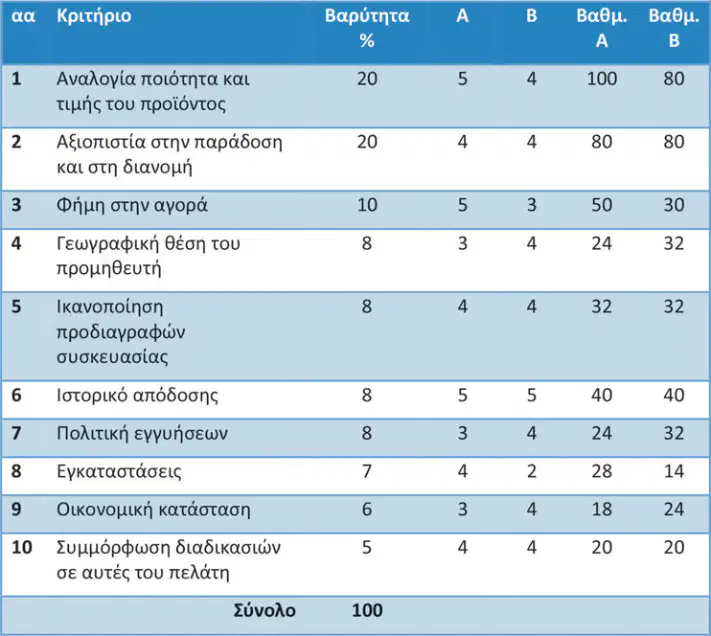
If a criterion has weight 8 and Supplier A’s rating is 4, what is the weighted score for that criterion?
24
32
12
8

For the criterion ‘Reputation in the market’ with weight 8, Supplier B’s rating is 4. What is Supplier B’s weighted score?
24
32
16
28
Which pair correctly matches criterion and typical business concern it represents?
Economic condition—supplier’s cash flow health
Historical performance—marketing campaign reach
Installations—customer’s warehouse layout
Policy guarantees—employee attendance rate
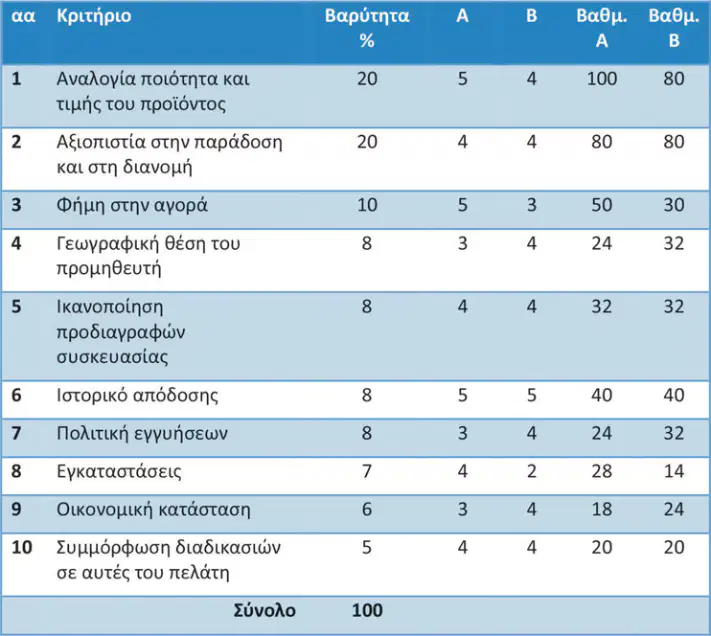
A criterion shows weight 7 and Supplier A rating 4. What total does the table report for that row?
14
21
28
24
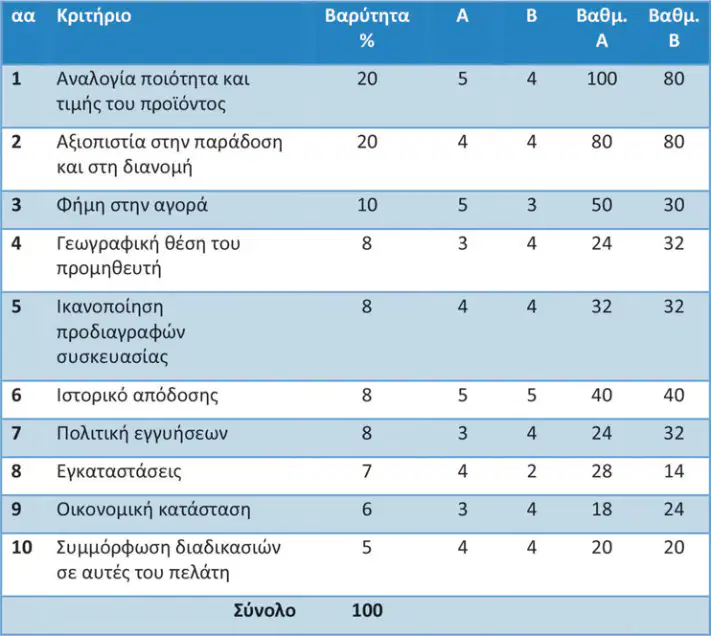
If Supplier B’s rating is 3 on a weight-6 criterion, which outcome aligns with the model?
Score equals 18
Score equals 9
Score equals 24
Score equals 27
Why include ‘Compliance with customer procedures’ as a criterion in supplier selection?
It measures employee benefits of supplier
It reduces product unit cost only
It ensures alignment with process requirements
It guarantees faster geographic delivery
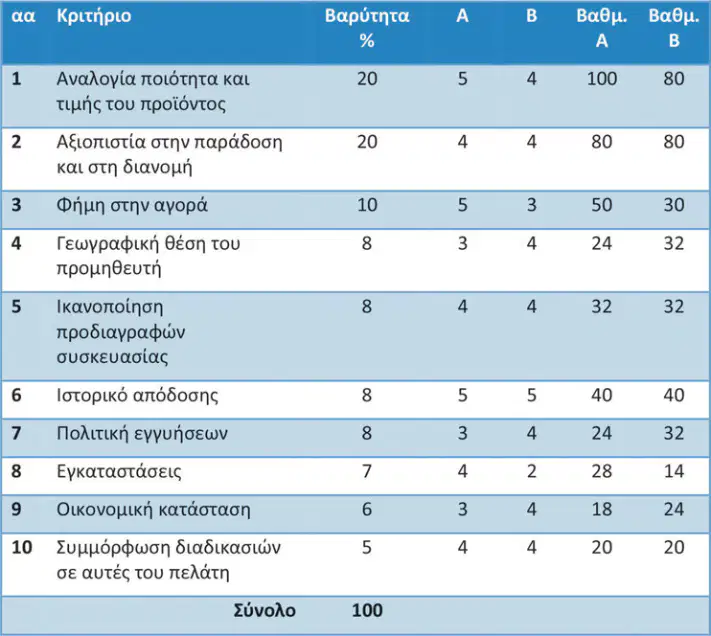
The table totals all criterion weights to what value?
100
90
120
80
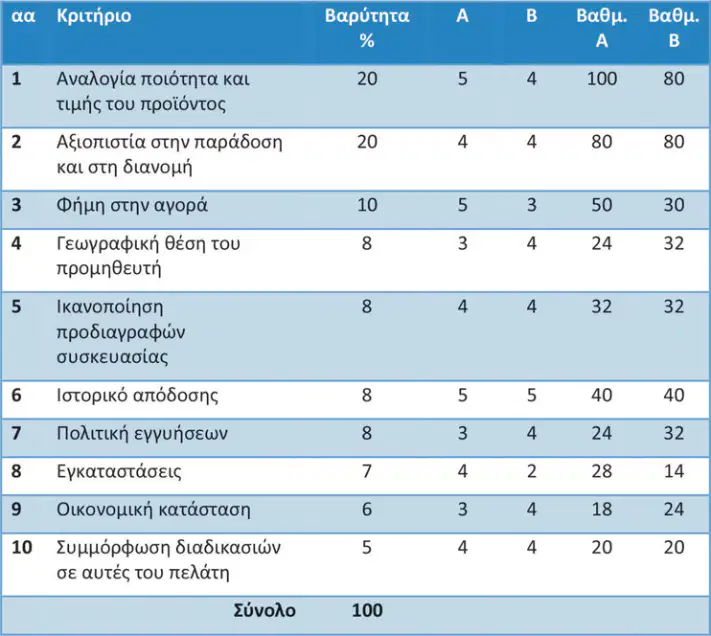
After computing weighted scores per criterion, how is a supplier’s final score determined?
Multiply total weight by average rating
Average ratings only
Sum all weighted criterion scores
Take the maximum row score
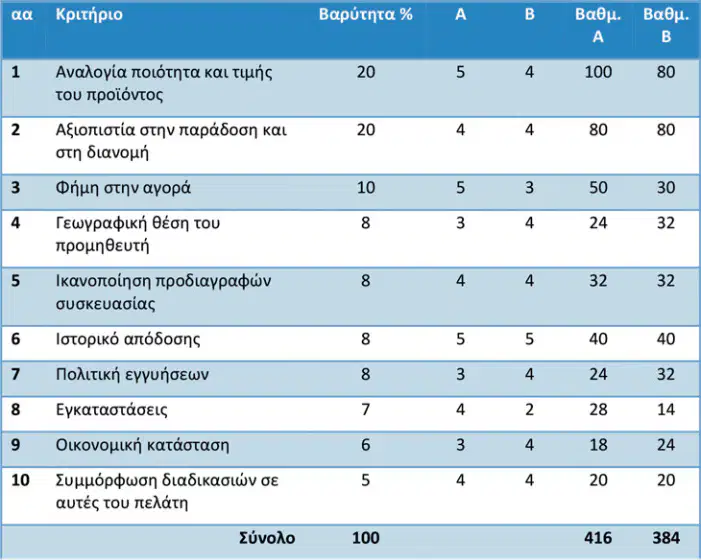
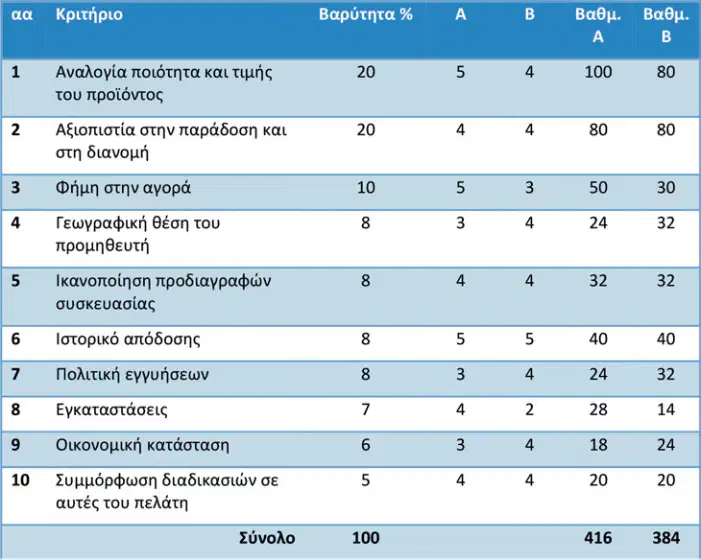
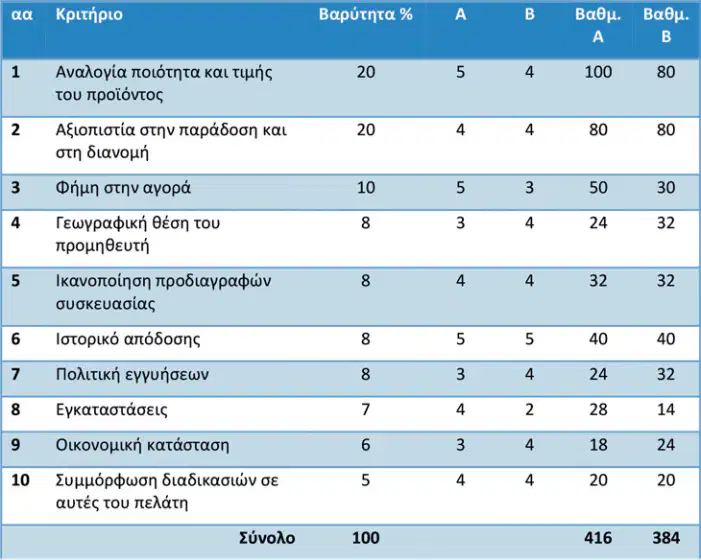
Which supplier achieves the higher total weighted score across all criteria in the table?
Supplier A with total 416 points
Supplier B with total 416 points
Supplier B with total 384 points
Supplier A with total 384 points
What is the weight percentage assigned to the criterion ‘Quality-to-price ratio of product’?
15 percent weight
20 percent weight
10 percent weight
25 percent weight
For the criterion ‘Market reputation’, what is the weighted score for Supplier A?
24 points total
30 points total
40 points total
50 points total
Which criterion carries the lowest weight in the table?
Installations
Process conformity to customer procedures
Geographical location of supplier
Economic condition
If Supplier B has a raw score of 4 in ‘Assurance in delivery and distribution’ with a weight of 20%, what weighted score is shown?
40 points calculated
60 points calculated
80 points calculated
20 points calculated
Which criterion lists a weight of 10% with Supplier A’s raw score equal to 3?
Installations
Geographical location of supplier
Economic condition
Process conformity to customer procedures
What is the weighted score for Supplier B in ‘Geographical location of supplier’ given weight 10% and raw score 2?
24 points total
20 points total
12 points total
30 points total
Which statement best describes a noted advantage of the method mentioned under the table?
Simple to use and yields quick results
Eliminates all subjectivity in scoring
Requires complex quantitative models
Focuses only on qualitative features
According to the notes, what factor often influences the final scoring results in practice?
Vendor self-assessment surveys
Collaboration among company staff
External audit certification
Exclusive use of objective scales
What ongoing use of the method is highlighted in the notes?
Tracking supplier performance over time
Selecting marketing channels annually
Setting product prices by quarter
Forecasting customer demand monthly

