
 Worksheets
Unit 7 Review
Total questions: 35
Worksheet time: 19mins
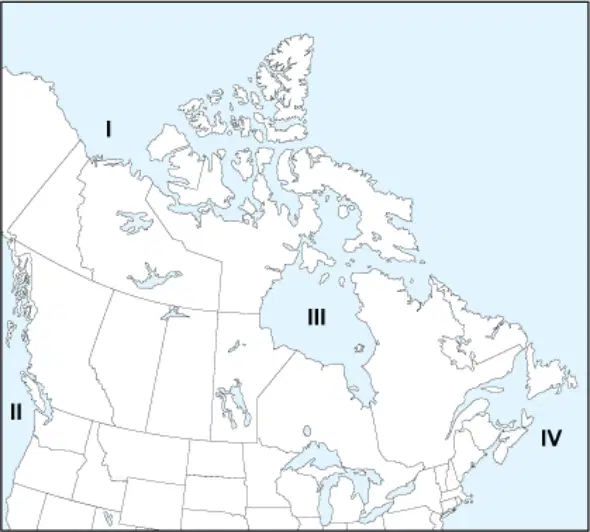
Which numeral on this map represents the location of Hudson Bay?
I
II
III
IV
A Canadian farmer who lives near Lake Ontario wants to use a new pesticide to protect his crops. The pesticide is absorbed by fish and causes sickness in people who eat contaminated fish. The farmer plans to be very careful and avoid spraying the pesticide near any rivers that feed into Lake Ontario. Should the farmer be allowed to use the pesticide?
Yes, because insects are damaging his crops.
Yes, because he will not use the pesticide near water.
No, because runoff water and soil will carry the pesticide into Lake Ontario.
No, because food grown without the use of pesticides is healthier for humans.
Why would the Canadian government resist imposing harsh environmental regulations on mining and timber businesses that operate in the Canadian Shield?
because these industries have little impact on the environment of Canada
because the government wants to encourage people to move to the region
because of the large number of jobs provided by these businesses for residents of the region
because the pollution created by these industries affects the United States more than Canada
Which environmental concern is MOST associated with Canada's timber industry?
the creation of acid rain
the reduction of air quality
the pollution of freshwater
the destruction of habitats
Why did the Canadian government enter into the North American Free Trade Agreement?
to improve trade between North America and Europe
to protect Canada's domestic industries from competition
to reduce barriers to trade with Canada's closest neighbors
to create a common currency to be used in North America
Why would Canada MOST LIKELY embargo trade with another country?
to increase the volume of exports to the country
to punish the country for breaking international law
to encourage domestic businesses to invest in the country
to convince the country to lower the prices of goods it exports
How are quotas different from embargoes?
Quotas limit the volume of a good that can be imported, while embargoes prohibit the import of any amount of a good.
Embargoes limit the volume of a good that can be imported, while quotas prohibit the import of any amount of a good.
Embargoes are taxes on imported and exported goods, while quotas are limits on the number of goods that can be imported.
Quotas are taxes on imported and exported goods, while embargoes are limits on the number of goods that can be imported.
What makes it easier for people and businesses from different countries to trade with each other?
high tariff rates
the use of embargoes
investment in capital goods
a currency exchange system
Ava lives in New York state. She and her mother are planning to visit her grandmother, who lives in Montreal, Canada. They are going to drive across the border and meet Ava's grandmother for lunch. As they prepared for the trip, Ava's mother visited a bank in New York. She wanted to be ready to pay for lunch in Canada. What was she MOST LIKELY doing at the bank?
requesting a Canadian passport
withdrawing a large amount of US dollars
applying for Canadian citizenship
exchanging US dollars for Canadian dollars
Alexander lives in Calgary, Canada. He has just returned home from a trip to Mexico. Alexander still has 20 Mexican pesos in his wallet. He tries to buy a sandwich with the pesos at a restaurant in Calgary. What will MOST LIKELY happen and why?
The restaurant will accept that form of payment as both Canada and Mexico use a common currency.
The restaurant will accept that form of payment as both Canada and Mexico are members of NAFTA.
The restaurant will not accept that form of payment as the Mexican peso cannot be converted to Canadian dollars.
The restaurant will not accept that form of payment as the Mexican peso is not accepted as legal tender in Canada.
What helps the members of the North American Free Trade Agreement to trade with one another?
a system of tariffs and quotas
the use of a common currency
a system of currency exchange
the use of boycotts and embargoes
The Canadian Shield encircles a large portion of which body of water?
the Baffin Bay
the Hudson Bay
the Amundsen Gulf
the Gulf of Saint Lawrence
What is the role of Canada's mineral resources in its economy?
The country's economy benefits from the export of the minerals.
The country's economy relies on the continuous import of minerals.
The country can produce what it needs from its mineral resources and does not trade.
The country does not benefit from its minerals because mining them harms the environment.
Why is it difficult for Canada to effectively address the problem of acid rain?
Canada's cities are surrounded by mountains that trap polluted air.
Canada uses hydropower to produce most of the country's electricity.
Commercial farming makes up the largest portion of Canada's economy.
Pollution from the United States often flows across its border with Canada.
Which industries reduce air quality, contaminate groundwater, and create other significant environmental issues in the Canadian Shield region?
the textile and carpet industries
the oil and natural gas industries
the mining and logging industries
the farming and fishing industries
Match each type of barrier to trade to its effect. Which barrier to trade blocks all trade with another country?
tariff
quota
embargo
Match each type of barrier to trade to its effect. Which barrier to trade taxes certain classes of imported or exported goods?
tariff
quota
embargo
Match each type of barrier to trade to its effect. Which barrier to trade limits the volume of goods imported from a foreign country?
tariff
quota
embargo
Which body of water serves as part of the international boundary between Ontario, Canada, and New York State?
the Hudson River
the Mississippi River
the Rio Grande
the St. Lawrence River

The Rocky Mountains begin in the United States and run up into Canada.
Which letter is the Rocky Mountains?
D
C
B
J

The Canadian Shield is a worn-down range of mountains that surround the Hudson Bay.
Which letter points toward the Canadian Shield?
B
H
C
D

This province noted by number 3, has the most citizens speaking French.
Quebec
Alberta
British Columbia
Nova Scotia

SS6G5 Timber, minerals, fresh water, wheat, and fish are all examples of Canada's
provinces
population distribution
natural resources
trade barriers
Why would the Canadian government resist imposing harsh environmental regulations on mining and timber businesses located in the Canadian Shield?
because these industries have little impact on the environment of Canada
because not many live in the region so not many people are affected by the businesses
because of the large number of jobs provided by these businesses for residents of the region
because the pollution created by these industries affects the United States more than Canada
Which industries reduce air quality, contaminate groundwater, and create other significant environmental issues in the Canadian Shield region?
the textile and carpet industries
the oil and natural gas industries
the mining and logging industries
the farming and fishing industries

Based on the map, most cities in Canada are located near the ________________
Arctic Circle
United States
Atlantic Ocean
St. Lawrence Seaway

Canada is located _______ of the United States.
South
North
East
West
Which of the following is a major natural resource found in the Canadian Shield?
Coal
Gold
Rubber
Tea
What is the main purpose of a tariff in international trade?
To block all trade with another country
To increase the price of imported goods
To limit the amount of goods imported
To encourage free trade between countries
Which environmental issue is most likely caused by mining activities in Canada?
Acid rain
Urban sprawl
Deforestation
Overfishing
Which of the following is a direct effect of acid rain on Canada's forests?
Increased tree growth
Damage to leaves and soil nutrients
Improved air quality
Expansion of wildlife habitats
What is one reason why most Canadians live close to the United States border?
Higher elevation in the south
Warmer climate and better access to trade
Closer proximity to the Arctic Ocean
More mountains in the north
Which of the following is a major environmental concern related to mining in the Canadian Shield?
Overfishing in nearby lakes
Deforestation and water pollution
Increased rainfall
Urban sprawl

