
 Worksheets
Chapter 6: Fibers Review
Total questions: 220
Worksheet time: 2hrs 22mins
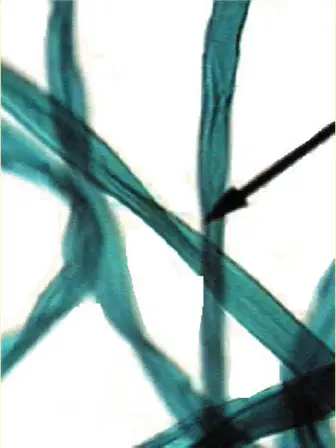
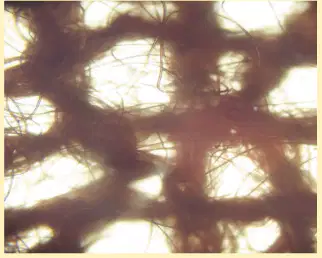
Using the provided micrographs, identify the differences between the cotton on the left image and the rayon on the right image.
Cotton fibers appear twisted and irregular, while rayon fibers appear straight and uniform.
Cotton shows parallel, smooth filaments, while rayon shows ribbon-like twists.
Cotton displays varying thickness with frayed edges, while rayon shows consistent thickness with smooth edges.
Cotton strands run mostly parallel in the field, while rayon strands are tangled and crossing.
Cotton shows more crossings and entanglement, while rayon shows mostly parallel alignment.
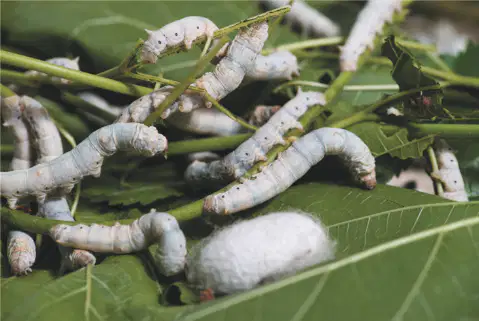
Protein fibers: An insect fiber is spun by a silkworm to make its cocoon; the fiber reflects light and has insulating properties. Which fiber fits this description?
Silk
Wool
Mohair
Angora
Protein fibers: Wool is an animal fiber coming most often from which source?
Sheep
Silkworm
Cotton plant
Petroleum derivatives
Mineral fibers: Which is identified as a natural fiber that has been used in fire‑resistant substances?
Asbestos
Rock wool
Fiberglass
Nylon
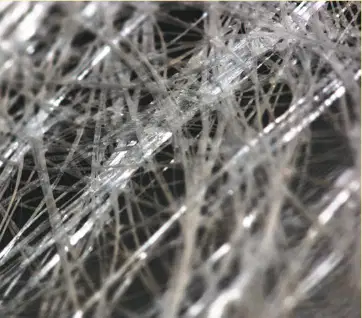
Mineral fibers: The close‑up image shows fiberglass strands. According to the text, fiberglass is classified as which type of fiber?
Manufactured inorganic fiber
Natural mineral fiber
Plant‑based organic fiber
Animal protein fiber
Synthetic fibers (made from derivatives of petroleum, coal, and natural gas): Which synthetic fiber is described as the most durable of man‑made fibers and extremely lightweight?
Nylon
Polyester
Acrylic
Spandex
Synthetic fibers: Which is identified as the most widely used man‑made fiber?
Polyester
Nylon
Acrylic
Spandex
Synthetic fibers: Which fiber is noted for extreme elastic properties?
Spandex
Acrylic
Nylon
Polyester
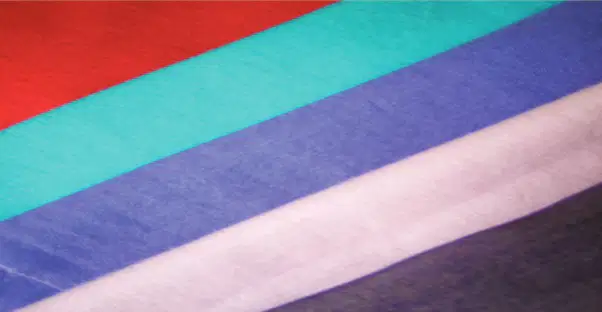
Fabric production: Most fabrics are composed of individual threads or yarns made of fibers and are constructed by many methods. According to the text, most fabrics are either which of the following?
Woven or knitted
Felted or laminated
Bonded or crocheted
Knotted or laminated
Fabric production: Which qualities are listed as individual qualities of different fabrics? Select all that apply.
Stretch
Absorbency
Water repellence
Softness
Durability
Weave terminology: Match each term to its description.
Yarn
A continuous strand of fibers or filaments that may be twisted together
Warp
Lengthwise yarn
Weft
Crosswise yarn
Blend
A fabric made up of two or more different types of fibers
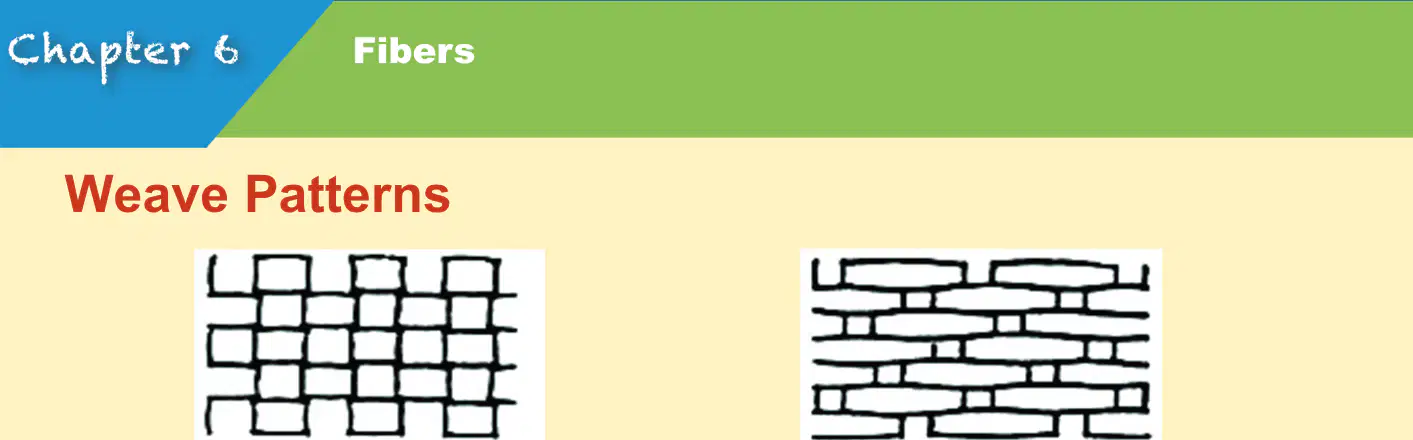
Match each weave pattern to the design it resembles, based on the illustrated weave diagrams of plain, twill, and satin.
plain
checkerboard
twill
stair steps
satin
long floats
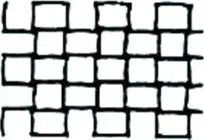
Which weave pattern is characterized by warp and weft yarns passing under and over each other alternately, creating a checkerboard design?
plain weave
twill weave
satin weave
knitted fabric
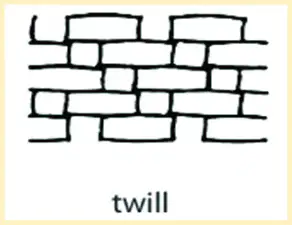
In a twill weave, how does the warp yarn pass over the weft yarns before going under one?
Over one to three weft yarns
Alternately under and over each weft yarn
Over four or more yarns
It does not interlace uniformly
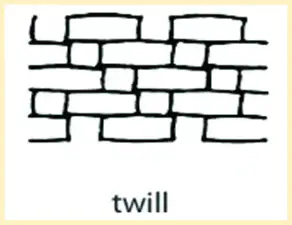
Which fabric is one of the most common examples of a twill weave?
Denim
Satin
Plain cotton sheeting
Knit jersey
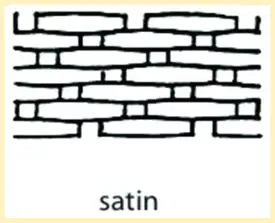
Which weave pattern has yarn interlacing that is not uniform and creates long floats?
Satin weave
Plain weave
Twill weave
Knitted fabric
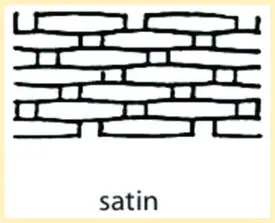
In a satin weave, the interlacing weave typically passes over how many yarns before going under one?
One
One to three
Four or more
It alternates every yarn
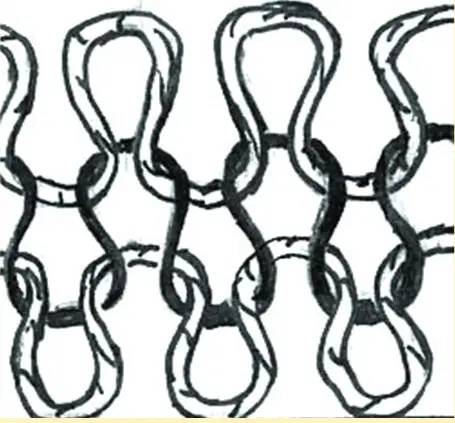
Which statement best describes how knitted fabrics are made?
By interlocking loops in successive rows and drawing them through another series of loops
By alternate over–under interlacing of warp and weft yarns
By passing warp yarns over one to three weft yarns to form diagonals
By passing yarns over four or more yarns to create long floats

Silk fibre is obtained from the _____ of the silk moth.
Cocooon
Hair
Fleece
Cocoons
Skin
Wool is obtained from the ____ of sheep.
Silk
Sheep
Fibre
Fleece
Skin
Llama & Alpaca, found in _______. (Llama & Alpaca kha milti hein)
India
Japan
North africa
South America
Chennai
Fibres of _______ resemble that of silk and hence, it is popularly known as ‘artificial silk’.
acrylic
polyester
rayon
nylon
One of the advantages of nylon over rayon is that nylon:
Is wrinkle free.
Has low elasticity.
Is a natural fibre.
Is a good conductor of electricity.
Which of the following material is a mixture of two fibres?
Jute
Polywool
Polyester
Nylon
Which of the following do not provide wool?
Alpaca
Goat
Yak
Dog
Camel
Pashmina shawls are obtained by the under fur of ________. (Pashmina shawls kiski under fur se milti Hein.)
Yak
Llama
Camel
Alpaca
Kashmiri goat
Yak wool is common in _______. (Yak wool _____ mein common hei.)
Tibet & whole india
Whole India & ladakh
Japan
China
Tibet & ladakh
Mohair is obtained from _____. (Mohair kisse milti hei.)
Yak
Camel
Alpaca
Angora goat
Llama
Wool- yielding animals bear ____ on their body.
Clothes
Jeans
Rope
Hair
Feathers
Hairy skin of sheep has ___ types of fibres.
3
2
5
6
1
Fabrics are made from fibres obtained from (fabrics un fibres se bnti Hein Jo milte hei-)
Only natural source
Only artificial source
Natural or artificial source
Only man- made source
Can not say
Which of the following in natural Fibre? (Inme se konsa natural fibre hei?)
Rayon
Nylon
Silk
Polyester
Acrylic
Polyester is a natural fibre.
true
false
What is the difference between a fibre and a fabric?
fibre is a collection of many fabrics
fabric is a collection of many fibres
fibre is hard and fabric soft
all of these
Which among the following are synthetic fibres?
Nylon
Polyester
Rayon
Spandex
All of the above are synthetic fibres.
Match the following
Natural Materials
Materials that are only found in nature.
Synthetic Materials
Materials that are created by humans.

Natural Material Image

Synthetic Material Image
A natural material is (a) while a synthetic material is (b)
The (a) the borax solution the less cross-linking. Which gave the slime (b)

Choose the material you can stretch.


Choose the correct option:
Glass isn't transparent and rigid.
Glass is bendy and soft.
Paper is transparent.
Glass is transparent and rigid.


The smallest unit of textile material that has a length many times greater than its diameter is a(n)
Fiber
Cuticle
Strand
Tress
The most prevalent plant fiber is:
Hemp
Cotton
Mohair
Wool
In the examination of fibers, the first and most important step in the examination will be:
Determining whether the fiber is natural or manufactured
Microscopically comparing for color and deameter using a comparison microscope
Synthesizing long-chained molecules into a polymer
None of the above
Fibers are an excellent source of trace evidence because
they are easily transferred from a victim to a suspect
they are often overlooked by a suspect
they can be easily collected and stored
all of these choices
Natural fibers can be harvested from
plants and animals
only from plants
only from animals
None of these
All of the following are characteristics of a synthetic fiber except
they are formed by combining monomer compounds into polymer molecules
they are man-made
they are used in the production of carpet fibers
they do not contain any natural fibers
A characteristic of natural fibers is that they
are stronger than synthetic fibers
will not break down when exposed to bright light
melt at a lower temperature that synthetic fibers
are affected by microscopic organisms
Which of the following observations are used to help identify a specific fiber?
smell of the burned fiber
on contact with flame, does the fiber coil or melt?
color and structure of the residue left after the fiber burns
all of these choices
Fibers are considered what kind of evidence?
Which of the following fabrics is NOT made up of plant material?
bamboo
hemp
silk
cotton
Which of the following is not a synthetic material?
Nylon
Wool
Polyester
Acrylic
What occurs to natural fibers like plant and animal material during a burn test?
They melt into a solid substance
They produce ash
They do not ignite
The produce a red residue
Which of the following observations are used to help identify a specific fiber?
smell of the burned fiber
on contact with the flame, does the fiber ignite or melt?
color and structure of the residue left after the riber burns
all of the above
Fibers are an excellent source of trace evidence because
They are easily transferred from victim to suspect.
They are often overlooked by a suspect.
They can be easily collected and stored.
All of the above.
What is Loccard's Exchange Principle?
Perpetrators always leave evidence behind.
Every contact leaves a trace.
All touches leave evidence.
Long, violent confrontations leave evidence.
A horizontal/lengthwise yarn or thread in a weave
Which of the following is NOT a natural fiber?
Silk
Bamboo
Wool
Nylon
Which of the following is a manufactured fiber?
Acetate
Coir
Linen
Cotton
the passing of evidence, such as fiber, from victim to suspect or vice versa.
polymer
monomer
secondary transfer
direct transfer
the transfer of evidence such as a fiber from a source to a person, and then to another person.
primary evidence
secondary evidence
primary transfer
secondary transfer
a flexible, flat material made by interlacing fibers.
yarn
textile
filaments
fibers
Which of the following are ways to collect fiber evidence?
vacuuming
adhesive tape
dusting
forceps
burning
Check all descriptions appropriate for: Cotton
Synthetic
Natural
Plant
Animal
Mineral
Check all descriptions appropriate for: Polyester
Synthetic
Natural
Plant
Animal
Mineral
Fiber can be considered (a) evidence because they narrow down the suspects to a group but not a single person.
Fiber can be considered (a) evidence when they are man-made or synthetic.
Fiber can be considered (a) evidence because they are often just tiny things that are left behind after direct or secondary transfer.
Fibers will always be considered (a) evidence and not (b) evidence because they only imply facts without directly proving or witnessing the crime.
Match the following weaves to the correct pattern that shows them.

Plain

Twill

Basket
Two methods that can analyze fibers without damaging them are:
polarizing light microscopy and infrared spectroscopy.
polarizing light spectroscopy and infrared microscopy.
heat and light.
None of these choices.
Fiberglass is a fiber form of:
proteins.
cellulose.
mineral.
polymers.
The number of threads that are packed together for any given amount of fabric is known as ___________.
abaca
linen
thread count
satin
tabby

This weave pictured is
Satin
Plain
Twill
When fibers are transferred directly from victim to suspect or suspect to victim, this is called:
necessary transfer.
absolute transfer.
direct transfer.
None of these choices.
The transfer of evidence such as a fiber from a source to a person, then to another person, is called:
primary transfer.
secondary transfer.
tertiary transfer.
direct transfer.
Fiber evidence is gathered with:
vacuums.
tape.
glue.
forceps.
lint roller.
Fibers are classified as either:
natural fibers or synthetic fibers.
polymers or synthetic fibers.
acrylic fibers or plant fibers.
olefins or synthetic fibers.
Natural fibers come from:
animals.
plants.
minerals that are mined from the ground.
All of these choices.
The simplest weave pattern is the plain, or ____________, weave.
abaca
linen
thread count
satin
tabby
The number of threads that are packed together for any given amount of fabric is known as ___________.
abaca
linen
thread count
satin
tabby
Cotton is
A synthetic fiber
A natural fiber
An artificial fiber
Rayon is
A synthetic fiber
A natural fiber
An artificial fiber
Nylon is
A synthetic fiber
A natural fiber
An artificial fiber
Hemp is
A synthetic fiber
A natural fiber
An artificial fiber
Silk is
A synthetic fiber
A natural fiber
An artificial fiber
Acrylic is
A synthetic fiber
A natural fiber
An artificial fiber
Wool is
A synthetic fiber
A natural fiber
An artificial fiber
Jute is
A synthetic fiber
A natural fiber
An artificial fiber
Polyester is
A synthetic fiber
A natural fiber
An artificial fiber
This type of fiber is found in plants or animals.
Natural
Artificial
Synthetic
This type of fiber is made primarily from plastics.
Natural
Artificial
Synthetic
A forensic scientist performs a burn test and finds that the fiber melts when it is put in the flame. This suggests that the fiber is…
A synthetic fiber
A natural fiber

This weave pictured is
Satin
Plain
Twill
This weave pictured is
Satin
Plain
Twill
A blue fiber found at the crime scene is…
Direct Evidence
Class Evidence
Testimonial Evidence
Individual Evidence
A blue polyester fiber found at the crime scene matches the outfit the suspect was wearing at the time they allegedly committed the crime. What type of evidence is this?
Individual Evidence
Direct Evidence
Testimonial Evidence
Circumstantial Evidence
A cross transfer of evidence between a suspect and victim
Chain of Custody
District Attorney
Locard Exchange principle

In a classroom activity about hair structure, Oliver compares a strand of hair to a pencil. He explains that just like a pencil has paint on its surface, a certain part of the hair serves a similar protective function. Which part of the hair is comparable to the pencil's paint?
Follicle
Cortex
Cuticle
Medulla
In a classroom activity about hair structure, Liam compares a strand of hair to a pencil. Which part of the hair does Liam say corresponds to the wood of the pencil?
Follicle
Cortex
Cuticle
Medulla
In a classroom discussion about human hair structure, Jackson compares the hair to a pencil. He asks Rohan, which structure corresponds to the lead of the pencil?
Follicle
Cortex
Cuticle
Medulla

During a biology class, Ethan observed a slide under the microscope showing a medulla pattern in a hair sample. He described the pattern as being not solid but having breaks at regular intervals. How is this medulla pattern called?
fragmented
continuous
interrupted
Abigail, Avery, and Noah are investigating a crime scene for their school project. They come across some trace evidence. What does this term 'trace evidence' mean in their context?
small but measurable amounts of physical or biological material found at crime scene
the tough outer covering of a hair composed of overlapping scales
the centrel core of a hair fiber
the actively growing root or base of hair containing DNA and living cells

During a forensic science class, Liam examines a hair sample under the microscope. He asks Maya, 'What kind of medulla is this?'
Fragmented
Continuous
Interrupted/Intermittent
There is no medulla - Absent

Jackson is examining a hair sample under the microscope in his biology class. He turns to Abigail and asks, 'What kind of medulla is this?'
Fragmented
Continuous
Interrupted/Intermittent
There is no medulla - Absent

During a forensic science class, Kai examines a hair sample under the microscope and asks Priya, 'What kind of medulla is this?'
Fragmented
Continuous
Interrupted/Intermittent
There is no medulla - Absent
During a forensic science class, Arjun stated that hair always contains DNA. Is this statement true?
true
false

James found a strand of hair in his science lab. Should he categorize it as human or nonhuman hair?
human
nonhuman

Arjun found a strand of hair on his desk and he is trying to identify its source. The picture he took shows a __________ hair.
human
animal

Scarlett found a strand of hair on her sweater. She is not sure if it's her hair or her pet dog's. What kind of hair could it be?
Human
Animal
During a forensic science class, Nora, Benjamin, and William learned that nDNA can be extracted from a hair sample. Which part(s) of a hair can be analyzed for nDNA?
root
cuticle
medulla
cortex

Ava is studying forensic science and is examining a hair sample under the microscope. She notes the medulla pattern of the hair. Which pattern is she most likely observing?
Continuous
Fragmented/Interrupted
Absent

During a school science fair, Priya presented a sample of hair under a microscope. Kai asked, 'Is this hair from an animal or a human?'
Animal
Human

Oliver found a strand of hair in his science lab. He is unsure if it's from an animal or from his classmates, Abigail or Mia. Can you help him identify if the hair is animal or human?
Animal
Human
Grace is studying biology and she came across the term 'hair follicle'. She asked Jackson and Aria about it. Jackson gave her four explanations. Which one is correct?
the actively growing root or base of hair containing DNA and living cells
material that connects an individual or thing to a certain group
a type of fibrous protein that makes up the majority of the cortex of a hair
the tough outer covering of a hair composed of overlapping scales
During a science class, Abigail states that DNA can be found on the root of a hair. Ava disagrees, saying DNA is never present on hair. Who is correct?
Abigail is correct; DNA can be found on the root of a hair.
Ava is correct; DNA is never present on hair.
During a forensic science class, Michael wonders if it's possible to determine what body part hair evidence came from. Can the lab technician confirm the body part origin of the hair?
yes
no
Ethan, Harper, and Aiden are having a debate. Ethan believes that race origin can be determined by hair. Is he correct?
Yes
No
During a biology class, Evelyn was asked about the composition of the hair shaft. What important protein did she mention?
Cellulose
Chitin
Peptidoglycan
Keratin
During a science fair, Abigail, Zoe, and Olivia presented a forensic science project. They explained that when evidence can only be associated with a group and never with a single source, that evidence is said to possess:
Class categories
Class characteristics
Group categories
Group characteristics
During a forensic science class, Daniel examines a strand of hair under the microscope. He notices a distinctive scale pattern that identifies it as human hair. Which scale pattern is he observing?
Imbricate
Coronal
Spinous
None of these

Emma is studying different scale patterns in her biology class. Which scale pattern is indicated by the sample she's observing?
Coronal
Spinous
Imbricate
None of these
During a biology class, James learned about the hair growth cycle. He discovered that there is a transitional or regressive stage that lasts a few weeks during which hair growth slows. What is this stage called?
Anagen
Telogen
Catagen
Metagen
Hannah, Isla, and Samuel were studying about the hair life cycle in their biology class. They learned that the hair follicle is dormant and hairs are easily lost during which stage of the hair life cycle?
Anagen
Telogen
Catagen
Metagen
During a forensic science class, Jackson, Lily, and Priya are examining hair samples under a microscope. They conclude that a hair is from a human if...
The medullary index is 0.5 or greater
The medullary index is 0.33 or less
The cuticle is coronal
The medulla is fragmented
During a biology class, Arjun observed a slide under the microscope showing a medulla pattern in a hair sample. He described the pattern as being consistent along the length of the hair. How is this medulla pattern called?
fragmented
continuous
interrupted
Lily, Kai, and Rohan are studying for their biology exam. They come across a question about the structure of hair. They are asked to identify the 'cortex'. What could be the correct definition?
the region of hair located outside of the medulla containing granules of pigments
material that connects an individual or thing to a certain group
a type of fibrous protein that makes up the majority of the cortex of a hair
the tough outer covering of a hair composed of overlapping scales
During a biology class, Daniel learned that the cuticle is a part of the hair structure. What is the cuticle?
the tough outer covering of a hair composed of overlapping scales
material that connects an individual or thing to a certain group
a type of fibrous protein that makes up the majority of the cortex of a hair
the central core of a hair fiber
During a school science fair, Ava, Oliver, and Rohan are presenting a project on forensic science. They explain 'trace evidence' to the audience. What is 'trace evidence'?
small but measurable amounts of physical or biological material found at a crime scene
the tough outer covering of a hair composed of overlapping scales
the central core of a hair fiber
the actively growing root or base of hair containing DNA and living cells
Kai, Daniel, and Samuel are studying the structure of hair for their biology project. They are trying to identify the oldest part of the hair. According to their research, which part is the oldest?
Middle
Tip
Root
Shaft
During a biology class, Abigail examines a hair sample under the microscope. She asks Aiden, 'What kind of medulla is this?'
Fragmented
Continuous
Interrupted/Intermittent
There is no medulla - Absent
During a science class, Michael learns that hair always contains DNA. Is this statement true?
true
false

Aria, Maya, and Emma are studying the hair patterns of small rodents and dogs for their biology project. They noticed a crown-like scales pattern. Which pattern is this?
Coronal Pattern
Spinous Pattern
Imbricate Pattern
During a biology class, Charlotte examines a model of the hair and points out that the hair shaft is
the part of the hair enclosed in the hair follicle
the structure containing capillaries and nerves that supply nutrients to the hair
"Bag" that encloses the root of the hair
the part of the hair that is visible on the scalp or skin.
Anika, Michael, and Elijah are studying different types of hair for their biology project. They are particularly interested in Asian hair. Which characteristic would they most likely observe in Asian hair?
Dark Medulla
Sparsely distributed pigment granules
flattened cross-section
Hair is curly
Luna, Charlotte, and Scarlett are studying for their biology exam. They come across a question in their textbook that asks, 'What type of cuticle does human hair have?'
Imbricate
Spinous
Coronal
Pigmented
During a forensic science class, Benjamin, Noah, and Nora were learning about hair analysis. The instructor asked, 'Which part of the hair can be used as individual evidence?'
Follicle
Cuticle
Medulla
Cortex
During a biology class, Scarlett learned that the period of the most active hair growth is called the ____________ stage. Harper and William were curious to know which stage that was.
catagen
telogen
anagen
imagen
In which direction do the scales of the cuticle point?
to the root
to the medulla
to the tip of the hair
to the follicle
Which of the following is not a function of hair in mammals?
Help control body temperature
Decrease friction from outside forces
Act as a sensory organ
Absorb body odor when stressed
What is the repeated pattern of rounded pigments in animal hair?
Ovoid Bodies
Cortex Pigments
Colored Spots
Pigment Spheres
How many centimeters does hair grow in a day
1.3 cm
0.5 cm
2 cm
0.044 cm

Part A is the (a)
Part B is the (a)
Part C is the (a)
Part D is the (a)
Part E is the (a)
Part F is the (a)
Part G is the (a)
Part H is the (a)
fibers composed of a loose arrangement of polymers that are soft, elastic, and absorbing.
yarn
crystalline
amorphous
polymer
fibers composed of polymers packed side by side, which make it stiff and strong.
natural fiber
crystalline
yarn
synthetic fiber
the passing of evidence, such as fiber, from victim to suspect or vice versa.
polymer
monomer
secondary transfer
direct transfer
a fiber produced naturally and harvested from animal, plant, or mineral sources.
natural fiber
synthetic fiber
mineral fiber
yarn
Aria, Charlotte, and Kai are working on a school project about different types of fibers. They come across a fiber made from a man-made substance such as plastic. What type of fiber is this?
yarn
mineral fiber
natural fiber
synthetic fiber
the transfer of evidence such as a fiber from a source to a person, and then to another person.
primary evidence
secondary evidence
primary transfer
secondary transfer
When fibers are transferred directly from victim to suspect or suspect to victim, this is called:
necessary transfer.
absolute transfer.
direct transfer.
None of these choices.
The transfer of evidence such as a fiber from a source to a person, then to another person, is called:
primary transfer.
secondary transfer.
tertiary transfer.
direct transfer.
Fiber evidence is gathered with:
vacuums.
tape.
glue.
forceps.
lint roller.
Fibers are classified as either:
natural fibers or synthetic fibers.
polymers or synthetic fibers.
acrylic fibers or plant fibers.
olefins or synthetic fibers.
Natural fibers come from:
animals.
plants.
minerals that are mined from the ground.
All of these choices.
Cotton is
A synthetic fiber
A natural fiber
An artificial fiber
Rayon is
A synthetic fiber
A natural fiber
A manufactured
Nylon is
A synthetic fiber
A natural fiber
A manufactured fiber
Hemp is
A synthetic fiber
A natural fiber
An artificial fiber
Silk is
A synthetic fiber
A natural fiber
An artificial fiber
Acrylic is
A synthetic fiber
A natural fiber
An artificial fiber
Wool is
A synthetic fiber
A natural fiber
An artificial fiber
Polyester is
A synthetic fiber
A natural fiber
An artificial fiber
This type of fiber is found in plants or animals.
Natural
Artificial
Synthetic
This type of fiber is made primarily from plastics.
Natural
Artificial
Synthetic
A forensic scientist performs a burn test and finds that the fiber melts when it is put in the flame. This suggests that the fiber is…
A synthetic fiber
A natural fiber
A blue fiber found at the crime scene is…
Direct Evidence
Class Evidence
Testimonial Evidence
Individual Evidence
A blue polyester fiber found at the crime scene matches the outfit the suspect was wearing at the time they allegedly committed the crime. What type of evidence is this?
Individual Evidence
Direct Evidence
Testimonial Evidence
Circumstantial Evidence
Evelyn found a strand of hair at the crime scene. She believes it could be a cross transfer of evidence between Ethan, the suspect, and Harper, the victim. What principle is she referring to?
Principle of Individuality
Principle of Linkage
Locard Exchange principle
a collection of mineral crystals formed into a recognizable pattern.
synthetic fiber
polymer
mineral fiber
monomer
a fiber produced naturally and harvested from animal, plant, or mineral sources.
natural fiber
synthetic fiber
mineral fiber
yarn
a fiber made from a man-made substance such as plastic.
yarn
mineral fiber
natural fiber
synthetic fiber
Fibers can be specific to a single person.
True
False
What time period should fibers be collected within after the crime?
1 hour
10 hours
24 hours
1 week
Fiber evidence is collected using all of the following except
broom
vacuum
sticky lint roller
forceps
Synthetic fibers come from animals, plants, and minerals.
True
False
Which fibers are most commonly found at crime scenes?
Animal fibers
Plant fibers
Minerals fibers
All animal fibers are made of
Cellulose
Proteins
Hemp
Plant fibers are made of
Cellulose
Protein
Keratin
All of the following are plant fibers except
Cotton
Hemp
Raylon
Manila
Synthetic fibers are stronger than natural fibers.
True
False
This type of fiber can deteriorate in bright sunlight and will melt at low temperatures.
Synthetic
Natural
Fiber identification provides both class and individual evidence.
True
False
Which of the following are ways to collect fiber evidence?
vacuuming
adhesive tape
dusting
forceps
burning