
NEW
Font size
 Worksheets
MATH 7 THIRD PERIODICAL EXAM1
Total questions: 50
Worksheet time: 25mins
Choose the letter of the best answer. Which data collection method involves drawing names from a hat to ensure every student has an equal chance of being chosen?
Convenience Sampling
Systematic Sampling
Random Sampling
Stratified Sampling
Choose the letter of the best answer. If a researcher at Divisoria market groups vendors by the type of goods they sell (fish, vegetables, or fruits) and then selects a random sample from each group, what technique is being used?
Cluster Sampling
Stratified Sampling
Random Sampling
Convenience Sampling
Choose the letter of the best answer. A researcher counts every 10th jeepney passing the Cubao terminal. How would you describe this sampling technique?
It uses a fixed interval (k) to select members from a population.
It groups the population into clusters and surveys everyone in the cluster.
It relies on the ease of access to the participants.
It ensures that specific subgroups are proportionally represented.
Choose the letter of the best answer. A DepEd survey needs to represent the entire Quezon City division. Which action best illustrates cluster sampling?
Selecting 5 random students from every single classroom in the city.
Choosing one specific school at random and surveying every student in that school.
Posting a survey on Facebook and waiting for teachers to respond.
Listing all teachers and picking every 20th name on the list.
Choose the letter of the best answer. teacher at a school in Makati needs to survey 50 students about their recess food preferences. Which of the following actions best illustrates convenience sampling?
Asking the first 50 students she encounters near the canteen entrance.
Using an online app to randomly select 50 names from the school roster.
Surveying every single student eating in the canteen during the break.
Selecting exactly 10 students from each grade level to ensure variety.
Choose the letter of the best answer. What is the primary purpose of a Frequency Distribution Table (FDT)?
To show the raw scores in the exact order they were collected.
To organize large sets of data into manageable groups or intervals.
To calculate the average of all scores in a data set.
To represent data using colorful bars and circles.
Choose the letter of the best answer. You are organizing 20 mango weights (ranging from 0.4kg to 2.5kg). If you want to create a frequency table, what is the most logical way to group them?
List every unique weight individually.
Use class intervals like 0.1–0.5kg, 0.6–1.0kg, etc.
Group them by "Heavy" and "Light" only.
Arrange them alphabetically by the name of the farm.
Choose the letter of the best answer. A weather reporter in Manila is preparing a summary of this week’s rainfall: 8mm, 12mm, 10mm, and 15mm. To present this data in a grouped frequency table, which approach should be used?
Group the measurements into class intervals (e.g., 5–9mm and 10–14mm).
List each specific measurement in the order it was recorded.
Calculate the mean rainfall and report only the average.
Arrange the numbers in a single row from lowest to highest.
Choose the letter of the best answer. A researcher recorded the following fish prices per kilo: P25, P45, P28, P50, and P35. When organizing this into a frequency table, why would the P20–P30 class interval have a frequency of 2?
There are only two values from the list (P25 and P28) that fall within that range.
P20 and P30 are the only two numbers used to define the group.
The difference between P20 and P20 is 10.
The average of the prices is P30.
Which graph is specifically designed to show how "parts" of a budget contribute to the "whole" school canteen expenses?
Line graph
Bar graph
Pie graph
Stem-and-leaf plot
You want to show the increase and decrease of rice harvest in Nueva Ecija over the last 12 months. Which graph is most appropriate?
Line graph
Bar graph
Pie graph
Stem-and-leaf plot
A market vendor wants to compare the total sales of three different types of fish (Tilapia, Bangus, and Galunggong). What is the best visual tool for this?
Line graph
Bar graph
Pie graph
Stem-and-leaf plot
Why is a stem-and-leaf plot often preferred over a bar graph for a small class of 25 students?
It uses colors to show different grades.
It allows you to see the actual individual scores while showing the overall shape of the data.
It is the only graph that can show percentages.
It takes up less space on a piece of paper.
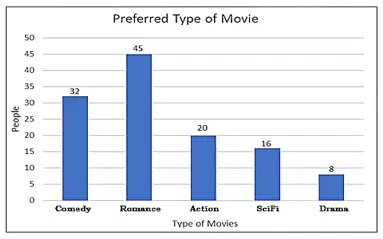
Based on the provided bar graph of preferred Type of Movie, how many people prefer Comedy movies?
45
32
20
8
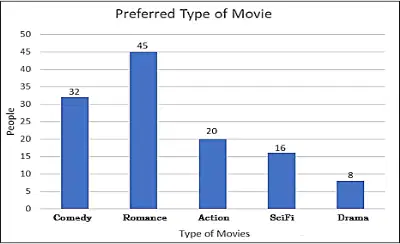
Based on the provided bar graph of Preferred Type of Movie, what is the total number of people surveyed for their movie preferences?
100
113
121
135
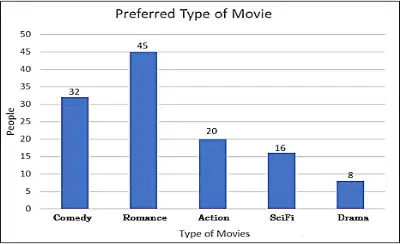
Based on the provided bar graph of Preferred Type of Movie, which of the following statements is true regarding the combined preferences?
The preference for Action (20) is greater than SciFi and Drama combined (24).
The combined preference for SciFi and Drama (24) is 4 more than Action (20).
Romance has exactly double the frequency of Action.
Comedy is the least popular genre.
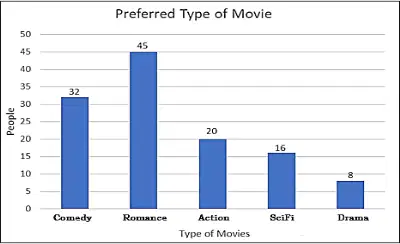
If a TV executive decides to air a Romance movie during Prime Time based on the provided bar graph of Preferred Type of Movie, is this a valid decision?
Yes, because it has the highest frequency (45), indicating it is the most popular.
No, because Comedy and Action combined have more viewers.
Yes, because Romance movies are always cheaper to air.
No, because the total number of people surveyed is too small to make a decision.
Which of the following best describes the set of integers?
Only positive numbers are used for counting.
Zero and all positive whole numbers.
All whole numbers, their negative opposites, and zero.
All numbers that can be written as fractions or decimals.
Mt. Apo stands at 2,954 meters above sea level. How would you represent the elevation of Mt. Apo and the sea level using integers?
Mt. Apo: -2954; Sea Level: 0
Mt. Apo: +2954; Sea Level: 0
Mt. Apo: +2954; Sea Level: -2954
Mt. Apo: 0; Sea Level: +2954
A submarine is 500 meters below the surface of the ocean. Which integer represents its position?
+500
0
-500
500
In a business, a profit of ₱500 and a loss of ₱500 are opposites. How are they represented?
Profit: +500; Loss: -500
Profit: -500; Loss: +500
Both are +500
Both are 0
Why is it necessary to use integers (both positive and negative) in a bank's record-keeping system?
Because positive numbers are easier to add.
To distinguish between money added (deposits) and money taken out (withdrawals).
Because banks are only allowed to use whole numbers.
To make the bank statements look more professional.
What integer represents 5 km northbound from Manila?
-5 km
0 km
+5 km
+10 km
A temperature drop of 3°C in Baguio is represented by which integer?
+3°C
-3°C
0°C
3°C
A bank account transaction shows -200. What does this likely represent?
A deposit of ₱200.
A balance of exactly ₱200.
A withdrawal of ₱200.
An interest gain of ₱200.
Why is a temperature of 10°C above zero and a depth of 10 feet below sea level represented by different signs (+10 and -10)?
Temperature only measures magnitude, while depth is directional.
Zero represents the lowest possible value for temperature.
Sea level is the fixed starting point, while zero is the fixed starting point for temperature.
They represent opposite directions from a common reference point (zero).
A hiker is at -30 meters relative to a base camp. What must the hiker do to return to base camp?
Descend another 30 meters.
Move 30 meters in the opposite direction (upwards).
Stay at the current location.
Move to 0 meters elevation above sea level.
How can you justify using only positive numbers to describe the total flight time of an airplane, even though the plane might be traveling in multiple directions?
Time has no direction; it is a scalar quantity that only increases.
The plane's speed is always positive.
The negative direction cancels out the time.
Pilots are not allowed to use negative numbers.
On a standard number line, what is the role of the number zero?
It is the largest negative number.
It is the smallest positive number.
It is the origin/reference point that is neither positive nor negative.
It indicates where the counting stops.
Where is -8 located on a number line?
8 units to the right of 0.
8 units to the left of 0.
Between 0 and 1.
To the right of -5.
How does the distance of an integer from zero relate to its "Absolute Value"?
The further it is from zero, the smaller its absolute value.
The distance from zero is the absolute value.
Positive numbers are closer to zero than negative numbers.
Absolute value only exists for negative numbers.
When evaluating the position of two integers, a and b, how can you definitively prove that a > b using the number line?
Show that a is closer to zero than b.
Show that a is farther from zero than b.
Show that a is located to the right of b.
Show that a is located to the left of b.
Which mathematical symbol is used to state that the first integer is smaller than the second integer?
>
≤
≥
<
Why is +1 always greater than -100?
+1 has more digits.
Any positive integer is located to the right of any negative integer on the number line.
-100 is closer to zero.
Negative numbers don't actually exist in real life.
How should the integers -15, 0, and -20 be ordered from least to greatest?
0, -15, -20
-15, -20, 0
-20, -15, 0
-20, 0, -15
How would you solve the expression -7 - (-3) using the concept of a number line?
Start at -7 and move 3 units to the left.
Start at -7 and move 3 units to the right.
Start at 0 and move 7 units left, then 3 units left.
Start at 0 and move 7 units left, then 3 units right.
When adding two integers with different signs, such as 15 + (-20), how do you determine the sign of the sum?
The sum is always negative.
The sum is always positive.
The sum takes the sign of the integer with the smaller absolute value.
The sum takes the sign of the integer with the larger absolute value.
What counter-example would you use to evaluate the statement: "The difference between any two negative integers is always a negative integer"?
−5−(−2)=−3
−2−(−5)=3
−5+(−2)=−7
−2+5
You have 8 positive chips (+) and 5 negative chips (-). After removing all possible "zero pairs," what is left?
13 positive chips
3 negative chips
3 positive chips
0 chips
What is the result of multiplying two negative integers?
A negative integer
A positive integer
Zero
An undefined result
How is the division of two integers with different signs, such as −48÷6 , compare to the division of their absolute values?
The quotient has the same magnitude and is positive.
The quotient has the same magnitude and is negative.
The quotient is always zero.
The quotient is always undefined.
When applying the Order of Operations (GEMDAS), which operation must be completed immediately after solving terms inside Parentheses/Grouping symbols?
Addition
Exponents
Multiplication
Subtraction
How would you simplify the expression 10+5×2−4 using the Order of Operations?
10
16
26
30
When analyzing the expression 18−(6÷2)+42 , which step must be executed first according to GEMDAS?
Calculate the exponent 42 .
Solve the group 6÷2 .
Perform the subtraction 18−6 .
Perform the addition 2+42 .
Which property justifies why 4×(−3)=(−3)×4 ?
Associative Property of Multiplication
Commutative Property of Multiplication
Distributive Property
Inverse Property of Multiplication
If a student incorrectly performs the addition before the multiplication in the expression 10+5×2 , what is the incorrect result?
17
20
22
30
Why is it essential to use the grouping symbols in the expression (3+4)×5 compared to 3+4×5 ?
The grouping symbols change the order of addition and division.
The grouping symbols force the addition to be executed first, changing the result.
The grouping symbols indicate that the Commutative Property must be applied.
The grouping symbols ensure the result is always a prime number.
What does the absolute value of an integer represent on the number line?
The value of the integer's opposite.
The number's size or magnitude, regardless of its sign.
The distance of the integer from its opposite.
The position of the integer relative to all other integers.
Which statement correctly explains why ∣−12∣=∣12∣ ?
−12 and 12 are both positive numbers.
The absolute value function only applies to positive numbers.
Both integers are 12 units away from zero on the number line.
Both integers are equal to zero when they are added together.
When is it correct to evaluate the absolute value of a number, ∣x∣ , as equal to the number itself, x ?
Only when x is a negative integer.
Only when x is a positive integer.
When x is any non-negative integer.
When x is any non-positive integer.

