
 Worksheets
Wave Interactions HW Quiz - Chapter 13 Lesson 3 (McGrawHillEdu)
Total questions: 15
Worksheet time: 15mins
Reflection is defined as what?
Transfer of energy to the medium
Bouncing of a wave off a surface
Bending of a wave through a prism
Complete passage through the object
A black pavement becomes warm under bright sunlight mainly due to which process?
Transmission of all light energy
Absorption of wave energy by the surface
Reflection of nearly all incoming light
Creation of new waves with no heating
According to the law of reflection, how do the angles of incidence and reflection compare?
They are equal in measure
They vary unpredictably
Incidence is always larger
Reflection is always larger
In a ray diagram of a mirror, which angle is measured between the incoming ray and the normal?
Refracted angle
Critical angle
Angle of reflection
Angle of incidence
Why does a pencil in a clear glass of water appear bent at the water surface?
Light slows down in water and refracts
Water magnifies the submerged part
Light speeds up in water and reflects
The glass distorts the pencil image
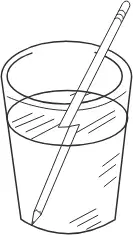
In the submerged part of the pencil image, how does light speed compare to the part in air?
It stops at the boundary
It is the same in both media
It travels faster in water
It travels more slowly in water
Which situation best illustrates refraction rather than diffraction?
Wave spreading after a doorway
Wave bending when passing into glass
Wave interference producing beats
Wave echo from a canyon wall
Which sentence correctly contrasts refraction and diffraction?
Refraction occurs through objects; diffraction occurs around edges
Refraction occurs at edges; diffraction occurs through media
Refraction reflects waves; diffraction absorbs waves
Refraction spreads waves; diffraction straightens waves
A teacher draws straight wavefronts hitting a small slit and then curved wavefronts emerging. What concept is being modeled?
Diffraction producing curved wavefronts
Absorption reducing wave amplitude
Refraction increasing wave frequency
Reflection at a smooth boundary
What happens to the direction of a light ray when it passes from air into water at an angle?
It bends towards the normal due to refraction
It continues straight without bending
It bends away from the normal due to reflection
It is absorbed completely by the water
Which process causes a rainbow to form when sunlight passes through raindrops?
Absorption and transmission
Refraction and reflection
Diffraction only
Reflection only
When a wave encounters a barrier with a small opening, what phenomenon allows the wave to spread out?
Absorption
Refraction
Diffraction
Reflection
Which phenomenon explains why sound can be heard around a corner?
Refraction
Absorption
Diffraction
Reflection

White light is ...
The absence of light
All colors of light combined
The first color in the rainbow
The last color in the rainbow

Why does a lemon appear yellow in colour?
Because it _________ all other colours and reflects yellow.
transmits
reflects
refracts
absorbs

