
 Worksheets
Boiling
Total questions: 122
Worksheet time: 1hrs 1mins
Which process changes a solid into a liquid when heat is absorbed?
Condensation of vapor into liquid
Evaporation from the liquid surface
Boiling of the liquid into gas
Melting of the solid into liquid
Which process occurs at the surface of a liquid at any temperature below the boiling point?
Boiling throughout the liquid
Freezing at the surface
Melting of a solid surface
Evaporation from the surface only
At the boiling point, what happens inside a liquid?
Solid particles begin forming
Gas condenses back to liquid
Only surface molecules escape
Bubbles form throughout the liquid
Which statement best distinguishes boiling from evaporation?
Evaporation forms bubbles throughout the liquid
Both occur only at very low temperatures
Boiling happens only in closed containers
Boiling occurs throughout; evaporation at surface
Which factor most increases the rate of evaporation for a liquid spill?
Lower temperature and smaller surface
Higher temperature and larger surface
Higher pressure and sealed container
Darker color and deeper container
When a solid melts, what happens to the average kinetic energy of its particles?
It becomes zero at the melting point
It remains unchanged with added heat
It decreases as heat is released
It increases as heat is absorbed
Lowering the external pressure on a liquid will generally do what to its boiling point?
Freeze the liquid immediately
Keep the temperature unchanged
Decrease the boiling temperature
Increase the boiling temperature
Which situation best illustrates evaporation?
A wet shirt drying in warm air
Steam turning to droplets
Ice becoming water in a bowl
Water bubbling on a hot stove
Why does sweating help cool the human body?
Condensation adds body heat
Melting releases latent heat
Boiling adds thermal energy
Evaporation removes latent heat
Which combination correctly pairs process and energy exchange with surroundings?
Melting: releases heat; Boiling: absorbs heat
Melting: absorbs heat; Boiling: absorbs heat
Melting: absorbs heat; Evaporation: releases heat
Evaporation: releases heat; Boiling: releases heat
At standard atmospheric pressure, what are the melting point and boiling point of pure water?
-10°C and 90°C
10°C and 120°C
5°C and 80°C
0°C and 100°C
Which pair best represents the temperature change when ice turns to liquid water and then to steam at sea level?
-5°C to 50°C
0°C to 100°C
-20°C to 20°C
10°C to 60°C
A thermometer reads 100°C for a pot of pure water at sea level. What phase change is occurring?
Sublimation of ice
Freezing of water
Boiling of water
Condensation of steam
Pure water placed in a freezer at standard pressure begins to change phase at which temperature?
5°C
-5°C
0°C
10°C
Which statement about pure water at 0°C and standard pressure is correct?
All water must be steam
Only solid ice is possible
Ice and liquid can coexist
Only liquid water is stable
A student claims pure water boils at 90°C at sea level. What is the best response?
Incorrect; it boils at 100°C
Correct; it varies by pot
Incorrect; it boils at 80°C
Correct; any value is fine
If a beaker of pure water is heated from 20°C to 100°C at sea level, when does its temperature stop rising briefly despite continued heating?
During boiling at 100°C
At 50°C mid‑way
Just after 0°C
After 120°C
Which factor would most directly change the boiling point of pure water from 100°C?
Container color
Atmospheric pressure
Stirring speed
Water clarity
At high altitude with lower pressure, the boiling point of pure water will be
Exactly 100°C
Unchanged by pressure
Lower than 100°C
Higher than 100°C
Which pair shows correct SI units for melting and boiling points of water?
Degrees Celsius (°C)
Kelvin per hour (K/h)
Cubic meters (m³)
Degrees Fahrenheit (°F)
What term describes the melting and boiling points of pure water used as reference temperatures?
Phase markers
Fixed points
Energy thresholds
Calibration limits
Thermal anchors
At standard atmospheric pressure, the melting point of ice is closest to which value?
0 °C
100 °C
25 °C
50 °C
75 °C
Pure liquid water reaches its boiling point at what temperature under atmospheric pressure?
150 °C
100 °C
75 °C
50 °C
0 °C
Which statement best explains why 0 °C and 100 °C are called fixed points for water?
They are the hottest possible temperatures
They are the coldest possible temperatures
They are average daily temperatures
They are accepted reference temperatures
They never change with altitude
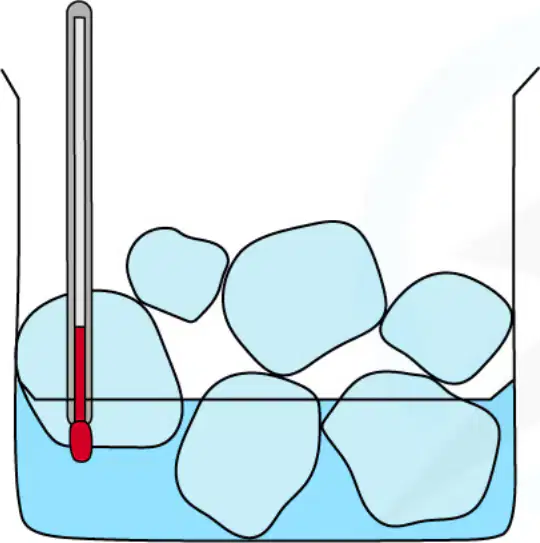
In the left beaker diagram with ice and a thermometer, which process is primarily occurring at 0 °C?
Evaporation of liquid
Freezing of water
Melting of ice
Condensation of steam
Sublimation of ice
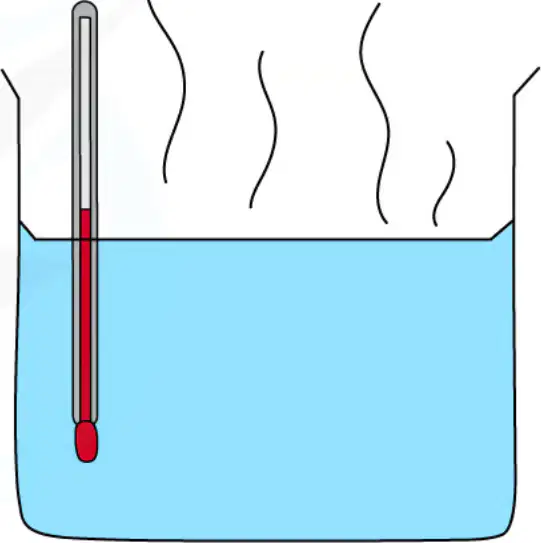
In the right beaker diagram showing steam above the surface, what process is occurring at 100 °C?
Freezing of water
Boiling of water
Sublimation of ice
Melting of ice
Condensation of vapor
Which condition is assumed when stating water melts at 0 °C and boils at 100 °C?
High pressure
Vacuum pressure
Atmospheric pressure
Low humidity
No impurities
Which factor would most likely change the boiling point from 100 °C in a classroom experiment?
Volume of the water
Altitude affecting pressure
Shape of the thermometer
Time of the experiment
Color of the beaker
Why are pure samples specified when giving water’s fixed points?
Impurities stop thermometers working
Impurities remove surface tension
Impurities raise freezing point
Impurities lower freezing point
Impurities change phase temperatures
A student heats saltwater at sea level. Compared with pure water, the boiling point of the solution is most likely:
Lower than 100 °C
Exactly 100 °C
Slightly above 100 °C
Exactly 0 °C
Exactly 50 °C
During melting or boiling, what happens to a substance’s temperature while energy is being transferred?
It fluctuates around the average value
It remains constant at the plateau value
It increases steadily with added heat
It decreases due to latent cooling
Which statement best distinguishes boiling from melting in terms of energy?
Both occur at the same energy for all substances
Energy is not involved in boiling or melting
Boiling occurs at lower energy than melting
Boiling occurs at higher energy than melting
What physical change allows a solid to become a liquid during melting?
Particles compress into fixed positions
Particles lose all kinetic energy
Particles become completely separated
Particles gain freedom to move more freely
During boiling, what happens to the intermolecular forces between particles?
They cause molecules to arrange
They strengthen due to high pressure
They become slightly weakened only
They are completely overcome by energy

On a temperature–time graph for heating, what does a horizontal segment during melting represent?
Cooling due to evaporation at the surface
Constant temperature while latent heat is absorbed
Measurement error in the thermometer
Rapid temperature rise without energy input
Which process requires energy input without a change in temperature for a pure substance?
Cooling a gas steadily
Condensing with temperature drop
Heating a solid linearly
Melting and boiling plateaus
Why does the boiling plateau occur at a higher temperature than the melting plateau for the same substance?
More energy is needed to fully separate particles
Gas particles have lower kinetic energy overall
No energy difference exists between plateaus
Less energy is needed to form bonds in liquids
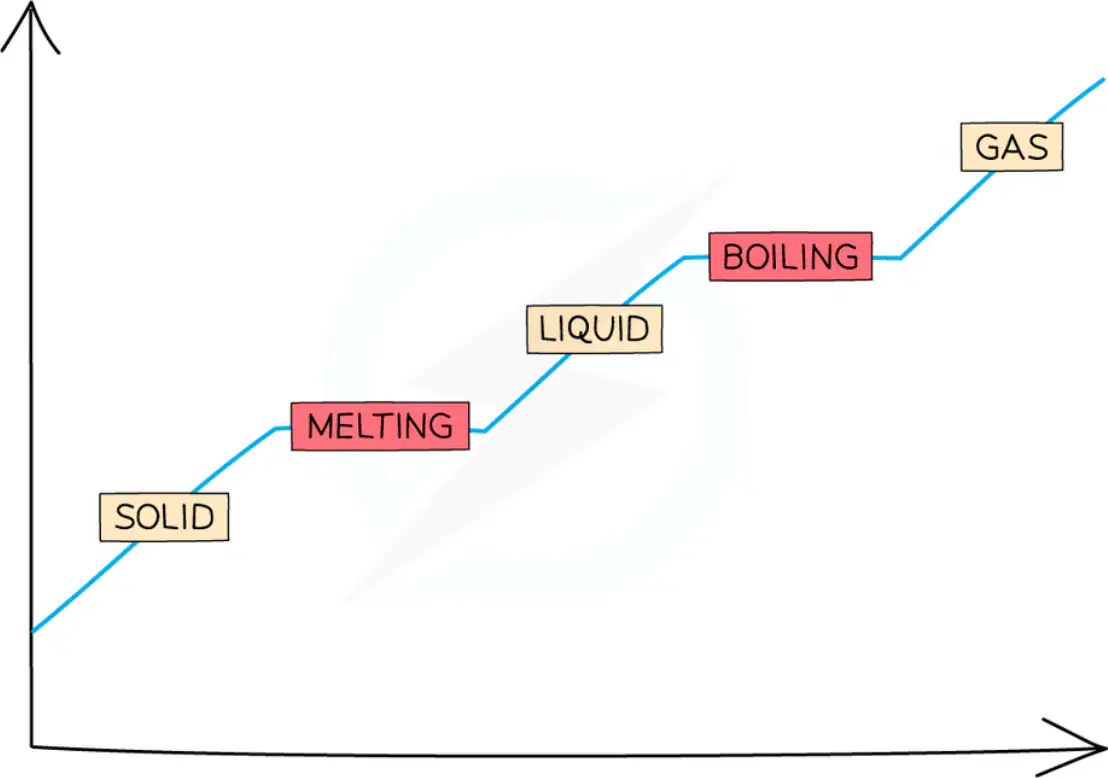
In the heating curve shown, which region corresponds to a liquid being warmed?
The plateau at the boiling point
The sloped segment between melting and boiling
The plateau at the melting point
The initial sloped solid segment
Which description best matches what is meant by ‘changing state’?
A mixture separates into components by filtration
A substance transitions between solid, liquid, or gas
A substance changes chemical composition permanently
A substance breaks into ions during electrolysis
A student heats a solid until it begins to melt. Despite continuous heating, the thermometer reading stays the same for several minutes. What conclusion is most appropriate?
Energy is breaking intermolecular forces, not raising temperature
The thermometer has stopped working completely
The solid is decomposing in a chemical reaction
The burner is faulty and gives no heat to the sample
When liquid water is heated, what happens to its temperature before it reaches the boiling point?
It rises until the boiling point
It remains constant throughout heating
It decreases due to evaporation
It oscillates around a mean value
At the boiling point, adding more thermal energy to liquid water primarily causes what change?
Kinetic energy of molecules decreases
Water density increases significantly
Intermolecular forces are overcome
Temperature of the liquid increases steadily
Which statement best describes the temperature of liquid water exactly at its boiling point while heating continues?
Temperature keeps rising with added heat
Temperature remains essentially constant
Temperature drops due to vapor bubbles
Temperature fluctuates randomly
What phase change occurs when intermolecular forces in liquid water are overcome by added energy?
Freezing to solid ice
Sublimation to solid
Condensation to liquid
Evaporation to water vapour
During boiling, the added thermal energy is mainly used to do which of the following?
Create chemical bonds in water
Increase pressure of the container
Increase temperature of the liquid
Break intermolecular attractions
Which term correctly names the process where liquid water becomes a gas at its boiling point?
Condensation or liquefaction
Deposition or desublimation
Evaporation or vaporisation
Fusion or melting
Which claim is most accurate about internal energy of liquid water at the boiling point during heating?
Internal energy keeps rising rapidly
Internal energy shifts forms, not temperature
Internal energy remains entirely unchanged
Internal energy is converted into ice
A kettle heats water until it boils. Why does the thermometer show no further temperature increase during steady boiling?
Heat is lost faster than added
Water becomes denser at high heat
Energy goes into overcoming attractions
Thermometer is malfunctioning
Which observation would best indicate boiling rather than just heating below boiling?
Rising temperature without steam seen
Rapid bubbling at constant temperature
Steam forming while temperature increases
Slow warming without bubbles forming
Which outcome directly follows once enough intermolecular forces are overcome in heated water?
Temperature of liquid spikes
Water cools and condenses
Liquid water turns into steam
Ice crystals begin to form
When ice is heated, what happens to its temperature before it reaches the melting point?
It increases until the melting point
It decreases as energy is added
It stays constant from the start
It fluctuates up and down randomly
At the melting point of ice, adding more thermal energy causes which immediate effect?
Temperature rises at the same rate
Temperature remains constant for a while
Temperature drops slightly at first
Temperature oscillates around a value
What does a constant temperature at the melting point indicate about the internal energy of the ice?
Internal energy is rapidly decreasing
Internal energy is oscillating randomly
Internal energy is rapidly increasing
Internal energy is not increasing then
During melting, where does the additional thermal energy primarily go?
Heating surrounding air mostly
Speeding up molecular motion only
Converting liquid to solid again
Overcoming intermolecular forces
Which statement best describes melting at the particle level for ice?
Attractive forces are overcome gradually
New bonds form strengthening solid
Electrons leave molecules entirely
Particles become heavier and sink
When the intermolecular forces in ice are overcome, the result is that water becomes a:
Solid with stronger bonds
Plasma with charged ions
Gas with zero pressure
Liquid with free movement
Which scenario best explains why ice temperature plateaus during melting?
Energy breaks forces instead of warming
Energy is lost only to the air
Thermometer stops working temporarily
Ice has reached absolute zero
A student keeps heating a beaker of ice at 0°C. After several minutes, the thermometer still reads 0°C while some water appears. What is the best explanation?
Thermometer calibration is wrong
Water cools the thermometer more
Beaker prevents heat transfer
Energy is used for phase change
Which choice correctly pairs process and energy change during melting of ice?
Potential energy increases mainly
Kinetic energy increases mainly
Chemical energy is released mainly
Total energy decreases overall
Which change would most quickly complete melting if heat input stays the same?
Crushing ice to increase surface
Using narrower beaker shape
Lowering room temperature
Stirring less to avoid mixing
During condensation, what happens to the system’s energy and the molecules’ kinetic energy?
Energy leaves; kinetic energy increases
Energy enters; kinetic energy decreases
Energy leaves; kinetic energy decreases
Energy enters; kinetic energy increases
Which statement best describes heating in terms of energy transfer and molecular motion?
Energy enters the system; motion slows down
Energy leaves the system; motion slows down
Energy enters the system; motion speeds up
Energy leaves the system; motion speeds up
Cooling a gas so it becomes a liquid involves which type of energy change?
Energy transferred to the system
Energy transferred within the system
Energy transferred by chemical reaction
Energy transferred away from the system
When a liquid solidifies, the average kinetic energy of its molecules most likely
oscillates unpredictably
stays exactly constant
decreases overall
increases significantly
Which scenario best illustrates heating as described on the slide?
Ice forming as heat dissipates outward
Metal cooling as energy transfers away
Water warming as energy flows inward
Steam condensing as energy leaves
In the slide’s convention, red arrows to the right most likely indicate
random molecular collisions
energy entering during heating
energy leaving during cooling
internal potential energy rise
Blue arrows to the left on the slide correspond to
no net energy transfer observed
energy stored as chemical energy
energy transfer away from the system
energy transfer to the system
Which pair correctly matches process with energy direction?
Heating: within; Cooling: within
Heating: to; Cooling: away
Heating: random; Cooling: random
Heating: away; Cooling: to
A sealed gas is warmed. Which change is most consistent with the slide?
Molecules lose kinetic energy overall
Molecules stop colliding completely
Molecules move slower on average
Molecules move faster on average
Which best explains why condensation often releases heat to surroundings?
System transfers energy to surroundings
Condensation stops all molecular motion
Gas gains kinetic energy while condensing
Molecules require energy to stick together
When a gas cools toward condensation, which energy transfer occurs first as temperature drops to the boiling point?
Energy enters the system reducing kinetic energy
Energy leaves the system increasing potential energy
Energy enters the system increasing potential energy
Energy leaves the system reducing potential energy
At the boiling point during condensation, what main change happens to particle energy?
Kinetic energy increases while potential stays constant
Both kinetic and potential energy increase
Potential energy decreases while kinetic stays constant
Potential energy increases while kinetic decreases
Why do gas particles start forming a liquid during condensation?
They cannot overcome intermolecular forces
They gain energy to break all forces
They spread farther reducing attractions
They lose mass causing stronger gravity
In the condensed state, how do particles move relative to one another?
They move completely independently like gas
They orbit in fixed circular paths
They have enough energy to flow over each other
They are locked rigidly with no movement
During the actual phase change from gas to liquid, what happens to temperature?
Temperature drops continuously without plateau
Temperature oscillates due to random motion
Temperature remains constant through the process
Temperature rises significantly during the change
Which statement best explains constant temperature during condensation at boiling point?
Energy added reduces both energy stores
Energy removed reduces potential energy stores
Energy removed increases kinetic energy stores
No energy transfer occurs during condensation
Which change most directly signals that a gas has condensed into a liquid?
Particles can flow but cannot escape container
Particles have no intermolecular attractions
Particles occupy nearly all available volume
Particles move faster than before cooling
A sealed gas is cooled to its boiling point and held there while heat is removed. Which graph best describes temperature versus time during the phase change?
A steadily increasing straight line
A repeating up‑down sawtooth line
A steadily decreasing straight line
A flat plateau during condensation period
Which statement about energy stores is correct for condensation at constant temperature?
Potential store increases, kinetic store decreases
Both potential and kinetic stores decrease
Kinetic store decreases, potential store unchanged
Potential store decreases, kinetic store unchanged
Which classroom mistake shows a misunderstanding about condensation?
Saying potential energy decreases at boiling point
Saying energy is removed from the system
Saying particles lose ability to overcome forces
Saying temperature drops during the phase change
What is the best definition of evaporation in physics?
Change of a liquid to a gas
Change of a gas to a liquid
Change of a solid to a liquid
Change of a liquid to a solid
Where in a liquid does evaporation occur?
Only at the container walls
Uniformly throughout
Only at the bottom region
Only at the surface region
At what temperatures can evaporation take place?
Only below freezing point
Only above room temperature
Only at boiling point
At any temperature
Which particles are most likely to evaporate from a liquid?
Average energy bulk molecules
Less energetic deep molecules
Heavier molecules near bottom
More energetic surface molecules
Why does a liquid cool during evaporation?
Surface area always decreases
Molecules gain mass when leaving
Heat flows in from air
High-energy particles leave first
A shallow tray of water and a deep cup contain equal volumes. Which evaporates faster, assuming same conditions?
The shallow tray of water
The deep cup of water
Both evaporate equally fast
Neither will evaporate at all
Which statement correctly compares evaporation and boiling?
Boiling cools liquids; evaporation always heats liquids
Evaporation requires bubbles; boiling never forms bubbles
Evaporation occurs at any temperature; boiling occurs throughout
Both occur only at the surface; both need same temperature
A wet cloth dries on a windy day faster than on a calm day mainly because
Wind decreases surface area
Wind adds water molecules
Wind lowers the boiling point
Wind removes moist air layer
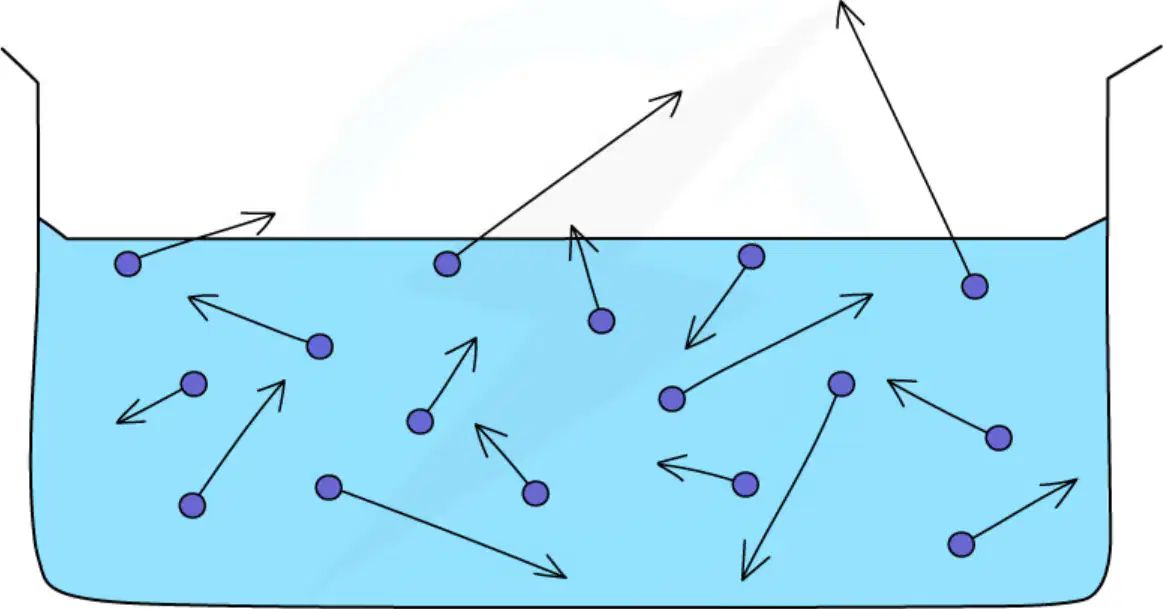
In the beaker diagram, arrows show some molecules leaving the surface. What do the arrows represent?
Molecules with enough energy escaping
Molecules gaining mass while sinking
Molecules forced down by pressure
Molecules cooling before condensing
Which change would reduce the cooling effect from evaporation of a liquid sample?
Warming the liquid slightly
Covering the surface with a lid
Spreading the liquid into film
Blowing dry air across it
Which set lists three primary factors that affect the rate of evaporation of a liquid?
Altitude, container shape, liquid taste
Temperature, surface area, air movement
Pressure, salinity, color of container
Viscosity, density, container mass
Why does increasing temperature generally increase the rate of evaporation?
Molecules gain kinetic energy to overcome attractions
Air above the liquid becomes immediately saturated
The liquid becomes heavier and sinks faster
Intermolecular forces get stronger with heat
Molecules escape a liquid most easily from which region, and why does this matter for evaporation?
From the surface; larger surface increases escape chances
From the sides; walls reduce attractive forces
From the bottom; pressure helps push molecules out
From the center; collisions eject molecules outward
How does increasing the surface area of a liquid affect its evaporation rate?
It increases the rate by exposing more molecules
It decreases the rate by cooling the liquid
It has no effect because depth is unchanged
It stops evaporation by reducing energy losses
What role does air movement play in evaporation near a liquid’s surface?
It heats the liquid uniformly from above
It compresses air and increases condensation
It removes moist air and brings in drier air
It traps water vapor near the surface
A wet cloth dries faster when spread out and fanned. Which two factors are mainly increased?
Temperature and pressure
Surface area and air movement
Depth and viscosity
Density and salinity
Which situation would most likely slow down evaporation of a pan of water?
Covering it with a lid to trap humid air
Placing it in warm sunlight outdoors
Spreading it into a shallow wide tray
Positioning a fan to blow across it
If two identical beakers of water are at the same temperature, which will evaporate faster and why?
Both evaporate equally; surface area is irrelevant
The smaller beaker; higher walls block humidity
The deeper beaker; higher pressure pushes molecules out
The beaker with larger surface area; more molecules can escape
A student claims increasing temperature strengthens the forces holding molecules in a liquid, reducing evaporation. What is the best evaluation of this claim?
Uncertain; depends only on container material
Incorrect; higher temperature helps overcome these forces
Partly correct; forces stay constant with temperature
Correct; stronger forces form at higher temperature
Why does wind increase the rate of evaporation from a pond?
It carries away water vapor, reducing local humidity
It cools the pond, lowering molecular energy
It increases pressure, forcing vapor back down
It dissolves air into water, reducing surface area
Which statement best describes why a liquid cools during evaporation?
External pressure increases, raising average kinetic energy
Fastest particles escape, lowering average kinetic energy
All particles stop moving, lowering average kinetic energy
Slowest particles escape, raising average kinetic energy
What happens to the average kinetic energy of the remaining liquid as the most energetic particles evaporate?
It oscillates due to random collisions
It decreases because higher speeds leave
It increases because slower speeds leave
It stays constant because energy is conserved
Placing an object next to an evaporating liquid tends to cool the object because the liquid does what?
Blocks thermal energy from the air
Releases thermal energy to the object
Absorbs thermal energy from the object
Converts thermal energy into sound
Which household technology uses evaporation to remove heat from nearby spaces?
Humidifiers and dehumidifiers
Microwave ovens and toasters
Electric heaters and radiators
Some refrigerators and air conditioners
A wet cloth is wrapped around a bottle. Over time the drink becomes cooler. What is the primary mechanism?
Evaporation removes energetic molecules
Conduction adds energy to molecules
Radiation increases molecular speeds
Compression raises the gas temperature
During evaporation, which particles are most likely to leave the liquid surface?
Those with exactly average speeds
Those with zero translational speeds
Those with lower-than-average speeds
Those with higher-than-average speeds
If evaporation reduces a liquid’s temperature, which change would most directly oppose this cooling?
Placing the liquid in moving air
Lowering the surrounding air humidity
Decreasing the surface area of the liquid
Condensation of vapor back into the liquid
A metal can is placed next to a rapidly evaporating liquid in a lab setup. Predict the energy transfer between the can and the liquid.
Thermal energy flows from can to liquid
Thermal energy flows from liquid to can
No energy transfer occurs between them
Electrical energy flows through the can
Which explanation best connects particle motion to macroscopic cooling during evaporation?
Loss of faster molecules reduces average energy
Gain of slower molecules increases average energy
Uniform molecule speeds increase total energy
Collision frequency alone controls total energy
A student claims evaporation always warms the surrounding air. Which reasoning best evaluates this claim?
Correct, evaporation releases energy into surroundings
Incorrect, evaporation has no energy exchange involved
Correct, particle loss raises average kinetic energy
Incorrect, evaporation absorbs energy from surroundings
Which change of state occurs in both evaporation and boiling?
Liquid to gas
Gas to liquid
Solid to liquid
Gas to solid
At what temperature does boiling occur for a pure liquid at fixed pressure?
100°C
0°C
25°C
50°C
Which quantity measures how much matter an object contains?
Density of the object
Volume of the object
Weight of the object
Mass of the object
What is the SI unit of force used in physics?
Watt unit
Pascal unit
Newton unit
Joule unit
Which statement best describes inertia?
Force per unit area on a surface
Rate of change of displacement over time
Energy stored due to an object's height
Tendency of matter to resist acceleration
An object moves at constant velocity on a frictionless surface. Which net force acts on it?
Backward net force
Forward net force
Zero net force
Upward net force
A 2 kg cart accelerates at 3 m/s^2. What is the net force on the cart?
6 newtons
2 newtons
3 newtons
5 newtons
Which graph shows uniform acceleration in a velocity-time plot?
A vertical line
A downward curving line
An upward sloping line
A horizontal line
Doubling the unbalanced force on a constant-mass object will do what to its acceleration?
Halves its acceleration
Doubles its acceleration
Leaves its acceleration
Triples its acceleration
A stone is thrown straight up. At the highest point, which is true about its velocity and acceleration?
Velocity zero, acceleration zero
Velocity zero, acceleration downward
Velocity upward, acceleration zero
Velocity downward, acceleration upward
Which situation best illustrates Newton’s third law?
Ball slowing due to friction
Book resting on a shelf
Car moving at steady speed
Rocket pushing gas backward
Pressure increases when the same force is applied over a smaller area. Which example shows this principle?
Sharp knife cutting vegetables
Broad tires on muddy roads
Wide skis on soft snow
Large shoes reducing foot pressure

