
Font size
 Worksheets
Part I: General - Introduction to Engineering Materials
Total questions: 61
Worksheet time: 31mins
Which list shows the four basic classifications of engineering materials commonly used in engineering?
Metals, ceramics, polymers, semiconductors
Crystals, liquids, gases, plasmas
Conductors, insulators, magnets, superconductors
Metals, glasses, woods, composites
Alloys, minerals, plastics, fluids
Primary chemical bonds that largely determine solid material properties are mainly which of the following?
van der Waals attractions
Hydrogen bonds between molecules
Metallic bonds among cations
Ionic bonds between ions
Covalent bonds between atoms
In metals and their alloys, the dominant primary bonding type is typically what?
Only van der Waals bonding
Mostly hydrogen bonding
Primarily ionic bonding
Mainly covalent bonding
Predominantly metallic bonding
Which statement best contrasts crystal structure and lattice structure in crystalline materials?
Both describe periodic atomic arrangements
Crystal is order; lattice is amorphous disorder
Crystal is microscopic; lattice is macroscopic
Crystal is random packing; lattice is voids
Crystal is chemical bonding; lattice is defects
Match each material class to the bonding behavior that is commonly present in that class.
Metals and alloys
Mostly metallic bonding
Semiconductors
Mainly covalent bonds
Many ceramics
Mixture of covalent and ionic
Which crystalline structures are frequently observed in metals?
Face-centered cubic (fcc)
Body-centered cubic (bcc)
Amorphous random network
Zincblende tetrahedral network
Hexagonal close-packed (hcp)
Which statement about microstructure is most accurate for engineering materials?
It describes grain size, phase presence, and distributions
It considers composition but not internal phases
It is only the arrangement of electrons in atoms
It ignores defects like dislocations and interfaces
It applies only to single crystals of metals
According to the summarized trends, which material properties are strongly influenced by both atomic arrangements/defects and microstructure in metallic materials?
Mechanical properties like strength and ductility
Chemical properties like catalytic potential
Nuclear properties like neutron cross section
Optical properties like color saturation
Biological properties like biocompatibility
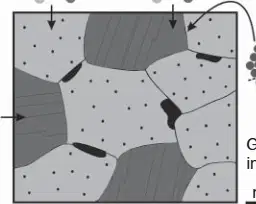
In the schematic, two phases are shown with different crystal structures. Which pair correctly matches the labeled α- and β-phases?
α is bcc, β is fcc
α is fcc, β is bcc
α is amorphous, β is fcc
α is bcc, β is hcp
α is hcp, β is bcc
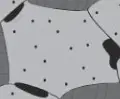
Which microstructural feature in the diagram represents a line defect that ends within a crystal and contributes to plastic deformation?
Edge dislocation line
Grain boundary area
Twin boundary plane
Vacancy point defect
Phase boundary line
Vacancies have an equilibrium concentration that depends strongly on temperature. Which range best represents their mole fraction from room temperature to near melting?
10−12to10−8
10−9 to 10−5
10−3to10−2
10−6 to 10−1
10−15to10−4
According to the table, what is a typical range for dislocation density in metals from annealed to heavily cold-worked states?
104 to 108 m^{−2}
1012to1014m−2
10^{16} to 10^{20} m^{−2}
10^2 to 106m−2
1010 to 1016 m^{−2}
Match each microstructural constituent to a role or effect it is responsible for.
Vacancies
Diffusional creep at elevated temperatures
Dislocations
Plastic deformation and strength control
Grain boundaries
Work hardening by acting as barriers
Precipitates/dispersoids
Increase in strength by interacting with dislocations
Phase arrangement
Control of thermo-physical properties; embrittlement risk
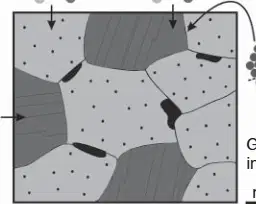
Which statement best describes a solid solution in the context of the phases shown?
Mechanical mixture of unmixed crystals
Nanoporous network with void channels
Homogeneous crystalline phase with two or more species
Amorphous matrix with crystalline inclusions
Two-phase mixture with sharp interfaces
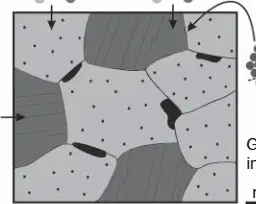
Which features are boundaries separating regions of different crystal orientation within the same phase?
Grain boundaries
Subgrains/domains
Vacancies
Twin boundaries
Phase boundaries
Which factors most directly influence the behavior of dislocations listed in the table?
Stacking fault energy and ordered structure
Heat treatment and particle–matrix coherency
Lattice orientation between neighboring grains
Alloy system, composition, phase stability
Deformation, temperature, recovery and recrystallization
What effect do annealing twins have during grain growth, as noted in the table?
Increase vacancy formation
Lower total boundary energy
Promote cross-slip motion
Increase diffusion rates
Harden at high strain rates
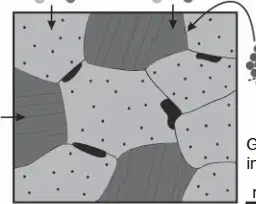
Which size ranges are appropriate for grains and subgrains listed in the constituents table?
Grains: μm–cm; Subgrains: nm–dm
Grains: pm–nm; Subgrains: nm–dm
Grains: nm–mm; Subgrains: cm–m
Grains: nm–μm; Subgrains: μm–cm
Grains: nm–dm; Subgrains: nm–μm
Which combination correctly links dependent characteristics with grain boundaries from the roles table?
Heat treatment and coherency
Alloy system and phase stability
Stacking fault energy of fcc materials
Ordered structure in intermetallics
Lattice orientation between neighboring grains
Which statement best explains why dislocation motion is central to plastic deformation in metals?
Because moving dislocations allow slip under shear stress
Because vacancies diffuse rapidly at low temperatures
Because grain boundaries melt and permit flow
Because precipitates dissolve and increase ductility
Edge and screw dislocations differ primarily in which aspect?
Orientation of Burgers vector relative to dislocation line
Magnitude of stacking fault energy in the lattice
Presence of interstitial atoms near the core
Ability to form antiphase boundaries in domains
Which change generally increases grain boundary energy in a polycrystal?
Larger misorientation between neighboring grains
Lower dislocation density within each grain
Formation of coherent precipitate interfaces
Presence of extensive twin boundaries
Twins in metals are characterized by which structural feature?
Mirror image atomic positions across the boundary
Random orientation relationship between domains
Thick amorphous layers at interfaces
Extensive vacancies concentrated along planes
Match each term with its most appropriate description.
Antiphase boundary
Interface separating ordered domains in a crystal
Small-angle boundary
Boundary describable by arrays of dislocations
High-angle boundary
Boundary with large misorientation and higher energy
Twin boundary
Boundary with mirror symmetry across the plane
Cross-slip
Slip of screw dislocations to another plane
In precipitation hardening, which factor most directly provides strengthening when nanoscale particles are uniformly dispersed within grains?
Obstacles to dislocation motion within the matrix
Enhanced grain boundary sliding at high temperature
Promotion of vacancy diffusion across domains
Increase in electron valency of the alloying elements
Which scenarios are likely to decrease the hardening achieved by precipitates over service time? Select all that apply.
Transformation to incoherent phases at interfaces
Loss of coherency at particle–matrix interfaces
Stable nanoscale dispersion within each grain
Coarsening reduces particle number density
Large precipitates located along grain boundaries can have mixed effects. Which outcome is a potential drawback described for steels?
Significant increase in creep resistance
Enhanced diffusion bonding between grains
Serious embrittlement at the boundaries
Complete elimination of dislocation sources
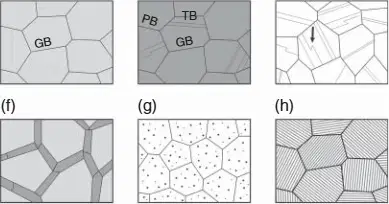
Look at the schematic labeled (a). It shows a single crystal with no grain boundaries. Which property most distinguishes a single crystal from a polycrystal of the same material?
Higher number of grain boundary defects
Randomly oriented grains in regions
Presence of multiple phase interfaces
Uniform lattice orientation throughout
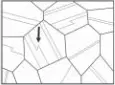
Panels (b) and (d) show polycrystalline single-phase metals. In (d) many twin boundaries are visible. Which statement best explains the lines marked TB in (d)?
Incoherent precipitate interfaces in the matrix
Phase boundaries separating fcc and bcc phases
Coherent twin planes formed during annealing
High-angle grain boundaries from solidification
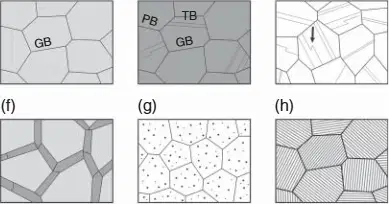
Compare schematics (c), (f), and (h). All depict two-phase materials but with different architectures. Match each schematic to the most appropriate description.
(c) two phases separated by PBs
α+β grains with phase boundaries
(f) ferrite along GBs of pearlite
proeutectoid network at grain edges
(h) alternating lamellae after eutectoid
plates/lamellae of phases in colonies
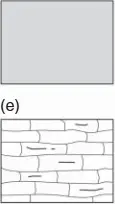
Panel (e) shows elongated grains after rolling. Which microstructural feature is most directly responsible for anisotropic sheet properties after heavy cold work?
Deformation texture aligning crystallographic planes
Increase in average melting temperature
Formation of new phases at triple points
Removal of all dislocations by recovery
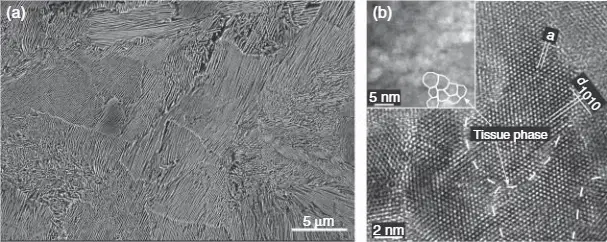
Figure 1.4 compares a pearlitic steel microstructure (~10 μm grains) with a TiB2 coating nanostructure (<5 nm grains). Which conclusions are valid? Select all that apply.
Grain size reduction strengthens by hindering dislocations
Coatings with <5 nm grains have fewer boundaries per volume
Nanostructures have vastly higher grain boundary area
Pearlitic steel shows lamellar colonies at micrometer scale
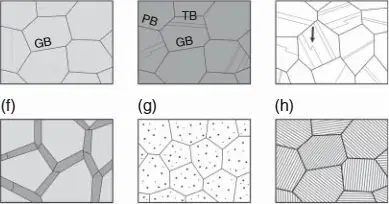
Panel (c) in Figure 1.3 shows α and β grains, some labeled PB for phase boundaries. Which statement best distinguishes a phase boundary (PB) from a grain boundary (GB) in metals?
PB separates regions with different crystal structures
PB separates same phase with different orientations
PB always has lower interfacial energy than GBs
PB forms only during recovery processes
Which mechanism primarily increases yield strength by increasing dislocation density through plastic deformation?
Dispersion strengthening promotes pore growth
Solid solution reduces vacancy diffusion
Grain refinement reduces boundary sliding
Work hardening increases dislocation density
A finer grain size generally strengthens a metal because grain boundaries act as barriers to what?
Dislocation motion during plastic deformation
Electron diffusion under thermal gradients
Nucleation of second phase particles
Formation of long-range crystallographic order
Why does misorientation between neighboring grains contribute to strengthening in polycrystalline metals?
Dislocations must change slip planes at boundaries
Vacancies condense into stable nanopores
Atoms reorder into a single crystal
Electrons reflect and increase resistivity
In solid solution hardening, how can a solute atom impede dislocation motion?
By reducing the shear modulus of the matrix
By promoting recovery and recrystallization
By increasing grain boundary sliding rates
By creating a misfit strain field around dislocations
Which statement best describes dispersion strengthening at room temperature?
Recovery eliminates obstacles to slip
Alloying reduces climb around particles
Fine grains accelerate diffusional creep
Coherent particles obstruct dislocation cutting
At elevated temperatures above roughly one third of the melting temperature, which processes begin to dominate strength loss?
Recovery, recrystallization, diffusion and creep
Increased dislocation multiplication only
Rapid precipitation of coherent particles
Enhanced electrical resistivity hardening
Which mechanism can overcome particle obstacles to dislocations at high temperatures, reducing strengthening?
Diffusion-assisted climb of dislocations
Cross-slip on primary planes only
Grain rotation without diffusion
Twinning under low stresses
Match each strengthening mechanism to its main scaling parameter.
Work hardening
Dislocation density
Grain size reduction
Grain size
Solid solution hardening
Concentration of solute atoms
Dispersion strengthening
Particle size and volume fraction
Which combination is most likely to maximize barrier effects to dislocations at ambient temperature?
High dislocation density from cold work
Coherent fine particles well dispersed
Large grains with strong texture only
Low solute concentration in matrix
Reduced grain size increasing boundary area
Which observation best captures the Hall–Petch type trend described for grain size?
Yield strength is independent of dislocation density
Yield strength falls with increasing solute size
Yield strength rises with decreasing grain size
Yield strength peaks at maximum pore growth
In solid solutions, a solute with elastic modulus differing from the matrix strengthens by which interaction?
Promotion of long-range diffusion creep
Formation of microvoids around solute clusters
Enhanced electron scattering at boundaries
Dislocation–atom interaction via modulus mismatch
Which microstructural change can cause a cold-worked metal to lose strength on heating?
Recovery and recrystallization reduce dislocations
Increased multiplication of forest dislocations
Formation of coherent nanoprecipitates
Strengthening by transformation hardening
Which technique is typically used to determine grain size in engineering materials and is limited by the ~500 nm wavelength of light?
Scanning electron microscopy (SEM)
Light optical microscopy (LOM)
Transmission electron microscopy (TEM)
Scanning transmission electron microscopy (STEM)
On the microstructural length scale diagram, which methods probe features at atomic-to-nanometer scales?
SEM and FIB
CTEM and HRTEM
STEM and atom probe
LOM and X-ray diffraction
Which statement best describes a common limitation of SEM for chemical composition mapping using EDX/WDX?
Only qualitative spectra can be recorded without calibration
Electrons cannot excite X rays in metals at room temperature
Beam diameter is too large, limiting to ~1 mm
Interaction volume exceeds beam size, blurring to ~1 μm
Match each technique to the typical spatial resolution it can achieve.
LOM
~500 nm limit
SEM imaging
several to tens of nanometers
EBSD in SEM
~50 nm on surfaces
STEM–EELS
few nanometers or better
Which capability is specific to TEM but not accessible by LOM for sub‑micrometer particles?
Estimating sample surface roughness visually
Observing millimeter-scale features clearly
Determining crystal orientation relationships
Measuring macroscopic sample dimensions
In FIB/SEM tomography of a two‑phase TiAl alloy, what did 3D reconstructions reveal about the phases?
Both phases formed interconnected networks
Only γ phase was continuous throughout
Only β0 phase was continuous throughout
Both phases were isolated spherical particles
Which pair of microstructural features is commonly identified in conventional TEM images?
Voids and macropores
Dislocations and twins
Macrocracks and machining marks
Grain-size bands and shear lips
Why can SIMS in FIB often not classify small particles by chemistry despite sub‑micrometer lateral resolution in principle?
Detector dynamic range is too small
Insufficient counting statistics in practice
Surface charging prevents ion emission
Primary ions cannot sputter metals
High‑resolution TEM using STEM can visualize which of the following with Z‑contrast imaging?
Bulk texture via millimeter diffraction rings
Millimeter‑scale porosity in castings
Surface color differences due to oxidation
Atomic structure at interfaces of nanometer precipitates
Which statement best distinguishes HRTEM imaging from Z-contrast imaging in STEM?
HRTEM relies on condenser lens size; Z-contrast ignores lens aberrations
HRTEM detects atomic number; Z-contrast detects phase contrast
HRTEM uses a parallel beam; Z-contrast scans a convergent beam
HRTEM collects scattered electrons; Z-contrast collects diffraction spots
In Z-contrast imaging, the detected signal is roughly proportional to which quantity for the scattering atoms?
Square root of the atomic mass
Square of the atomic number
Fourth power of the atomic radius
Inverse of the atomic number
Match each technique to the specific capability described.
HRTEM
Interference pattern image with parallel beam
Z-contrast STEM
Atomic-number sensitive signal by scanned probe
Field-ion microscopy
Terrace geometry via imaging gas ionization
Atom probe tomography
3D elemental mapping via time-of-flight
Which limitation is common to conventional TEM imaging of microstructures?
It provides a two-dimensional projection of a 3D sample
It cannot image crystalline lattice fringes at all
It measures dislocation density with absolute accuracy
It analyzes large volumes in a single acquisition
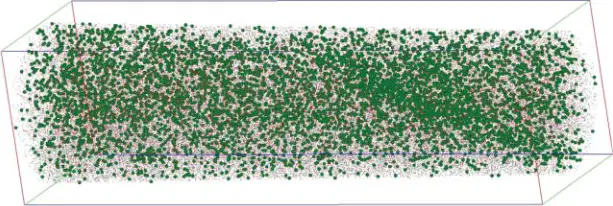
Atom probe tomography is especially suitable for which tasks? Select all that apply.
Measuring surface roughness at the micrometer scale
Mapping long-range residual stresses over centimeters
Determining 3D elemental distributions at defects
Studying initial stages of precipitation chemistry
Cottrell atmospheres observed in Ti–Al–Nb alloys refer to what phenomenon?
Local solute enrichment at dislocations
Uniform solute distribution in the matrix
Complete depletion of solute around precipitates
Formation of voids at grain boundaries
Which statement about field-ion microscopy (FIM) is correct?
Imaging gas ions reveal tip terrace geometry on a fluorescent screen
A parallel electron beam scans the sample and measures Z-contrast
Electrons form an interference image detected point by point
It directly provides 3D composition without mass spectrometry

