
 Worksheets
Unit 9 Bellringer Questions
Total questions: 13
Worksheet time: 7mins
Name
Class
Date
1.
Why was the name "Holy Roman Empire" chosen for the empire?
a)
So the world would know they were a Christian version of the Roman Empire
b)
Martin Luther got to choose it
c)
It was a continuation of the religion of the Roman Empire
d)
To scare the Muslims into converting to Christianity
2.
Which of the following best describes peasants in the feudal system?
a)
They paid nobles to work the land and keep the crops they grew.
b)
They divided up land for the vassals to rule over.
c)
They worked the land for the nobles, giving the nobles the crops they grow.
d)
They fought on horseback with lances.
3.
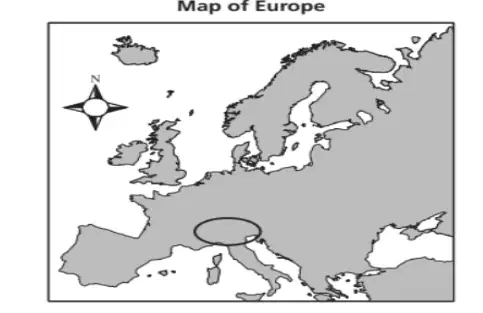
Which feature can be found in the area circled on the map?
a)
Alps
b)
Ural Mountains
c)
North European Plain
d)
North Atlantic Drift
4.
Which of the following does not explain the influence of Charlemagne in medieval Europe?
a)
He strengthened the influence of the pope over rulers
b)
He contributed to the spread of Christianity throughout Europe
c)
He supported voyages of exploration to discover new lands
d)
He united much of western Europe together into a single empire
5.
Which statement describes the relationship between the pope and Charlemagne during the Middle Ages?
a)
They needed each other's help in order to maintain power.
b)
They frequently encouraged attacks on each other's power.
c)
They seldom came to each other's aid when power was threatened.
d)
They acted independently of each other to prevent disputes.
6.
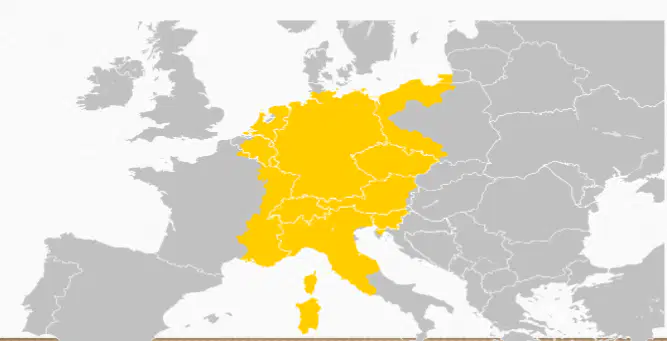
The area highlighted in yellow was ruled over by Charlemagne during the Middle Ages. What was it called?
a)
Central Asia
b)
the Holy Roman Empire
c)
the Byzantine Empire
d)
the Germanic tribes
7.
Monasteries played an important role in early medieval culture mainly by
a)
teaching people better methods of military defense
b)
providing a court system for local justice
c)
preserving ancient knowledge in libraries
d)
establishing the manorial system
8.
What was feudalism, and why was it important to medieval Europe?
a)
The social system in Europe consisting of kings, clergy, knights, lords, and peasants. It created rules and protection during a violent time when people needed it.
b)
The social system in Europe consisting of kings, clergy, knights, lords, and peasants. It allowed peasants an opportunity to gain power and wealth.
c)
The name of the rivers that connected Europe together. It opened up the country for trade.
d)
The name of the rivers that connected Europe together. It allowed Christianity to spread.
9.
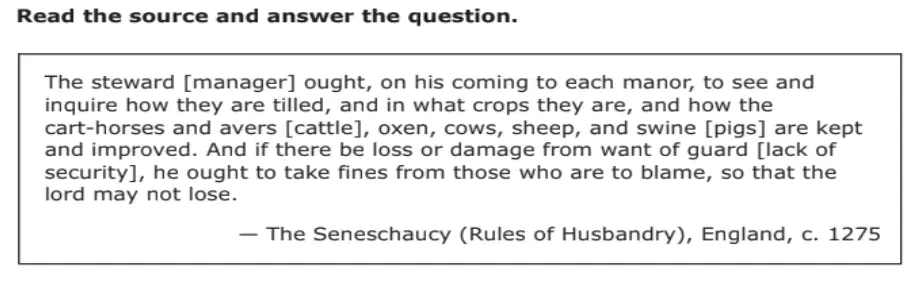
Which statement about manorialism and its role in the medieval economy is supported by this source?
a)
The nobles wealth came from the labor of the peasants
b)
Kings became less able to protect nobles' lands against invasions
c)
The leaders of the church held more authority than nobles
d)
Cities lost their importance as nobles became more powerful
10.
What was the importance of the guilds?
a)
the guilds made it impossible for peasants to own land or find jobs
b)
the guilds set the prices and standards of quality for the products sold
c)
the guilds made laws for people in the cities to live by
d)
the guilds would keep invaders like the Muslims out of their city
11.
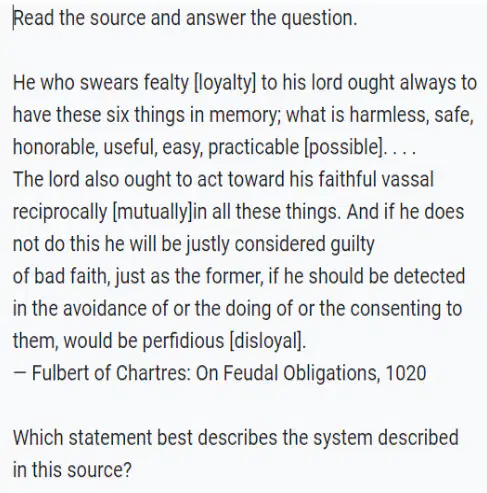
Which answer best describes the system from the source?
a)
Feudalism is dependent on the vasal and lord upholding obligations of service to one another
b)
Under a fedual system, the lord is able to retain all profits made by the work of the vasal on the land
c)
Feudalism requires the vasal and the lord to act independently of each other in service to the king
d)
Under a feudal system, the king is obligated to the lord to provide assistance in exchange for titles of nobility
12.
What were the mendicant orders?
a)
Orders from the king that dealt with religious matters
b)
Groups of people who lived in monasteries and studied to become priests
c)
Groups of people who owned no property or possessions because they wanted to live a simple life like Jesus did
d)
Trade routes that involved peasants from Europe
13.
What did Thomas Aquinas prove that was important?
a)
The will of God can only be fulfilled by those who are pure in heart
b)
That there is no conflict between faith and reason because both come from God
c)
Universities only work when they are secular in nature and not religious
d)
Studies like Greek philosophy should not be taught because they go against the Bible
100 %

