
 Worksheets
Introduction to Geotechnical Engineering
Total questions: 52
Worksheet time: 26mins
A new highway embankment is planned over soft clay. Which initial action should a civil engineer prioritize to manage soil-related risks effectively?
Conduct subsurface exploration and soil testing program
Rely on historical maps to estimate foundation depth
Increase pavement thickness without soil investigation
Specify stronger concrete for bridge superstructure
Which statement best describes the primary purpose of shallow foundations in building projects?
Anchor structures against lateral wind forces
Increase architectural floor-to-floor heights
Prevent water ingress into basement spaces
Transfer building loads into underlying ground
Concrete spread footings are typically selected for which site condition and loading scenario?
Soft clay requiring deep pile foundations
Loose soil with extremely heavy bridge loads
Firm soil with relatively light structural loads
Variable rock with need for tension anchorage
Mat (raft) foundations are most appropriate when which condition exists?
Differential settlement is advantageous structurally
Rock is shallow with high allowable pressure
Loads are light and widely spaced columns
Soil bearing capacity is low across the site
A building’s column layout would require individual footings covering more than half the plan area. Which foundation type provides a more efficient alternative?
A single mat foundation supporting all columns
Deep drilled shafts under each column
Strip footings under only perimeter walls
Timber piles with isolated cap beams
Which combination of site and structural factors most justifies choosing a raft foundation instead of isolated footings?
Low bearing capacity, heavy column loads, settlement control
High bearing capacity, light column loads, cost reduction
Exposed bedrock, minimal loads, rapid construction
Variable wind loads, tall steel frames, braced cores

Which statement best describes the primary purpose of deep foundations in geotechnical engineering?
Transfer structural loads to firm ground
Eliminate the need for reinforcement steel
Increase building height without extra supports
Reduce concrete volume for tall buildings
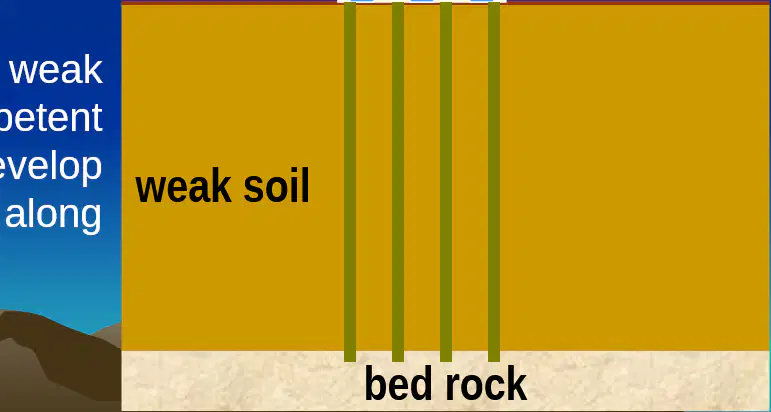
A site has thick weak clay over bedrock. Which mechanism can a pile use to safely support loads if bedrock is very deep and cant be attained?
Buoyancy uplift from groundwater
Lateral bracing from adjacent piles
End bearing only at the pile tip
Side or Shaft friction developed along its length
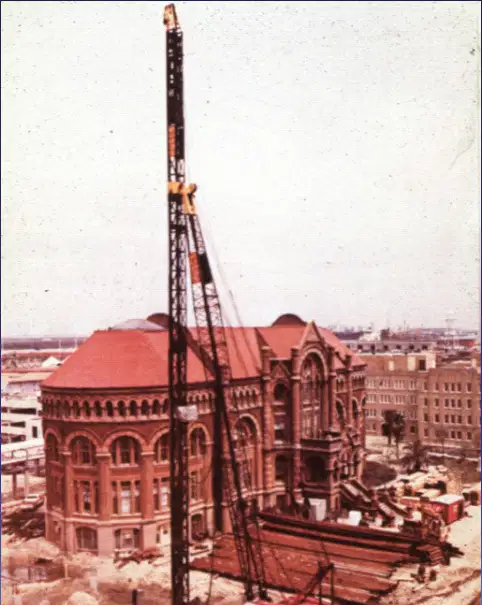
Driven piles are most accurately characterized by which construction feature?
Installed by impact hammers into the ground
Formed by pumping grout under low pressure
Advanced using continuous flight augers only
Cast in place using slurry trench methods
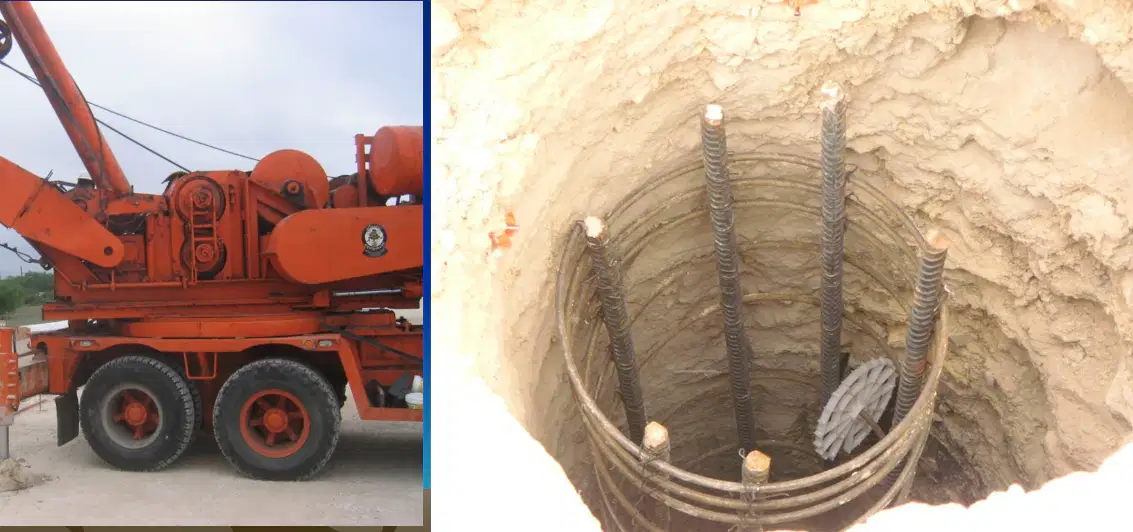
At a historic downtown site, vibrations from pile driving are not acceptable. Which foundation choice is most appropriate?
Driven timber piles installed with diesel hammers
Micro-piles driven with high-energy hammers
Precast concrete piles driven to refusal
Drilled shafts constructed with reinforcement cages
Imagine a famous structure, the Leaning Tower of Pisa, which has been standing for centuries. Engineers are trying to understand the behavior of its foundation. Which soil profile best explains the Leaning Tower of Pisa’s foundation behavior?
Thick dense sand over bedrock
Thin clay over stiff gravel
Uniform dense silty sand
Sandy layer over weak clay
Peat over weathered shale
During a visit to Italy, Emma learned about the famous Leaning Tower of Pisa. She was curious about the reasons behind its southward tilt. What was the primary mechanism causing the Pisa tower to tilt southward?
Liquefaction during construction
Uniform consolidation under the base
Differential settlement from uneven stresses
Creep of the masonry superstructure
Erosion from groundwater flow
While visiting Italy, Benjamin noticed that the Leaning Tower of Pisa was not standing straight. He wondered, what is the approximate current lean of the Leaning Tower of Pisa?
Five degrees from vertical
Twelve degrees from vertical
Two degrees from vertical
Fifteen degrees from vertical
Eight degrees from vertical
The Transcona grain elevator failure in Canada primarily illustrates
Excessive settlement from uniform consolidation
Bearing capacity failure of a shallow foundation
Slope instability of a retaining embankment
Structural collapse from concrete crushing
Overturning due to wind-induced resonance
During a recent inspection of the Transcona elevator, engineers discovered that it was tilting dramatically. After thorough analysis, they sought to identify the factor that most likely contributed to this issue.
Rock socketed caissons with high capacity
Deep pile foundation with high stiffness
Underloaded foundation with wide footings
Overloaded shallow foundation on weak soil
Raft foundation on competent bedrock
During a recent inspection, engineers discovered that the Palacio de Bellas Artes experienced more than 340 cm of
Settlement in spongy soil
Torsional rotation collapse
Heave from swelling clay
Upward buoyant uplift
Lateral spreading failure
Why was structural damage at the Palacio de Bellas Artes minimized despite large movement?
Settlement occurred evenly across the foundation
Foundation was anchored to bedrock
Superstructure used flexible steel frames
Immediate underpinning was installed early
Groundwater lowering prevented pore pressure rise
When planning foundations for heavy silos on soft ground, a robust strategy is to
Use isolated pads with narrow widths
Increase height without changing base area
Ignore consolidation effects in design
Rely on post-construction mudjacking alone
Adopt deep foundations or soil improvement
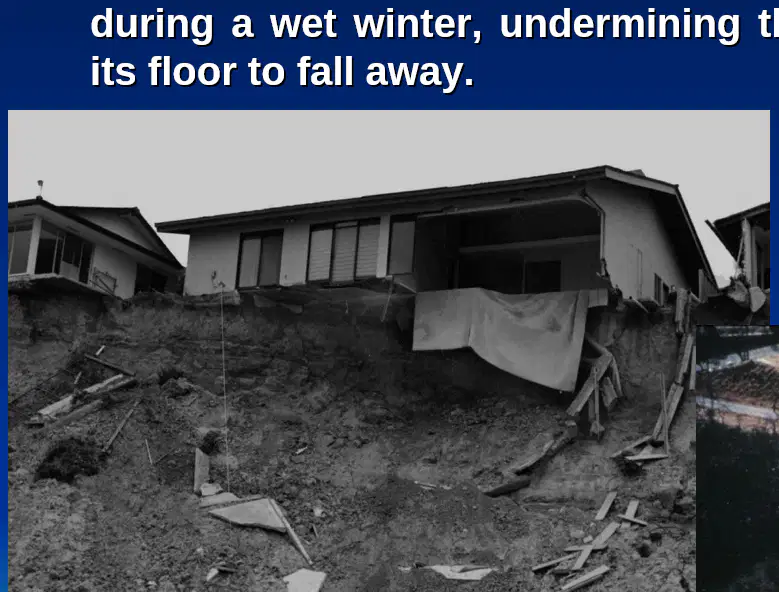
Which condition most likely triggered the landslide that undermined Ethan's ocean‑view house near a slope crest?
Thermal expansion during a summer heatwave
Gradual subsidence from groundwater pumping
A single dry-season wind erosion event
Prolonged wet winter increasing pore pressures
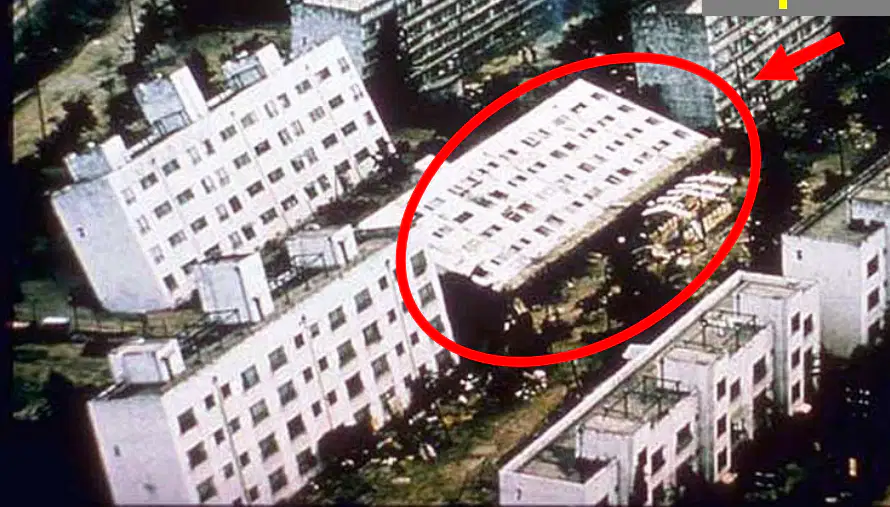
During a recent earthquake in a coastal city, residents noticed that several apartment buildings at the port site tilted significantly. What could explain this phenomenon?
Saturated loose sands lost shear strength
Bedrock fractured into large joint blocks
Clay desiccation caused differential shrinkage
Deep foundations overheated and elongated
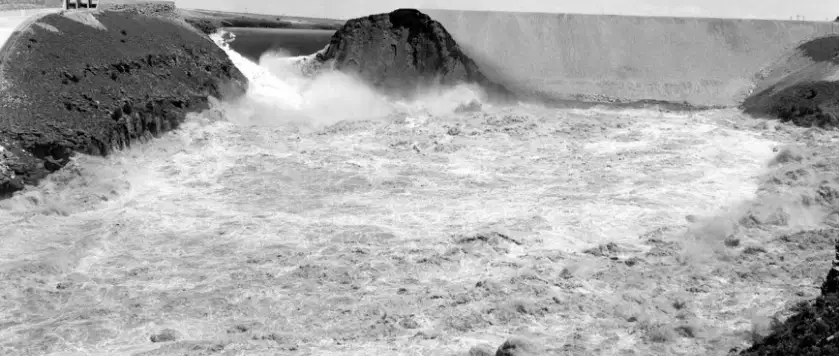
Which historical dam failure emphasized the importance of proper dam design and construction in the United States during the 1970s?
The Glen Canyon crack in 1970 Utah
The Teton Dam breach in 1976 Idaho
The Hoover Dam spill in 1937 Nevada
The Oroville weir in 1968 California
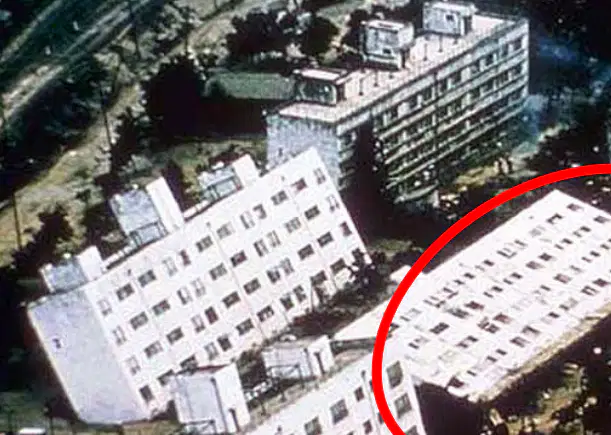
During strong shaking, what primary mechanism transforms saturated loose sand into a fluid-like mass capable of causing building rotation?
Dilative shear causing stress hardening
Cementation increase raising apparent cohesion
Pore pressure buildup reducing soil grains friction
Capillary rise strengthening particle contacts
A project in a seismic region requires mitigation planning. Which question fits this need?
How will the site respond to earthquakes and what mitigation is needed?
Which crane configuration minimizes jobsite downtime during lifts?
What landscaping will reduce irrigation water consumption the most?
How can the roof slope be increased without changing height?
Elijah is studying the behavior of different soil types in his garden. He notices that the way the soil drains water varies depending on the direction he measures it. Which statement best describes anisotropy in soils?
Properties change only with temperature
Properties differ with direction in the soil
Properties are identical in all directions
Properties vary only with time of loading
In a construction project, Kai discovers that the soil deposit at the site shows significant variations. This non-homogeneity in the soil primarily means that
properties change with depth and location
properties remain uniform across the site
properties are defined by grain color
properties depend only on pore water
During a construction project in a hilly region, engineers face challenges due to material variability. This variability makes geotechnical engineering challenging because
soil and rock properties vary significantly across sites
soil layers always have sharp defined boundaries
laboratory results are identical for all samples
field measurements are unaffected by sampling
Hannah is conducting a geological survey in a region where the soil layers are not clearly defined. She encounters a challenge while trying to analyze the data collected from the site. Which challenge is associated with unclear soil layer contacts?
Perfect stratification reduces errors
Undefined boundaries complicate analysis
Homogeneous layers simplify testing
Anisotropy ensures easy predictions
In a construction project, Ava is analyzing a type of clay used for building foundations. She notices that the clay is stiffer when tested vertically than when tested horizontally. This observation leads her to conclude that the clay exhibits a specific behavior. What type of behavior is Ava observing in the clay?
homogeneous isotropic soil
anisotropic behavior in soils
chemically stabilized clay
time-dependent creep only
During the construction of a new building, the engineers are assessing the ground conditions to ensure the foundation can support the structure. Which factor is central to load-bearing capacity in foundations?
optical mineralogy of grains
ability to carry loads without failing
rate of chemical weathering only
color uniformity of soil layers
In a construction project, Abigail is tasked with predicting the time-dependent settlement of foundations for a new building. She knows that understanding the consolidation properties of the soil is critical for making accurate predictions.
time-dependent settlement of foundations
ultimate tensile strength of steel
erosion of riverbanks by waves
color changes in weathered rock
Which combination best describes soil as a material in geotechnical engineering?
Compacted clay with no water or gases
Pure mineral crystals without voids or air
Cemented rock with crystals and salts
Loose grains with organics, water, and air
Which term best describes how much a soil layer compresses under sustained loading from a foundation?
Hydraulic conductivity of pores
Shear strength at failure planes
Settlement or deformation under load
Bearing capacity of shallow soil
A site experiences rapid vertical displacement of clay immediately after a heavy load is applied and then slowly continues deforming over months. Which paired concepts most directly describe these stages?
Peak strength then residual strength
Immediate settlement then consolidation
Liquefaction onset then densification
Elastic rebound then creep rupture
For a square footing on sand, the design question 'How much load can we apply before it fails?' refers primarily to which capacity?
Tensile capacity of the pad
Compaction capacity of fill
Bearing capacity of the soil
Flexural capacity of the slab
During an earthquake, saturated loose sand temporarily behaves like a fluid, causing foundations to lose support. What is this phenomenon called?
Cavitation in groundwater flow
Undrained swelling of clays
Liquefaction of granular soil
Consolidation settlement of strata
Which statement best explains why earthquake engineering is important in Lebanon?
Lebanon is isolated from regional plate boundaries
Lebanon experiences only rare microseismic tremors
Lebanon lies near multiple active fault systems
Lebanon has uniformly stable crystalline bedrock
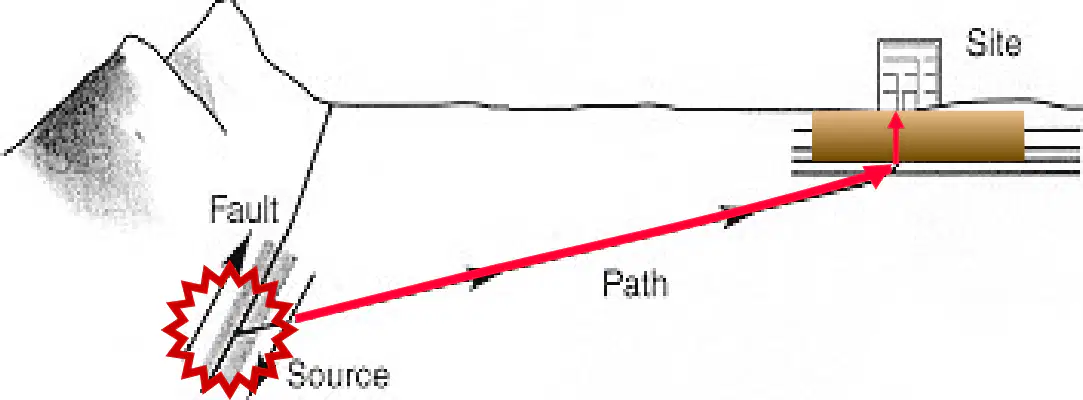
A seismic wave travels from a fault source toward a site. Which segment is most likely to amplify ground motion for buildings?
Deep competent bedrock along the path
Surficial soil layers near the ground surface
The free surface of open water bodies
The rupture plane within the fault zone
A regional network recorded earthquakes in Lebanon between 2006 and 2018 with magnitudes roughly from 2 to 6. Which design action most appropriately addresses this seismicity for urban sites on soft soils?
Rely solely on historical felt reports
Design only for rare magnitude seven events
Ignore local soils and apply rock motions
Perform site response analysis for amplification
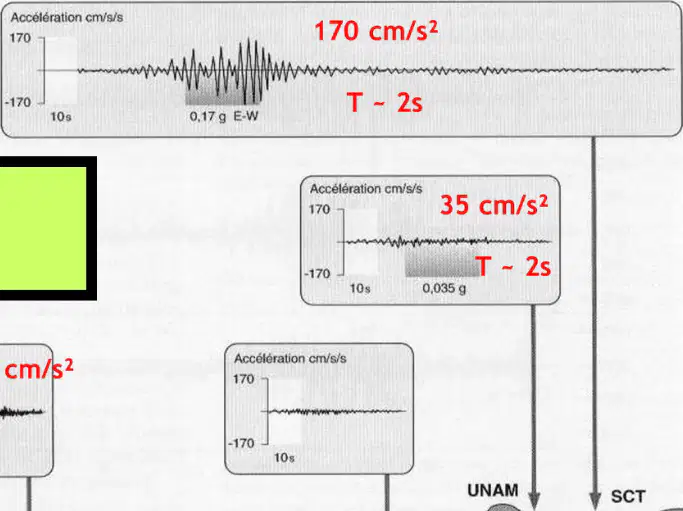
Which site condition primarily caused amplified ground accelerations in Mexico City during the 1985 earthquake?
Weathered bedrock with minor fractures
Hard rock basin edges with thin layers
Soft lake-bed soils with deep deposits
Stiff sandy soils with low damping
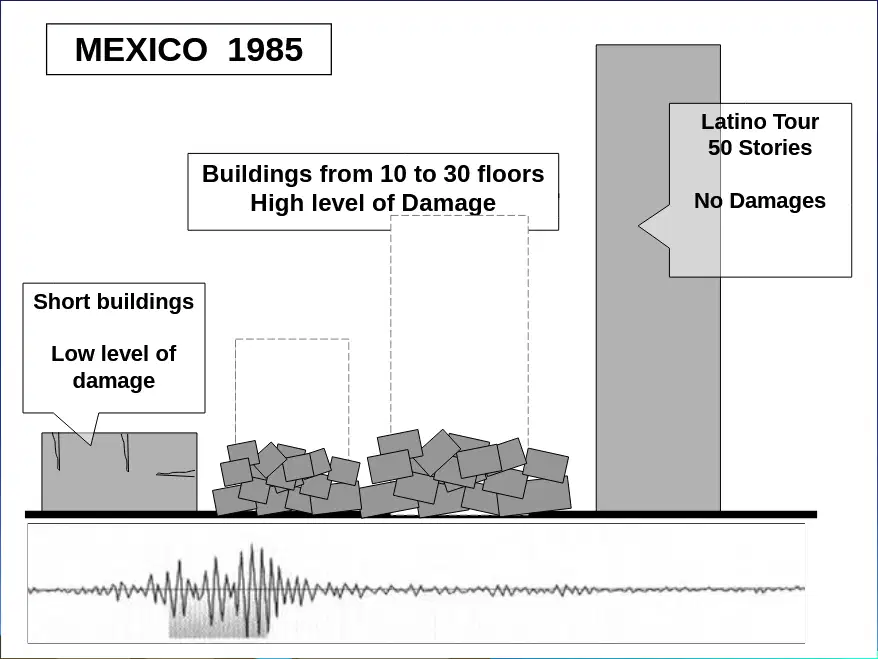
Why did 10–30 story buildings in Mexico City suffer higher damage than very short buildings in 1985?
Nonstructural failures controlled collapse mechanisms
Wind-induced coupling increased lateral loads
Resonance with ~2 s soil vibration period
Foundation settlements dominated structural response
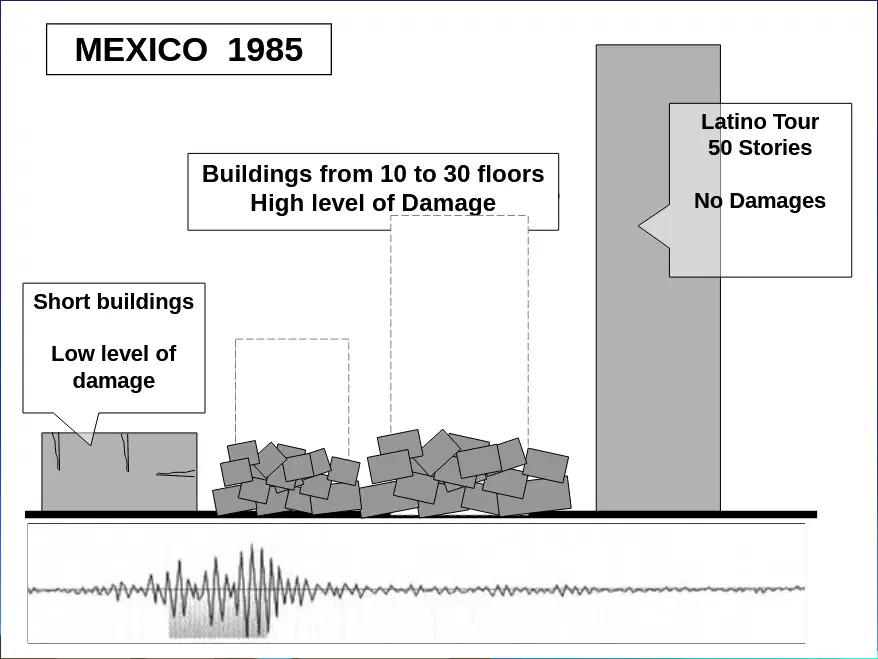
Which statement best explains why the 50‑story Latino Tower reportedly avoided major damage in 1985?
It was located on hard bedrock near the epicenter
Its natural period differed from the ~2 s site period
Its mass reduced inertial forces from shaking
It used timber bracing that absorbed earthquake energy
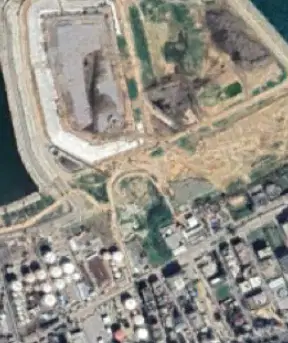
In the aerial view of coastal landfills, what primary role does proper geotechnical design serve for urban waste disposal sites near the shoreline?
Prevent environmental contamination spreading to waters
Increase landfill capacity without engineering controls
Maximize waste compaction regardless of site geology
Relocate waste closer to dense urban neighborhoods
According to the exposure pathways diagram, which risk occurs when volatile compounds escape from waste masses?
Groundwater mounding beneath liners
Surface runoff reducing landfill erosion
Noise pollution from collection vehicles
Air pollution affecting nearby populations

In the diagram, what is the primary purpose of the black geomembrane layer shown above the compacted clay liner?
Serve as a drainage blanket for rapid dewatering
Increase shear strength of the underlying subgrade
Act as a low-permeability barrier to leachate migration
Provide structural load distribution across the cell
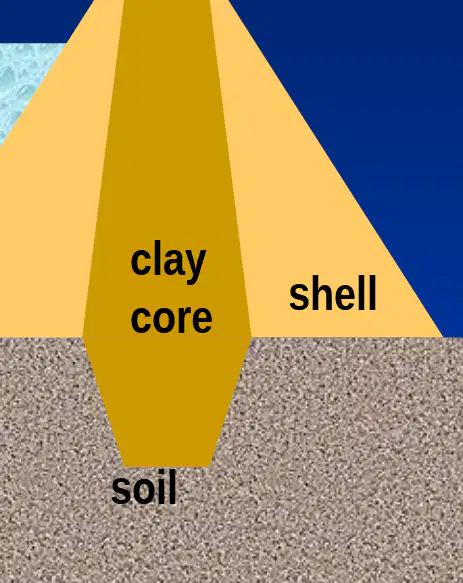
Which component in an earthfill dam primarily provides low permeability to limit seepage through the structure?
Outer rockfill shell for drainage control
Central clay core for seepage control
Downstream berm for slope stabilization
Crest roadway for maintenance access
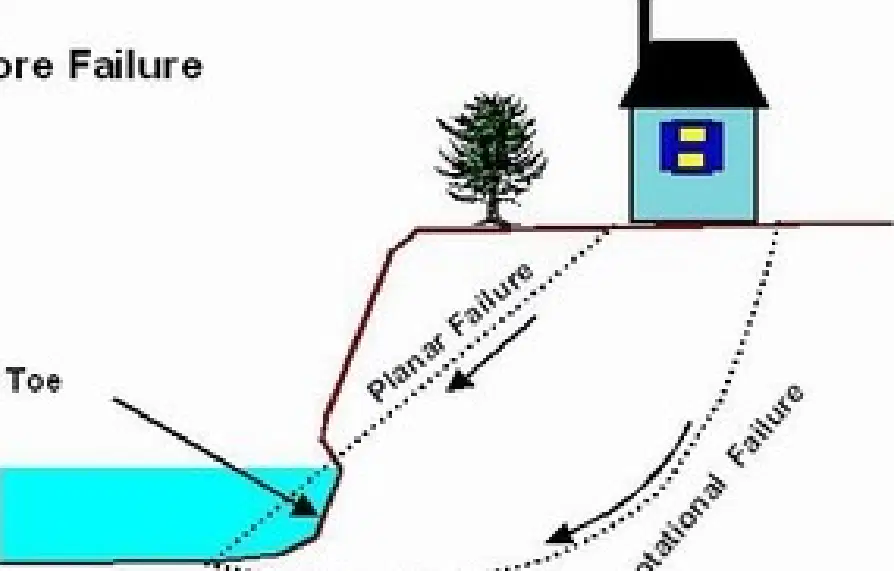
In the diagram, what geotechnical feature most likely contributes to initiating the failure at the slope toe?
Undermined toe reducing support
Vegetation roots increasing cohesion
Drainage blanket lowering pore pressure
Added berm increasing counterweight
Rock anchors increasing shear strength
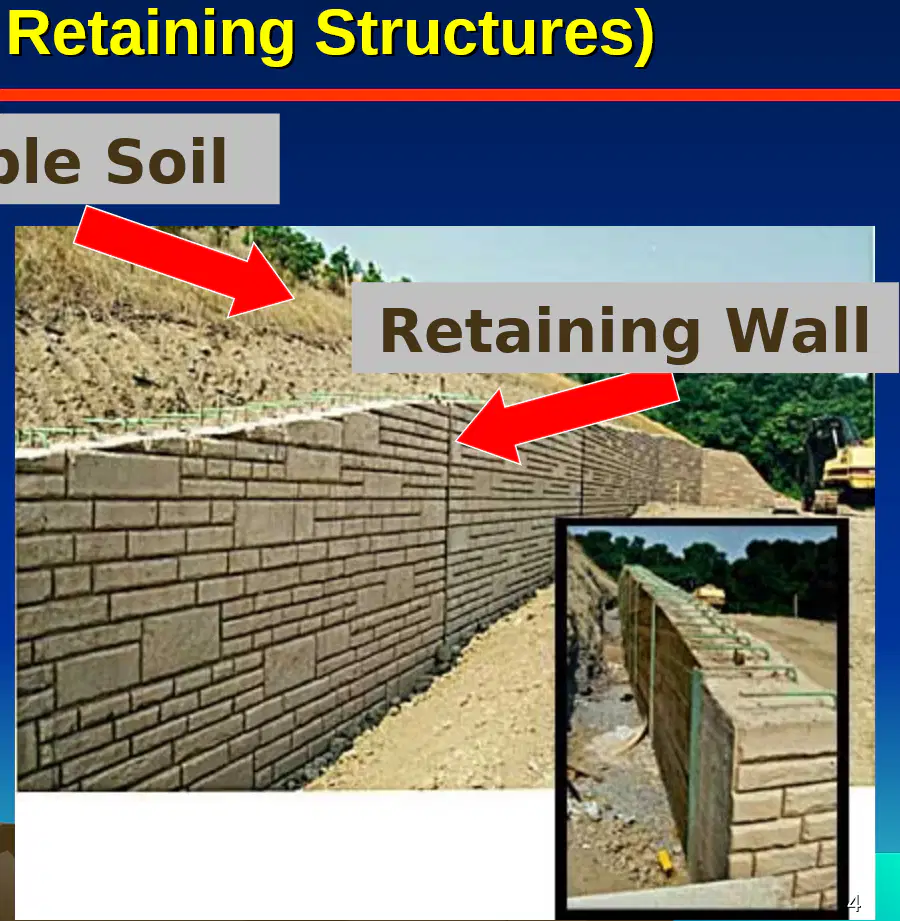
In the first diagram, what primary function of a retaining wall is illustrated by the arrows pointing to unstable soil?
Resisting lateral earth pressure from backfill
Supporting vertical building loads above
Draining groundwater through weep holes
Reducing seismic forces during earthquakes
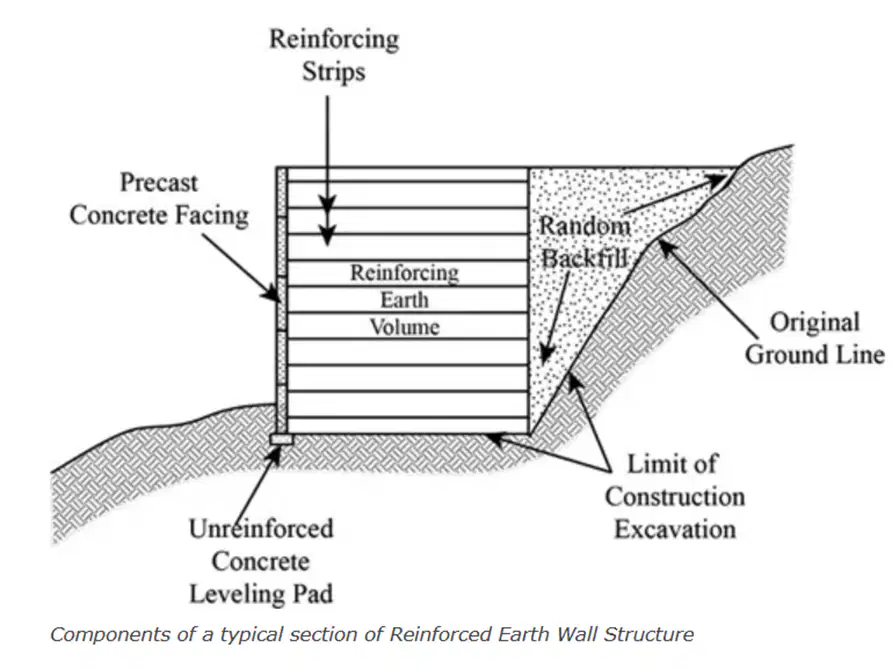
Which component in a reinforced earth wall provides tensile resistance within the soil mass, as depicted in the second image?
Random backfill behind reinforced zone
Concrete leveling pad at the foundation
Precast concrete facing panels on exterior
Horizontal reinforcing strips embedded in soil

Why are precast concrete facing panels used in reinforced earth systems, as suggested by the second image?
To provide an attractive finish and cover the excavation face from falling debris
To increase drainage capacity of backfill
To replace the need for soil reinforcement
To act as primary structural cantilevers
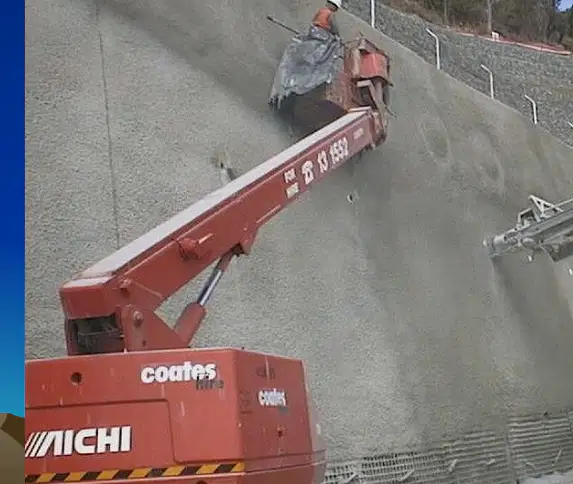
Which statement best describes soil nailing in stabilizing exposed slopes or excavations?
Compacting soil with vibratory rollers
Placing geotextiles to separate soil layers
Driving interlocking sheets to form a wall
Installing grouted steel rods into drilled holes
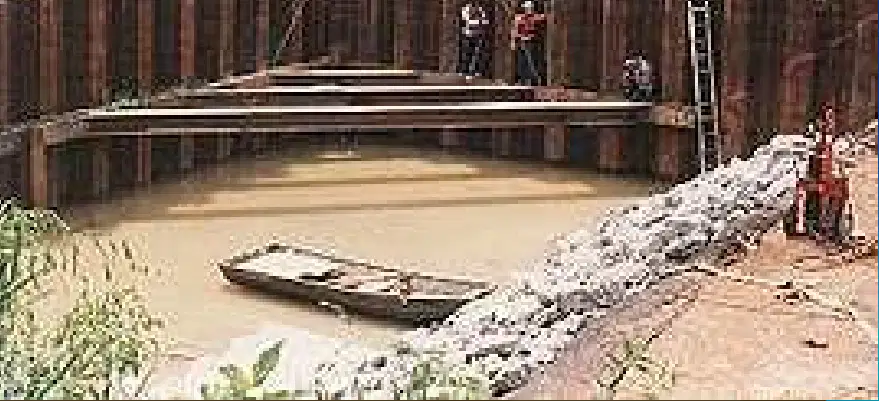
For offshore structures, which shoring system technique is most appropriate?
Concrete gravity retaining blocks stacked
Soil nails grouted into the riverbank face
Cantilevered timber posts without ties
Sheet piles forming a continuous interlocked wall

In a deep urban excavation, lateral earth pressure threatens wall movement. What is the setup shown in this figure providing a rigid framework across the pit?
Tieback anchors into the street
Temporary timber lagging alone
Compressed struts or braces spanning the excavation
Vertical soil nails at regular spacing

