
 Worksheets
Database
Total questions: 25
Worksheet time: 19mins
Retail stores use databases to store information about products, customers, and orders.
Normalising a relational database reduces data redundancy because it removes duplicate data.
Which ONE of the following is another benefit of normalising a relational database?
It improves data accuracy by ensuring all values entered into the database are correct
It increases data consistency because changes to related data are made in one place only.
It makes the database faster by increasing the amount of duplicated data stored.
It improves database security by separating data into multiple related tables.
A relationship where one sale can include many artworks is called a (a) relationship
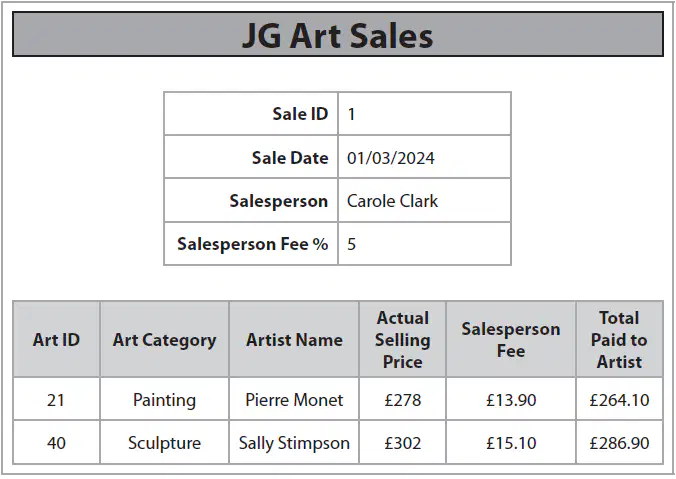
Which of the following is an example of a calculated field?
Art ID
Artist Name
Actual Selling Price
Salesperson Fee
The Total Paid to Artist can be calculated by subtracting the
(a) from the Actual Selling Price.
Which table is missing if the database needs to store salesperson details?
Sale
Art
Salesperson
Artist
The Total Paid to Artist can be calculated by subtracting the
(a) from the Actual Selling Price.
Where should the Actual Selling Price be stored?
Sale
Art
Salesperson
Artist
Which relationship best describes Artist → Art?
One to many
Many to many
Many to one
One to one
SoldArt table uses a composite primary key of
(SaleID, ArtID).
Which field must be removed to achieve Second Normal Form (2NF)?
Quantity
Actual Selling Price
Sale Date
Total Paid to Artist
Which situation shows a BEST transitive dependency?
Address determines city and
Salesperson Name determines Address
SalespersonID determines Salesperson Name and
Salesperson Name determined by SalespersonID
SaleID determines Sale Date and and
SaleID determines SalespersonID
ArtID determines Actual Selling Price and
ArtID determines Minimum Selling Price
When designing a data entry form, it is important to use user friendly error messages to improve the validation process and the user experience.
Which error message is the MOST user-friendly?
Error 104: Invalid input detected.
Validation failed.
Nu uh, you wrong
Please enter a number between 1 and 10.
Which query criterion would return records where City is exactly “Leeds”?
City = Leeds
City LIKE Leeds
City CONTAINS "Leeds"
City = "Leeds"
To find prices greater than £50, the correct operator is _
(a)
We have 2 conditional statement: TRUE, FALSE.
The logical operator AND means both conditions must be _.
(a)
Which criterion finds surnames that start with “Sm”?
Surname = "Sm*"
Surname LIKE "Sm*"
Surname LIKE "*Sm"
Surname = "*Sm"
What does the wildcard * represent in a query?
One character
One number only
Any sequence of characters
A space
Which aggregate function returns the highest value in a field?
(a)
The aggregate function used to calculate the average value is _
(a)
Which is the correct way to name a calculated field?
SUM(Price) AS TotalPrice
TotalPrice: Sum([Price])
Price SUM AS Total
SUM(Price) = TotalPrice
Which query finds the average price of products costing more than £20?
SELECT Avg([Price])
FROM Products
WHERE [Price] > 20;
SELECT [Price]
FROM Products
WHERE [Price] > 20;
SELECT Sum([Price])
FROM Products
WHERE [Price] > 20;
SELECT Count([Price])
FROM Products
WHERE [Price] > 20;
Why are calculated queries useful?
They store calculated values permanently
They reduce the number of tables needed to calculate
They perform calculations without changing stored data
They remove the need for validation rules for each table
Which criterion retrieves sales made on or after 01/06/2026?
SaleDate > 01/06/2026
SaleDate >= #01/06/2026#
SaleDate >= "01/06/2026"
SaleDate = 01/06/2026
Which criterion retrieves sales that are NOT from London?
City = NOT "London"
City != London
City <> "London"
NOT City = London
Write a calculated field to find the average price.
Here our format:
NewFieldName: [Expression]
NewFieldName: Aggregate([TargetedField])
Which query feature allows results to be sorted from highest to lowest price?
WHERE
SELECT
GROUP BY
ORDER BY

