
 Worksheets
G4 Q3
Total questions: 125
Worksheet time: 2hrs 34mins
machine
protection
stomach
Which organelle takes in "sun showers" and helps plants with the process or photosynthesis?
Vacuole
Mitochondria
Cytoplasm
Chloroplast
Which of the following, found ONLY in plant cells and provides structure?
vacuole
nucleus

This is a picture of...
cell membrane
ribosomes
mitochondria

This is a...
vacuole
cell wall
cytoplasm

What is the structure labeled #10?
Ribosome
Within each cell are _ _ _ _ _ _ _ _ _ _ which each have their own structure and function.
(a)
Which organelle is responsible for producing energy in the cell?
Mitochondria
Ribosome
Vacuole
Cell wall
What is the function of the cell membrane?
It provides energy
It stores genetic material
It produces proteins
It controls what enters and leaves the cell
Which structure is found in plant cells but not in animal cells?
Mitochondria
Ribosome
Nucleus
Cell wall

Which type of cell is this?
Animal Cell
Plant Cell
Which organelles within plant cells help protect the cell and maintain it's shape?
If Michelle's body were a city, which tiny part inside her cells would be like the 'power plant,' making energy for her to run and play?
nucleus
mitochondria
vacuole
ribosomes
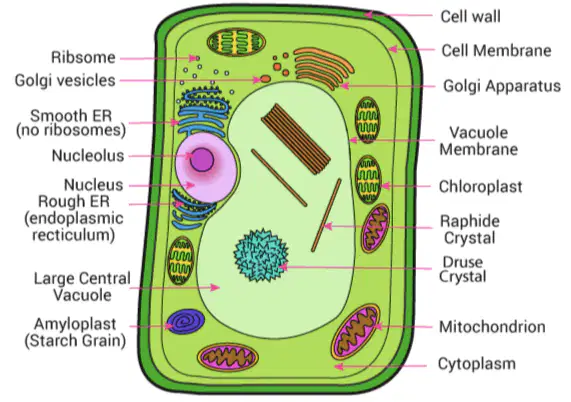
Which type of cell is this?
Plant cell
Animal Cell
Bacteria Cell
Understanding the Cell as a Tiny City
Imagine a cell as a bustling city where every part has a special job to keep things running smoothly. The nucleus acts like the mayor's office, making important decisions and controlling the activities of the cell. Ribosomes are like factories, producing proteins that are essential for the cell's growth and repair. These proteins are the building blocks that help the cell function properly.
The mitochondria are the cell's power company, generating energy to keep everything working. They convert nutrients into usable energy, ensuring the cell has the power it needs to perform its tasks. Chloroplasts, found in plant cells, are like solar farms. They capture sunlight and turn it into food through a process called photosynthesis, providing energy for the cell and the plant.
The cell membrane is like the city gates, controlling what enters and exits the cell. It ensures that nutrients come in while waste is removed, keeping the cell safe and healthy. Vacuoles act as warehouses, storing water, nutrients, and waste products. They help maintain the cell's structure and provide the resources it needs to survive.
Each organelle in the cell works together, just like parts of a city, to keep everything running smoothly. The cell wall, found in plant cells, acts as the city wall, providing protection and support. By understanding the roles of these organelles, we can see how the cell functions as a tiny, organized city full of teamwork and purpose.
What is the role of the nucleus in a cell?
Acts as the mayor's office, controlling activities
Generates energy for the cell
Stores water and nutrients
Captures sunlight for photosynthesis
Which organelle is responsible for generating energy in the cell?
Ribosomes
Mitochondria
Chloroplasts
Vacuoles
What is the function of chloroplasts in plant cells?
Store waste products
Capture sunlight and perform photosynthesis
Control what enters and exits the cell
Produce proteins for growth and repair
What does the cell membrane do?
Acts as the city wall, providing protection
Controls what enters and exits the cell
Generates energy for the cell
Stores water and nutrients
Which organelle acts as a warehouse in the cell?
Nucleus
Vacuoles
Ribosomes
Cell membrane
Which is the correct spelling for the plural version?
Mitochondria
Mitocondrion
Mitochondrion
Metochondrion
What is the main function of the vacuole in plant cells?
To produce energy
To store water and nutrients
To control cell division
To synthesize proteins
Which structure surrounds the cell and provides support and protection in plant cells?
Cell membrane
Cell wall
Nucleus
Mitochondria
Draw an animal cell with labeled organelles


turns SUNLIGHT into food for PLANTS
cell wall
chloroplasts
lysosome
endoplasmic reticulum

makes PROTEINS
ribosomes
endoplasmic reticulum
cytoplasm
mitochondria
Select all that have cells
wood
rock
human
bacteria
oxygen
Comparing Animal and Plant Cells
Animal and plant cells share many similarities, but they also have key differences in their structure. Both types of cells have a cell membrane, which acts as a protective barrier, but only plant cells have a rigid cell wall that provides extra support and shape. Inside the cells, organelles like the nucleus, mitochondria, and cytoplasm are present in both animal and plant cells, helping them function properly.
Plant cells have unique organelles that set them apart from animal cells. One of these is the chloroplast, which allows plants to perform photosynthesis and make their own food using sunlight. Another difference is the large central vacuole found in plant cells, which stores water and nutrients and helps maintain the cell's shape. These features are essential for plants to survive and grow.
Animal cells, on the other hand, rely on mitochondria for energy production. Mitochondria are often called the powerhouse of the cell because they convert food into energy that the cell can use. Unlike plant cells, animal cells do not have chloroplasts or a cell wall. Instead, their flexible cell membrane allows them to take on different shapes and adapt to their environment. These differences highlight how animal and plant cells are uniquely designed for their roles in nature.
Which organelle is unique to plant cells and allows them to perform photosynthesis?
Chloroplast
Mitochondria
Nucleus
Cytoplasm
What is the function of the large central vacuole in plant cells?
Stores water and nutrients
Produces energy
Performs photosynthesis
Acts as a protective barrier
What is the main structural difference between animal and plant cells?
Plant cells have a rigid cell wall
Animal cells have chloroplasts
Plant cells lack a nucleus
Animal cells have a large central vacuole
Why are mitochondria referred to as the powerhouse of the cell?
They convert food into energy
They store water and nutrients
They perform photosynthesis
They act as a protective barrier
Which feature allows animal cells to adapt to their environment?
Flexible cell membrane
Rigid cell wall
Chloroplast
Large central vacuole
Draw a plant cell and label the organelles
Which organelle is known as the 'control center' of the cell?
Nucleus
Vacuole
Cell wall
Chloroplast
What is the main function of ribosomes in a cell?
To generate energy
To protect the cell
To store water
To produce proteins
Which structure helps maintain the shape and rigidity of plant cells?
Cell wall
Nucleus
Cell membrane
Mitochondria

Name the part: Number 1
Stage
Eyepiece lens
Barrel
Diaphragm
The Skeletal System: Structure and Function
The skeletal system is made up of different types of bones, each with unique functions. Long bones, like those in the arms and legs, help with movement, while flat bones, such as the skull, protect vital organs. Short bones provide stability, and irregular bones, like the vertebrae, support the body. Together, these bones form the framework of the human body.
Major bones in the body include the skull, spine, ribs, and limbs. Joints connect these bones and allow movement, such as bending and rotating. For example, the knee joint helps us walk, and the shoulder joint lets us lift and rotate our arms. Joints are supported by ligaments and cartilage, which keep them strong and flexible.
Bone growth and development begin early in life and continue as we grow. Bones also protect important parts of the body, like the brain and heart. However, the skeletal system can face problems, such as fractures, arthritis, and osteoporosis. Taking care of our bones through exercise and a healthy diet helps keep the skeletal system strong and healthy.
What type of bones help with movement in the skeletal system?
Long bones
Flat bones
Short bones
Irregular bones
Which part of the skeletal system protects vital organs like the brain and heart?
Flat bones
Long bones
Short bones
Irregular bones
What connects bones and allows movement in the skeletal system?
Joints
Ligaments
Cartilage
Muscles
Which joint helps us lift and rotate our arms?
Shoulder joint
Knee joint
Elbow joint
Hip joint
What is a common problem faced by the skeletal system?
Fractures
Diabetes
Asthma
Hypertension
How the Skeletal, Muscle, and Nervous Systems Work Together
The skeletal system provides the framework for the human body. It supports and protects vital organs like the heart and lungs. Bones also help the body move by working with muscles. Inside bones, there is a substance called marrow that makes blood cells. Without the skeletal system, the body would not have its shape or strength.
Muscles are responsible for movement and come in three types: skeletal, smooth, and cardiac. Skeletal muscles are attached to bones and help us move. Smooth muscles are found in places like the stomach and help with digestion. Cardiac muscles are special because they make the heart pump blood. Muscles work by contracting and relaxing, which allows the body to perform different actions.
The nervous system controls everything in the body. It has two main parts: the brain and the spinal cord. The brain sends messages to the body through nerves, telling it what to do. The spinal cord acts like a highway, carrying signals between the brain and the rest of the body. Together, the nervous system helps us think, feel, and react to the world around us.
What does the skeletal system provide for the human body?
Framework and support
Digestion
Blood circulation
Nerve signals
Which type of muscle is responsible for pumping blood in the human body?
Skeletal muscle
Smooth muscle
Cardiac muscle
Marrow muscle
What is the role of the spinal cord in the nervous system?
It pumps blood
It carries signals between the brain and the body
It helps with digestion
It produces blood cells
Where are smooth muscles found in the human body?
Attached to bones
In the stomach
In the heart
Inside the brain
What substance inside bones is responsible for making blood cells?
Marrow
Calcium
Cartilage
Nerves
Match the following
Support
Allow the body to stand up
Protection
Rib cage surrounds heart and lungs
Movement
Joints let us bend
Making blood cells
Flow through bones to deliver oxygen
What is the main function of the skeletal system?
Provides support and protection
Connects muscle to bone
Cushions between bones
Connects bone to bone
What do ligaments connect?
Muscle to bone
Bone to bone
Cushions between bones
Muscle to muscle
What is the role of tendons in the body?
Connect bone to bone
Connect muscle to bone
Provide support and protection
Cushion between bones
What does cartilage do in the body?
Connect muscle to bone
Provide support and protection
Cushion between bones
Connect bone to bone
What is the main job of the muscular system?
To protect the body from diseases
To move the body
To produce energy
To digest food
Which of the following is NOT a role of the skeletal system?
Providing support to the body
Protecting internal organs
Producing hormones
Helping with movement
What do the terms "contract" and "relax" refer to in the muscular system?
The process of digestion
The movement of muscles
The growth of bones
The production of energy
Which type of muscle tissue is found in the heart?
Skeletal muscle
Cardiac muscle
Smooth muscle
Voluntary muscle
What is the difference between voluntary and involuntary muscles?
Voluntary muscles work automatically, while involuntary muscles are controlled by the brain.
Voluntary muscles are controlled consciously, while involuntary muscles work automatically.
Voluntary muscles are found in the heart, while involuntary muscles are found in the arms.
Voluntary muscles are smooth, while involuntary muscles are skeletal.
What is the main job of muscles in the body?
To push bones
To pull on bones
To make bones longer
To make bones softer
What happens to your bicep when you bend your arm?
It relaxes and gets soft
It contracts and gets hard
It becomes longer and softer
It stops working
What does the term "contract" mean in relation to muscles?
The muscle gets shorter and tighter
The muscle gets longer and softer
The muscle stops moving
The muscle pushes bones
What does the term "relax" mean in relation to muscles?
The muscle gets shorter and tighter
The muscle returns to its longer, softer state
The muscle pushes bones
The muscle stops working
Which of the following is an example of an involuntary muscle action?
Smiling.
Writing.
Heart beating.
Kicking a ball.
What is the main difference between voluntary and involuntary muscles?
Voluntary muscles work automatically, while involuntary muscles are consciously controlled.
Voluntary muscles are consciously controlled, while involuntary muscles work automatically.
Voluntary muscles are stronger than involuntary muscles.
Voluntary muscles are used for breathing, while involuntary muscles are used for digestion.
Which of the following is NOT an example of a voluntary muscle action?
Smiling.
Kicking a ball.
Writing.
Stomach digesting food.
Where is cardiac muscle found in the body?
In the stomach
In the heart
In the intestines
In the blood vessels
Which type of muscle works slowly to move food and control blood flow?
Skeletal muscle
Smooth muscle
Cardiac muscle
Voluntary muscle
What is a characteristic of cardiac muscle?
It is voluntary and striated.
It is found in internal organs.
It never gets tired and pumps blood.
It moves food through the stomach.
What is the primary function of the muscular system in the human body?
To provide oxygen to the body
To support movement and maintain posture
To digest food
To produce hormones
Which type of muscle is responsible for voluntary movements in the human body?
Cardiac muscle
Skeletal muscle
Smooth muscle
Involuntary muscle
What is the role of tendons in the muscular system?
To connect muscles to bones
To produce energy for muscles
To protect internal organs
To transport nutrients to muscles
Which type of muscle is involved when you "give your biggest, cheesiest smile"?
Voluntary muscle
Involuntary muscle
Cardiac muscle
Skeletal muscle
What type of muscle is used when you "take a deep breath and let it out slowly"?
Voluntary muscle
Involuntary muscle
Cardiac muscle
Smooth muscle
Which type of muscle is used when you "pretend to drink a thick milkshake through a straw"?
Voluntary muscle
Involuntary muscle
Cardiac muscle
Smooth muscle
What connects muscle to bone?
Ligament
Tendon
Cartilage
Muscle fiber
When a muscle gets shorter, we say it (a) .
What type of muscle is found only in the heart?
Skeletal
Smooth
Cardiac
Voluntary
Is the muscle that helps you blink voluntary or involuntary?
Voluntary
Involuntary
Both
Neither
Understanding the muscular system is important for athletes because it helps them:
Train safely, prevent injuries, and build strength
Increase flexibility in bones
Improve digestion
Enhance brain function
Which statement best defines a biome?
A small habitat with one species only
A large area with unique climate and life
An island with the same weather everywhere
A city where plants are grown indoors
Looking at the images of Forest, Desert, and Tundra, which factor links biomes to the plants and animals that live there?
Number of mountains nearby
Colors of the landscape
Time of day affects behavior
Climate shapes living things
If you remove your blindfold and feel hot, very dry air with sand dunes around you, which biome are you most likely in?
Rainforest with tall wet trees
Desert with dry sandy dunes
Freshwater with slow rivers
Taiga with snowy conifers
Which sensory clue would help identify a rainforest biome?
Wide grasslands and few trees
Salt water and coral reefs
Tall trees and humid air
Cold winds and frozen ground
A biome is described as having specific climate, plant life, and animal species. What is the main reason organisms differ between biomes?
Biomes change every single day
Climate conditions shape adaptations
Animals prefer random locations
Soil is the same in all biomes
Which example correctly matches a biome with typical organisms?
Grassland with coral and sea fish
Desert with monkeys and tall trees
Rainforest with cacti and lizards
Desert with cacti and lizards
You see wide open land with grasses, few trees, and many grazing animals. Using evidence, which biome is most likely?
Tundra with frozen ground
Marine with deep oceans
Grassland with open prairies
Taiga with snowy forests
Look at the flower photo and the list beside it. Which item is a biotic factor because it is living or once-living?
Sunlight from the sky
Rocks by the stream
Cold air and wind
Fallen leaves on ground
Which item in the canyon scene is an abiotic factor because it is non-living?
Bacteria in soil
Worms under rocks
Buzzing bees nearby
Temperature shown by thermometer
Choose the best definition of biotic factors shown in the left panel.
Non-living parts of environments
Living or once-living parts
Only things made of rocks
Only air, water, and light
From the circle icons page, which group is entirely abiotic factors?
Air, light, water
Plants, animals, fungi
Bacteria, protists, archaea
Soil, temperature, minerals
A student finds worms in soil under a plant. Which classification is correct for the worms?
Abiotic, because they are dirt
Biotic, because they are living
Abiotic, because they are tiny
Biotic, because they are rocks
Which pair shows one biotic and one abiotic factor together?
Flower and sunlight
Air and water
Rocks and temperature
Light and humidity
In the biome collage, which biome’s obvious abiotic factor is sand dunes shaped by wind?
Desert with sand hills
Marine with coral fish
Rainforest with thick trees
Taiga with snowy pines
In the marine photo, which is a biotic factor affecting the ecosystem there?
Salinity of seawater
Light from the sun
Fish swimming in reef
Water temperature level
Which sentence best describes an adaptation in living things?
A feature that helps survival in a place
A habit that makes animals play games
A change that always happens overnight
A behavior that makes food taste better
Look at the polar bear in the icy scene. Which trait helps it survive in the freezing Arctic?
Thin skin for cooling fast
Thick fur for keeping warmth
Short legs for slow walking
Bright colors for looking pretty
Which adaptation would most help a duck swim faster across a pond?
Sharp claws on front feet
Thick fur for staying warm
Webbed feet for pushing water
Long neck for reaching leaves
A bird eats hard seeds. Which beak shape is the best match?
Long, narrow beak for insects
Short, strong beak for seeds
Flat, wide beak for leaves
Curved beak for soft fruit
Which plant adaptation helps a tree survive in dry soil by reaching water further down?
Deep roots under the ground
Bright flowers on branches
Smooth bark on the trunk
Large leaves near the top
A bird with a long, narrow beak is most likely adapted to eat which food?
Insects hiding in small spaces
Floating leaves on wide ponds
Heavy seeds with hard shells
Soft buds from thick stems
Which statement explains why thick fur is helpful for animals living in cold places?
It makes running faster on ice
It traps heat close to the body
It changes fur color every season
It helps animals grow larger claws
A frog blends in with green leaves and stays still to avoid predators. Which two words name this type of adaptation and behavior?
Camouflage and hiding
Hibernation and jumping
Photosynthesis and sunning
Migration and swimming
Which statement best describes an abiotic factor?
A predator hunting smaller animals
A fungus growing on a fallen log
A plant competing for soil space
Temperature changing with the seasons
What adaptation helps a polar bear survive in its environment?
Thin skin for warm beaches
Bright flowers to attract bees
Long neck for high leaves
Thick fur for extreme cold
Why do cacti have thick stems in desert biomes?
To store extra water in dry air
To make shade for tall trees
To keep predators far away
To hold many colorful petals
Which environmental factor mainly affects how fast a plant grows?
Sunlight reaching the leaves
Birds nesting on branches
Bugs crawling on roots
Loud sounds near the stem
A zebra finch lives where the ground is sandy and water is scarce. Which adaptation would most help this bird?
Webbed feet for deep lakes
Bright tail for night flying
Long whiskers for sensing wind
Beak suited to cracking dry seeds
Which factor most directly influences an animal’s health and size?
Sunlight hours each day
Nutrition from available food
Shape of nearby mountains
Amount of surrounding rocks
If a cold snap lowers temperatures in a forest for weeks, what change is most likely for local animals?
Grow faster due to heat
Make more pollen for bees
Need thicker fur or shelter
Lose water through stems
What is the main function of the skeletal system?
Provides support and protection
Connects muscle to bone
Cushions between bones
Connects bone to bone
What do ligaments connect?
Muscle to bone
Bone to bone
Cushions between bones
Muscle to muscle
What is the role of tendons in the body?
Connect bone to bone
Connect muscle to bone
Provide support and protection
Cushion between bones
What does cartilage do in the body?
Connect muscle to bone
Provide support and protection
Cushion between bones
Connect bone to bone
What is the main job of the muscular system?
To protect the body from diseases
To move the body
To produce energy
To digest food
Which of the following is NOT a role of the skeletal system?
Providing support to the body
Protecting internal organs
Producing hormones
Helping with movement
What do the terms "contract" and "relax" refer to in the muscular system?
The process of digestion
The movement of muscles
The growth of bones
The production of energy
Which type of muscle tissue is found in the heart?
Skeletal muscle
Cardiac muscle
Smooth muscle
Voluntary muscle
What is the difference between voluntary and involuntary muscles?
Voluntary muscles work automatically, while involuntary muscles are controlled by the brain.
Voluntary muscles are controlled consciously, while involuntary muscles work automatically.
Voluntary muscles are found in the heart, while involuntary muscles are found in the arms.
Voluntary muscles are smooth, while involuntary muscles are skeletal.
What is the main job of muscles in the body?
To push bones
To pull on bones
To make bones longer
To make bones softer
What happens to your bicep when you bend your arm?
It relaxes and gets soft
It contracts and gets hard
It becomes longer and softer
It stops working
What does the term "contract" mean in relation to muscles?
The muscle gets shorter and tighter
The muscle gets longer and softer
The muscle stops moving
The muscle pushes bones
What does the term "relax" mean in relation to muscles?
The muscle gets shorter and tighter
The muscle returns to its longer, softer state
The muscle pushes bones
The muscle stops working
Which of the following is an example of an involuntary muscle action?
Smiling.
Writing.
Heart beating.
Kicking a ball.
What is the main difference between voluntary and involuntary muscles?
Voluntary muscles work automatically, while involuntary muscles are consciously controlled.
Voluntary muscles are consciously controlled, while involuntary muscles work automatically.
Voluntary muscles are stronger than involuntary muscles.
Voluntary muscles are used for breathing, while involuntary muscles are used for digestion.
Which of the following is NOT an example of a voluntary muscle action?
Smiling.
Kicking a ball.
Writing.
Stomach digesting food.
Where is cardiac muscle found in the body?
In the stomach
In the heart
In the intestines
In the blood vessels
Which type of muscle works slowly to move food and control blood flow?
Skeletal muscle
Smooth muscle
Cardiac muscle
Voluntary muscle
What is a characteristic of cardiac muscle?
It is voluntary and striated.
It is found in internal organs.
It never gets tired and pumps blood.
It moves food through the stomach.
What is the primary function of the muscular system in the human body?
To provide oxygen to the body
To support movement and maintain posture
To digest food
To produce hormones
Which type of muscle is responsible for voluntary movements in the human body?
Cardiac muscle
Skeletal muscle
Smooth muscle
Involuntary muscle
What is the role of tendons in the muscular system?
To connect muscles to bones
To produce energy for muscles
To protect internal organs
To transport nutrients to muscles
Which type of muscle is involved when you "give your biggest, cheesiest smile"?
Voluntary muscle
Involuntary muscle
Cardiac muscle
Skeletal muscle
What type of muscle is used when you "take a deep breath and let it out slowly"?
Voluntary muscle
Involuntary muscle
Cardiac muscle
Smooth muscle
Which type of muscle is used when you "pretend to drink a thick milkshake through a straw"?
Voluntary muscle
Involuntary muscle
Cardiac muscle
Smooth muscle
What connects muscle to bone?
Ligament
Tendon
Cartilage
Muscle fiber
When a muscle gets shorter, we say it (a) .
What type of muscle is found only in the heart?
Skeletal
Smooth
Cardiac
Voluntary
Is the muscle that helps you blink voluntary or involuntary?
Voluntary
Involuntary
Both
Neither

