
 Worksheets
INSURANCE PRICING
Total questions: 99
Worksheet time: 50mins
Which of the following is a defect in the traditional net cost method for determining the cost of life insurance?
It ignores the time value of money.
It provides accurate future projections.
It considers all policyholder benefits.
It includes investment returns in calculations.
The interest-adjusted and surrender cost index methods, along with the net payment cost index method, are used to determine the cost of life insurance by:
Comparing the cost of premiums and benefits over time, accounting for interest and surrender values.
Calculating only the total premiums paid without considering interest or surrender values.
Evaluating the insurance company's profit margins.
Assessing the risk level of the policyholder.
The yearly rate-of-return method is used to determine the annual rate of return on the saving component in a life insurance policy. Which of the following best describes this method?
It calculates the annual return by comparing the increase in the policy’s cash value to the premiums paid each year.
It estimates the return based on the total death benefit divided by the number of years the policy is held.
It uses the average interest rate offered by the insurance company over the policy term.
It determines the return by subtracting administrative fees from the total premiums paid.
Explain how federal income taxes apply to life insurance and how federal estate taxes are calculated on an estate.
Federal income taxes generally do not apply to life insurance proceeds, but federal estate taxes may be calculated on the value of the estate including life insurance if the deceased owned the policy.
Federal income taxes are always applied to life insurance proceeds, and federal estate taxes are only calculated on cash assets.
Federal income taxes and federal estate taxes are both applied directly to life insurance proceeds regardless of ownership.
Federal income taxes apply only to the premiums paid for life insurance, and federal estate taxes are not calculated on life insurance proceeds.
Which of the following lists the seven rules to follow when purchasing life insurance?
Assess your needs, compare policies, check company reputation, read the fine print, consider riders, review premium costs, and update beneficiaries.
Buy the cheapest policy, ignore company ratings, skip reading terms, avoid riders, pay annual premiums, never update beneficiaries, and rely on agent advice.
Choose any policy, focus only on coverage amount, ignore riders, disregard premium costs, never compare companies, avoid reading details, and forget about beneficiaries.
Select based on advertisements, ignore your needs, trust all companies equally, skip reading policy details, avoid riders, pay without reviewing costs, and never update beneficiaries.
Understand how life insurance premiums are calculated.
Life insurance premiums are calculated based on factors such as age, health, coverage amount, and lifestyle.
Life insurance premiums are calculated solely based on the policyholder's occupation.
Life insurance premiums are calculated only by the insurance company's profit margin.
Life insurance premiums are calculated by random selection.
What is one of the main challenges of life insurance costs described as 'Huge variations exist among insurers for similar policies sold to individuals of the same age and gender'?
Cost Variation
Policy Duration
Claim Settlement Ratio
Premium Payment Frequency
Consumers often pay thousands of extra dollars over their lifetime by purchasing high-cost policies. What is this risk called?
Overpayment Risk
Underwriting Risk
Liquidity Risk
Market Risk
Most consumers only use premiums as a basis for comparing costs, which provides an incomplete picture. What is this challenge called?
Misleading Comparisons
Premium Bias
Cost Overlook
Partial Pricing
Traditional cost methods ignore the time value of money, making them misleading for evaluating true costs. What is this challenge called?
Time Value Ignored
Cost Allocation Error
Depreciation Overlooked
Inflation Adjustment Missed
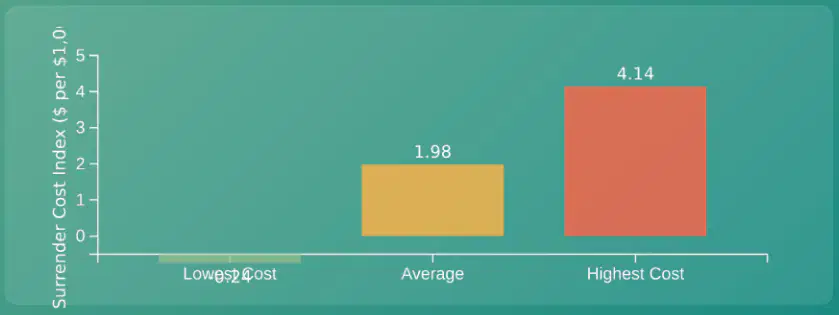
According to the bar graph titled 'Cost Variation Among Insurers', what is the Surrender Cost Index ( per 1,000) for the highest cost policies?
1.98
4.14
2.40
3.00
According to Consumers Union, is it true or false that first-year premium costs tell you everything about what a life insurance policy will cost over the long run?
True
False
Fill in the blank: The amount paid regularly to maintain the policy is called ________.
Annual Premiums
Deductible
Sum Assured
Grace Period
Fill in the blank: The accumulated value of the policy that can be accessed by the policyholder is known as ________. Higher values may indicate lower cost.
Cash Values
Premiums
Dividends
Surrender Charges
Fill in the blank: Payments to policyholders from the insurer's surplus are called ________. Higher amounts generally indicate better value for the premium paid.
Dividends
Premiums
Claims
Reserves
Fill in the blank: The economic principle that money available today is worth more than the same amount in the future, affecting policy cost comparisons, is called ________.
Time Value of Money
Opportunity Cost
Inflation Rate
Marginal Utility
Which of the following is NOT a key component of the Traditional Net Cost Method for life insurance?
A) Annual premiums for a specific time period
B) Subtract accumulated dividends during the same period
C) Add cash-surrender value at the end of the period
D) Subtract cash-surrender value at the end of the period
Fill in the blank: The average cost per year is calculated by dividing the total net cost by the _________
number of years in the period
total revenue
average annual profit
total expenses
The Traditional Net Cost Method considers the time value of money.
True
False
According to the Traditional Net Cost Formula, what is subtracted from the total premiums for the period?
Accumulated dividends and cash value at end of period
Policy loans and interest accrued
Surrender charges and administrative fees
Premiums paid in previous periods
What is the formula to calculate the annual cost in the Traditional Net Cost Method?
Net cost × number of years
Net cost ÷ number of years
Total premiums × number of years
Surrender value ÷ number of years
According to the Traditional Net Cost Method example, what is the total premium paid over 20 years for a $10,000 ordinary life insurance policy for a female, age 20?
$2,642
$3,500
$4,200
$1,980
According to the Traditional Net Cost Method example, what is the amount of accumulated dividends for 20 years?
$599
$450
$725
$1,000
According to the Traditional Net Cost Method example, what is the net premium for 20 years?
$2,043
$1,500
$2,500
$1,800
According to the Traditional Net Cost Method example, what is the cash value at the end of 20 years?
$2,294
$1,850
$3,100
$2,000
According to the Traditional Net Cost Method example, what is the insurance cost for 20 years?
$251
$300
$175
$400
According to the Traditional Net Cost Method example, what is the net cost per year?
$12.55
$15.00
$10.25
$20.75
According to the Traditional Net Cost Method example, what is the net cost per $1,000 per year?
$1.26
$2.50
$0.98
$1.75
What is the annual premium for the $10,000 ordinary life insurance policy in the Traditional Net Cost Method example?
$132.10
$145.50
$120.75
$158.00
A negative net cost under the traditional net cost method indicates which of the following, according to the key insight?
The benefit outweighs the cost
The cost outweighs the benefit
There is no net effect
The calculation is invalid
Which of the following is a defect of the traditional net cost method?
Ignores time value of money
Always provides accurate cost calculation
Considers future value of premiums
Ensures free insurance for all
The traditional net cost method often produces misleading negative costs, showing insurance to be 'free', which contradicts common sense and business principles.
True
False
No insurer could provide free insurance, as the method suggests insurance can be provided at no cost, which is impossible for insurers to sustain in business.
True
False
Which defect of the traditional net cost method is described as not accounting for the accumulated value of premiums over time, leading to an inaccurate assessment of true cost?
Ignores time value of money
Produces misleading negative costs
No insurer could provide free insurance
Fails to consider future value of premiums
According to Consumers Union, what is relatively easy to compare when you buy life insurance?
Long-term policy costs
First-year premium costs
Future value of premiums
Negative costs
What organization developed the more accurate measure of life insurance costs known as the Interest-Adjusted Cost Method?
The National Association of Insurance Commissioners (NAIC)
The American Council of Life Insurers (ACLI)
The Insurance Information Institute (III)
The Society of Actuaries
Unlike traditional methods, the Interest-Adjusted Cost Method incorporates the ________ by applying an interest factor to cost calculations.
time value of money
cost of goods sold
depreciation rate
market value
Which cost index measures the cost of life insurance if you surrender the policy at the end of a specified period and takes compound interest into account?
Surrender Cost Index
Net Payment Cost Index
Premium Cost Index
Cash Value Cost Index
Which cost index should you use if you intend to keep your life insurance policy in force and not surrender it?
Net Payment Cost Index
Surrender Cost Index
Annual Renewable Index
Cash Value Index
The Net Payment Cost Index is based on the assumption that you will surrender the policy at the end of a specified period.
True
False
What does the Surrender Cost Index measure in life insurance?
The total payout at policy maturity
The cost if you surrender the policy at the end of a specific time period (e.g., 10 or 20 years)
The annual premium amount
The interest earned on premiums
The Surrender Cost Index is expressed as cost per ______ of insurance protection.
$1,000
$100
$10,000
$500
Which of the following does the Surrender Cost Index take into account?
Simple interest
Compound interest (typically 5% interest rate)
No interest
Only the first year's premium
The Surrender Cost Index considers the time value of money by accumulating premiums at what rate?
At interest rate (typically 5%)
At inflation rate (typically 2%)
At risk-free rate (typically 3%)
At discount rate (typically 4%)
Which of the following is a key distinctive feature of the Surrender Cost Index?
Uses only current cash value
Interest-adjusted cost method
Ignores opportunity cost
Based on policyholder's age only
The Surrender Cost Index reflects the opportunity cost of premium payments.
True
False
When is it helpful to use the Surrender Cost Index method?
When you plan to keep the policy for your entire life
When you believe you may surrender the policy at the end of 10 or 20 years
When you want to increase your premium
When you do not want to compare policies
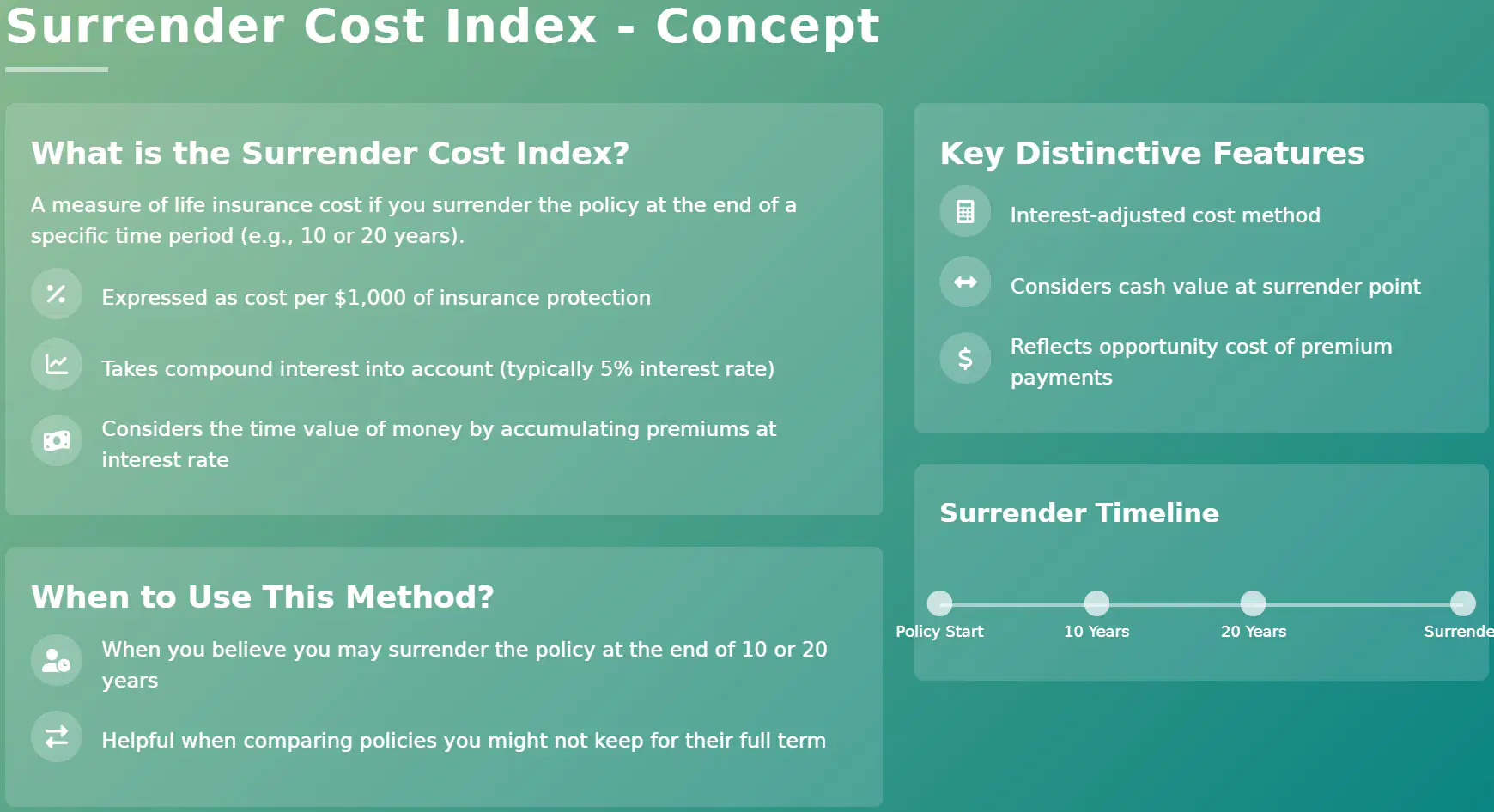
At which points is the Surrender Cost Index typically calculated?
Policy Start and 5 Years
10 Years and 20 Years
Only at Surrender
Every year
What is the accumulated premium after 20 years at 5% interest?
$2,642
$4,586
$599
$824
What is the accumulated value of dividends over 20 years at 5% interest?
$599
$824
$2,642
$4,586
Fill in the blank: 4,586− 824 = _____. This is the net cost before cash value.
$3,762
$3,862
$3,722
$3,786
Fill in the blank: 3,762− 2,294 = _____. This is the total insurance cost for 20 years.
$1,468
$1,562
$1,328
$1,498
What is the amount to which $1 deposited annually at 5% accumulates in 20 years?
$1,468
$34.719
$42.28
$4.23
Fill in the blank: 1,468÷ 34.719 = ____ per year.
$42.28
$34.72
$41.68
$44.29
What is the formula for calculating the Surrender Cost Index?
Annual Cost = Total Cost × Annuity Due Factor
Annual Cost = Total Cost ÷ Annuity Due Factor
Annual Cost = Total Cost + Annuity Due Factor
Annual Cost = Total Cost - Annuity Due Factor
The interest-adjusted cost is positive ( 4.23per 1,000), indicating that it costs something to own life insurance when forgone interest is considered.
True
False
What does the Net Payment Cost Index measure?
The cost of life insurance if the policy is surrendered early
The cost of life insurance if death occurs at the end of a specified time period, assuming the policy is not surrendered
The cash value of the policy
The interest earned on premiums
Fill in the blank: The Net Payment Cost Index is appropriate if you intend to keep your life insurance in force for the ________ term.
long
short
medium
temporary
Which of the following is NOT a key characteristic of the Net Payment Cost Index?
A) Assumes policy remains in force
B) Excludes cash value
C) Shows cost per $1,000
D) Includes cash value in premium calculations
The Net Payment Cost Index excludes cash value from premium calculations.
True
False
Which step is NOT part of calculating the Net Payment Cost Index?
Calculate premium costs
Apply interest factor
Calculate cost index
Determine cash surrender value
This method is particularly useful for comparing policies when you plan to keep your insurance for a ______ period, such as whole life insurance needs.
long
short
fixed
uncertain
What does the Net Payment Cost Index measure?
The relative cost of a policy if death occurs at the end of a specified time period
The surrender value of a policy
The cash value at the end of the period
The premium amount only
Unlike the surrender cost index, the net payment cost index does not subtract the ______ at the end of the period.
cash value
premium
interest
dividend
Calculate total premiums accumulated at 5% interest over 20 years.
$4,586
$3,200
$5,800
$6,450
Calculate accumulated dividends at 5% interest over 20 years.
-$824
-$500
-$1000
-$1200
Calculate insurance cost for 20 years.
$3,762
$2,500
$4,500
$5,200
Calculate future value of $1 deposited annually at 5% for 20 years.
$34,719
$26,533
$21,725
$18,679
Calculate annual interest-adjusted cost.
$108.36
$120.50
$95.75
$112.00
What is the cost per $1,000 per year for the 20-Year Net Payment Cost Index example?
$10.84
$12.50
$8.75
$15.20
According to the guideline 'Compare Only Similar Plans', when comparing cost data, what should you compare?
Policies of different types
Policies of the same type with the same benefits
Policies from different insurers
Policies with different coverage amounts
According to the guideline 'Ignore Small Variations', what can offset small cost differences?
Other policy features or services that you can expect to get from an agent or insurer.
The location of the insurance company headquarters.
The color of the insurance policy document.
The number of employees at the insurance agency.
According to the guideline 'Shop for Policy, Not Insurer', some insurers have excellent low-cost policies at certain ages and coverage amounts, but are they always competitive at other ages and coverage amounts?
True
False
According to the guideline 'Apply Only to New Policies', should cost data be used to determine whether to replace an existing policy with a new one?
True
False
According to the guideline 'Policy Type Should Not Be Based Solely on Cost Index', what should you do before comparing costs?
Decide on the type of policy that best meets your needs, such as term, whole life, or some combination.
Compare the cost index of all available policies first.
Choose the policy with the lowest premium regardless of type.
Select a policy based on recommendations from friends.
Based on the cost comparison table, which policy has the lowest cost per $1,000?
Policy A
Policy B
Policy C
According to the research findings, how many whole life insurance policies were examined in the study?
10
13
20
25
What was the coverage amount for the whole life insurance policies examined in the study?
$100,000
$250,000
$500,000
$1,000,000
Fill in the blank: The period of the cost comparison study was from ______ to ______.
12/31/1990 to 12/31/2010
01/01/2000 to 12/31/2020
06/15/1985 to 06/15/2005
03/10/1995 to 03/10/2015
All dividends in the study were paid in cash.
True
False
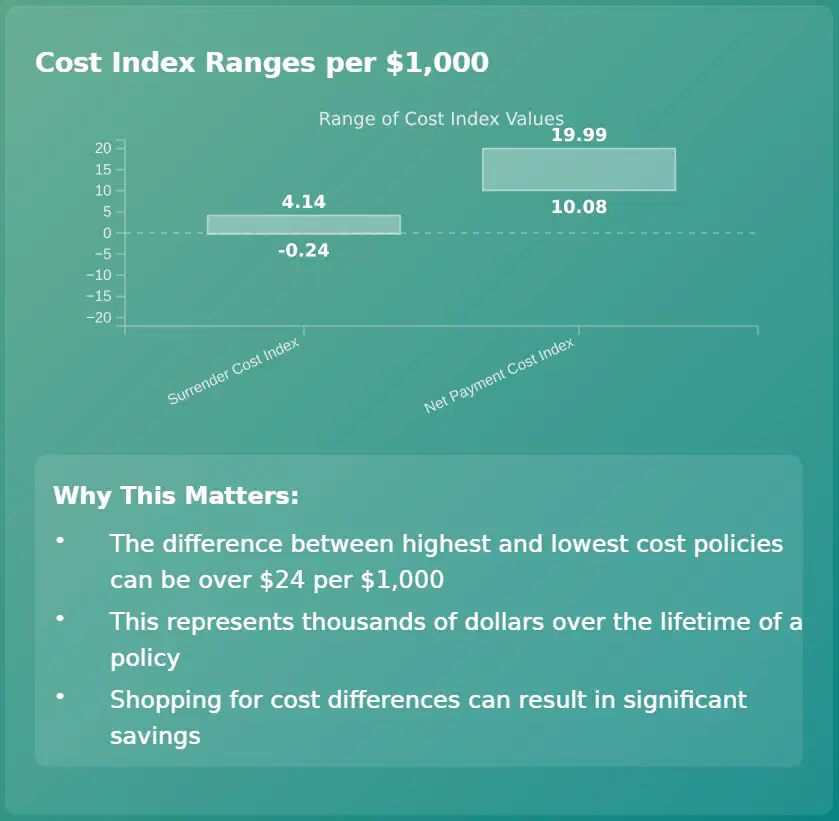
According to the chart titled 'Cost Index Ranges per $1,000', what is the highest value shown for the Net Payment Cost Index?
19.99
15.50
12.75
17.25
Why does shopping for cost differences among insurers matter?
It can result in significant savings
It has no impact on costs
It increases the cost of insurance
It is required by law
What is the term used when consumers don't know the annual rate of return on their saving component?
Hidden Return
Unknown Yield
Masked Interest
Obscured Rate
Low return in traditional cash-value policies can lead to significant money loss through ______ interest.
forgone
compound
nominal
simple
Rate of return on saving component should be a significant factor in ______ comparison.
policy
price
interest
risk
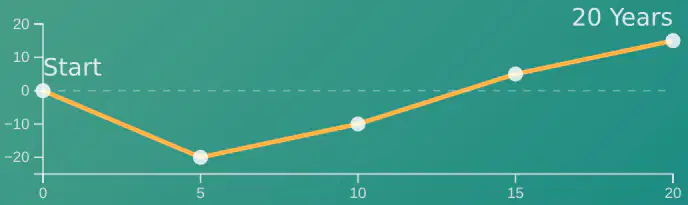
According to the 'Rate of Return Impact' graph, do annual rates of return vary significantly across policies?
True
False
What is the Linton Yield Method?
A method to calculate insurance premiums
A method to determine the average annual rate of return on a cash-value policy if held for a specified period
A way to invest in stocks
A method to calculate loan interest rates
According to the Linton Yield Method, the policy is viewed as a combination of ______ and a savings fund.
insurance protection
investment portfolio
retirement plan
annuity
How is the part of the annual premium deposited in the savings fund determined according to the Linton Yield Method?
By dividing the premium by two
By subtracting the insurance protection cost from the premium
By adding the insurance protection cost to the premium
By multiplying the premium by the interest rate
The Linton yield is the compound interest rate required to make savings grow to equal guaranteed cash value.
True
False
What is one limitation of the Linton Yield Method?
It is easy to calculate
Current rates of return are not readily available to consumers
It always gives positive rates
It is used for stock investments
Fill in the blank: Annual rates based on the Linton Yield Method vary widely, from ______ in the first year to 8.2% by the 20th year.
-87.9%
2.5%
15.0%
0.0%
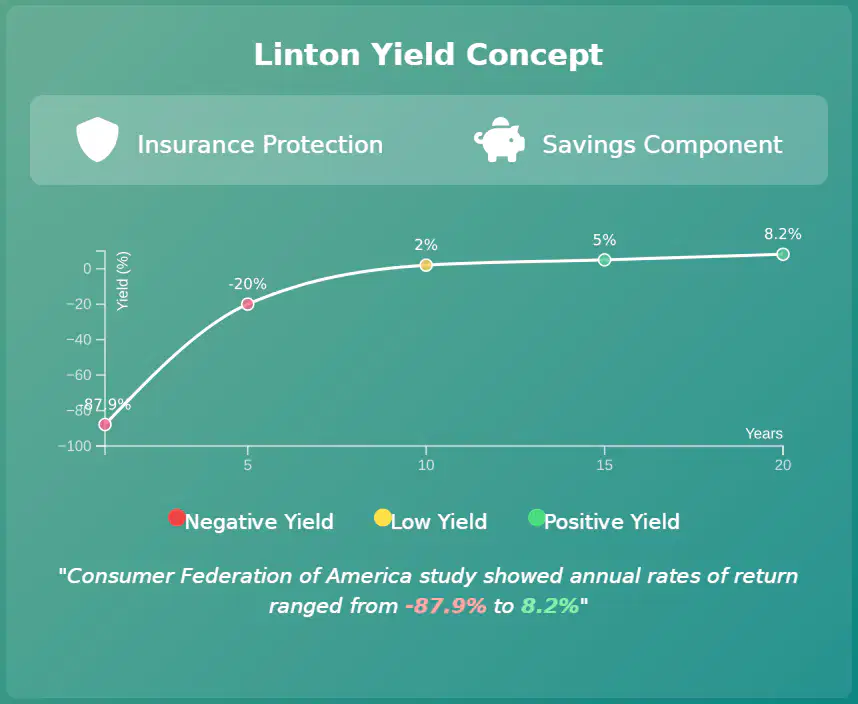
According to the graph, what happens to the yield during the early years of a policy?
It is positive
It is negative due to high acquisition expenses
It remains constant
It increases rapidly
What does the variable 'i' represent in Belth's Formula for Annual Return?
Yearly rate of return on the saving component (decimal)
Initial investment amount
Inflation rate
Interest paid on loan
What does the variable 'CV' represent in Belth's Formula for Annual Return?
Cash value at end of policy year
Commission value at start of policy year
Current value of premium paid
Cumulative value of dividends received
What does the variable 'D' represent in Belth's Formula for Annual Return?
Annual dividend
Annual depreciation
Annual demand
Annual debt
What does the variable 'YPT' represent in Belth's Formula for Annual Return?
Assumed yearly price per $1,000 of protection (benchmark prices)
Annual yield percentage on total investment
Yearly premium total for all policies
Yield per thousand on investment returns
What does the variable 'DB' represent in Belth's Formula for Annual Return?
Death benefit
Dividend bonus
Deposit balance
Discounted bond
What does the variable 'P' represent in Belth's Formula for Annual Return?
Annual premium
Policyholder's age
Profit margin
Present value

