
 Worksheets
Music 6 Summative 3 (Unit 3)
Total questions: 155
Worksheet time: 2hrs 53mins
What is the Greek meaning of the word "monophonic"?
Many sounds
One voice
Interweaving lines
Singing together
Which texture is described as having two or more different melodies performed at the same time?
Monophonic
Homophonic
Polyphonic
Duet
In music, what determines whether a texture is monophonic or polyphonic?
The total number of performers
The loudness of the instruments
The number of different melodies being used
The length of the musical piece
When you sing a song alone without any accompaniment, what is the texture?
Thin
Thick
Heavy
Wide
What do you call a group of three or more pitches played or sung at the same time?
An interval
A melody
A chord
A rhythm
If a group of 50 students all sing the same melody at the same time, what texture are they creating?
Polyphonic
Monophonic
Homophonic
Heterophonic
Which of the following is an example of a polyphonic style where a melody is imitated by different instruments entering at different times?
Unison
Solitaire
Fugue
Descant
What is the German term used when two or more different songs are sung together?
Quodlibet
Salidumay
Polyphony
Chordal
In the song "Silent Night," the main melody is supported by chords. This is an example of:
Monophonic texture
Polyphonic texture
Homophonic texture
A round
Which texture can be compared to a thick fabric with many interwoven threads?
Monophonic
Polyphonic
Solo
Unison
An extra melody added above or below a main song is called a:
Round
Descant
Chord
Interval
In Homophonic texture, the relationship between the parts is best described as:
Independent and interweaving
One main melody plus accompaniment
Everyone singing the same notes
Only one instrument playing
Which of these is a Kalinga folk song mentioned in the lesson?
Paru-parong Bukid
Kataka-taka
Salidumay
What is the distance between two notes in an accompaniment called?
Texture
Pitch
Interval
Contour
If Group A sings "Santa Clara Pinung-pino" and Group B sings "Kataka-taka" at the same time, what are they performing?
A monophonic solo
Partner songs/Quodlibet
A unison chant
A solo with no accompaniment
Why is a "Round" (like Row, Row, Row Your Boat) considered polyphonic?
Because the same melody starts at different times, creating overlapping layers.
Because everyone starts and ends at the same time.
Because it only has one melody.
Because it is always sung very loudly.
Which chord is known as the "home chord" in the Key of C Major?
Subdominant (IV)
Dominant (V)
Tonic (I)
Minor (ii)
What happens to the texture when you add a descant to a solo melody?
It stays thin.
It becomes monophonic.
It becomes thick/polyphonic.
The melody disappears.
Which composer's work was used as an example of polyphonic texture?
Ludwig van Beethoven
Johann Sebastian Bach
Wolfgang Amadeus Mozart
Claude Debussy
When a second melody follows the exact same "up-and-down" shape of the first melody at a different pitch, it is moving in:
Interlocking lines
Unison
Parallel
Opposite directions
Compare a solo flute playing a melody to an orchestra playing the same melody in unison. How does the texture change?
It changes from monophonic to polyphonic.
It changes from thin to thick.
The texture remains monophonic because there is still only one melody.
The texture becomes homophonic.
A student says, "Polyphonic music is better because it has more people." Why is this statement incorrect?
Because polyphonic music must be played by only two people.
Because texture is about the number of melodies, not the number of people.
Because monophonic music is always performed by large groups.
Because people do not affect the sound of music.
Which fabric comparison best represents a song with a descant?
A single thin thread
Two different colored threads woven together
A giant piece of plain white cloth
A thread that has been cut into pieces
If you are listening to a singer and a guitarist playing chords to support them, which texture are you hearing?
Monophonic
Polyphonic
Homophonic
Quodlibet
What is the main difference between Polyphonic and Homophonic texture?
Polyphonic has one melody; Homophonic has many.
Polyphonic melodies are independent; Homophonic parts support one main melody.
Analyze this scenario: You hear a melody that sounds "interwoven" and "interlocking." Which texture are you most likely describing?
Monophonic
Polyphonic
Homophonic
Unison
If you draw the "shape" of a melody in the air, you are drawing its:
Texture
Rhythm
Contour
Interval
Which of these combinations would result in a thin texture?
A choir singing in 4-part harmony.
A person whistling a tune while walking.
A band playing a fugue.
Three different songs being sung at once.
In the Key of C Major, which chord provides variety and is labeled as IV?
Tonic
Dominant
Subdominant
Primary
Why is texture compared to "weaving" in the lesson?
Because music is made of fabric.
Because melodies are like threads that can be combined in different ways.
Because you need to wear special clothes to sing.
Because weaving is a type of Filipino folk song.
What do you call the sound of harmony if it is not pleasing to the ears, described as harsh-sounding and unstable?
Consonance
Dissonance
Resonance
Unison
What do you call the sound of harmony if it is pleasing to the ears, described as smooth sounding and stable?
Consonance
Dissonance
Cadence
Syncopation
It is when multiple notes or voices play simultaneously to produce a new sound.
Melody
Harmony
Rhythm
Tempo
A combination of two or more notes played at the same time is called a what?
Interval
Scale
Chord
Cadence
A chord made of three notes is called a what?
Dyad
Triad
Tetrad
Pentad
A set of notes within an octave arranged by their pitch is called what?
Harmony
Music Theory
Melody
Musical scale
Which is one of the ways to harmonize music?
Triad
Chord
Harmony
Scale
A pitch in a triad that has the lowest pitch and is also the first note is called what?
Third
Root
Fifth
Octave
What is the last and highest note in a triad?
Root
Third
Fifth
Seventh
What is the second note in a triad, with an interval of a third from the root?
Root
Third
Fifth
Octave
How do you look for a triad from a specific note?
Identify the root note and play the same note twice.
Select a note and play the octave above.
Identify the root note, then add the third and fifth notes to form a triad.
Choose any note and play it randomly.
What is the sequence of half steps in a major triad?
0-3-4
1-5-3
0-4-7
0-3-5
What is the sequence of half steps in a minor triad?
0-3-4
1-5-3
0-4-7
0-3-5
How do you get the third note from the root in a major triad?
Count up five half steps from the root note.
Count down four half steps from the root note.
Count up four half steps from the root note.
Count up three half steps from the root note.
What are the four kinds of triads in music?
Whole Tone, Pentatonic, Blues, Chromatic
Major Seventh, Minor Seventh, Dominant Seventh, Half-Diminished
Major, minor, diminished, and augmented
Suspended, Added, Seventh, Extended
What is the fifth note in a major triad?
The fifth note is the major third above the root note.
The fifth note in a major triad is the perfect fifth above the root note.
The fifth note is the octave above the root note.
The fifth note is the minor seventh above the root note.
What is the difference between the major and minor triad?
The major triad is always played in a higher octave than the minor triad.
The major triad has a major third interval, while the minor triad has a minor third interval.
The major triad consists of four notes, while the minor triad has three notes.
The major triad has a diminished fifth interval, while the minor triad has an augmented fifth interval.
It gives the relationships of the notes in the scales to determine their function with the first note of the scale or tonic.
Musical scale
Scale degrees
Harmony
Triad
What is the triad of the C major?
C–E–G
C–D–G
C–F–A
B–D–F
What is the scale degree of F in C major scale?
Supertone
Mediant
Subdominant
Dominant
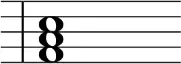
Identify the triad shown on the staff. The diagram displays a treble clef with a stacked triad on the lines/spaces forming C–E–G.
C major
A minor
G major
D minor
Identify the triad shown on the staff. The diagram displays a treble clef with a stacked triad on the lines/spaces forming A–C–E.
A minor
C major
G major
D major
Identify the triad shown on the staff. The diagram displays a treble clef with a stacked triad on the lines/spaces forming G–B–D.
G major
D minor
C major
A minor
What chord is this? The diagram shows a triad on the staff matching D–F–A.
C Major
G major
D Major
D minor
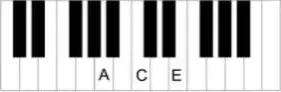
Identify if the image shows a major or minor triad. The keyboard diagram highlights A–C–E.
Major
Minor
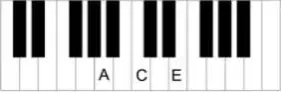
Identify if the image shows a major or minor triad. The keyboard diagram highlights A–C–E.
Major
Minor
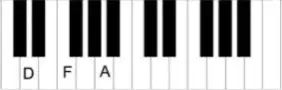
Identify if the image shows a major or minor triad. The keyboard diagram highlights D–F–A.
Major
Minor
A tonic chord of a relative minor scale is a minor triad.
True
False
The dominant scale degree of C major scale is _____.
C
G
E
A
A minor triad uses the sequence root, minor third, and perfect fifth.
True
False
What do you call the sound of harmony if it is harsh-sounding and unstable?
(a)
What do you call the sound of harmony if it is smooth sounding and stable?
(a)
It is when multiple notes or voices play simultaneously to produce a new sound.
(a)
A (a) is a combination of two or more notes played at the same time.
A (a) is a chord made of three notes.
A _____________ is a set of notes within an octave arranged by their pitch.
Harmony
Music Theory
Melody
Musical scale
This is one of the ways to harmonize music.
Triad
Chord
Harmony
Scale
A pitch in a triad that has the lowest pitch. It is also the first note.
(a)
It is the last and highest note in a triad.
(a)
It is the second note in a triad, its distance from the root to the second note is an interval of a third.
(a)
How do you look for a triad from a specific note?
Identify the root note and play the same note twice.
Select a note and play the octave above.
Identify the root note, then add the third and fifth notes to form a triad.
Choose any note and play it randomly.
What is the sequence of half steps in a major triad?
0-3-4
0-4-7
1-5-3
0-3-5
What is the sequence of half steps in a minor triad?
0-3-4
0-3-7
1-5-3
0-3-5
How do you get the third note from the root in a major triad?
Count up five half steps from the root note.
Count down four half steps from the root note.
Count up four half steps from the root note.
Count up three half steps from the root note.
What are the four kinds of triads in music?
Whole Tone, Pentatonic, Blues, Chromatic
Major Seventh, Minor Seventh, Dominant Seventh, Half-Diminished
Major, minor, diminished, and augmented
Suspended, Added, Seventh, Extended
What is the fifth note in a major triad?
The fifth note is the major third above the root note.
The fifth note in a major triad is the perfect fifth above the root note.
The fifth note is the octave above the root note.
The fifth note is the minor seventh above the root note.
What is the difference between the major and minor triad?
The major triad is always played in a higher octave than the minor triad.
The major triad has a major third interval, while the minor triad has a minor third interval.
The major triad consists of four notes, while the minor triad has three notes.
The major triad has a diminished fifth interval, while the minor triad has an augmented fifth interval.
It gives the relationships of the notes in the scales to determine their function with the first note of the scale or tonic.
Musical scale
Scale degrees
Harmony
Triad
What is the triad of the C major?
C-E-G
C-A-G
C-G-E
A-C-E
What is the scale degree of F in C major scale?
Supertonic
Mediant
Subdominant
Dominant

What chord is this?
C Major
G major
D Major
D minor
A tonic chord of a relative minor scale is a minor triad.
True
False
The dominant scale degree of C major scale is _____.
C
G
E
A
A minor triad used the sequence root, minor third, and perfect fifth.
True
False
It’s how high or low a note will sound.
Rhythm
Melody
Harmony
Pitch
___________ is a recurring movement of notes and rests (silences) in time. It’s the human perception of time.
Pitch
Melody
Rhythm
Harmony
___________ are the next highest or lowest pitch of the same note.
Chords
Triads
Octave
Pitch
The seven notes in all __________ scales follow the same interval pattern: W-W-H-W-W-W-H (whole-whole-half-whole-whole-whole-half).
Minor
Major
Beat
Chord
Natural _________ scales are dark, sad, and emotional sounding. The seven notes in all minor scales follow the same interval pattern: W-H-W-W-H-W-W (whole-half-whole-whole-half-whole-whole).
Minor
Major
Beat
Triads
__________ is a succession of notes or voices arranged into a musical phrase.
pitch
harmony
melody
rhythm
A __________ interval is two semitones
half step
whole step
interval
pitch
A _________ interval is one semitone
half step
whole step
interval
chord

What chord is this?
C Major
D Major
G Major
D Minor

What chord is this?
A Minor
D Major
G Major
A Major

What chord is this?
C Major
D Major
G Major
G Minor

What chord is this?
C Major
F Major
F Minor
D Major

Is this a Major Chord?
Yes
No

Is this a Minor Chord?
Yes
No

Is this a Major Chord?
Yes
No

Is this a Minor Chord?
Yes
No

Is this a Major Chord?
Yes
No
Which of the following is a melodic interval?


What is the interval of the given notes?
4th
3rd
2nd

What is the interval of the given notes?
octave
6th
7th
What is the mediant of G Major scale?
The leading tone of C major scale is ___.
If a triad consists of the notes A, C, and E, what type of triad is it?
Easiest Piano keys
C major
D major
E major
F major
G major
It makes use of notes far away from each other.
Single notes
Melodic patterns
Wide melodic range
Close melodic range
It is defined as the sequence of pitches in a melody that creates a distinct shape when visually represented on a musical staff.
A melodic range that makes use of notes near each other.
Narrow melodic range
Wide melodic range
This scale is made out of five notes only. This scale has been around for a long time and is used in ancient music.
Chromatic scale
Pentatonic scale
A set of notes arranged in order of pitch, either ascending or descending.
A type of interval that sounds farther from one note to the other. It has a key between two pitches.
Wide Interval
Whole Step
Half Step
A type of interval that sounds nearer from one note to the other. It has no key between two pitches.
wide interval
whole step
Half step
octave
What are the pitches involved in C Major Pentatonic Scale?
C, D, E, G, A
B, C, D, E, F
What is the pattern of whole step and half step in major scale?
The order of pitches in G major scale.

What pitch has a sharp accidental based on the picture below?
D#
F#
How are melodic contours visualized?
Melodic contours are visualized by plotting note durations on a graph.
Melodic contours are mapped by drawing the emotional reactions to a melody.
Melodic contours are visualized using simple graphs showing pitch movements.
Melodic contours are represented by detailed musical scores showing dynamics.
People tend to hear major scales as sounding...
"happy" or "bright"
"windy" or "cold"
“dark" or "gloomy"
"scared" or "worried"
By what interval do sharp signs "#" and flat signs "b" raise or lower pitches?
half step
c major
whole step
g major

What scale do these letters in this order represent?
A# major
Ab major
A major
C# major
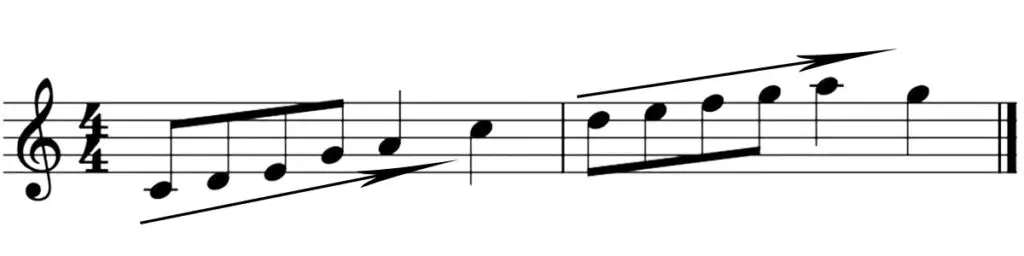
What is the melodic contour of the picture below?
Ascending
Descending
Repeated

The interval of these 2 notes is_________.
5th
6th
7th
Octave
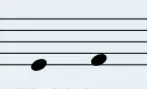
Identify whether the interval is a whole step or half step.
Whole Step
Half Step
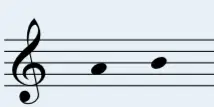
Identify whether a whole step or a half step.
Whole Step
Half Step
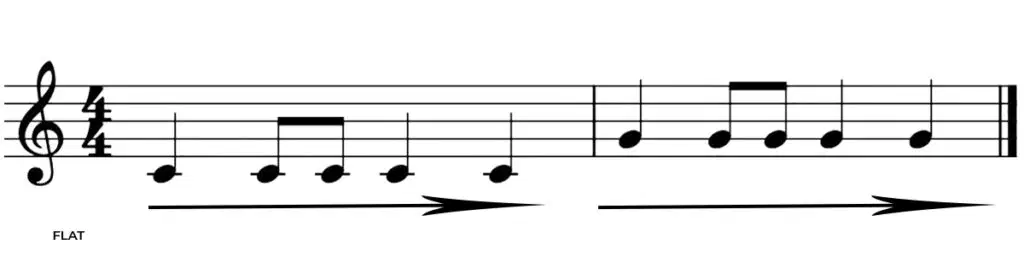
What melodic contour is shown?
Repeated
Where you can find the first note on the staff in C Major Scale?
First ledger line below the staff
First space
2nd line
2nd space
A descending melody moves ___________ , while an ascending melody moves ___________.
slowly; quickly
upward; downward
quickly; slowly
downward; upward
How do you get the melodic range of the notes?
What is the interval between the notes C and E?
Perfect fifth
Perfect fourth
Minor third
Major third
What is the Latin term for scale?
scale
scala
scaled
It is a musical symbol that raises the pitch of a note by a half step.
clef
sharp
flat
It is the only key without flats or sharps.
Key of C Major
Key of G Major
Key of F Major
It has one sharp on the fifth line of the staff.
Key of C Major
Key of G Major
Key of F Major
It has one sharp on the fifth line of the staff.
Key of C Major
Key of G Major
Key of F Major
It has one flat on the third line of the staff.
Key of C Major
Key of G Major
Key of F Major
What type of scale is used in most of the pop music you hear on Top 40 radio?
Diatonic scale
Pentatonic scale
Chromatic scale
Dialectic scale
What can you conclude about the F major scale from its name?
Its root is F
Its interval is F
Its major third is F
Its minor triad is F
If the root of a scale is D flat, the eighth note in the scale is:
E
D natural
D natural
D flat
"Fa" represents the ______ tone in an eight-note scale.
First
Second
Third
Fourth
Which of the following describes an interval of one half-step?
F to F sharp
A to C
B flat to C sharp
F major to F minor
A song in a minor key is most likely to be:
A football fight song
A sad ballad
A popular dance track
A fun sing-along
Which of the following statements is true?
In a C major scale, C has a higher pitch than D
In a C minor scale, C has a higher pitch than F
In a C major scale, F has a higher pitch than C
In a C minor scale, C has a higher pitch than D
If a song is written in the key of E minor:
Most of the notes in the song will be taken from the E Minor scale
All of the notes in the song must be taken from the E Minor scale
Only notes from the E Minor and E Major scales can be used
Notes from the E major scale cannot be used
The relative minor key follows the same home tone do as its parallel major key.
TRUE
FALSE
The home tone is the beginning note of a minor scale.
TRUE
FALSE
It tells the mid-range to low-range pitches.
Bass clef
Major clef
Treble clef
Baritone Clef
Why is the bass clef also called an F-clef?
Because its curl encircles the note G on the second line of the staff.
Because the second line from the top is the line for the pitch F, where the two dots are placed on the spaces above and below the line.
Because the pitch starts in F.
This symbol cancels out any accidental applied to a pitch. It signifies the return to the original pitch.
Flat
Sharp
Natural
Clef
The melody can either go up, down, or repeat.
Melodic Pattern
Melodic Direction
Melodic Interval
Two notes are written on the same line or space and have the same pitch.
Second interval
Octave
Unison
Half step

What pitch is this?
A
B
C
D
These are the notes found on the lines of the staff G-clef?
A, C, E, G
A, B, C, D,
E, G, B, D, F
G, B, D, F,A

