
Font size
 Worksheets
Page 1
Total questions: 130
Worksheet time: 1hrs 5mins

According to the overview, sustainable procurement aligns purchasing decisions with the broader goals of sustainable development.
Sustainable development
Short-term profit maximization
Brand awareness campaigns
Faster delivery times only

Instead of choosing suppliers or products based only on the lowest upfront price, which practice is central to sustainable procurement?
Considering whole-life costs from creation to disposal
Selecting the cheapest available option
Ignoring disposal and end-of-life impacts
Focusing solely on economic outcomes

Sustainable procurement aims to deliver best overall value while generating which outcomes, both now and in the long term?
Positive economic, environmental, and social outcomes
Only economic savings
Reduced delivery times
Higher upfront costs only

In the context of sustainable procurement, what does considering whole-life costs mean?
Evaluating costs across the product’s lifecycle from creation to disposal
Accounting only for the purchase price
Including maintenance costs but excluding disposal
Charging only recycling fees at end-of-life

Which strategy reflects how sustainable procurement uses purchasing power to influence market practices?
Shaping markets toward better practices
Avoiding supplier engagement to reduce complexity
Prioritizing speed over all other factors
Outsourcing responsibility for environmental impacts

According to the infographic titled The Three Pillars of Sustainable Procurement, sustainable procurement integrates how many dimensions?
One dimension
Two dimensions
Three dimensions
Four dimensions

In the Environmental Aspects pillar, what term is used to describe reducing impacts across the entire life cycle?
Cradle to cradle
Cradle to grave
Gate to gate
Seed to shelf

Which pillar focuses on reducing environmental impacts across the entire life cycle, including raw material extraction, manufacturing, distribution and packaging, use and energy consumption, and end-of-life disposal or recycling?
Best Value for Money
Environmental Aspects
Social Aspects
Supplier Negotiation Strategies

In the Best Value for Money pillar, a product with a higher purchase price may be what over its lifetime?
Cheaper over its lifetime
More expensive over its lifetime
The same cost over its lifetime
Cost cannot be compared over its lifetime

Which factors are explicitly listed under Best Value for Money as going beyond price? Select all that apply.
Quality and performance
Availability and functionality
Running and maintenance costs
Innovation and market development
Added environmental or social benefits

Which items are explicitly listed under Environmental Aspects life cycle stages? Select all that apply.
Raw material extraction
Manufacturing
Distribution and packaging
Use and energy consumption
End-of-life disposal or recycling

According to the Environmental Aspects pillar, the aim is to reduce which of the following? Select all that apply.
Emissions
Waste
Pollution
Resource depletion
Procurement lead times

Which items are explicitly listed under Social Aspects as how procurement affects people and communities? Select all that apply.
Support for local communities and suppliers
Job creation and regional development
Fair and legal labor conditions
Respect for human rights
Use of fair-trade and ethically sourced products

Which outcomes are explicitly listed under Social Aspects? Select all that apply.
Contribution to poverty reduction and social equity
Procurement becomes a tool for social responsibility
Reduction of marketing costs
Increase in product prices
Elimination of all supply chain risks

Which statement best describes Green Public Procurement (GPP) as presented in the diagram?
A specific component of sustainable procurement with a strong environmental focus
A general purchasing strategy focused solely on cost savings
A method designed to increase social benefits even if environmental impacts rise
A policy intended mainly to reduce government spending across all departments

According to the European Commission, what characterizes the GPP process used by public authorities?
Procuring goods, services, and works with a reduced environmental impact throughout their life cycle, compared to alternatives serving the same function
Prioritizing the cheapest suppliers regardless of environmental effects
Focusing exclusively on maximizing social outcomes in procurement
Restricting procurement to local vendors to support regional economies

In the key difference shown, what does sustainable procurement emphasize?
An economic, environmental, and social focus
Primarily an environmental focus only
Only an economic focus
Only a social focus

In the key difference shown, what does Green Public Procurement (GPP) emphasize?
Primarily an environmental focus
Economic and social priorities without environmental considerations
Primarily cost reduction across procurement
Equal emphasis on all three pillars: economic, environmental, and social

Within the European Commission’s definition, what does the phrase "reduced environmental impact throughout their life cycle" imply for items procured under GPP?
Considering environmental effects from production through use to end-of-life disposal compared to alternatives
Assessing only the purchase price at the time of acquisition
Evaluating supplier reputation without environmental criteria
Measuring social impact exclusively during the procurement decision
According to the passage, many companies now treat sustainability as a key strategic objective, not just an environmental issue. Which organization is cited for this statement?
United States Environmental Protection Agency (EPA)
United Nations Framework Convention on Climate Change (UNFCCC)
World Bank
U.S. Department of Energy (DOE)
According to the passage, what direct outcome is associated with reducing costs and waste in sustainability efforts?
Higher efficiency
Lower employee morale
Increased emissions
Reduced legal compliance
Which of the following is listed in the passage as a reason companies pursue sustainability?
Attract new customers
Improve employee vacation benefits
Increase short-term stock speculation
Eliminate supplier audits
Which benefit of sustainability is described in the passage as protecting public trust?
Protect brand reputation
Automate financial reporting
Eliminate all regulatory inspections
Increase raw material prices
Which reason for pursuing sustainability is explicitly linked to business continuity in the passage?
Ensure long-term business survival
Improve quarterly marketing metrics
Reduce office space
Increase overtime hours
According to the passage, companies comply with sustainability regulations to achieve which outcome?
Benefit from new policy opportunities
Avoid all media coverage
Replace strategic planning entirely
Limit customer growth
According to the slide, which statement best describes Willmott Dixon Holdings Ltd?
A large UK construction and property company
A small local retail chain
A government environmental regulator
A global software developer
According to the slide, construction uses many natural resources, so procurement choices strongly affect which areas? Select all that apply.
People
Communities
The environment
Shareholder profits

According to the slide, what does their Sustainable Procurement Policy explain?
How the company and its suppliers choose goods, works, and services
How to market properties to buyers
How to design buildings for aesthetics only
How to negotiate employee contracts

Which goal is included in their policy for choosing goods, works, and services?
Get value for money
Use more natural resources
Increase environmental damage
Exclude community health considerations

Which goal stated in the slide aims to reduce resource use?
Use fewer natural resources
Maximize raw material consumption
Ignore resource efficiency
Replace suppliers frequently

Which standard does their policy follow, according to the slide?
BS 8903
ISO 14001
BS 7671
LEED v4.1

According to the slide, which outcome is a goal of the policy when choosing goods, works, and services?
Create healthier buildings and communities
Focus solely on short-term profits
Eliminate all community engagement
Increase pollution to reduce costs

According to the slide titled Main Aims of Willmott Dixon’s Policy, which aim addresses energy and resource use?
Use less energy and fewer resources
Increase energy-intensive processes
Expand raw material extraction regardless of cost
Promote unlimited consumption of materials

In the Main Aims of Willmott Dixon’s Policy, what is stated about timber purchasing?
Buy legal and sustainably sourced timber
Prioritize the cheapest timber available
Use only imported tropical hardwoods
Avoid certification when purchasing timber

Which aim in the slide emphasizes considering multiple dimensions when making decisions?
Balance economic, social, and environmental factors
Focus solely on immediate financial returns
Prioritize marketing over environmental impact
Limit decisions to short-term operational needs

Which product-related aim is listed in the Main Aims of Willmott Dixon’s Policy?
Choose resource-efficient products
Buy products with the highest carbon footprint
Select items based only on brand recognition
Prefer disposable single-use products
What does supporting the circular economy include, according to the slide?
Reuse
Planned obsolescence
One-way linear production
Discarding materials after first use
Which aim highlights purchasing practices that strengthen local communities?
Buy locally and support SMEs and social enterprises
Centralize all procurement with global vendors only
Outsource purchasing to reduce local engagement
Avoid working with small businesses

Which ethical commitment is explicitly stated in the Main Aims of Willmott Dixon’s Policy?
Ensure fair prices, ethical labour, and human rights
Ignore labour standards to cut costs
Restrict human rights considerations to suppliers only
Base pricing solely on market fluctuations
Which health-related objective appears in the slide?
Improve health and wellbeing through better building materials
Focus exclusively on aesthetic appearance of buildings
Reduce wellbeing considerations to non-structural elements
Avoid material changes that affect occupant health
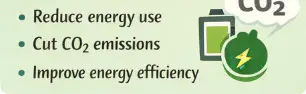
According to the Sustainable Procurement Guide infographic, which key area specifically includes cutting CO2 emissions as an action?
Energy & Emissions
Water
Biodiversity
Trade Compliance
Based on the Sustainable Procurement Guide infographic, which actions are listed under Waste? Select all that apply.
Reduce landfill waste
Use recyclable packaging
Consider life-cycle costs
Increase raw water extraction

In the Sustainable Procurement Guide infographic, which practices fall under the Water key area? Select all that apply.
Reduce water use
Good water management
Use recycled materials
Support local economies
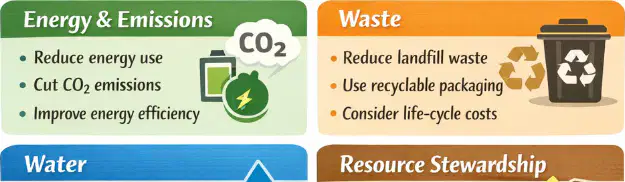
According to the infographic, which certification examples are specified when buying certified timber under Resource Stewardship?
FSC/PEFC
ISO 14001
LEED
RoHS
Which actions are included under Economic Sustainability in the Sustainable Procurement Guide infographic? Select all that apply.
Support local economies
Pay fair and on time
Encourage innovation
Respect regulations

Which key area in the infographic emphasizes protecting ecosystems?
Biodiversity
Waste
Trade Compliance
Resource Stewardship

According to the Sustainable Procurement Guide infographic, which practices are specified under Trade Compliance? Select all that apply.
Follow export laws
Respect regulations
Cut CO2 emissions
Buy certified timber
In the infographic, which actions are listed under Energy & Emissions? Select all that apply.
Reduce energy use
Improve energy efficiency
Cut CO2 emissions
Use recyclable packaging
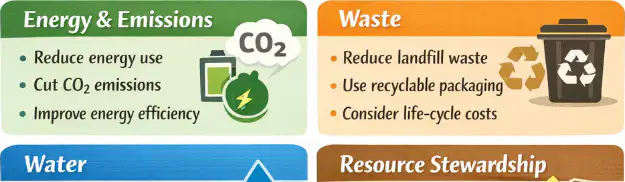
Which key area in the Sustainable Procurement Guide infographic includes buying certified timber as a listed action?
Resource Stewardship
Economic Sustainability
Waste
Water

According to the infographic, which key area focuses on reducing water use?
Water
Energy & Emissions
Trade Compliance
Biodiversity
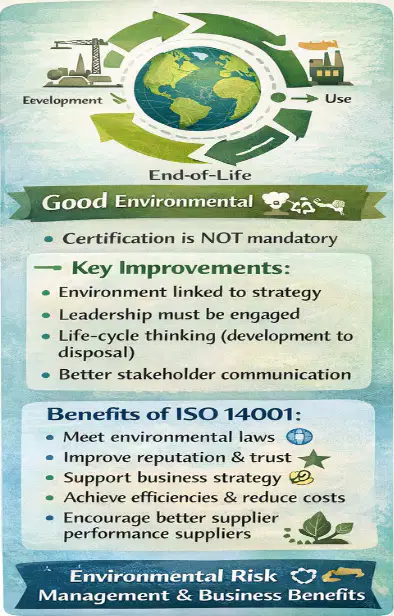
In the infographic section on ISO 14001:2015 Environmental Management Systems, what does it state about certification requirements?
Certification is mandatory for all organizations
Certification is NOT mandatory
Certification is only required for manufacturers
Certification is required once every three years
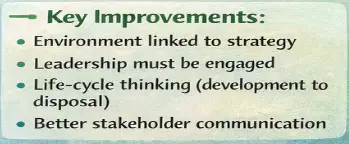
According to the ISO 14001:2015 infographic, which items are listed as key improvements? Select all that apply.
Environment linked to strategy
Leadership must be engaged
Life-cycle thinking (development to disposal)
Better stakeholder communication
Focus solely on short-term cost cutting
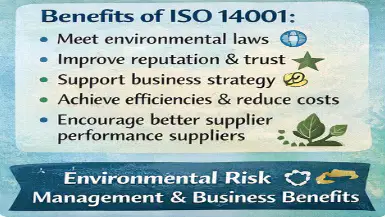
Which benefits are explicitly listed for ISO 14001 in the infographic? Select all that apply.
Meet environmental laws
Improve reputation and trust
Support business strategy
Achieve efficiencies and reduce costs
Increase product prices
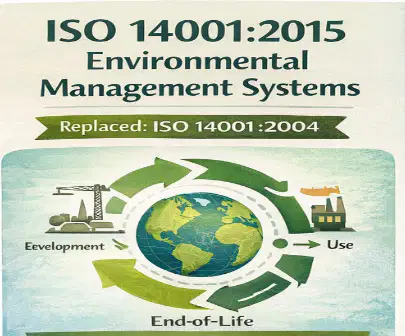
In the ISO 14001:2015 panel, what does life-cycle thinking encompass?
Considering impacts only during manufacturing
Considering impacts only at end-of-life
Considering impacts from development to disposal
Considering impacts only during product use
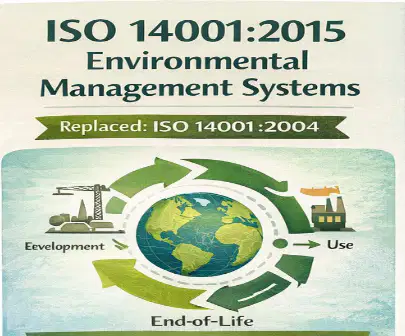
Which earlier standard does ISO 14001:2015 replace, as shown in the infographic?
ISO 9001:2008
ISO 14001:2004
BS ISO 20400:2017
BS 8903:2010
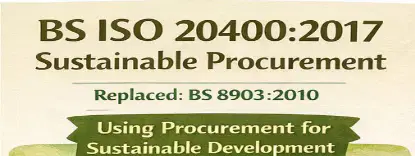
Which earlier guidance does BS ISO 20400:2017 replace, according to the infographic?
ISO 14001:2004
BS 8903:2010
UN SSDGs
ISO 9001:2015

In the BS ISO 20400:2017 panel, what is the overarching purpose stated at the top?
Using Procurement for Sustainable Development
Using Procurement for Cost Reduction
Using Procurement for Risk Avoidance Only
Using Procurement for Supplier Compliance
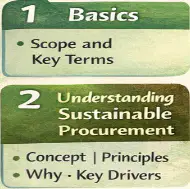
According to the BS ISO 20400:2017 infographic, which topics are listed under Basics?
Scope and Key Terms
Concept and Principles
Commitment and Accountability
Planning and Specification
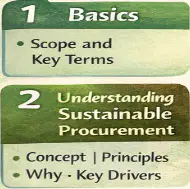
Which elements are included under Understanding Sustainable Procurement in the BS ISO 20400:2017 panel?
Concept
Principles
Why
Key Drivers
Supplier audit cycle

Which items are listed under Policy & Strategy in the BS ISO 20400:2017 infographic?
Commitment
Accountability
Supply Chain
Sustainable Procurement Strategy
Inventory valuation
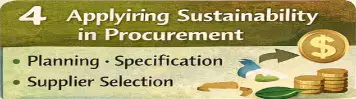
Which topics are shown under Applying Sustainability in Procurement in the BS ISO 20400:2017 panel?
Planning, Specification, Supplier Selection
Budgeting, Auditing, Reporting
Design, Manufacturing, Distribution
Recruitment, Training, Retention
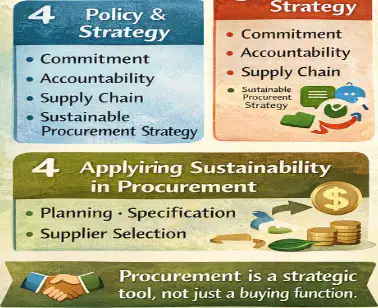
What strategic view of procurement is stated at the bottom of the BS ISO 20400:2017 infographic?
Procurement is a routine buying function only
Procurement is a strategic tool, not just a buying function
Procurement is mainly a legal compliance activity
Procurement is exclusively supplier management
Based on the slide titled “New Thinking in Sustainable Procurement (BSR View),” which items describe the old approach (past 20 years) to sustainable procurement? Select all that apply.
Codes of conduct
Supplier audits
Compliance checks
Strategic engagement with suppliers
According to the slide, which elements are part of the new approach (today) to sustainable procurement? Select all that apply.
Strategic engagement with suppliers
Transparency across the whole supply chain
Innovation and long-term value creation
Compliance checks
What is identified as the key idea of sustainable procurement in the slide?
It is primarily about control and punishment.
It is about partnership and impact.
It is mainly about cost-cutting and short-term savings.
It focuses on isolated compliance activities.

In which year did Business for Social Responsibility (BSR) publish the paper explaining that sustainable procurement is evolving?
2008
2018
2020
2015

What does the acronym BSR stand for as shown on the slide?
Business for Sustainable Results
Business for Social Responsibility
Bureau of Strategic Resources
Board for Supply Resilience
Based on the slide titled Real Sustainability Achievements in Public Procurement, which place made sustainability criteria mandatory in major public contracts?
Barcelona
Stockholm
Luxembourg
Netherlands
According to the Stockholm example on the slide Real Sustainability Achievements in Public Procurement, what percentage reduction compared to petrol vehicles was reported for the joint purchase of electric vehicles?
95%
50%
25%
10%
In the Stockholm case described on the slide Real Sustainability Achievements in Public Procurement, how much CO₂ was saved through the joint purchase of electric vehicles?
34 tonnes
29,000 tonnes
340 tonnes
3,400 tonnes
In the Germany (Interior Ministry) example on the slide Real Sustainability Achievements in Public Procurement, how much energy was saved by energy-efficient IT systems?
58.7 million kWh
5.87 million kWh
587,000 kWh
58,700 kWh
According to the Germany (Interior Ministry) example on the slide Real Sustainability Achievements in Public Procurement, what was the reported reduction in CO₂ emissions?
29,000 tonnes
34 tonnes
2,900 tonnes
290 tonnes
Which country’s cleaning contracts banned harmful chemicals, as shown on the slide Real Sustainability Achievements in Public Procurement?
Luxembourg
Germany
Netherlands
Spain
On the slide Real Sustainability Achievements in Public Procurement, PIANOo supports 3,500 procurement professionals with tools and best practices. In which country is PIANOo located?
Netherlands
Germany
Spain
Sweden
Which example on the slide Real Sustainability Achievements in Public Procurement specifically references the joint purchase of electric vehicles?
Stockholm
Barcelona
Luxembourg
Germany (Interior Ministry)
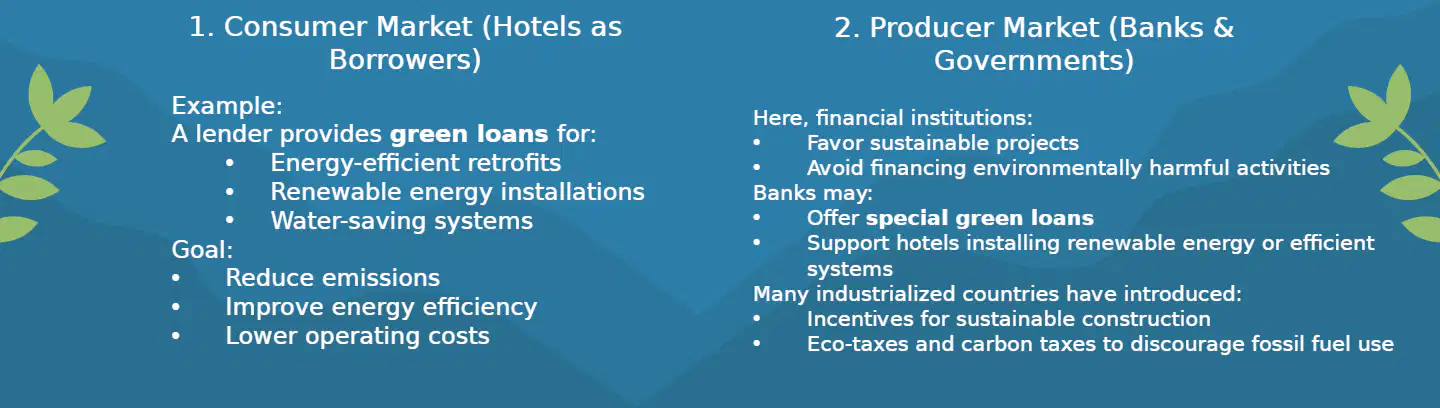
Based on the infographic titled "It applies to two markets," to which markets does the concept apply?
Consumer market only
Producer market only
Consumer and producer markets
Neither market
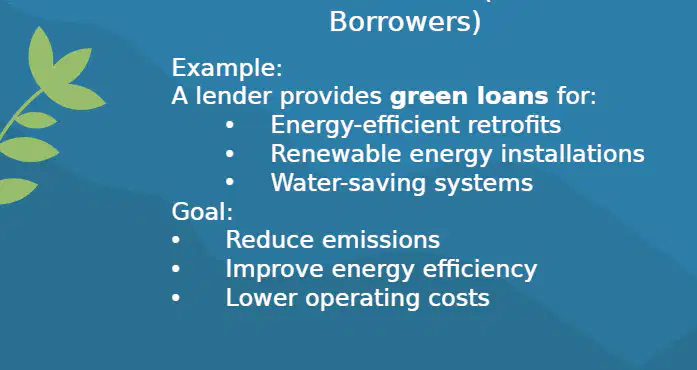
In the consumer market example shown, what type of financing does a lender provide to hotels?
Green loans
Microcredit
Venture capital
Crowdfunding
According to the consumer market section, for which projects are green loans provided? Select all that apply.
Energy-efficient retrofits
Renewable energy installations
Water-saving systems
Expansion of fossil fuel capacity
Which goals are stated for consumer market green loans? Select all that apply.
Reduce emissions
Improve energy efficiency
Lower operating costs
Increase water consumption
In the producer market, what do financial institutions aim to do? Select all that apply.
Favor sustainable projects
Avoid financing environmentally harmful activities
Maximize short-term returns regardless of impact
Prioritize fossil fuel subsidies
What actions may banks take in the producer market? Select all that apply.
Offer special green loans
Support hotels installing renewable energy or efficient systems
Provide zero-interest credit cards
Require hotels to expand fossil fuel use
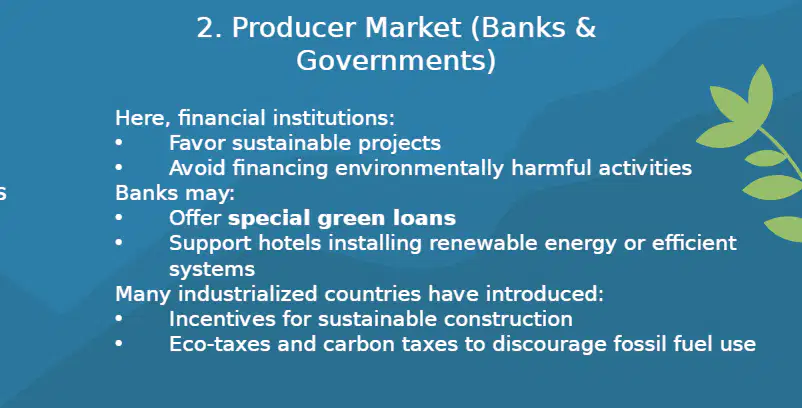
Which measures have many industrialized countries introduced, according to the producer market section? Select all that apply.
Incentives for sustainable construction
Eco-taxes and carbon taxes to discourage fossil fuel use
Subsidies to increase coal mining
Mandates to finance environmentally harmful activities

Who are identified as borrowers in the consumer market?
Hotels
Banks
Governments
Manufacturers

According to the infographic titled "Financing Sustainability and Green Investments," sustainability or green investments are financial investments made in companies or projects that reduce environmental damage. Which option best reflects this stated goal?
Reduce environmental damage
Increase fossil fuel dependence
Prioritize short-term profits over environmental impact
Encourage higher resource consumption
Which investment type is explicitly listed in the infographic as a form of sustainability or green investment?
Stocks
Real estate flipping
Cryptocurrency speculation
Commodities futures
According to the infographic, sustainability or green investments aim to improve which area?
Resource efficiency
Marketing reach
Tax liabilities
Executive compensation

Which company type is provided as an example of a business suitable for sustainability investments in the infographic?
Renewable energy developers (solar, wind)
Coal mining expansion firms
Tobacco producers
Fast-fashion retailers focused on volume
Which loan category is specifically identified as a sustainability investment instrument in the infographic?
Green loans
Payday loans
Subprime auto loans
High-interest consumer credit
Based on the infographic titled Sustainability Performance of Small & Medium Hospitality Businesses, what is stated about small and medium-sized hotels in relation to global indices?
They are not listed on global indices
They are ranked annually on global indices
They are always included in major global indices
They lead most sustainability rankings on global indices
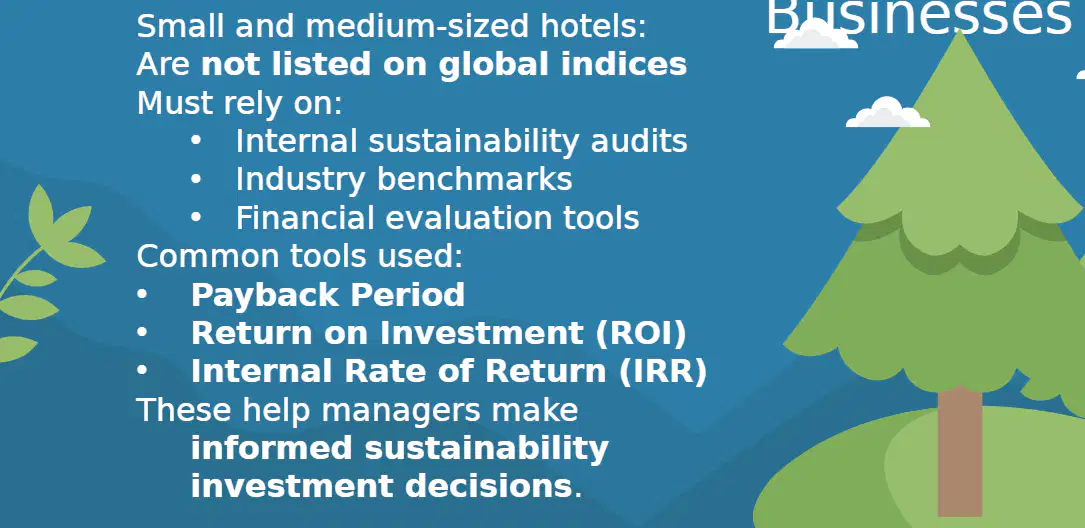
According to the infographic, small and medium-sized hotels must rely on which sources to assess sustainability performance?
Internal sustainability audits
Industry benchmarks
Financial evaluation tools
Celebrity endorsements
Viral social media campaigns
Which tools are listed in the infographic as common financial evaluation tools used by managers in small and medium hospitality businesses?
Payback Period
Return on Investment (ROI)
Internal Rate of Return (IRR)
Net Present Value (NPV)
Earnings per Share (EPS)
According to the infographic, what do these tools help managers do?
Make informed sustainability investment decisions
Increase occupancy rates immediately
Bypass sustainability audits
Eliminate the need for benchmarking

According to the slide, the payback period answers one simple question: what does it determine?
How long it takes to recover the initial investment
How much profit is earned each year
What interest rate the investment pays
How many units are sold
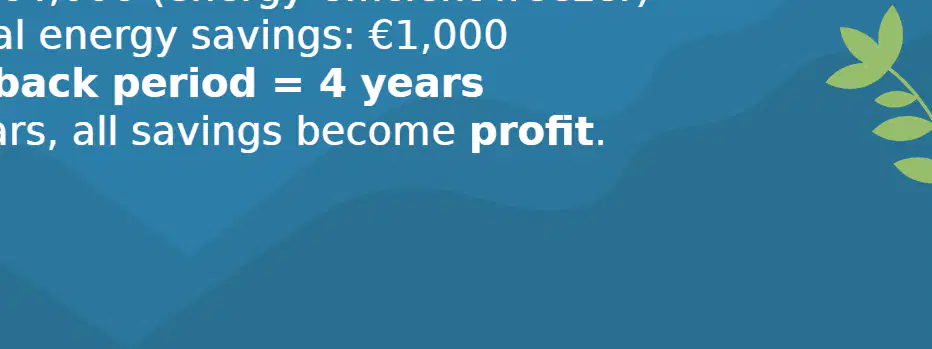
Using the simple example (restaurant freezer): investment €4,000 and annual energy savings €1,000. What is the payback period?
3 years
4 years
5 years
It cannot be determined from the information
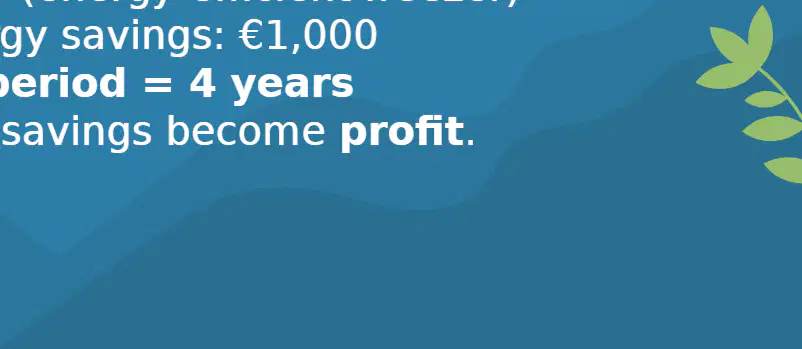
In the simple example, after the payback period, what do all savings become?
Profit
Additional investment required
Tax liability
Depreciation
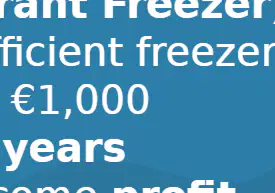
In the simple example, what is the annual energy savings amount?
€500
€1,000
€2,000
€4,000

In the simple example, what was the initial investment in the energy-efficient restaurant freezer?
€1,000
€4,000
€5,000
€400

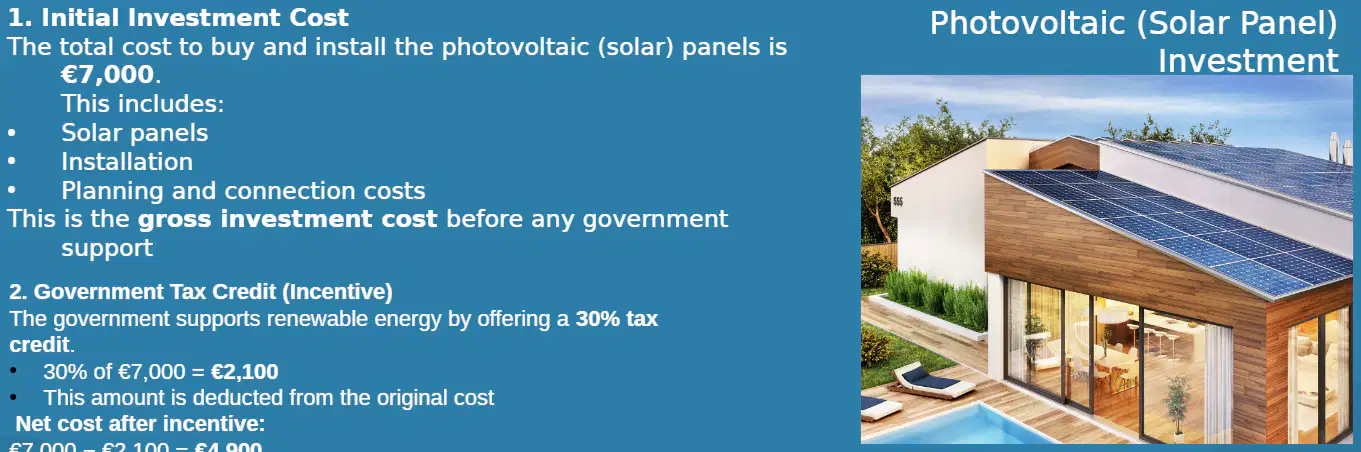
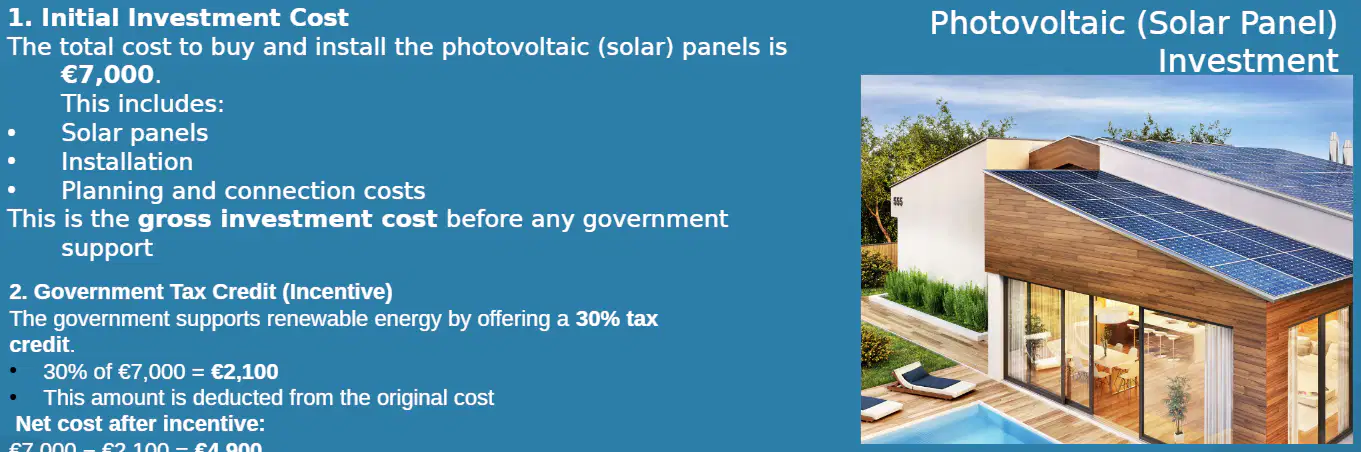
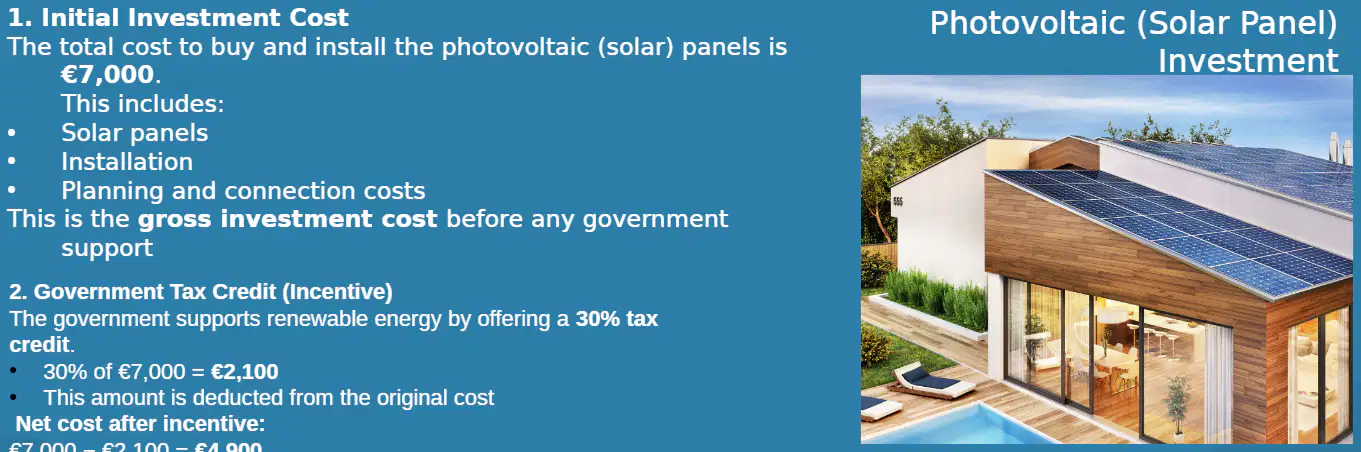
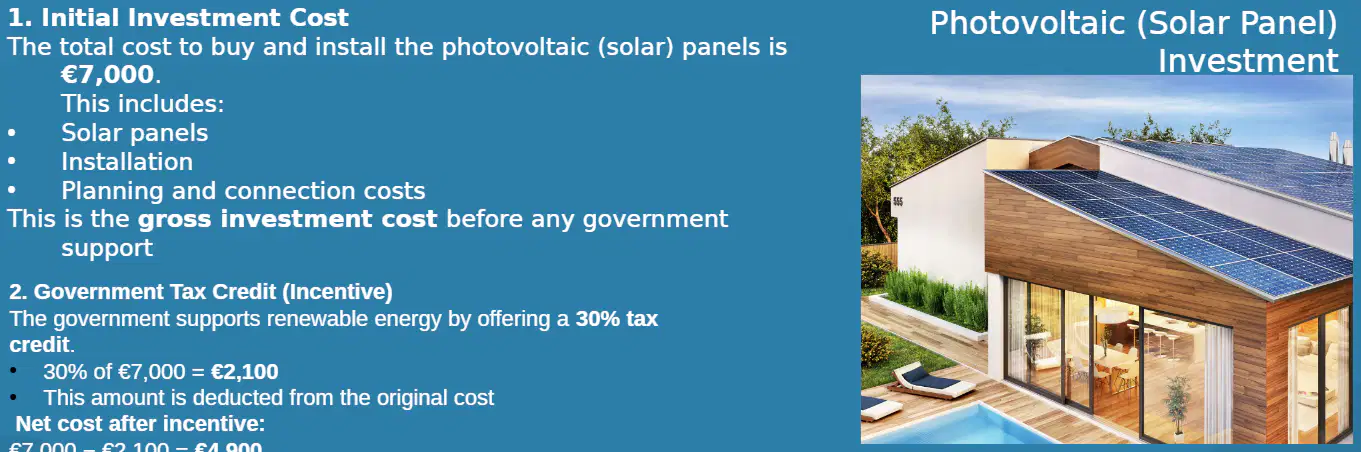
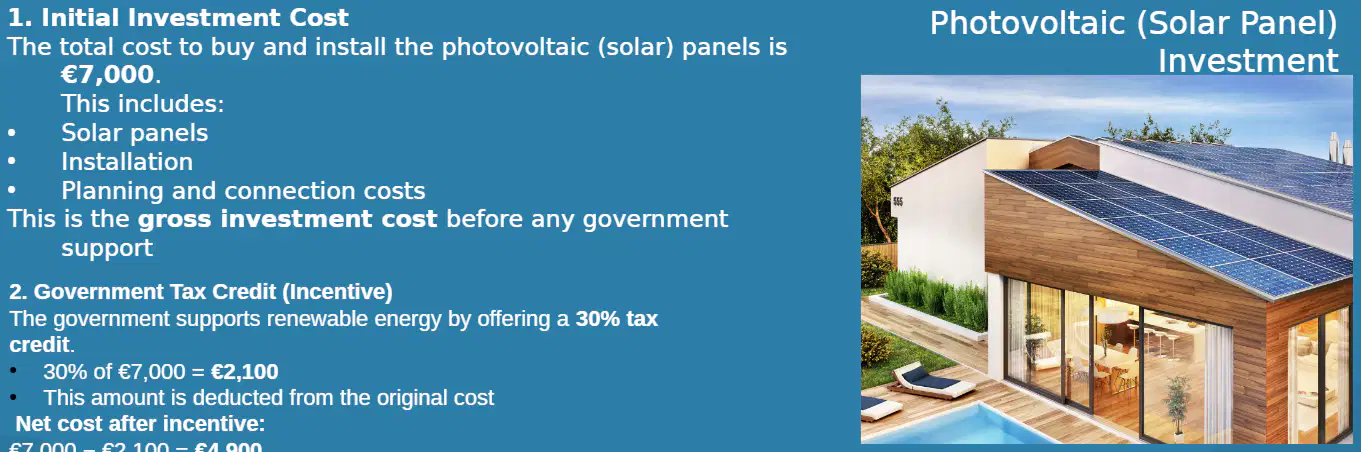
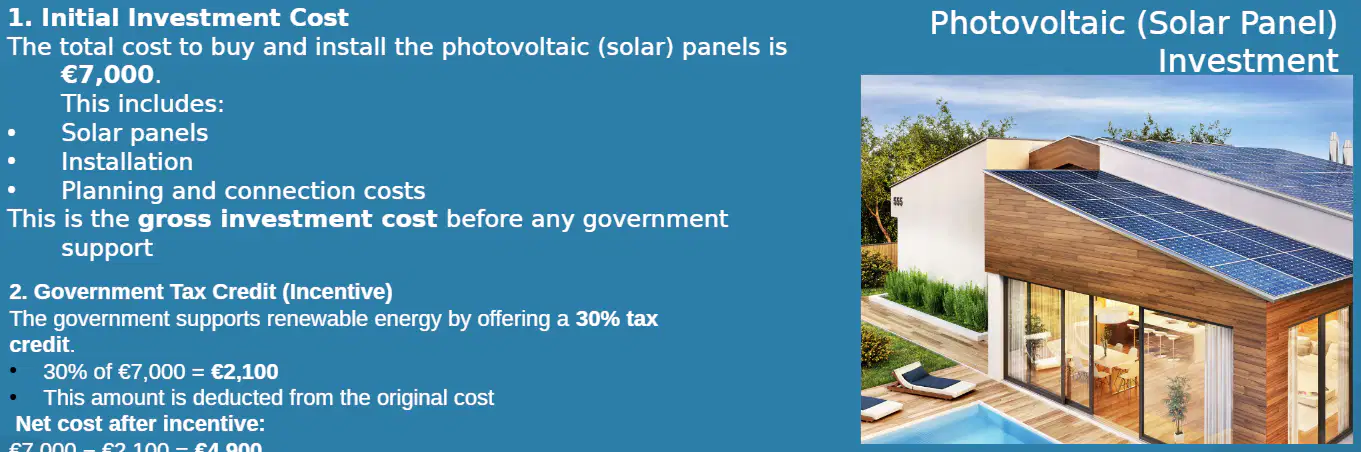
According to the infographic, what is the total gross investment cost to buy and install the photovoltaic (solar) panels before any government support?
€7,000
€4,900
€2,100
€80 per month

Which items are included in the initial investment cost listed in the infographic? Select all that apply.
Solar panels
Installation
Planning and connection costs
Government tax credit
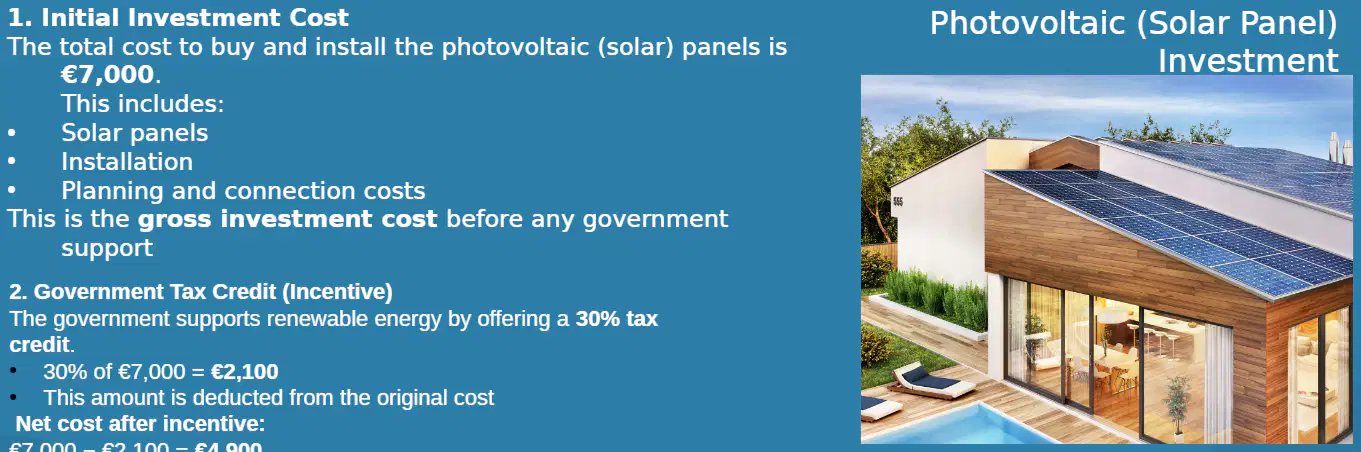
What percentage government tax credit for renewable energy is shown in the infographic?
20%
25%
30%
10%
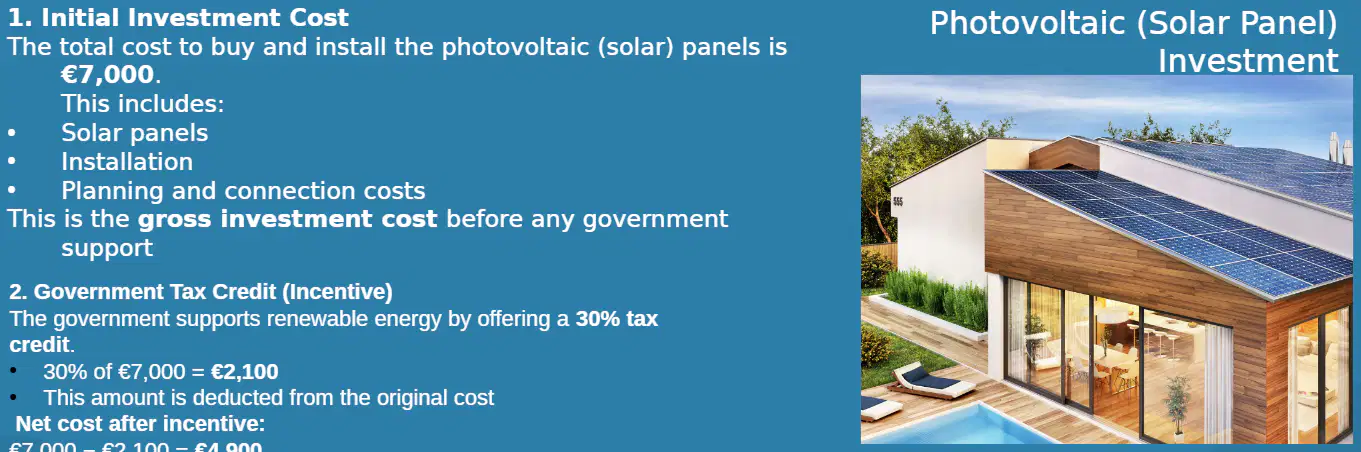
What is the euro amount of the tax credit on an initial cost of €7,000, as shown?
€2,000
€1,400
€2,100
€900
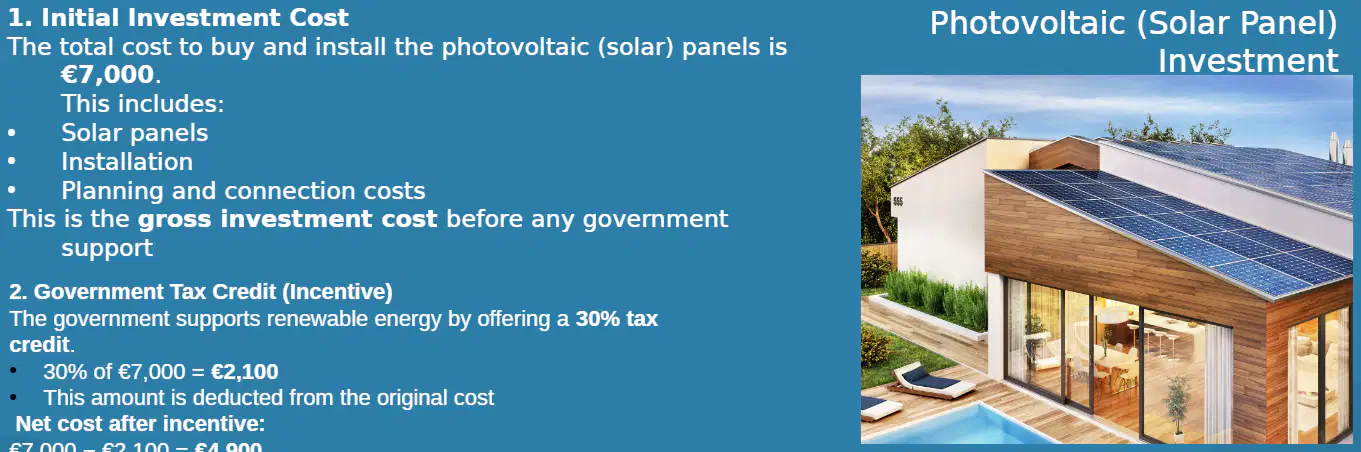
After deducting the tax credit, what is the net cost paid by the business?
€7,000
€2,100
€4,900
€5,800
According to the monthly energy savings section, how much electricity do the solar panels produce per month for the business?
200 kWh
500 kWh
400 kWh
800 kWh
What electricity price per kWh is used in the savings calculation?
€0.10 per kWh
€0.20 per kWh
€0.50 per kWh
€1.00 per kWh
What monthly savings amount does the business achieve by using the solar panels, according to the infographic?
€40 per month
€60 per month
€80 per month
€100 per month
Approximately how many months are required to reach the payback period (break-even point) based on the figures provided?
36–38 months
48–50 months
61–62 months
72–74 months
Approximately how many years does the payback period correspond to, according to the infographic?
3 years
4 years
5 years
6 years

What does the payback period show, as defined in the infographic?
How much profit the system will generate each year
How long it takes for savings to recover the investment
The total lifetime of the solar panels
The annual maintenance cost of the system
After the payback period is reached, what statement does the infographic make about the investment?
It has doubled in value
It has paid for itself
It needs replacement
It becomes unprofitable

According to the “Payback Period Considerations — Sustainability Investment Timeline” infographic, what is the payback period labeled short term?
0–2 years
3–4 years
5–8 years
6–15 years

In the infographic, which item is listed under Quick Wins / Operational Improvements for the short term timeline?
Compressors
Solar Panels
LED Lighting
Building Renovation

Which benefits are shown for short term Quick Wins / Operational Improvements in the infographic? Select all that apply.
Low Cost
Fast Savings
Low Risk
High Investment
Long Lifespan

According to the infographic, what is the payback period labeled medium term?
0–2 years
3–4 years
5–8 years
6–15 years

Which item appears under Efficiency Through Equipment Upgrades in the medium term timeline?
Heat Recovery Systems
Renewable Energy
HVAC Upgrades
Insulation of Boilers & Pipes

Which benefits are associated with the medium term equipment upgrades in the infographic? Select all that apply.
Moderate Investment
Cost Reduction
Operational Efficiency
Major Savings
Low Risk

According to the infographic, what is the payback period labeled long term?
0–2 years
3–4 years
5–8 years
6–15 years

Which item is listed under Strategic Sustainability Investments in the long term timeline?
Staff Training
Motion & Key Card Sensors
Solar Panels
Chillers

Which benefits are shown for long term strategic investments in the infographic? Select all that apply.
High Investment
Long Lifespan
Major Savings
Fast Savings
Low Cost

In the infographic, which timeline includes Motion & Key Card Sensors?
Short term Quick Wins / Operational Improvements
Medium term Equipment Upgrades
Long term Strategic Sustainability Investments
None of the timelines

Which statement at the bottom of the infographic summarizes the recommended sustainability strategy?
Focus exclusively on short-term quick wins
Combine short-, medium-, and long-term payback investments
Prioritize only long-term strategic investments
Delay all investments until payback is under 2 years

Which item from the medium term list specifically relates to cooling equipment?
Chillers
Thermal Insulation
LED Lighting
Staff Training
Case Study 1: Healthy Food Vending Machine. Identify the initial investment based on a vending machine at €5,000 and products for one year at €1,000.
€5,000
€6,000
€1,000
€2,400
Case Study 1: Healthy Food Vending Machine. The monthly profit is €200. What is the annual profit calculated as €200 × 12?
€1,200
€2,400
€2,000
€400
Case Study 1: Healthy Food Vending Machine. Identify the total annual operating costs given lobby rent of €300/year and maintenance of €100/year.
€100
€300
€400
€600
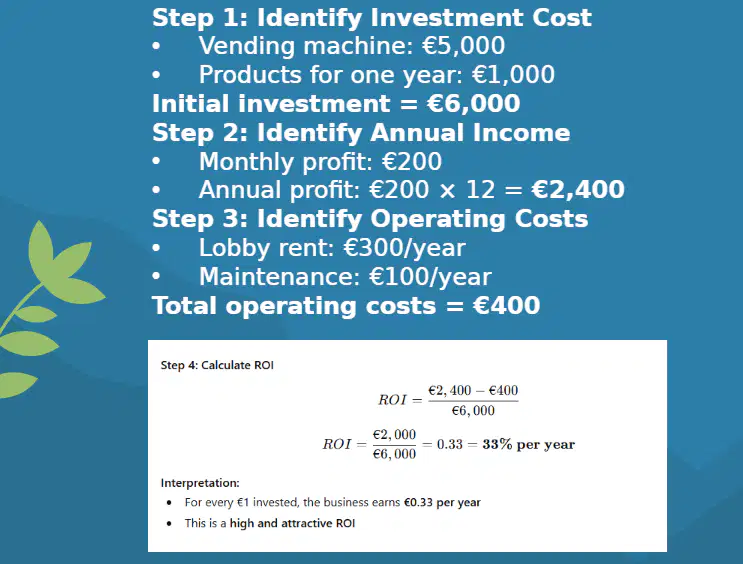
Case Study 1: Healthy Food Vending Machine. Using annual profit of €2,400, operating costs of €400, and initial investment of €6,000, what is the ROI per year shown in the worksheet?
25%
33%
20%
40%
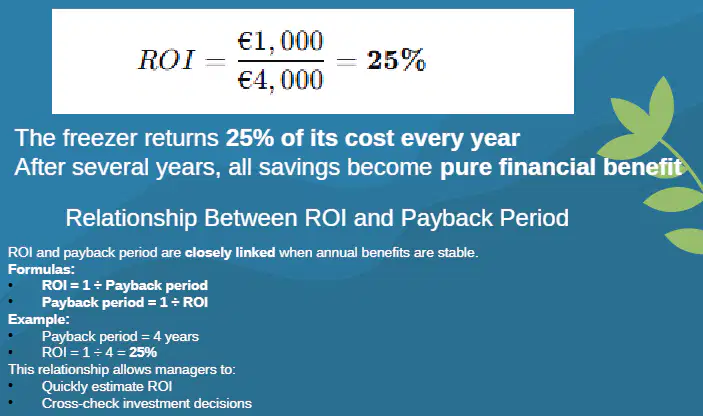
Case Study 2: Energy-Efficient Walk-In Freezer. This investment produces energy savings, not direct income. With an initial investment of €4,000 and annual energy savings of €1,000, what ROI is shown?
10%
20%
25%
33%
Case Study 2: Energy-Efficient Walk-In Freezer. Which statement aligns with the worksheet’s description of the return?
It generates new sales revenue every year.
It returns 25% of its cost every year through savings.
It incurs an annual maintenance loss of 25%.
It provides a one-time rebate equal to 25% of cost.
Relationship Between ROI and Payback Period. According to the formulas provided, which expression correctly links ROI to payback period when annual benefits are stable?
ROI = Payback period × 1
ROI = 1 ÷ Payback period
ROI = Payback period ÷ 100
ROI = 100 ÷ Payback period
Relationship Between ROI and Payback Period. Using the example provided, if the payback period is 4 years, what is the ROI?
20%
25%
33%
50%
Relationship Between ROI and Payback Period. Using the vending machine ROI of 33% per year, what is the approximate payback period according to the formula payback period = 1 ÷ ROI?
2 years
3 years
4 years
5 years

