
 Worksheets
P.E 6 SUMMATIVE 3 Lesson 3 (UNIT 2) - Lesson 2 (UNIT 3)
Total questions: 100
Worksheet time: 50mins
Who is credited with the invention of basketball in 1891?
William G. Morgan
James A. Naismith
Alexander Cartwright
Walter Camp
Which volleyball skill requires your hands to form a "diamond shape" above your head?
Forearm Pass
Underarm Serve
Overhead Pass
Spike
What was the original name given to volleyball when it was first invented?
Netball
Mintonette
Hand-tennis
Volley-ball
In invasion games, which team is responsible for protecting the goal and preventing a score?
Offensive Team
Striking Team
Defensive Team
Receiving Team
When performing a forearm pass in volleyball, where should the ball make contact?
On the palms of the hands
On the elbows
Just above the wrist on the forearms
On the shoulders
Which of the following is an example of an invasion game?
Tennis
Ultimate Frisbee
Badminton
Volleyball
How far back from the net should you stand when preparing to perform a spike?
1-2 feet
10-12 feet
5-6 feet
15 feet
What is the primary goal of the offensive team in an invasion game?
To protect their own territory
To move the object into the opponent's territory and score
To watch the referee for signals
To stand in a strategic position without the ball
Which skill involves tapping a ball with the inside edge of your foot while running?
Dribbling with hand
Passing
Dribbling with foot
Tackling
In volleyball, which serve involves a pendulum-like arm swing?
Overhand Serve
Underarm Serve
Jump Serve
Side Serve
What year was volleyball invented?
1891
1895
1900
1885
Which health benefit is specifically mentioned as a result of playing volleyball?
Improved flexibility
Better lung capacity
Improved hand-eye coordination
Increased height
Net and wall games require players to strike the ball with enough _______ and power that the opponent cannot return it.
Speed
Accuracy
Spin
Height
What are the two essential skills needed specifically for playing invasion games?
Power and Strength
Speed and Agility
Balance and Flexibility
Accuracy and Patience
In basketball, what part of your hand should you use to bounce the ball while dribbling?
The palm
The fist
The fingertips only
The back of the hand
Volleyball is a combination of which sports?
Basketball, Baseball, Tennis, and Handball
Soccer, Basketball, and Tennis
Football, Rugby, and Baseball
Badminton, Tennis, and Squash
Which movement is part of a Chest Pass in basketball?
Jumping as high as possible
Stepping one foot forward and following through
Rolling the ball on the floor
Throwing the ball over the shoulder
Why is "strategic positioning" important in net and wall games?
To make the game look professional
To defend the team's space and return the ball
To take a rest during the game
To talk to the other team
What value should a student display during physical activities according to the lesson?
Competitive anger
Joy of effort and fair play
Selfishness
Silence
If you are playing a game where you must "protect the court" and "place the ball," what category of game are you playing?
Invasion Game
Net and Wall Game
Target Game
Lead-up Game
When performing an Overhand Serve, how high should you toss the ball?
As high as the ceiling
Just a few inches
An arm's length
Behind your head
Which sport is considered the most popular in the Philippines according to Lesson 3?
Volleyball
Football
Basketball
Tennis
What is the correct way to hit the ball during a Spike?
With a closed fist
With your palm and fingers
With your forearm
With the back of your hand
In soccer dribbling, the ball should not be more than _______ ahead of the runner.
One yard
One meter
One foot
Five feet
Which of these is a social benefit of playing volleyball?
Learning new rules
Opportunity to connect with other people
Earning money
Becoming famous
When catching a ball for a "high catch," which way should your fingers point?
Down
To the side
Up
Toward your chest
What should you do with your knees when preparing for an Overhead Pass?
Keep them locked straight
Keep them soft and ready to bend
Sit on the floor
Lift one leg up
According to the text, what is the nature of an Underarm Serve?
Hitting the ball with a high elbow
Swinging the arm backward then forward like a pendulum
Throwing the ball with two hands
Jumping and hitting the ball at its highest point
Besides basketball, what is another example of an invasion game?
Badminton
Water Polo
Tennis
Table Tennis
How does participating in various games help your fitness?
It makes you taller immediately
It improves cardiovascular endurance and burns body fat
It replaces the need for healthy eating
It only helps you make friends
What is the final step of a Spike move?
Jumping
Running to the net
Following through by bringing the hitting arm down across the body
Throwing the ball to a teammate
When dribbling with your hand, where should the ball be bounced?
Behind your back
High above your head
In front of your body without touching your feet
Directly on your toes
Which skill requires rotating your trunk and shoulder with a flexed high elbow?
Underarm Serve
Overhand Serve
Forearm Pass
Dribbling
What is the main difference between an invasion game and a net/wall game?
Invasion games use balls, net games do not.
Invasion games involve entering the opponent's territory; net games involve hitting over a barrier.
Net games are only played outdoors.
There is no difference.
In the Underarm Serve, where should your body weight be initially?
On the front foot
On the back right foot
Balanced on both heels
On your toes
Which skill is used to move a ball by hitting it back with elbows bent?
Throw Pass
Chest Pass
Spike
Dribbling
Why did William G. Morgan invent volleyball?
He wanted a more violent sport than basketball.
He wanted a game that combined skills from basketball, baseball, tennis, and handball.
He wanted a game that didn't use a ball.
He wanted a game played only by two people.
What is "spatial awareness" as mentioned in Lesson 3?
Knowing the names of all planets
Understanding your position and the position of others in the playing area
The ability to jump high
Knowing how to inflate a ball
What is the primary definition of dancing as mentioned in Lesson 1?
Moving to a specific story
Moving your body to the rhythm of music
Following a strict set of rules
Exercising for weight loss
In the "Let's Get Ready" activity, what does an artist use as a comparison for a dancer’s movements?
A musical instrument
A block of clay
A paintbrush on a canvas
A camera lens
Which of these is a non-locomotor movement?
Slide
Gallop
Wiggle
Crawl
When performing the 3rd position of the arms, where is your other hand if one arm is raised overhead?
In first position
In second position
On the waist
In front of the chest
Which element of dance involves "Fast and Slow"?
Space
Force
Time
Flow
What movement is described as moving the hand from the wrist in a clockwise or counterclockwise direction?
Hayon-hayon
Kumintang
T-position
Lateral position
How is the 4th position of the feet executed?
Slide one foot to the side shoulder-width apart
Bring heels close to touch
Bring the heel to the instep of the other foot
Slide the foot so it is directly in front of the other
Which of the following is an example of a body shape?
Symmetrical
Zigzag
Diagonal
Clockwise
What is the step pattern for a Waltz in 3/4 time?
Step, close, step
Step, hop
Slide, close
Step, point
Which type of dance uses improvised movements to communicate a thought or feeling?
Traditional Folk Dance
Ballet
Creative Dance 2020
Ballroom Dance
"Arms in T-position" means the arms are at the sides and bent at the elbows so the upper arms are at:
Waist level
Head level
Chest level
Shoulder level
Which pathway describes a movement that goes back and forth in sharp angles?
Spiral
Zigzag
Circular
Straight
If you are performing a Touch Step in 2/4 time, what is the correct pattern?
Step right, swing left
Touch right, close right
Why is creative dance considered an "avenue of self-expression"?
It requires expensive costumes
It uses improvised movements to communicate ideas
It is only performed for an audience
It follows a pre-written script
What is the 5th position of the arms?
Raise both arms overhead with palms facing down
Open arms to the sides in a curve
Raise arms to a circle in front of the body
One arm overhead, the other in front of the chest
Which of these is a locomotor movement?
Bounce
Twist
Skip
Stretch
In Philippine folk dance, what is the position where both arms are at one side at shoulder, chest, or waist level?
Hayon-hayon
Reverse T-position
Lateral position
T-position
What do "bound" and "free" refer to in the elements of dance?
Space
Flow
Relationships
Time
To perform the 1st position of the feet, you must:
Slide feet shoulder-width apart
Bring heels to touch with toes apart
Place one heel against the other instep
Place one foot directly in front of the other
A Change Step in 2/4 time follows which count?
1, 2
1, 2, 3
1 and 2
1, 2, and
Comparing a dancer to a baker (Lesson 2), what represents the "basic tools and skills" for a dancer?
Music and rhythm
Basic dance steps and positions
Costumes and makeup
Stage and lighting
Which movement involves placing one forearm in front and the other at the back of the waist?
Kumintang
Hayon-hayon
Hands on waist
Lateral position
Which of the following belongs to the "Relationship" element of dance?
High and Low
Lead and Follow
Fast and Slow
Light and Strong
How does the "Force" element change a dance?
It dictates where the dancer moves
It determines the shape of the body
It creates variety through light or powerful movements
It changes the speed of the music
In a Three-step Turn, what is the final action in the sequence (count 1, 2, 3)?
Hop
Close left to right
Swing left
Point right
Which foot position requires bringing the heel of one foot to touch the instep of the other?
2nd Position
3rd Position
4th Position
5th Position
What is the benefit of dance that involves interacting with others and showing respect?
Cognitive benefit
Psychomotor benefit
Social benefit
Technical benefit
Which dance element is explored when a dancer moves up, down, or sideward?
Pathways
Levels
Directions
Shapes
The Close Step in 3/4 time has a count of:
1,2,3
1,2
1,2
1,2,3
If a dancer is instructed to move through general space, what are they doing?
Staying in one spot (stationary)
Moving throughout the entire available area
Only moving their upper body
Moving within their personal reach
To create a sequence showing Contrast (a relationship element), two dancers should:
Perform the exact same movements at the same time
Move in opposite or different ways from each other
Follow one another in a line
Move in a circular pathway
You are choreographing a dance about a heavy storm. Which Force would be most appropriate?
Fine and gentle
Light and soft
Strong and powerful
Smooth and light
Why is it essential for a beginner to learn the five fundamental positions before learning complex folk dances?
It is the only way to get exercise
They serve as the foundation for most dance steps
To make the dance look more modern
Because the music will not play otherwise
What is the difference between a Step Point and a Step Hop?
One is locomotor, one is non-locomotor
One involves staying on the ground, the other involves leaving the ground
One is only for 2/4 time, the other is only for 3/4 time
One uses arms, the other uses feet
Which of the following movement sequences is purely locomotor?
Walk, Jump, Bend
Run, Slide, Stretch
Leap, Roll, Crawl
Shake, Turn, Hop
Which scenario best displays joy of effort and respect for others during a P.E. dance activity?
Laughing when a classmate forgets a step
Giving your best effort and encouraging your partner
Only dancing when the teacher is looking
Complaining that the basic steps are too easy
In the 4th position of the arms, one arm is raised overhead. Where is the other arm?
In front of the chest in a half circle
At the side shoulder level
On the waist
Behind the back
If you combine a Heel-place and a Toe-point, which dance step are you preparing to do?
Waltz
Cut Step
Change Step
Step Swing
How does Creative Dance differ from Folk Dance based on the lessons?
Creative dance has no rhythm, while folk dance does
Creative dance uses improvised movements; folk dance uses traditional, fundamental positions
Creative dance is only for artists, while folk dance is for bakers
There is no difference between the two
The 2 basic forms of tactics in an invasion game are what?
Attack and Defend
Go and Stop
Side to Side
Win and Lose
Invasion Games have many transferable skills? (example: catching, passing, running)
True
False
Maybe
are you serious!!

Lawin at Sisiw
Patintero
Agawan ng base

Sungka
Hopscoth (Piko)
Agawan ng base

Sungka
Tumbang Preso
Patintero

Lawin at Sisiw
Tumbang Preso
Sungka
These are team games where the purpose is to invade the opponent’s territory and score a goal or point.
Target Games
Striking / Fielding Games
Net / Wall Games
Invasion Games
Participants hit the ball over the net or wall towards a target area while trying to make it difficult for the opponent to return the ball.
Target Games
Striking / Fielding Games
Net / Wall Games
Invasion Games
Which of the following is NOT an example of Invasion Games?
Basketball
Volleyball
Football
Rugby
The following are target games except _________________

Archery

Bowling

Lacrosse

Pool
Need striking, agility and volleying skills to be successful
Net and Wall Games
Striking and Fielding Games
Target Games
Invasion Games
This is a racket and ball sport played by two players in a four-walled court with a small, hollow rubber ball.
Squash
Racquetball
Pickleball
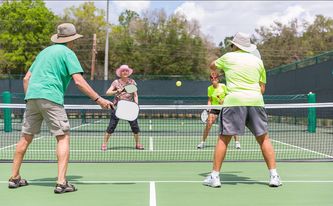
Tennis
Pickleball
Squash
Toss the ball an arm's length to make a contact.
Overhand Serve
Overhead Pass
Forearm Pass
Position your feet in an up-and back stride position with the weight on the back right foot.
Overhead Pass
Forearm Pass
Underarm Serve
Stand 5-6 feet from the net. Run to the net as the ball is approaching
Spike
Overhead Serve
Overhead Pass
It is a paddleball sport that combines elements of badminton, table tennis and tennis.
Pickleball
Racquetball
Squash

During a doubles match, how many players are on the court during a game?
2
4
6
8

The areas marked off in red in the picture are the
service boxes
out of bounds
doubles area
no volley zone

What do you get when your opponent fails to return the ball properly?
the ball
a fault
a win
a point

If a ball lands on the line, it is considered OUT.
True
False