
 Worksheets
Mechanics
Total questions: 38
Worksheet time: 19mins
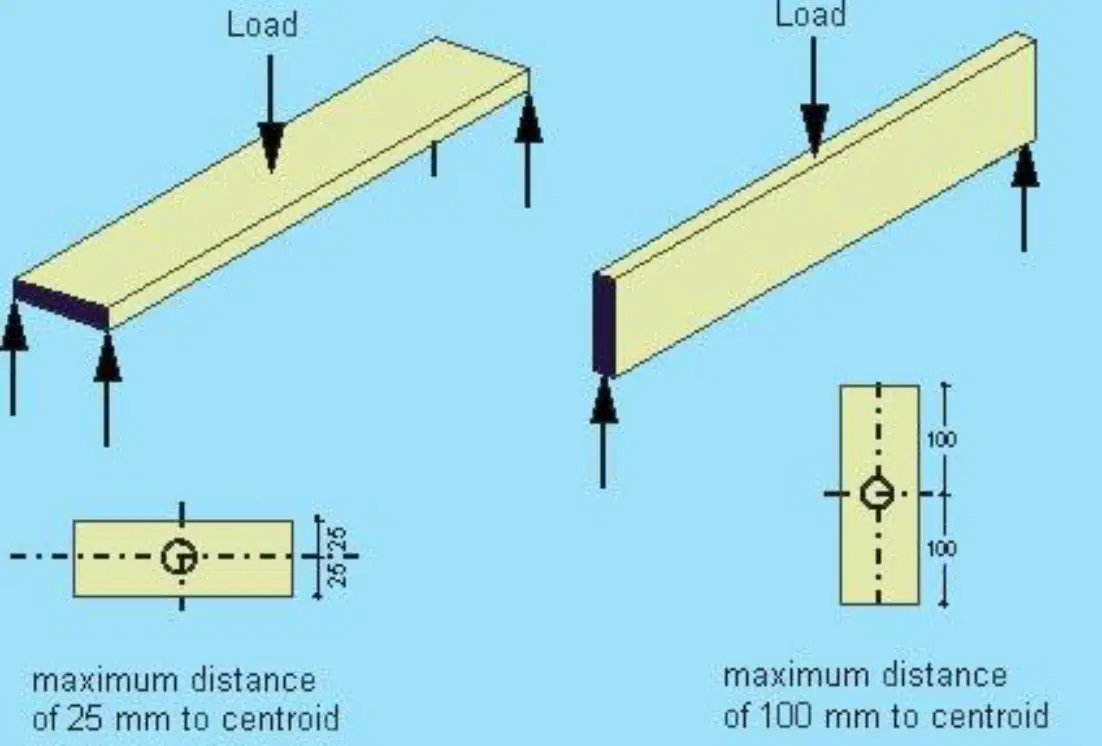
Which beam can carry more load? The left beam’s cross-section shows a maximum distance to the centroid of 25 mm, while the right beam’s cross-section shows a maximum distance to the centroid of 100 mm. Both beams are depicted under a downward load with end supports.
The beam with maximum distance of 100 mm to the centroid (right)
The beam with maximum distance of 25 mm to the centroid (left)
Both beams carry the same load regardless of cross-section
Neither; load capacity does not depend on section inertia

Using I = , compute the area moment of inertia for a rectangular section oriented vertically with B = 1 and H = 4. Give the value in cm^4.
0.33 cm^4
1.33 cm^4
5.33 cm4
16.00 cm4

Using I = , compute the area moment of inertia for a rectangular section oriented horizontally with B = 4 and H = 1. Give the value in cm^4.
0.33 cm^4
1.33 cm^4
5.33 cm4
16.00 cm4
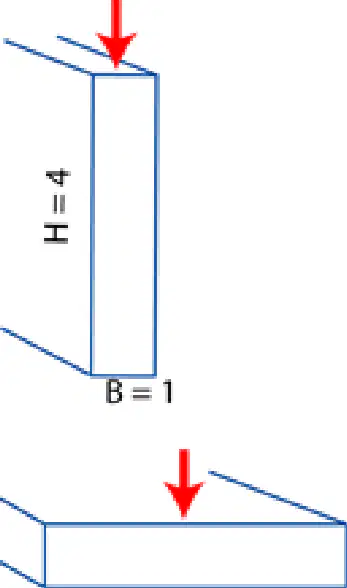
For the two rectangles of equal area shown (B = 1, H = 4) and (B = 4, H = 1), what is the ratio of their moments of inertia Ivertical/Ihorizontal based on I=12BH3 ?
4
8
12
16
According to the general definition in Mechanics of Materials, which statement correctly characterizes the area moment of inertia for a sectional area?
It is a load-dependent property varying with applied force.
It is a geometrical property of a sectional area, denoted I (e.g., Ix).
It is a material constant independent of shape.
It is defined only for circular sections.
In Mechanics of Materials, how does the magnitude of the area moment of inertia affect bending stresses in a beam of a given sectional area?
Higher moment of inertia increases bending stresses.
Higher moment of inertia lowers bending stresses due to bending.
Moment of inertia has no effect on bending stresses.
Lower moment of inertia lowers bending stresses due to bending.
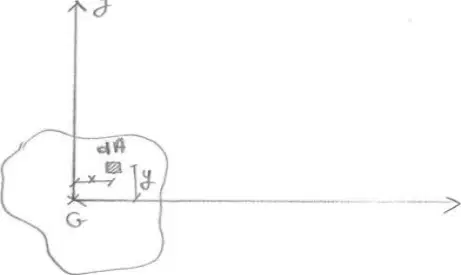
Which analytical expression defines Ix about a centroidal axis for an area A?
Ix = ∬Ax2dA
Ix = ∬Ay2dA
Ix = ∬A xy dA
Ix = ∬Ar2dA
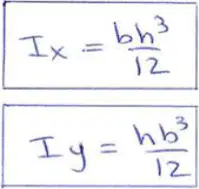
For a rectangular section of width b and height h, what is the centroidal moment of inertia Ix (axis parallel to b)?
12bh3
Ix=12b3h
Ix = bh/12
Ix=3bh2
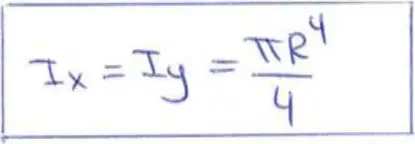
For a solid circular section of radius R, what is the centroidal moment of inertia about the x-axis?
Ix=πR4/4
Ix=πR3/3
Ix=πR2/2
Ix = πR4/2
For a solid circular section, which statement about the polar moment of inertia Ip over the area A is correct?
Ip equals Ix only.
Ip equals Iy only.
Ip equals Ix + Iy.
Ip equals Ix − Iy.
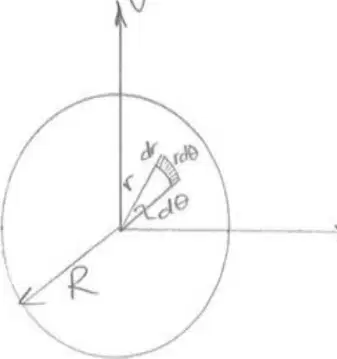
Which relations are correctly recalled for polar coordinates in the context of the circular section? Select all that apply.
r2=x2+y2
x = r cosθ
y = r sinθ
x = r sinθ
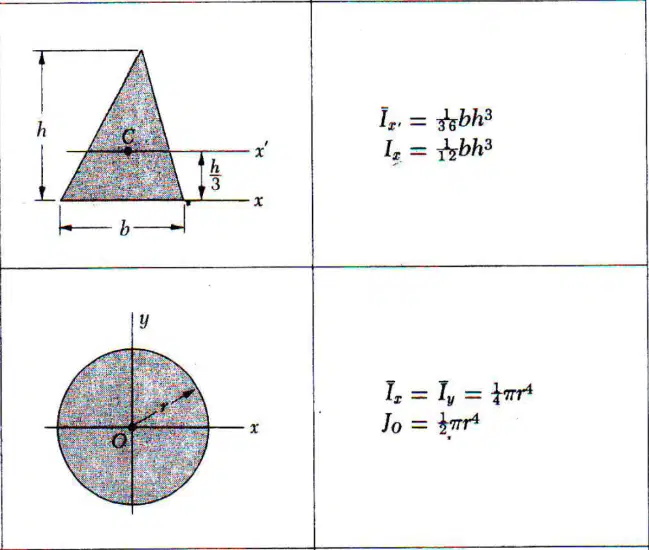
For a circular section, what is the polar moment of inertia Jo about the centroid?
Jo = πr4/4
Jo = πr4/3
Jo = 21πr4
Jo = 2πr4
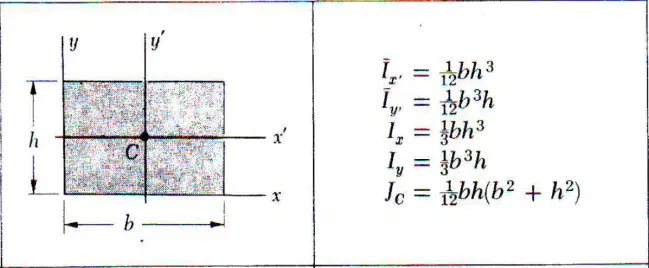
For a rectangular section with base b and height h, what is the centroidal polar moment Jc shown in the table?
Jc = (1/12)bh(b2+h2)
Jc = (21)bh(b2+h2)
Jc = (1/36)bh(b2+h2)
Jc=bh(b2+h2)
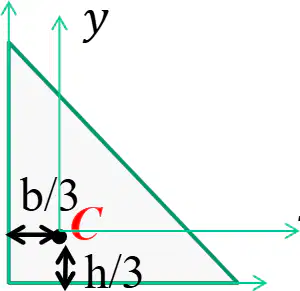
For the right triangular area of base b and height h shown, with centroid marked at C located at b/3 and h/3 from the right-angle corner, what is the product moment of inertia about the centroidal x and y axes?
Ixy=−72h2b2
Ixy=72h2b2
Ixy=0
Ixy=−12hb
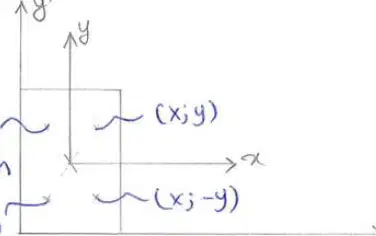
According to the definition shown, which integral gives the product moment of inertia of an area A about orthogonal axes x and y?
Ixy=∬AxydA
Ixy=∬Ax2dA
Ixy=∬Ay2dA
Ixy=∬A(x+y)dA
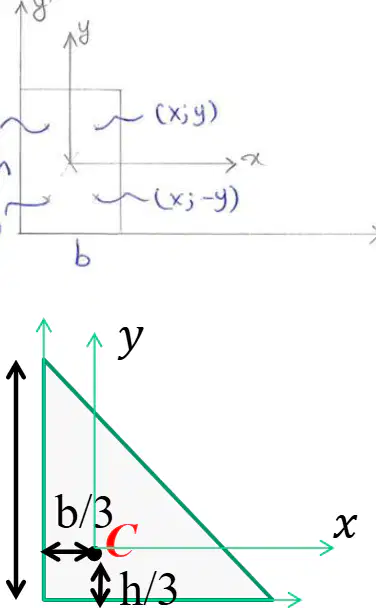
If a cross-section has at least one axis of symmetry (such as a rectangle or a circle), what is its product moment of inertia Ixy about centroidal axes?
Ixy=0
Ixy>0
Ixy<0
Ixy is undefined
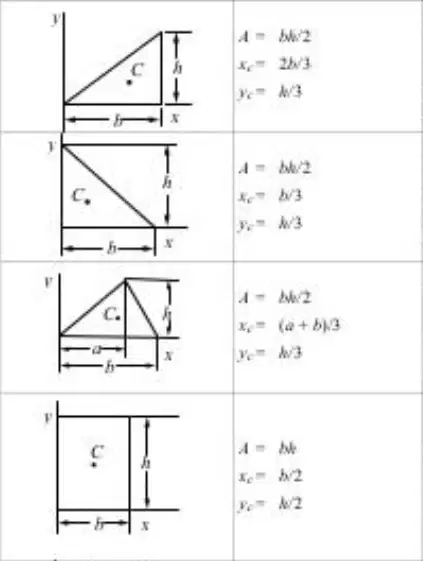
From the tabulated results for standard shapes, what is the product moment of inertia Ixy for a rectangle about its centroidal axes?
Ixy=0
Ixy=24b2h2
Ixy=12bh
Ixy=−72b2h2
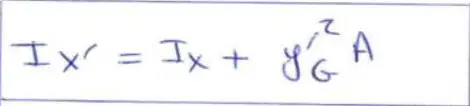
Using the parallel axis theorem, which expression correctly relates the moment of inertia about an axis x′ parallel to x and offset by yG from the centroid?
Ix′=Ix+yG2A
Ix′=Ix+xG2A
Ix′=Ix−yG2A
Ix′=A+yG2Ix
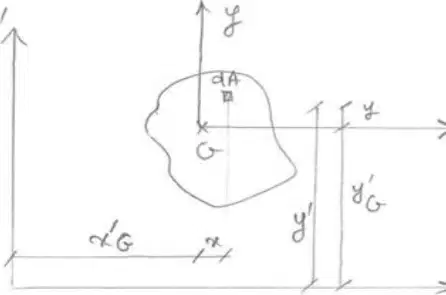
In the derivation of the parallel axis theorem for Ix′ , the term involving ∬AyyG′dA evaluates to which value for a centroidal axis shift?
0
yG′A
xG′A
Ix
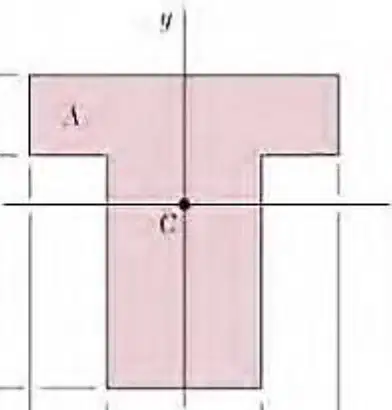
For a composite section made of n sub-areas, which formula correctly computes Ix about the composite centroid C?
Ix=i=1∑n(Ixci+Ai(YC−Yci)2)
Ix=i=1∑n(Iyci+Ai(XC−Xci)2)
Ix=i=1∑n(Ai(XC−Xci)(YC−Yci))
Ix=i=1∑nIxci
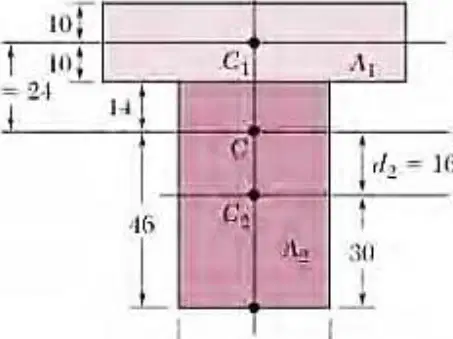
For the same composite section, which expression is used to compute the product moment of inertia Ixy about the composite centroid C?
Ixy=i=1∑n(Ixyci+Ai(XC−Xci)(YC−Yci))
Ixy=i=1∑n(Ixci+Ai(YC−Yci)2)
Ixy=i=1∑n(Iyci+Ai(XC−Xci)2)
Ixy=i=1∑nAi
Using the composite-area centroid definition shown, which expression gives the X-coordinate of the centroid for n parts?
XC=∑i=1nAi∑i=1nxciAi
XC=∑i=1nAi∑i=1nyciAi
XC=∑i=1nxci∑i=1nAi
XC=i=1∑nxci
For a composite area made of n parts, select all correct expressions for the moments/products of inertia about the centroid (parallel-axis form).
Ix=i=1∑n(Ixci+Ai(YC−Yci)2)
Iy=i=1∑n(Iyci+Ai(XC−Xci)2)
Ixy=i=1∑n(Ixyci+Ai(XC−Xci)(YC−Yci))
Ix=i=1∑n(Ixci+Ai(XC−Xci)2)
For a rectangular shape about its centroidal axes, what is the expression for Ix ?
Ix=12bh3
Ix=12b3h
Ix=12bh
Ix=bh3
For a rectangular shape about its centroidal axes, what is the expression for Iy ?
Iy=12b3h
Iy=12bh3
Iy=12bh
Iy=bh3
For the rectangular shape shown with an axis of symmetry, what is the centroidal product of inertia Ixy ?
Ixy=0
Ixy=12bh2
Ixy=12b2h
Ixy=bh
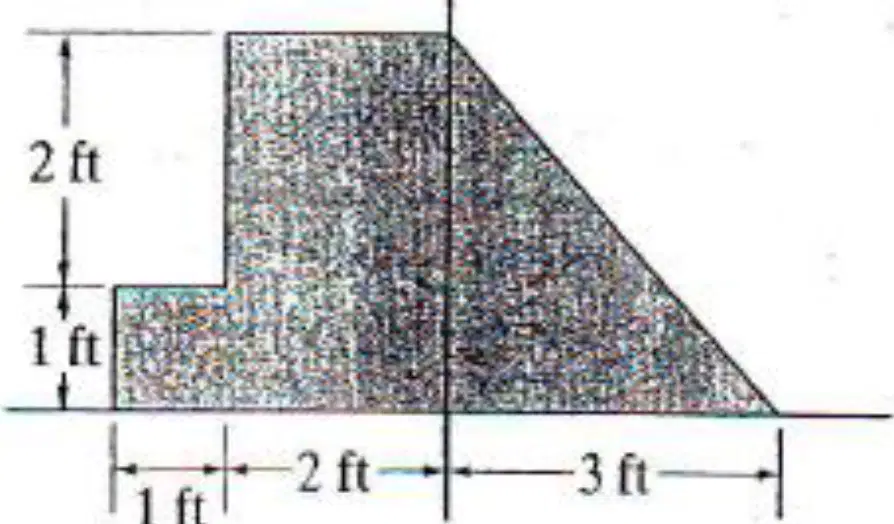
In the stepped-triangle area shown, what is the total base length along the X-axis?
5ft
6ft
7ft
4ft
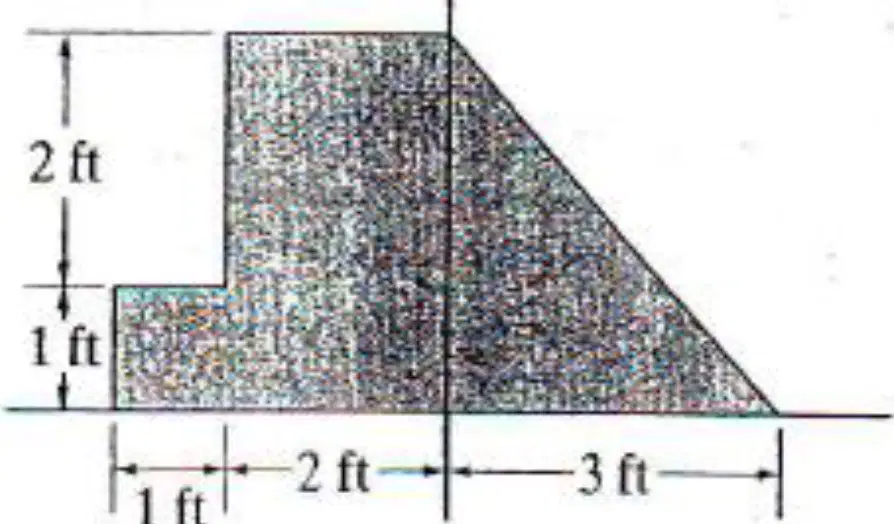
In the stepped-triangle area shown, what is the maximum vertical height of the shape measured from the base?
1ft
2ft
3ft
4ft
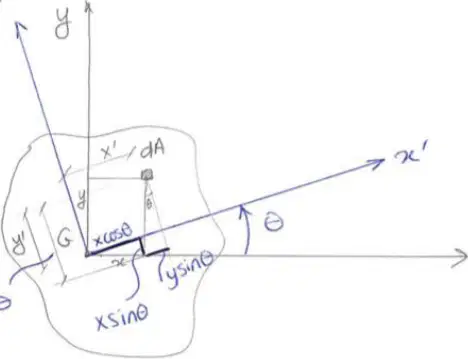
For a planar area with centroidal axes x and y rotated by an angle θ to new axes x′ and y′ as shown, which transformation correctly relates the coordinates of a differential area element?
x′ = x cos θ + y sin θ, y′ = y cos θ − x sin θ
x′ = x cos θ − y sin θ, y′ = y cos θ + x sin θ
x′ = x sin θ + y cos θ, y′ = y sin θ − x cos θ
x′ = x sin θ − y cos θ, y′ = y sin θ + x cos θ
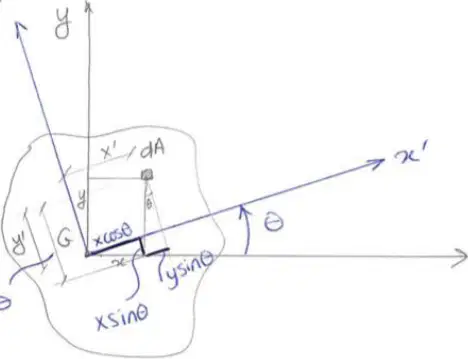
For the rotated axes x′ and y′ at angle θ, which expression gives the area moment of inertia about x′ in terms of the original moments about x and y and the product moment Ixy? Use standard trigonometric identities for cos 2θ and sin 2θ.
Ix′ = (Ix + Iy)/2 + ((Ix − Iy)/2) cos 2θ − Ixy sin 2θ
Ix′ = (Ix + Iy)/2 − ((Ix − Iy)/2) cos 2θ + Ixy sin 2θ
Ix′ = Ixcos2θ+Iysin2θ+2Ixysinθcosθ
Ix′ = Ixsin2θ+Iycos2θ−2Ixysinθcosθ
Under principal axes for an area, which statement is correct regarding the product moment of inertia?
Ixy′ = 0
Ixy′ = Ixy
Ixy′ = (Ix + Iy)/2
Ixy′ = ((Ix − Iy)/2)

For an area rotated by θ, which formula correctly transforms the product moment of inertia to the rotated basis?
Ix′y′ = Ixy cos 2θ + ((Ix − Iy)/2) sin 2θ
Ix′y′ = Ixy sin 2θ + ((Ix − Iy)/2) cos 2θ
Ix′y′ = (Ix + Iy)/2 cos 2θ − Ixy sin 2θ
Ix′y′ = (Ix − Iy) sin θ cos θ
Which recap equation correctly gives Ix′ for a basis rotated by angle θ?
Ix′ = (Ix + Iy)/2 + ((Ix − Iy)/2) cos 2θ − Ixy sin 2θ
Ix′ = (Ix + Iy)/2 − ((Ix − Iy)/2) cos 2θ + Ixy sin 2θ
Ix′ = (Ix − Iy)/2 − ((Ix + Iy)/2) cos 2θ + Ixy sin 2θ
Ix′ = (Ix + Iy) cos 2θ − Ixy sin 2θ
Which recap equation correctly gives Iy′ for a basis rotated by angle θ?
Iy′ = (Ix + Iy)/2 − ((Ix − Iy)/2) cos 2θ + Ixy sin 2θ
Iy′ = (Ix + Iy)/2 + ((Ix − Iy)/2) cos 2θ − Ixy sin 2θ
Iy′ = (Ix − Iy)/2 + ((Ix + Iy)/2) cos 2θ − Ixy sin 2θ
Iy′ = (Ix + Iy) cos 2θ + Ixy sin 2θ
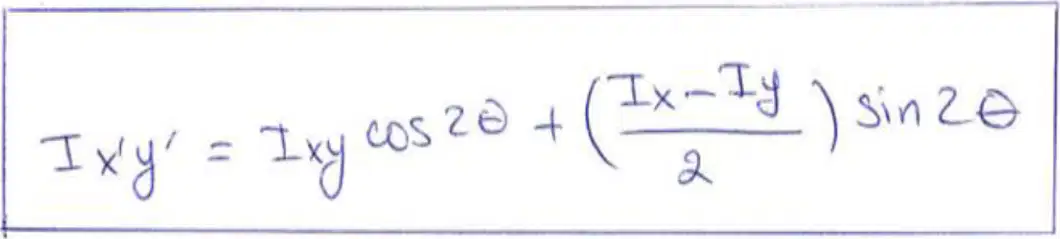
Which recap equation correctly states the product moment in the rotated basis?
Ix′y′ = Ixy cos 2θ + ((Ix − Iy)/2) sin 2θ
Ix′y′ = Ixy sin 2θ + ((Ix − Iy)/2) cos 2θ
Ix′y′ = (Ix + Iy)/2 − Ixy cos 2θ
Ix′y′ = ((Ix − Iy)/2) cos 2θ − Ixy sin 2θ
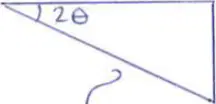
For principal moments (max/min), the angle to principal axes satisfies which relation based on the derivative condition dIx′/dθ = 0?
tan 2θ = Ixy / ((Ix − Iy)/2)
tan 2θ = ((Ix − Iy)/2) / Ixy
tan 2θ = Ixy / (Ix + Iy)
tan 2θ = (Ix + Iy) / Ixy
Which expressions correctly give the principal moments of inertia for a planar area?
Imax = (Ix+Iy)/2+(2(Ix−Iy))2+Ixy2
Imin = (Ix+Iy)/2−sqrt(((Ix−Iy)/2)2+Ixy2)
Imax = (Ix−Iy)/2+((Ix+Iy)/2)2+Ixy2
Imin = (Ix−Iy)/2−sqrt(((Ix+Iy)/2)2+Ixy2)
When transforming to principal axes, which statement is consistent with the max/min moment results shown?
Imax ≥ Imin and both equal (Ix + Iy)/2 only when Ixy = 0 and Ix = Iy
Imax ≤ Imin and both equal (Ix + Iy)/2 only when Ixy ≠ 0
Imax = Imin always and equals (Ix + Iy)/2
Imax = (Ix+Iy)/2−sqrt(((Ix−Iy)/2)2+Ixy2)

