
NEW
Font size
 Worksheets
States of Matter
Total questions: 15
Worksheet time: 10mins
In a typical solid, how are the particles arranged and how do they move?
Randomly spaced and move far distances
Packed closely and vibrate in place
Spread out evenly and flow freely
Loosely attached and rotate around
A student claims: 'Liquids have particles far apart like gases.' Which evidence-based correction is best?
Liquid particles are close together but can slide
Liquid particles are arranged in rigid lattices
Liquid particles are fixed and cannot move
Liquid particles are farther than gas particles
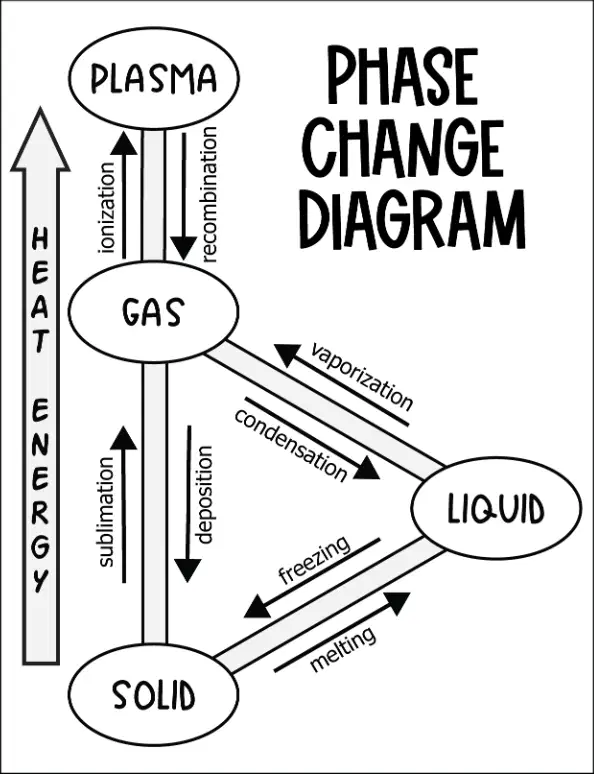
In the diagram, which phase change directly converts a solid to a gas without becoming a liquid first?
Sublimation
Condensation
Deposition
Vaporization
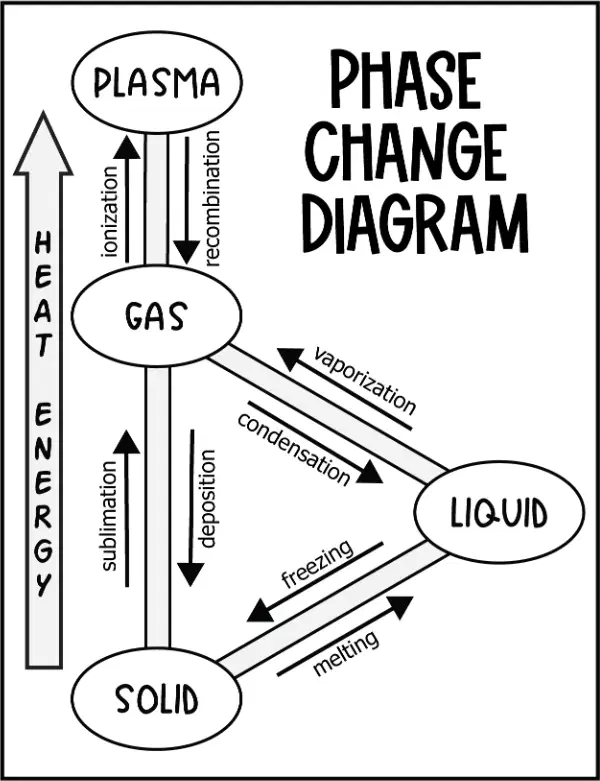
According to the phase change diagram, which process occurs when heat energy decreases and gas becomes liquid?
Ionization
Condensation
Vaporization
Sublimation

Which row correctly completes the table entry for melting? Choose the best set.
Original: liquid; Final: solid; Motion: slows
Original: solid; Final: liquid; Motion: speeds up
Original: gas; Final: liquid; Motion: speeds up
Original: liquid; Final: gas; Motion: speeds up
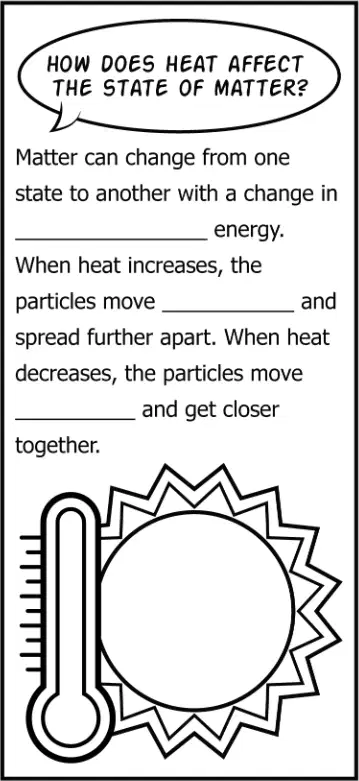
Which explanation best matches the question prompt: When heat increases, particles move ____ and spread further apart.
randomly less
inward together
slower
faster
Which change of state happens when a liquid turns into a gas at the surface over time?
Condensation
Vaporization
Deposition
Freezing
Which process correctly matches original state to final state?
Deposition: liquid to solid
Condensation: liquid to gas
Vaporization: gas to liquid
Sublimation: solid to gas
What type of energy directly drives phase changes among states of matter?
Heat (thermal) energy
Chemical potential energy
Nuclear binding energy
Electrical field energy
Which statement best explains why a balloon shrinks in a freezer?
Cold air has more heat energy overall
Freezer pressure pushes air outward
Air leaks through the rubber quickly
Particles move slower and get closer
Which scenario best illustrates condensation?
Water droplets forming on a cold glass
Ice cubes forming inside a freezer
Snow forming directly from water vapor
Puddle disappearing on a sunny day
In which phase are particles closest together while still able to flow past each other?
Gas
Solid
Liquid
Plasma
Which statement about solids is correct?
Solids have definite shape and volume
Solids have indefinite shape and volume
Solids have indefinite shape, definite volume
Solids expand to fill any container



