
NEW
Font size
 Worksheets
Art Section II
Total questions: 30
Worksheet time: 15mins
Which description best captures the Jazz Age in the United States from 1918 to 1929?
A cautious era of austerity and limited innovation
A period marked by opulent fashion and rapid change
A time dominated by rural life and slow technology
An age of strict academic art and minimal diversity
What was a key role of the National Academy of Design for American artists before World War I?
Encouraging abstract experiments in local salons
Rewarding conservative works in Impressionist styles
Promoting Ashcan realism through urban exhibitions
Funding avant‑garde photography and sculpture
Which feature most clearly distinguishes the Ashcan School’s paintings of New York City?
Geometric abstraction with mechanical motifs
Pristine landscapes free of urban life
Everyday scenes of working‑class grit
Idealized Renaissance allegories of virtue
Robert Henri’s influence on Ashcan technique is best evidenced by which practice?
Smooth glazes in classical revival style
Thin washes prioritizing linear precision
Thick impasto brushwork inspired by Europeans
Pointillist dots emphasizing optical color
Which statement best describes a key impact of the 1913 Armory Show on American art?
It focused exclusively on nineteenth-century Impressionism
It banned modernist works from public exhibition
It introduced European avant-garde experimentation to viewers
It reinforced traditional landscape painting styles
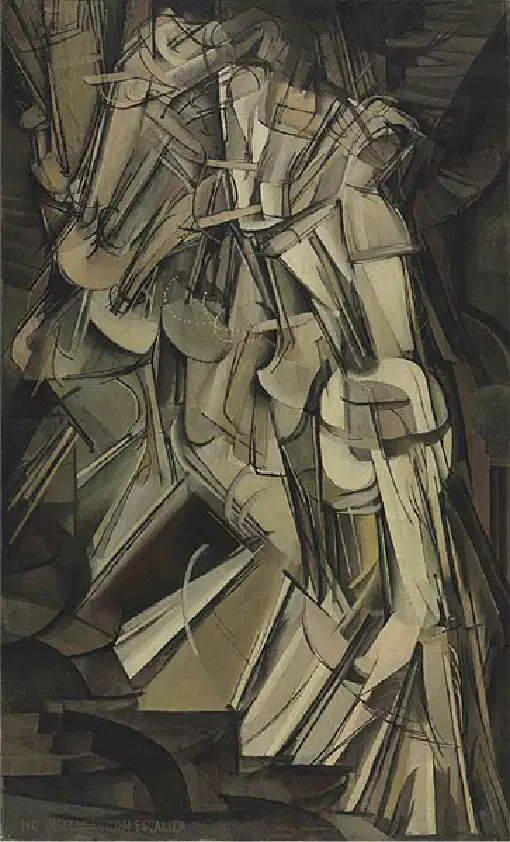
What artistic movement is Marcel Duchamp’s Nude Descending a Staircase, No. 2 most closely associated with in terms of style and themes?
Romanticism celebrating nature’s sublime power
Realism emphasizing everyday rural life
Neoclassicism reviving ancient ideals
Cubism exploring motion and time
Which idea distinguishes New York Dada artists from the European works shown at the Armory Show?
Preference for academic drawing techniques
Commitment to naturalistic representation of the eye
Emphasis on concept over visual representation
Return to handcrafted decorative ornament
Why are Duchamp’s readymades, such as In Advance of the Broken Arm, considered groundbreaking?
They perfected traditional bronze casting methods
They transformed ordinary objects into art through titling and display
They revived medieval guild systems for art production
They introduced realistic portraiture to modern audiences
Which broader cultural outcome followed the Armory Show’s reception in the United States?
Immediate governmental regulation of abstract art
Growth of collector interest and modernist discussion salons
Decline of independent galleries and magazines
Isolation of American artists from European ideas
Which best describes the 291 gallery’s exhibition approach that influenced modern and contemporary museums?
Rotating exhibitions monthly without curatorial themes
Displaying only narrative paintings with labels
Crowding many works with ornate gold frames
Highlighting fewer works with neutral white walls
What was a key goal of Pictorialism early in Alfred Stieglitz’s career?
Standardizing museum lighting across Europe
Promoting only non-Western photographic subjects
Replacing oil painting with mechanical processes
Arguing for photography to be accepted as fine art
Which combination correctly pairs Stieglitz’s roles with his impact on American art?
Gallerist and editor who championed abstract painters
Museum registrar who cataloged European sculpture
Academic historian who codified Renaissance methods
Restorer and dealer who revived medieval frescoes
How did the Stieglitz Circle contribute to modernist painting in the United States?
Incorporated Cubist and Expressionist innovations into abstraction
Rejected European avant-garde in favor of folk motifs
Returned to narrative realism using historical allegories
Focused on pastoral landscapes in naturalistic color
Which statement best describes geometric abstraction as used in I Saw the Figure 5 in Gold?
Creates lifelike depth through chiaroscuro and modeling
Relies on narrative scenes with figures and landscapes
Uses straight lines and simple shapes on a flat surface
Focuses on biomorphic forms from nature and fluid curves
Which poet is the subject of Demuth’s poster portrait I Saw the Figure 5 in Gold?
Ezra Pound
William Carlos Williams
T. S. Eliot
H. D. (Hilda Doolittle)
What visual strategy conveys movement and sound in I Saw the Figure 5 in Gold?
Radial symmetry formed by circular halos around lights
Blurred edges created by soft brushwork and glazes
Single central number outlined with heavy shading
Repeated shrinking numerals nested within curves
Demuth’s poster portraits differ from traditional portraits primarily because they
Prioritize biomorphic forms inspired by nature
Depict an exact likeness using realistic modeling
Reference the subject using symbols and text
Use thick impasto to build sculptural surface
Which art movements or styles influenced Demuth’s geometric abstraction?
Cubism, Futurism, Suprematism, Vorticism
Romanticism, Symbolism, Impressionism
Minimalism, Pop Art, Op Art
Baroque, Rococo, Neoclassicism
How does Demuth align visual composition with Williams’s poem The Great Figure?
Naturalistic figures acting out narrative events
Industrial stencil-like lettering and sharp brushstrokes
Soft tonal transitions suggesting gentle atmosphere
Pastoral imagery of fields and distant horizons
Which term best describes O’Keeffe’s use of ovoid, bulbous, and elongated forms that echo floral and landscape elements?
Biomorphic abstraction emphasizing organic forms
Geometric minimalism using strict angles
Photorealistic naturalism with exact detailing
Constructivist assemblage employing industrial parts
What role did Alfred Stieglitz play in O’Keeffe’s career after their marriage in 1924?
Supportive promoter yet controlling image choices
Detached observer ignoring her exhibitions
Financial backer without public advocacy
Studio assistant managing technical materials
Which New York City subject reflects O’Keeffe’s experimentation with geometric abstraction in the 1920s?
Brooklyn Bridge Morning steel cables
Central Park Autumn leaf studies
Hudson River Night ferry lights
The Shelton with Sunspots, N.Y. skyscrapers
Which early Taos figure helped found the Taos art colony and drew attention to Taos Pueblo?
Ernest Blumenschein of the Society of Artists
Arthur G. Dove of biomorphic jazz painting
Alfred Stieglitz of the 291 Gallery circle
Georgia O’Keeffe of the New Mexico school
Why did O’Keeffe title her pine painting The Lawrence Tree and instruct that it be hung so the tree appears to stand on its head?
To mimic Taos Pueblo ceremonial dances’ layout
To honor D. H. Lawrence’s writing and shift perspective
To match Stieglitz’s preferred photographic angles
To align with Constructivist rules of composition
Which statement best captures the concept of synesthesia in art as discussed around O’Keeffe’s milieu?
Linking visual brushstrokes to musical harmonies
Translating sculpture into written narratives
Converting photographs to chemical equations
Mapping architecture onto botanical taxonomy
Which movement emphasized crisp focus and objective recording, influencing Imogen Cunningham’s botanical studies in the late 1920s?
New Objectivity from Germany
Abstract Expressionism in America
Constructivism from Russia
Romantic Pictorialism tradition
Group f/64 photographers preferred which camera practice to achieve extreme sharpness and tonal gradation?
Choosing shallow depth of field
Employing handheld fast lenses
Relying soft-focus diffusion filters
Using a small f-stop setting
What distinguishes a Rayograph (Photogram) in Man Ray’s experiments?
Photo retouched with paint
Scene captured with long exposures
Portrait printed from negatives
Image made without a camera
In her essay from 1913, what combination did Imogen Cunningham argue photography needed for success?
Marketing with celebrity patrons
Mythic themes with elaborate costumes
Soft focus with sentimental staging
Good taste with mechanical skill
Which idea reflects Group f/64’s reaction against Pictorialism in works like Cunningham’s Leaf Pattern?
Presenting clean, machine-made photographic detail
Blending photos with painterly hand-drawn elements
Staging narrative scenes from literature and poetry
Manipulating prints to mimic charcoal drawings

