
 Worksheets
Group 5 - Chapter 3: Risk and Return
Total questions: 10
Worksheet time: 5mins
Which of the following risks is LEAST likely to be reduced through diversification?
Business risk
Financial risk
Market risk
Firm-specific risk
How is beta typically calculated?
By dividing a stock’s return by the market
By measuring the covariance of a stock with the market divided by market variance
By comparing expected and actual returns
By regressing market returns on stock returns
Which of the following best illustrates unsystematic risk rather than systematic risk?
A sudden increase in interest rates by the central bank that affects the entire economy.
A global recession that reduces consumer spending across all industries.
A new competitor enters the market, causing one company’s profits to decline.
Inflation rises sharply, impacting purchasing power nationwide.
Which of the following formulas correctly calculates the percentage return when considering capital gain and dividends?


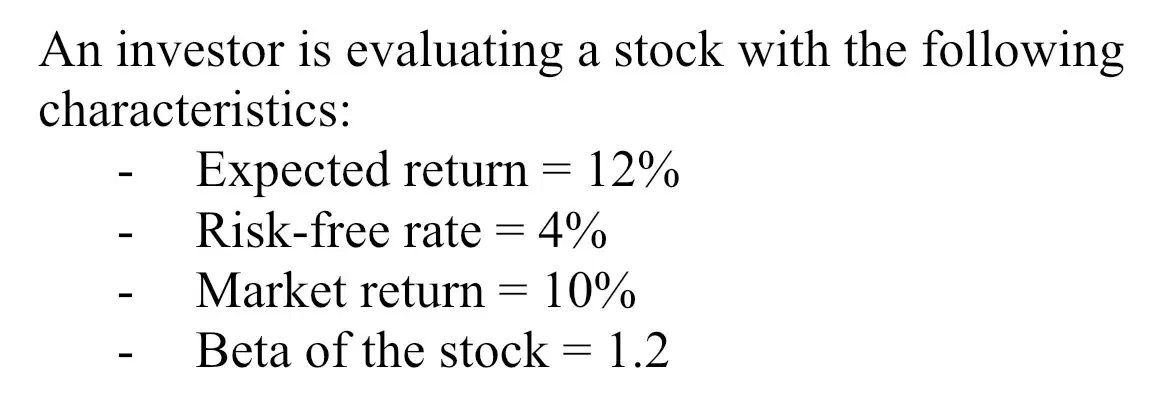
According to the CAPM, which of the following statements is correct?
The stock is fairly priced because its expected return equals the required return.
The stock is undervalued because its expected return is higher than the required return.
The stock is overvalued because its expected return is lower than the required return.
The CAPM cannot be applied because the beta is greater than 1.
Suppose a stock had an ending share price of VND 25,000, paid a dividend of VND 1,000 per share and had an initial price of VND 22,000, the percentage of total return is
16.00%
4.00%
12.00%
18.18%
Standard deviation is 18% and coefficient of variation is 1.5% and expected rate of return will be:
27.00%
12.00%
19.50%
None of the above
A stock has an expected return of 15%, the risk free rate is 7% and the market risk premium is 10%, the beta of this stock is:
6.00%
2.00
0.75
0.8%
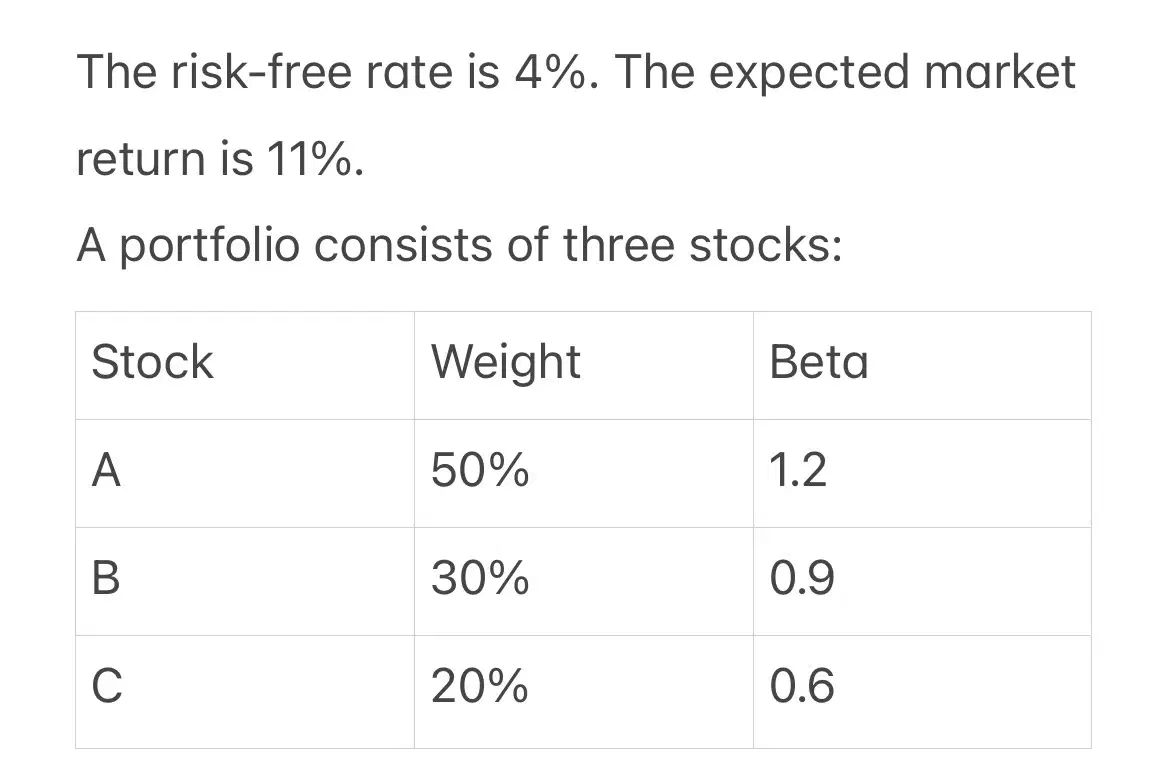
What is the expected return of the portfolio according to the CAPM?
9.80%
10.55%
10.90%
11.72%

If an investor allocates 60% to security X and 40% to security Y, what is the expected return of the portfolio?
14.0%
13.9%
14.3%
14.8%

