
 Worksheets
Earth and Space Science Mega Midterm Review
Total questions: 226
Worksheet time: 5hrs 48mins
What evidence best supports that the universe is expanding from an initial event like the Big Bang?
Comets increasingly appear from the Oort Cloud annually
Stars within the Milky Way rotate faster near the center
Planet orbits slowly drift farther from the Sun over time
Most galaxies show redshifted spectra indicating recession
Which statement correctly compares inner and outer planets in our solar system?
Inner planets are large and gaseous with many rings
Inner planets are dense and rocky with few moons
Outer planets orbit closer and complete years more quickly
Outer planets are small and metallic with thin atmospheres
Astronomers use stellar spectra primarily to determine a star’s
apparent magnitude from observed brightness
distance from Earth using parallax shift
atmospheric composition from absorption lines
luminosity class from clustering patterns
A star’s color is most directly related to its
surface temperature of the stellar photosphere
distance from Earth along the line of sight
chemical age within its life cycle stage
rotation speed around the galactic center
New stars typically form in which type of region?
Magnetic sunspot fields on stellar surfaces
Solid planetary rings around gas giants
Hot, empty voids between galactic arms
Cold, dense nebulae rich in gas and dust
If a star’s light is shifted toward longer wavelengths, the star is most likely
rotating slowly with little differential motion
cooling rapidly after a recent nova event
orbiting perpendicular to the observer’s line
moving away from the observer due to redshift
Which planet has the shortest orbital period around the Sun?
Mercury completes an orbit in about 88 days
Earth completes an orbit in about 365 days
Mars completes an orbit in about 687 days
Jupiter completes an orbit in about 12 years
The primary reason seasons occur on Earth is because
Ocean currents redistribute global heat
The Sun’s energy output varies each year
Earth’s elliptical orbit changes distance
Earth’s axis is tilted about 23.5 degrees
During winter in the Northern Hemisphere, the hemisphere is
tilted away from the Sun receiving lower angles
tilted toward the Sun receiving higher angles
closest to the Sun at perihelion distance
far from the Sun due to aphelion distance
How long does the Moon take to orbit Earth once relative to the stars, and how long is a full cycle of lunar phases?
About 14 days for orbit; about 28 days for phases
About 27 days for orbit; about 29–30 days for phases
About 29–30 days for orbit; about 27 days for phases
About 31 days for orbit; about 31 days for phases
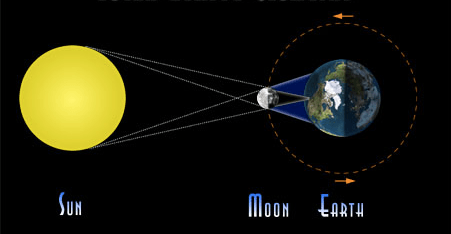
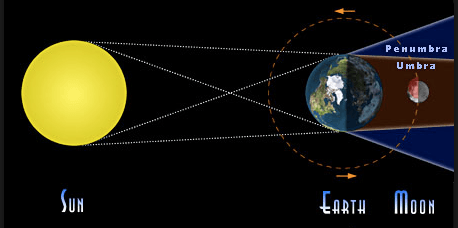
A lunar eclipse occurs when
Earth’s shadow sweeps across part of the Sun
The Moon passes through its first quarter
The Moon moves between the Sun and Earth
Earth moves between the Sun and the Moon
Greatest tidal ranges (spring tides) most commonly occur when
local winds reinforce coastal currents
Earth is closest to the Sun in January
the Moon is at first or third quarter
the Sun, Moon, and Earth are aligned
Ocean tides on Earth are caused primarily by the
solar wind pressure pushing surface waters
heat expansion of equatorial ocean waters
gravitational pull of the Moon on Earth’s oceans
rotation of Earth creating centrifugal forces
On a sundial, the changing position of the shadow throughout a day is mainly due to
Earth’s rotation about its axis
Seasonal tilt of Earth’s axis
Earth’s orbit around the Sun
The Moon’s revolution around Earth
Which observation would most strongly indicate a planet is an outer planet rather than an inner planet?
Rocky surface, thin atmosphere, and craters
High density, few moons, and short year
Low density, many moons, and greater distance
Small size, fast rotation, and closer orbit
Which Earth layer is the outermost solid layer where humans live?
Mantle of plastic-like rock
Crust as the solid surface
Inner core with dense metals
Outer core of liquid metal
What primarily drives the movement of tectonic plates?
Wind stress on the oceans
Convection currents in the mantle
Ocean tides from the Moon
Gravity pulling continents only
At a divergent plate boundary, which landforms most commonly develop?
Wide plains and shield volcanoes
Deep trenches and island arcs
Rift valleys and mid-ocean ridges
Folded mountains and high plateaus
When two continental plates converge, what is the most likely result?
Sea-floor basalt forming ridges
Subducted slab forming trenches
Uplifted mountains from collision
Transform motion causing faults
Oceanic-continental convergence typically produces which features?
Island arcs and deep trenches
Rift valleys and normal faults
Plateaus with thick sediments
Mid-ocean ridges with vents
Transform plate boundaries are strongly associated with which hazard?
Tsunamis from tidal forcing
Explosive volcanism from melting
Frequent earthquakes from sliding
Landslides from heavy rainfall
Which evidence supports the idea of continental drift across oceans?
Similar cloud patterns every season
Equal day length at all latitudes
Matching ocean salinity worldwide
Identical fossils on separate continents
Sea-floor spreading means that the farther ocean floor is from a mid-ocean ridge, the rock is generally
Older and more deeply buried
Hotter and newly formed crust
Younger with fewer minerals
Thinner with bigger crystals
Which statement best describes the Coriolis effect on moving air on Earth?
Rotation causes winds to curve paths
Solar heating makes winds blow east
Mountains block winds uniformly
Gravity pulls winds straight south
Earth’s earliest atmosphere most likely formed primarily through which process?
Volcanic outgassing during eruptions
Photosynthesis by complex plants
Comet impacts delivering oxygen
Weathering of continental rocks
The high percentage of free oxygen in the modern atmosphere developed mainly because early life performed
Photosynthesis producing oxygen gas
Chemosynthesis consuming oxygen gas
Fermentation releasing methane gas
Respiration releasing nitrogen gas
A geologist compares two basalt samples. Sample A lies near a mid-ocean ridge, and Sample B lies far from the ridge on the same plate. Which conclusion is most reasonable?
Sample A cooled earlier in time
Sample B has higher eruption rate
Sample B formed more recently
Sample A is younger basalt rock

Does this star contain Element X?
Yes
No
Where would you expect to find a Star that is very bright and very hot? (Select ONE answer)

Match the following for an AVERAGE star like our Sun:
Nebula
cloud of dust of gas
Main sequence
adult life: burning: light and heat
Red Giant
begins to die and expands
Planetary nebula
outer layers break down and leave core
White dwarf
Last stage: core emits very little light
The closest star to the Earth is (a) .
What DECREASES eccentricity?
A decrease in the distance between the foci
An increase in the distance between the foci
What INCREASES as the distance between a planet and the sun DECREASES?
Gravitational Attraction
Mass
What is Earth's eccentricity?
0.206
0.017
0.093
0.007
What is the relationship between a planet's distance from the sun and the velocity of that planet around the sun?
As the distance increases, the velocity decreases
As the distance increases, the velocity increases
[Select all that apply] What are characteristics that are TRUE about terrestrial planets?
High density
Low period of revolution
Closer to the sun
Eccentricity of one
[Select all that apply] What are characteristics that are true about Jovian planets?
High mass
Low period of rotation
High density
Close to the sun
Which two factors caused Earth to have different layers?
Density
Distance from the moon
Gravity
Distance from the sun
Which planet from below has a higher density than water?
Neptune
Saturn
Which of the following is a rocky object that is orbiting the Sun between Mars and Jupiter?
Comet
Meteor
Crater
Asteroid
Which of the following is rock and ice orbiting from the outer solar system to near the Sun?
Asteroid
Comet
Meteor
What are the heavier elements found in Earth's core?
oxygen and potassium
aluminum and silicon
carbon and sulfur
iron and nickel
How many million kilometers is one astronomical unit?
149.6 million km
227.9 million km
377.5 million km
108.2 million km
What are TWO pieces of evidence for the universe's expansion?
Coriolis Effect
Foucault Pendulum
Red-Shift of light from distant stars
Cosmic background radiation
Match the description to the planet.
Mercury
Mars
Uranus
Saturn


What is the location of point B?
Compared to oceanic crust, continental crust is...
thicker, with a less dense granitic composition
thicker, with a more dense basaltic composition
thinner, with a less dense granitic composition
thinner, with a more dense basaltic composition
Why does hot air RISE?
The molecules are spread farther apart and are LESS dense
The molecules are spread farther apart and are MORE dense
The molecules are close together and are LESS dense
The molecules are close together and are MORE dense
Why does cold air sink?
The molecules are spread farther apart and are LESS dense
The molecules are spread farther apart and are MORE dense
The molecules are close together and are LESS dense
The molecules are close together and are MORE dense

What is the time in Boston when it is 11 a.m. in San Diego?
8 a.m.
2 p.m.
3 p.m.
noon

The timeline below represents the entire geologic history of Earth. The lettered dots on the timeline represent events in Earth's history. Which lettered dot best indicates the geologic time when humans first appeared on Earth?
A
B
C
D
What is the approximate location of the Tasman Hot Spot in the Pacific Ocean?
36° N 160° W
36° S 160° E
160° N 36° W
160° S 36° E
The Coriolis effect, which causes the curving of planetary winds, is a direct result of the...?
distance between Earth and the Sun
inclination of Earth's axis
orbiting of Earth around the Sun
spinning of Earth on its axis
Earth's crustal bedrock at the Mid-Atlantic Ridge is composed mostly of...?
basalt, with a density of 2.7 g/cm3
basalt, with a density of 3.0 g/cm3
granite, with a density of 2.7 g/cm3
granite, with a density of 3.0 g/cm3

The diagram represents Earth orbiting the Sun. Four positions of Earth in its orbit are labeled A, B, C, and D. Letter N represents the North Pole. During which season in the Northern Hemisphere of Earth when the Earth is in its farthest position from the Sun?
winter
spring
summer
fall

What is the tilt of Earth's rotational axis relative to a line perpendicular to the plane of Earth's orbit?
15°
23.5°
66.5°
90°

Which type of plate boundary is represented at point A?
divergent
convergent
transform
complex

The data table shows the projected percentages of radioactive isotope X remaining and its disintegration product Z forming over 6.5 billion years. Identify radioactive isotope X.
(a)
The data table shows the projected percentages of radioactive isotope X remaining and its disintegration product Z forming over 6.5 billion years. Calculate the amount, in grams, of an original 300-gram sample of radioactive isotope X remaining after 3.9 billion years.
(a)
The Foucault pendulum and the Coriolis effect both provide evidence of Earth's
revolution
rotation
tilted axis
elliptical orbit
Which statement provides the best evidence that Earth revolves around the Sun?
The Sun follows an apparent daily path, rising in the east and setting in the west.
A Foucault pendulum appears to shift its direction of swing in a predictable manner.
The stars appear to follow circular paths around the North Star (Polaris).
The seasons of spring, summer, fall, and winter repeat in a pattern.

Which motion is responsible for this changing appearance of the Moon?
The Moon moves into the shadow of Earth.
The Moon moves into the shadow of the Sun.
The Sun moves into the shadow of Earth.
The Sun moves into the shadow of the Moon.

4.The diagram below shows Earth's orbit around the Sun. Locations A, B, C, and D represent Earth on the first day of each season.
Which location represents March 21?
A
B
C
D
The apparent rising and setting of the Sun, as viewed from Earth, is caused by...
Earth’s rotation
Earth’s revolution
the Sun’s rotation
the Sun’s revolution
In the Northern Hemisphere, planetary winds are deflected to the right due to the...
Doppler effect
Coriolis effect
tilt of Earth's axis
uneven heating of Earth's surface

Base your answer to the following question on the graph below, which shows the maximum altitude of the Moon, measured by an observer located at a latitude of 43° N during June in a particular year. The names and appearance of the four major Moon phases are shown at the top of the graph, directly above the date on which the phase occurred.
Which diagram best represents the Moon’s phase observed on June 11?


. Base your answer to the following question on the world map below, which shows regions of Earth where a solar eclipse was visible on May 20, 1947. Location A, B, C, and D are on Earth's surface.


Base your answer to the following question on the diagram below, which represents latitude and longitude lines on Earth. Points A through E represent locations on Earth. Arrows represent direction of rotation.
When the local time at location C is 3 p.m., the local time at location D is
1 p.m.
5 p.m.
3 p.m.
3 a.m.

The diagram below represents a plastic hemisphere upon which lines have been drawn to show the apparent paths of the Sun at a location in New York State on the first day of each season. Letters A through I represent points on the paths.
Which point represents the sunrise location on the first day of winter?
G
F
E
D
Most asteroids in our solar system are located in the asteroid belt between the orbits of Mars and Jupiter. What is the approximate distance from the Sun to the asteroid belt?
129 million km
210 million km
403 million km
1103 million km

The table below shows tide data for a location on the north shore of Long Island, in New York State.
Based on these data, what is the most likely time of the next high tide?
1:53 a.m.
1:53 p.m.
7:40 a.m.
7:40 p.m.
Which planet takes longer to complete one rotation on its axis than it does to complete one orbit of the Sun?
Mercury
Venus
Earth
Mars
The entire constellation of Orion is visible in the night sky in January to an observer in New York State. Which statement explains why this constellation is not visible in the night sky to this observer in June?
Earth rotates on its axis.
Earth revolves around the Sun.
The constellation Orion orbits the Sun
The tilt of Earth’s axis changes throughout the year.
The red shift in light from stars located in very distant galaxies suggests that these stars are
decreasing in temperature
increasing in temperature
moving toward the Milky Way
moving away from the Milky Way
Most of the electromagnetic energy radiated from Earth's surface is in the form of
ultraviolet rays
infrared rays
gamma rays
x-rays

A theory that says the universe began as a small point that expanded rapidly about 13.7 billion years ago.
Big Bang Theory
Singularity Theory
Galaxy Theory

(a) the process by which rock material moves under Earth’s outer layer and into the mantle due to plate motion

According to the graph, how many kilometers from the Mid-Atlantic Ridge are rock samples that are 75 million years old?
(a)
Which process is primarily responsible for the movement of tectonic plates on Earth's surface?
Evaporation of ocean water
Magnetic field reversal
Solar radiation
Convection currents in the mantle
Which process is responsible for the recycling of Earth's crust at convergent plate boundaries?
Deposition
Condensation
Evaporation
Subduction
During the waxing stage of the moon cycle, _____________.
we gradually see more of the moon.
we gradually see less of the moon.
Blue stars are the _____.
Coolest
Hottest
For the Southern Hemisphere, the seasons are the opposite of the Northern Hemisphere.
True
False
What is the location of point B?


Changing phases of the Sun
Changing phases of the Moon
Stages in an eclipse of the Sun
Stages in the eclipse of the Moon

The diagrams below represent Earth’s ocean tides at four different positions of the Moon. Which diagram shows the Moon position that will produce the highest high tides and the lowest iow tides? (The diagrams are not drawn to scale.)


According to the pattern shown on the given graph, the next high tide will occur on the following day at approximately:
12:30 am
4:00 am
2:00 am
3:13 am

The diagram below represents the light spectra given off by the same element as observed under two different conditions. Spectrum A was observed when that element was heated in a laboratory. Spectrum B shows the same element as seen in the light from a distant star.
The light spectrum observed from this distant star shows a
red shift, which indicates that the star is moving away from Earth
red shift, which indicates that the star is moving toward the Earth
blue shift, which indicates that the star is moving away from Earth
blue shift, which indicates that the star is moving toward Earth


What table correctly matches each type of eclipse with the orbital position of the Moon and cause of each eclipse?


Compared to our solar system, the universe is
younger, smaller, and contains fewer stars
younger, larger, and contains more stars
older, smaller, and contains fewer stars
older, larger, and contains more stars
The solid part of the earth is known as the
Atmoshpere
Lithosphere
Biosphere
Hydrosphere
What caused the interior of Earth to separate
into layers?
a decrease in the rate of rotation of Earth
the gravitational pull on materials of varying
densities
variations in heating by the Sun due to
Earth’s tilt
collisions with meteors and comets
Which layer of Earth’s interior is inferred to be
composed of solid iron and nickel?
asthenosphere
outer core
stiffer mantle
inner core
On the winter solstice, which latitude receives the vertical ray?
90 degrees North
23.5 degrees South
0 degrees
(the equator)
23.5 degrees North
On the spring and fall equinoxes, which latitude receives the vertical ray?
90 degrees North
23.5 degrees North
0 degrees
(the equator)
23.5 degrees South
How many degrees do the stars appear to move around Polaris in 3 hours?
15 degrees
30 degrees
45 degrees
60 degrees
Why is the earth's shape slightly flattened at the Poles and slightly bulging at the equator?
its rotation
the pull of the sun and moon
storms on the sun's surface
its molten core
As you travel towards the East, the time will
get earlier
get later
remain the same
Transfer of heat energy through direct contact
Convection
Conduction
Radiation
Heat
Transfer of heat energy in fluid (liquid or gas) by currents
Convection
Conduction
Radiation
Heat
The process plants use to make food using light, energy, carbon dioxide, and water
Photosythesis
Respiration
outgassing
radiation
Energy transmitted as rays or waves without the need of a substance to conduct the energy
Convection
Conduction
Radiation
Heat
Which element in Earth’s atmosphere, essential for human life, is extremely rare in the atmospheres of other planets in our solar system?
Carbon Dioxide
Hydrogen
Nitrogen
Oxygen
Volcanic eruptions release large quantities of gases into Earth’s early atmosphere. This process is called –
Stromatolites
Outgassing
Banded-iron
radiation
Most of the oxygen in Earth’s early atmosphere was produced by —
wind
photosynthesis by blue-green algae
release of gas by volcanic eruptions
the effects of the sun
11What is the name of the process that causes Venus’s surface temperature to be so high?
The blanketing process
the ceiling effect
the insulation process
the greenhouse effect
The youngest rocks on the ocean floor are located ____.
near continents
at mid-ocean ridges
far from mid-ocean ridges
near Asia
In sea-floor spreading, molten material rises from the mantle and erupts
in deep-ocean trenches
along the edges of all the continents
along mid-ocean ridges
at the north and south plate
_______ are mountain chains on the ocean floor.
Sea-floor ridges
Mid-ocean ridges
Tectonic plates
Photosynthesis
Mid-ocean ridges are the sites of intense _________ activity.
emotional
volcanic
earthquake
mathematical
___________ is the hypothesis that states that the continents once formed a single landmass, broke up, and drifted to their present locations.
Continental drift
Sea-floor spreading
Plate tectonics
Mid-ocean range
Old oceanic crust is more dense than new oceanic crust because it is _______________.
hot
moving toward a deep-ocean trench
cool
closer to the mid-ocean ridge

What words describe M? choose all
deep ocean trench
mid ocean ridge
sea floor spreading
subduction

What feature is at C?
Deep ocean trench
Mid ocean ridge
sea floor spreading
subduction

What is the process happening at R?
Deep ocean trench
mid ocean ridge
subduction
sea floor spreading
What evidence supported the Theory of Continental Drift?
Fossils
Land Features
climate Change
All three
What was the name of the Super continent?
Eurasia
Pangaea
America
Colonies
Why are fossils a good type of evidence for Continental Drift?
They were organisms that lived a long time.
They were many types of fossils
They were very old
They were organisms that could not swim over the ocean
What is the land feature called where subduction takes place in the ocean?
ridge
volcano
trench
mountain

The molten material that comes up through the ridge to create new ocean floor
comes from the core
comes from the continental crust
comes from the mantle
all three

What is NOT evidence that supports seafloor spreading -
fossils
relative age of rocks (youngest/oldest)
reversal of magnetism in rocks
strange shape of rocks by ridge

Is the inner core
Solid
Liquid
Gas
¯\_(ツ)_/¯

What type of features occur at Divergent Plate Boundaries?
Earthquakes.
Volcanoes or volcanic activity.
Mid-Ocean Ridges & Rift Valleys.
All of the above.

What type of features occur at Convergent Boundaries?
Volcanoes.
Mountain Building.
Earthquakes.
All of the Above.

What features are most common with Transform Plate Boundaries?
Earthquakes.
Volcanoes.
Both A & B.
None of these.

This map & picture shows the large amounts of Earthquakes, Volcanoes, & Tectonic Plate Activity in the Pacific Ocean region is know as what?
Lord of the Rings.
The Ring of Destruction.
The Ring of Fire.
The King of the Ring.
What is the distance light travels in one year?
Parsec
Light-year
Parallax
milo-mile
An astronomical unit is...
The average distance between the Earth and the Sun
The average distance between the Sun and Neptune
The diameter of the sun
The time it takes light to travel across our solar system

In comparison to other stars in the sky, the Sun appears brighter because it is–
Bigger
Smaller
Nearer
Further
Where would you expect to find a star that is very bright but cool in temperature?
At which location on the diagram does a star spend most of its life (fusing hydrogen into helium)?
Great amounts of energy are released in the core of a star as lighter elements combine and form heavier elements during the process of
compaction
condensation
fission
fusion
Which of the following sequences best describes the formation and evolution of stars with masses similar to the Sun?
Protostar, white dwarf, main sequence, red giant
Main sequence, protostar, white dwarf, red giant
Red giant, main sequence, black dwarf
Protostar, main sequence, red giant, white dwarf

What causes clouds of dust and gas to form a protostar?
magnetism
gravity
expansion of matter
cosmic background radiation
Which star has a lower temperature than our sun, but is brighter?
Alderbaran
Barnard's Star
Sirius
Rigel
What is the color of star with the lowest temperatures?
blue
orange
red
yellow
According to the Characteristics of Stars graph, what is the general relationship between temperature and luminosity?
The higher the surface temperature, the less luminous a star.
The higher the surface temperature, the brighter the star.
The lower the surface temperature, the brighter the star.
There is no correlation that can be made between temperature and brightness on the Characteristics of Stars graph.
What DECREASES eccentricity?
A decrease in the distance between the foci
An increase in the distance between the foci
What is Earth's eccentricity?
0.206
0.017
0.093
0.007

During the formation of Earth, small space rocks are attracted to each other by
gravitational forces
light forces
solar eclipses
white dwarfs

Which of these orbits is the most eccentric?
Yellow
Pink
Red
Green
Which of these options is most likely to happen at a planet's perihelion? Select all that apply.
The sun will appear the smallest in the sky.
The planet will be moving its fastest.
The planet will be moving its slowest.
The planet will be experiencing its strongest gravitational attraction to the Sun.
The sun will appear biggest in the sky.
Kepler's 1st Law states that planets orbit their home stars in paths called
Circles
Ovals
Ellipses
Ecliptics
Which group of planets are referred to as "jovian"?
Mercury, Venus, Earth, Mars
Jupiter, Saturn, Uranus, Neptune
Which planets have a longer period of revolution?
Inner planets (planets closer to the Sun)
Outer planets (planets farther from the Sun)
Which list of three planets and Earth’s Moon, are listed in order of increasing equatorial diameter?
Earth's Moon, Venus, Mars, Mercury
Earth's Moon, Mercury, Mars, Venus
Venus, Earth's Moon, Mercury, Mars
Mars, Mercury, Venus, Earth's Moon
This planet has a higher period of rotation than period of revolution.
Mercury
Venus
Earth
Mars

Compared to planet A, planet B has a
weaker gravitational attraction to the star and a shorter period of revolution
weaker gravitational attraction to the star and a longer period of revolution
stronger gravitational attraction to the star and a shorter period of revolution
stronger gravitational attraction to the star and a longer period of revolution
These planets are referred to as the "inner" planets
Terrestrial
Jovian

What spiral galaxy do we live in?
Andromeda Galaxy
Dwarf Galaxy Saggitarius
Milky Way Galaxy
Snickers Galaxy

During which moon phases will Earth experience the strongest, or greatest difference between high and low tides?
First Quarter and Full Moon
First Quarter and Last Quarter
New Moon and Full Moon
New Moon and Last Quarter


The diagram below represents the sun's path at equinox. According to the position of the Sun below, what is a possible time of the location?
9 am
12 noon
6 pm
3 pm
When the sun gets higher in the sky, shadows get ______.
longer
gone
shorter
darker
When the sun gets lower in the sky, shadows get______.
longer
gone
shorter
darker
The sun's path hits 90 degrees during the summer solstice in New York
True
False
Sometimes

What is the shadow direction when the Sun is at location C
East
Northwest
Northeast
West

Which date is represented by the diagram?
March 21
June 21
September 21
December 21
In which direction on the horizon does the Sun appear to rise on July 4th in New York State?
due north
due south
north of due east
south of due east
What do shadows on Earth help show?
Earth's rotation
Earth's revolution
Earth's equator
Earth's axis
When the sun rises in the morning, your shadow is _______ and points ________
short, west
long, west
short, east
long, east
A sundial is used to ...
tell the time of day
measure temperature
tell the day of the year
measure the tenths of objects

What is this tool called?
Compass
Sundial
Timer
Telescope
Stars and galaxies release energy. We see this energy as ...
visible light (colors)
mechanical sound waves
heat
satellites

A sample of gas is analyzed, producing the spectrograph in the image. Identify which element the sample is mostly made-up of?
Hydrogen
Helium
Neon
Mercury


Which element(s) are found in the star's spectra below?
Hydrogen only
Hydrogen & Helium
Calcium only
Hydrogen & Calcium

Stars are made of mostly which two gases?
Hydrogen and Helium
Hydrogen and Oxygen
Hydrogen and Nitrogen
Hydrogen and Carbon
How can the composition of a star be determined?
By its brightness
By its distance from Earth
By its absorption spectrum
By its size and shape
The process of fusion happens in a star's
Corona
Convection Zone
Radiative Zone
Core
What force creates the environment needed for nuclear fusion reactions to happen in stars?
Star Wars Force
Gravity
Friction
Normal Force
Main Sequence stars can only fuse up to this element on the periodic table
Gold
Carbon
Helium
Iron
The largest element that any "star" can create is.
Helium
Carbon
Iron
Uranium
Why can't our sun fuse elements together to form Calcium (Ca?)
Because it hasn't enough neutrinos
The temperature of the core will not be hot enough.
Because it's not massive enough and lacks the gravitational force needed
Wait, I think it can
The age of the universe is measured in 10 to 20
thousands of years
millions of years
billions of years
trillions of years
Background radiation detected in space is believed to be evidence that
the universe began with an explosion
the universe is contracting
all matter in the universe is stationary
galaxies are unevenly spaced throughout the universe
Studies of the universe generally indicate that
almost all galaxies appear to be moving away from Earth at tremendous velocities
few galaxies other than our own exist
all galaxies are approximately the same size
all galaxies are spiral shape

Each element on the periodic table can be identified by its
classification as a solid, liquid or gas.
location on the table.
ability to react to form compounds.
unique spectral "fingerprint."

The unknown emissions spectra belongs to the element
Hydrogen
Mercury
Neon
Helium

Spectral Lines
Spectral lines are unique patterns of light that are emitted or absorbed by atoms and molecules when they transition between different energy levels. Each element or compound produces its own distinctive set of spectral lines, often observed in the form of bright lines in emission spectra or dark lines in absorption spectra. These lines occur at specific wavelengths corresponding to the energy differences between electron orbits within atoms. Spectral lines serve as powerful tools for identifying elements in distant stars and galaxies, as well as understanding the physical properties of matter, such as temperature and density.
What is the most likely composition of the unknown star?
Oxygen and Silicon
Helium and Carbon
Carbon and Oxygen
Just Hydrogen

