
 Worksheets
Unit 5: Study Guide
Total questions: 35
Worksheet time: 18mins
Name
Class
Date
1.
In response to the issues leading to the French Revolution, France established a republican
government. What other revolution led to a republican type of government?
a)
The Latin American Revolutions.
b)
The American Revolution.
c)
The Glorious Revolution.
d)
The Haitian Revolution.
2.
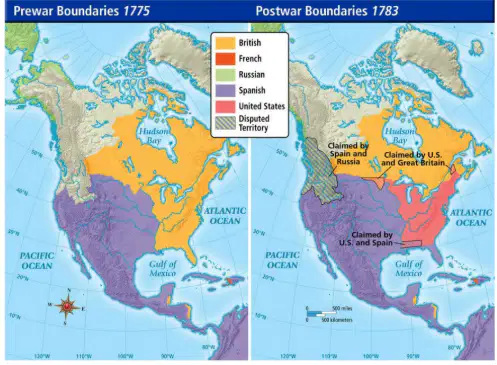
Use the map below to answer the following question. What was the biggest change in political
boundaries after the American Revolution?
a)
Russia had huge gains in territory.
b)
The United States became its own country in place of a British territory.
c)
Spain acquired more territory.
d)
Great Britain acquired more access to coastal lands for shipping.
3.
With the American Revolution happening at the same time as the beginning of the Industrial
Revolution in England, what would be Great Britain’s biggest economic reason for wanting to keep
the North American territory?
a)
More labor for its factories.
b)
Greater ocean access for trade.
c)
More natural resources and materials for its factories.
d)
To have more territory than France.
4.
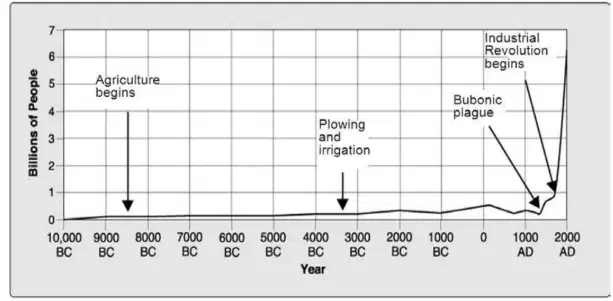
What event in the chart below coincides with the largest change in population?
a)
The beginning of agriculture.
b)
The beginning of plowing and irrigation.
c)
The development of the Bubonic plague.
d)
The beginning of the Industrial Revolution.
5.
Using an economic view, what is the biggest problem with massive population growth?
a)
There are extra supplies and little demand.
b)
There is extra demand and little supplies.
c)
There is no problem from an economic point of view.
d)
The banks will need to make more money for more people.
6.
The need for factory workers and a large population growth cause the population to change:
a)
From urban to rural.
b)
From large cites to the country.
c)
From rural to urban.
d)
From suburban to rural.
7.
The Industrial Revolution started in Great Britain in the late 1700’s. Which of the following is NOT
a reason it started there?
a)
Had great deposits of essential natural resources such as, coal and iron ore.
b)
Britain was a politically stable society.
c)
As the world’s leading colonial power, its colonies could serve as a source for raw materials, as well as a marketplace for manufactured goods.
d)
It already had a large railroad system in place for transportation.
8.
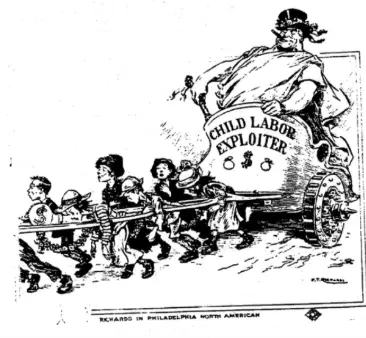
Which of the following conditions of factory
workers is the political cartoon making
reference?
a)
Wages were low.
b)
Working conditions could be dangerous and monotonous.
c)
Children were part of the labor force and often worked long hours.
d)
Inadequate, overcrowded housing and polluted, unsanitary living conditions in which disease was rampant.
9.
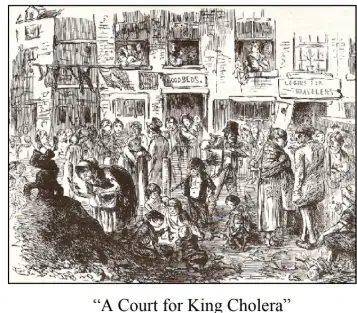
Which of the following conditions of factory workers is the political cartoon making reference?
a)
Wages were low.
b)
Working conditions could be dangerous and monotonous.
c)
Children were part of the labor force and often worked long hours.
d)
Inadequate, overcrowded housing and polluted, unsanitary living conditions in which disease was rampant.
10.

Which of the following conditions of factory workers is the political cartoon making reference?
a)
Wages were low.
b)
Working conditions could be dangerous and monotonous.
c)
Children were part of the labor force and often worked long hours.
d)
Inadequate, overcrowded housing and polluted, unsanitary living conditions in which disease was rampant.
11.
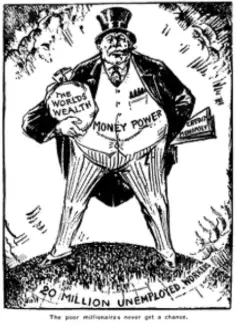
What type of economy is being portrayed in the cartoon to the right?
a)
Traditional Economy
b)
Command Economy
c)
Market Economy
d)
Mixed Economy
12.
The below quote is referring to what type of economy?
a)
Traditional Economy
b)
Command Economy
c)
Market Economy
d)
Mixed Economy
13.
The below quote is referring to what type of economy?
a)
Traditional Economy
b)
Command Economy
c)
Market Economy
d)
Mixed Economy
14.
In response to the working and living conditions of the working class during the Industrial Revolution, the public called for economic changes. While some people called for ending all public ownership, most people wanted government intervention. This change could be best classified as:
a)
Traditional economy to Command economy
b)
Command economy to Market economy
c)
Mixed economy to Traditional economy
d)
Market economy to Mixed economy
15.
The United States of America has this type of economy:
a)
Traditional Economy
b)
Command Economy
c)
Market Economy
d)
Mixed Economy
16.
The economic crisis that triggered the French Revolution was caused by
a)
the Revolutionary War in America.
b)
weak demand for consumer products.
c)
widespread corruption in the government.
d)
bad harvests and a slowdown in manufacturing.
17.
One economic cause of the French Revolution was an increase in prices, which
a)
channeled more money to merchants and salesmen
b)
depleted the government’s monetary reserves.
c)
led to an equivalent increase in wages among the nobility
d)
left people unable to purchase essential goods, such as food.
18.
In their rebellions of 1789, the French peasants were reacting to the high cost of bread, high taxes, and
a)
political inequality.
b)
religious persecution.
c)
foreign intervention.
d)
treatment of women.
19.
During most of the French Revolution (1789–1799), Napoleon was
a)
negotiating with the Catholic Church.
b)
codifying the French laws.
c)
studying in a military school.
d)
serving in the French military
20.
Napoleon’s agreement with the Catholic Church
a)
returned church lands to the pope and clergy.
b)
recognized Catholicism as the majority religion of France.
c)
created more stability within France.
d)
did not satisfy the priests and lower classes.
21.
Napoleon’s Civil Code treated women
a)
as legal equals to men.
b)
as co-owners of property with their husbands.
c)
equally in divorce proceedings
d)
as less equal than men.
22.
Promotion within Napoleon’s new bureaucracy was
a)
given only to those Napoleon favored.
b)
based on ability rather than rank or birth.
c)
available equally to men and women.
d)
designed to keep the middle class out of high-ranking positions.
23.
Napoleon’s empire collapsed because of
a)
Napoleon’s greed and laziness within his bureaucracy.
b)
the coalition of other European states and the force of nationalism
c)
the resentment of the clergy and the plotting of accountants.
d)
France’s weak economy and the drain of Napoleon’s many wars.
24.
Which of the following conditions caused the collapse of Napoleon’s Grand Empire?
a)
France’s strong economy
b)
laziness within his bureaucracy
c)
the drain of Napoleon’s many wars
d)
the spread of liberalism
25.
The arrangements worked out at the Congress of Vienna
a)
were a victory for those who supported the ideas of the revolution.
b)
would not allow the use of military force.
c)
were a victory for those who believed in conservatism.
d)
called for the execution of Napoleon.
26.
The 1848 revolution in France resulted in
a)
middle-class uprisings.
b)
restoration of the monarchy.
c)
new opportunities for workers.
d)
the creation of the Second Empire.
27.
The social change brought about by the Industrial Revolution was evident in the
a)
emergence of the middle class and the working class.
b)
famines caused by families abandoning their farms.
c)
cloud of air pollution that choked the British Isles.
d)
growing death rates from accidents on the roads.
28.
The revolutionary outbursts in Europe in the 1830s and the 1840s were sparked by attitudes of
a)
romanticism.
b)
nationalism.
c)
conservatism.
d)
religious intolerance.
29.
The factory created a new labor system in which
a)
products were produced by an assembly line of workers and animals.
b)
workers had to work regular hours and perform repetitive tasks.
c)
machines were valued more highly than the workers who ran them.
d)
workers had to adjust to periods of hectic work followed by idle periods.
30.
Two leaders of Italian unification were
a)
Bismarck and William I.
b)
Austria and Venice.
c)
Louis-Napoleon and the Papal States.
d)
Cavour and Garibaldi.
31.
Hungary and Austria shared the same
a)
constitution
b)
legislature
c)
monarch
d)
capital city
32.
Revolutionary leaders in Latin America were inspired by
a)
the American Revolution.
b)
writings of the peninsulares.
c)
the military power of the caudillos
d)
the economic strength of Spain and Portugal.
33.
Jose de San Martín and Símon Bolívar led South American independence movements against
a)
Mexico
b)
Portugal
c)
The United States.
d)
Spain
34.
The new republican governments in Latin America struggled because
a)
the United States intervened.
b)
their cash crops failed.
c)
they had no experience with self-rule.
d)
monarchies in Europe intervened.
35.
Spanish and Portuguese colonial empires were weakened when
a)
the peninsulares lost interest in ruling.
b)
the British established new trade routes.
c)
colonial leaders misused their authority.
d)
Napoleon overthrew their monarchies in Europe.
100 %

