
NEW
Font size
 Worksheets
Sci 122: Core Assessment 2
Total questions: 20
Worksheet time: 13mins
Which statement best describes matter in terms of particles and states?
All matter is made of tiny particles in three states
Matter has four main states based on particle energy
All matter is solid because particles barely move
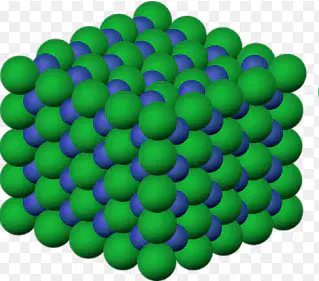
Look at the diagram of the solid state. Which statement best describes the particles in a solid?
Widely spaced and moving freely everywhere
Close together with sliding past movement
Spread far apart in random motion
Packed tightly in a fixed pattern, vibrating
Which statement best describes gas particles?
Tightly clustered filling part of container
Widely spaced moving at high speed
Closely packed with slow motion
Fixed positions with no movement
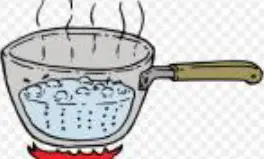
A block of ice is heated until steam forms. Which sequence of phase changes occurs as energy is added?
Solid to liquid to gas
Gas to liquid to solid
Solid to gas to liquid
Liquid to solid to gas
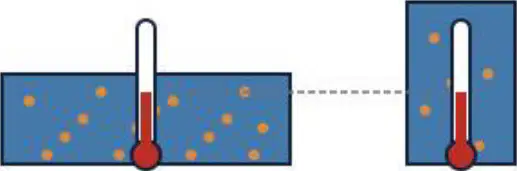
Two containers of water are both at 40°C. Which statement best explains why the large pot has more thermal energy than the small cup?
It has more total moving particles
Its particles move faster on average
Its temperature is higher than 40°C
Its particles are attracted more strongly
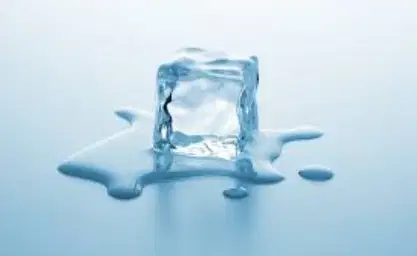
Look at the picture showing ice heated into water. Which change happens when particles gain energy and begin to slide past each other?
Freezing into a solid state
Depositing into solid frost
Melting into a liquid state
Condensing into water droplets
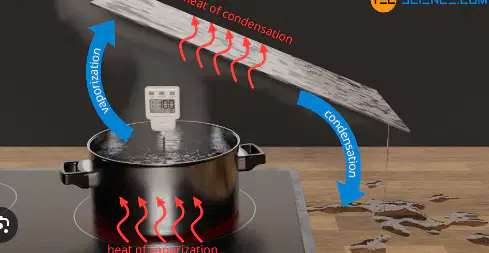
In the second diagram, cooling steam forms water droplets before becoming ice. Which process turns gas particles into liquid droplets as they slow down and come closer?
Sublimation of solid ice
Deposition forming frost
Condensation of water vapor
Evaporation of liquid water
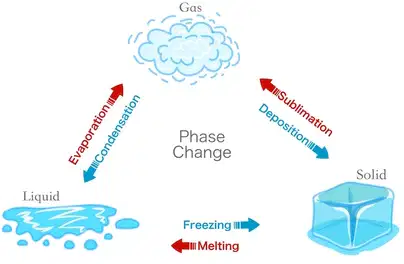
Using the phase change cycle diagram, which pair of processes correctly matches adding heat versus removing heat?
Deposition adds heat; sublimation removes heat
Condensation adds heat; melting removes heat
Evaporation adds heat; freezing removes heat
Freezing adds heat; evaporation removes heat
Which statement best defines a chemical reaction?
A substance changes from solid to liquid state
One or more substances change into new substances
Water turns into vapor during evaporation
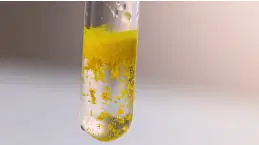
Two clear liquids are mixed and a yellow solid appears, as shown in the rightmost test tube image. What sign of a chemical reaction is this?
Gas bubbles rising to the surface
Color change in the liquid mixture
Precipitate forming from the liquids
Temperature decrease in the container
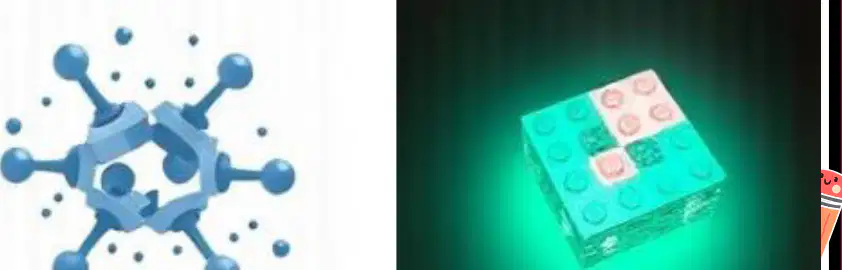
In the reaction sequence shown (mixing vinegar and baking soda, bonds break, new bonds form), what happens at the particle level to create products?
Particles keep their original bonds without rearranging
Bonds break and pieces form new bonds creating new substances
Reactants stay separate with no interaction occurring
Only physical properties change like shape or size
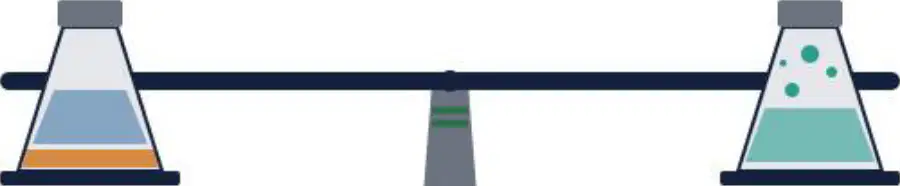
The Law of Conservation of Mass tells us that...
More matter is created during reactions than what we started with
In chemical reactions the mass stays the same before and after
Energy turns into extra matter during chemical reactions
A student mixes chemicals and the container feels colder. Which statement best explains what type of reaction occurred and why?
Endothermic, it released heat raising temperature
Endothermic, it absorbed thermal energy
Exothermic, it released heat to surroundings
Exothermic, it stored energy as temperature fell

A student must choose a device to warm cold hands quickly during a winter walk. Which type of reaction should the device use to release thermal energy?
Catalytic reaction speeding up heat
Neutral reaction with no heat
Exothermic reaction releasing heat
Endothermic reaction absorbing heat



