
 Worksheets
Page 1
Total questions: 150
Worksheet time: 1hrs 15mins
Which statement best defines an accounting worksheet used during the accounting cycle?
A legal document proving equality of debits and credits
A multi-column tool aiding adjustments and financial statements
A final report replacing the income statement entirely
A permanent ledger for recording all transactions
Which items are included in the worksheet heading when preparing a worksheet?
Treasurer’s name, Department, Authorization code
Company address, Ledger number, Fiscal policy
Branch code, Currency type, Tax registration
Company name, Worksheet, Period covered
What is the role of the adjustments columns in the worksheet?
Calculate payroll liabilities automatically
Provide data for journalizing adjusting and closing entries
Replace trial balance and income statement reports
Record permanent entries in the general ledger
When income statement columns are totaled on the worksheet, what does excess of debits over credits represent?
Error in trial balance totals
Increase in assets balance
Net loss for the period
Net profit for the period
Which step is NOT part of worksheet preparation according to the material?
Moving income and expense accounts to balance sheet columns
Entering a three-line heading
Using worksheet as a permanent accounting record
Totalling adjustments columns to verify equality
What is the last step described regarding profit or loss figure in worksheet preparation?
Transfer profit or loss directly to cash account
Post the profit or loss to all subsidiary ledgers
Distribute profit or loss evenly to asset accounts
Enter profit or loss as balancing figure in income and balance sheet columns
Why is the worksheet considered a convenient device in the accounting cycle?
It automates all financial statements without review
It organizes data to prepare adjustments and statements
It acts as the official audited financial record
It eliminates the need for closing entries entirely
What must be proven after entering all necessary adjustments in the worksheet?
Equality of debits and credits
Reduction in liability balances
Increase in revenue accounts
Accuracy of cash budget projections
Which description correctly contrasts a worksheet with the general ledger?
Worksheet is a permanent record; ledger is temporary
Worksheet is neither journal nor ledger; it is a working tool
Worksheet is a statutory book; ledger is optional
Worksheet is only for inventory; ledger handles expenses
Which purpose can a completed worksheet serve in financial reporting?
Calculate tax due and file returns automatically
Replace audit procedures and external confirmations
Authorize payments and manage cash disbursements
Determine profit and loss and prepare financial statements
Which set of column headings appears after the Trial Balance columns on an accounting worksheet?
Adjusted Trial Balance then Income Statement
Income Statement then Balance Sheet
Adjustments then Adjusted Trial Balance
Statement of Cash Flows then Notes
In the worksheet flow, what is entered into the Unadjusted Trial Balance columns?
Amounts from the income statement
Totals from adjusted journal entries
Figures from the balance sheet
Balances from general ledger accounts
Which is the correct order of major money columns shown across the worksheet?
Trial Balance, Adjustments, Adjusted Trial Balance, Income Statement, Balance Sheet
Trial Balance, Income Statement, Balance Sheet, Adjustments, Ledger
Adjustments, Trial Balance, Balance Sheet, Income Statement, Cash Flows
Adjusted Trial Balance, Trial Balance, Income Statement, Notes, Balance Sheet
What is the primary purpose of the Adjustments columns in a worksheet?
Record accruals and deferrals before final totals
Allocate departmental expenses across divisions
Summarize owner equity changes for the period
List permanent account balances after closing
When posting to the worksheet, where do you place an asset’s debit balance in the Trial Balance section?
In the income statement debit column
Under the debit money column
Under the credit money column
In the adjustments credit column
Which step immediately follows entering column headings in the worksheet process illustrated?
Close temporary accounts to capital
Compute net income and post to equity
Prepare adjusting journal entries
Enter unadjusted balances into Trial Balance
If Accounts Payable shows 2,800 credit in the Trial Balance, what does that indicate?
A normal debit asset balance
A normal credit liability balance
An abnormal debit expense balance
An owner withdrawal credit balance
Why is the Adjusted Trial Balance prepared after adjustments are entered?
To reconcile bank statements and cash
To close revenue and expense accounts
To verify debits equal credits before statements
To compute payroll taxes and withholdings
In the worksheet, where are revenue and expense amounts ultimately extended to?
Income Statement columns
Balance Sheet columns
Adjustments credit column
Adjusted Trial Balance columns
Which items are extended to the Balance Sheet columns from the adjusted trial balance?
Temporary accounts and drawings only
Revenues, expenses, and gains
Contra revenue and other income
Assets, liabilities, and owner’s equity
Which task verifies equality in the unadjusted Trial Balance columns on a worksheet?
Post closing entries to ledger
Extend amounts to Income Statement
Enter adjusting entries data
Compute totals in both columns
What is the primary action described as the 5th step in the worksheet process?
Add Debit and Credit trial balance
Record adjustment data into worksheet
Close temporary accounts to equity
Prepare post-closing trial balance
After entering adjustments, which columns should be totaled to check equality?
Adjustments Debit and Credit
Balance Sheet columns
Adjusted Trial Balance
Income Statement columns
Which step involves adding or deducting adjusting entry data to trial balance amounts?
Compute net income directly
Extend to Adjusted Trial Balance
Prepare cash flow statement
Verify unadjusted totals
Why add both Debit and Credit columns when verifying a trial balance?
Accelerate closing entries
Reduce worksheet complexity
Increase reported revenue
Confirm ledger equality
When adjustments are entered, what must be ensured about debit and credit impacts?
Debits exceed credits slightly
Credits always greater than debits
Debits equal credits overall
No effect on any account
Extending amounts to the Adjusted Trial Balance columns achieves which outcome?
Immediate posting to ledger
Updated balances for statements
Finalization of closing entries
Recognition of cash receipts only
Which sequence reflects the worksheet flow shown?
Journal, Ledger, Subsidiary
Income, Balance, Cash Flow
Unadjusted, Adjustments, Adjusted
Adjusted, Unadjusted, Closing
If totals in the Adjustments columns do not match, what is the most likely issue?
An entry not balanced
Cash shortage occurred
Depreciation not recorded
Income statement prepared
Which columns receive the amounts after combining trial balance with adjustments?
General Journal columns
Original Trial Balance columns
Adjusted Trial Balance columns
Subsidiary Ledger columns
Which step checks that the Adjusted Trial Balance debits and credits are equal?
Compute net income or net loss
Verify totals in Balance Sheet columns
Add columns in Adjusted Trial Balance
Extend amounts to Income Statement
After verifying the Adjusted Trial Balance totals, what is the next action on the worksheet?
Extend adjusted amounts to statement columns
Prepare closing entries for revenues
Reconcile bank and cash balances
Post adjustments to ledger accounts
What is the purpose of adding the Debit and Credit columns of the Balance Sheet and Income Statement sections?
Identify unrecorded transactions
Allocate depreciation evenly
Check posting accuracy to ledger
Determine net income or net loss
Where should the amount of net income for the period be entered on the worksheet?
Adjusted Trial Balance credit and Balance Sheet debit
Income Statement debit and Balance Sheet credit
Income Statement credit and Balance Sheet debit
Income Statement debit and Adjusted Trial Balance credit
Which step confirms that the final Balance Sheet and Income Statement totals are equal?
Add both sections' Debit and Credit columns
Prepare post-closing trial balance
Extend adjustments to trial balance
Recalculate Adjusted Trial Balance totals
Why are adjusted trial balance amounts extended to both the Income Statement and Balance Sheet columns?
Separate cash flows from changes in equity
Classify accounts by performance and position
Eliminate temporary accounts before closing
Offset errors from previous postings
If totals in the Adjusted Trial Balance do not match, what is the appropriate immediate response?
Ignore differences until audit
Record closing entries
Proceed to extend amounts
Recheck adjustments and calculations
Net loss on the worksheet is indicated by which placement?
Income Statement debit and Balance Sheet credit
Income Statement credit and Balance Sheet debit
Income Statement debit and Adjusted Trial Balance debit
Adjusted Trial Balance debit and Balance Sheet credit
Which columns are used to verify equality before determining net income or net loss?
Adjusted Trial Balance only
General ledger totals
Adjustments columns only
Balance Sheet and Income Statement
What does the final addition of the Balance Sheet and Income Statement columns ensure?
Adjustments are reversed
Closing entries are recorded
Subsidiary ledgers agree
Worksheet columns are balanced
Which section of an accounting worksheet lists adjusting entries before they affect balances?
Income statement columns
Adjusted trial balance columns
Adjustments debit and credit columns
Unadjusted trial balance columns
What is the primary purpose of the adjusted trial balance columns in a worksheet?
To summarize effects of adjustments
To record original ledger balances
To prepare cash flow details
To reconcile bank statements
In the worksheet shown, which financial statement uses revenue and expense accounts?
Unadjusted balance section
Adjustments section
Balance sheet section
Income statement section
Which accounts typically extend to the balance sheet columns on a worksheet?
Revenue and expense accounts
Assets, liabilities, and equity
Temporary revenue accounts
Adjusting entry accounts
When preparing the worksheet, which comes first after listing account titles?
Prepare income statement totals
Compute net income or loss
Enter unadjusted trial balance
Post-adjustment balances
What does the label '9th step' near the right side of the worksheet likely indicate?
Proving trial balance equality
Posting closing entries
Computing net income or loss
Journalizing adjustments
Which totals are compared to determine net income on the worksheet?
Balance sheet debit and credit totals
Adjusted revenue and expense totals
Unadjusted debit and credit totals
Adjustments debit and credit totals
The annotation '10th step' near the bottom of the worksheet most likely refers to which action?
Preparing closing entries
Recording initial balances
Calculating column totals
Extending balances to statements
On the typical yellow worksheet, where are adjusting debits and credits entered?
In the unadjusted balance columns
In the income statement columns
In the adjustments columns
In the balance sheet columns
Which step occurs after computing net income in the worksheet flow?
Post to subsidiary ledgers
Prepare the cash budget
Extend net income to balance sheet
Record opening inventory
Which account is a contra-asset that reduces Buildings on the balance sheet?
Accumulated Depreciation—Buildings
Delivery Fees Earned
Mortgage Payable
Beauty, Capital
What is the unadjusted balance of Accounts Payable shown?
28,200
38,000
42,000
43,200
An expired insurance adjustment of P12,000 should be recorded as which entry?
Debit Insurance Expense, credit Prepaid Insurance
Debit Prepaid Insurance, credit Insurance Expense
Debit Insurance Expense, credit Cash
Debit Cash, credit Insurance Expense
Which adjustment recognizes revenue previously recorded as Unearned Delivery Fees?
Debit Delivery Fees Earned, credit Unearned Delivery Fees
Debit Unearned Delivery Fees, credit Delivery Fees Earned
Debit Cash, credit Unearned Delivery Fees
Debit Accounts Receivable, credit Delivery Fees Earned
Given depreciation on equipment of P18,000, which accounts are affected?
Depreciation Expense—Equipment and Accumulated Depreciation—Equipment
Depreciation Expense—Buildings and Accumulated Depreciation—Buildings
Repairs Expense and Equipment
Utilities Expense and Accumulated Depreciation—Equipment
Salaries earned but not yet paid, P3,600, require what adjusting entry?
Debit Salary Expense, credit Accounts Payable
Debit Salary Expense, credit Salaries Payable
Debit Cash, credit Salary Expense
Debit Salaries Payable, credit Salary Expense
Interest on the mortgage of P4,200 should be recorded as which entry?
Debit Interest Expense, credit Interest Payable
Debit Mortgage Payable, credit Interest Expense
Debit Interest Expense, credit Cash
Debit Cash, credit Interest Expense
Delivery fees earned but not recorded and not received, P10,000, require what entry?
Debit Unearned Delivery Fees, credit Accounts Receivable
Debit Accounts Receivable, credit Delivery Fees Earned
Debit Cash, credit Delivery Fees Earned
Debit Delivery Fees Earned, credit Accounts Receivable
If supplies used are P5,400, which accounts are affected by the adjustment?
Cash and Supplies Expense
Supplies and Supplies Expense
Repairs Expense and Supplies
Utilities Expense and Supplies
The unadjusted trial balance shows Delivery Fees Earned of P669,200. After recognizing P26,000 from unearned fees, what is the adjusted Delivery Fees Earned before other revenue adjustments?
P695,200
P693,200
P669,200
P675,200
Which statement best describes temporary accounts in accounting?
Accounts reported on the balance sheet and carried forward
Accounts in income statement that relate to a single period
Accounts representing owner’s capital and future periods
Accounts used only for budgeting and forecasting
What is the main purpose of closing entries at period end?
To record external audit recommendations
To transfer balances to the cash flow statement
To bring temporary account balances to zero
To adjust permanent accounts to zero
Which account is commonly used as a clearing account during the closing process?
Accumulated Depreciation
Unearned Revenue
Income Summary
Retained Earnings
Permanent accounts differ from temporary accounts because they
are closed and reset every period
record drawing and nominal items
are part of the income statement only
carry balances into the next period
Which is a likely example of a temporary (nominal) account?
Building
Service Revenue
Accounts Receivable
Owner’s Capital
In the worksheet shown, why would net income be closed to capital after using Income Summary?
To reclassify expenses as assets for next period
To update owner’s equity with results of operations
To avoid reporting revenue on the balance sheet
To eliminate permanent accounts from the ledger
Which step typically occurs first when preparing closing entries?
Post-closing trial balance
Close revenues to Income Summary
Close Income Summary to capital
Close drawings to capital
Why are drawings closed at period end?
They are permanent increases to capital
They represent temporary decreases in equity
They are non-cash financing activities
They are contra assets that must be capitalized
After closing entries, which statement remains affected by permanent account balances?
Statement of cash flows
Balance sheet
Notes to financial statements
Income statement
If a company forgets to close expense accounts, what is the most likely impact on the next period?
Incorrect depreciation method
Overstated expenses carried into next period
Overstated revenue in next period
Understated beginning capital balance
Which closing entry properly transfers a revenue account balance to the Income Summary?
Debit Revenue, credit Owner’s Capital
Debit Owner’s Capital, credit Revenue
Debit Revenue, credit Income Summary
Debit Income Summary, credit Revenue
Delivery Fees Earned shows P695,200 at period end. What is the closing entry effect on Income Summary?
Income Summary credited P244,600
Income Summary credited P695,200
Income Summary debited P244,600
Income Summary debited P695,200
Which statement about closing expense accounts is correct?
Credit Income Summary, debit each expense
Debit Owner’s Capital, credit each expense
Debit Income Summary, credit each expense
Debit each expense, credit Owner’s Capital
An expense account normally has which balance and is closed by which action?
Credit balance, debit to close
Debit balance, credit to close
Zero balance, no closing needed
Debit balance, debit to close
The Income Summary shows expenses totaling P244,600. What does this figure represent in closing?
Unadjusted trial balance difference
Total expenses transferred to Income Summary
Total revenues transferred to Income Summary
Owner’s Capital increase before closing
If Income Summary has a credit balance after revenues and expenses are closed, what should be done?
Credit Owner’s Capital for net income
Debit Revenue to reduce net income
Debit Owner’s Capital for net income
Credit Income Summary to increase expenses
If Income Summary has a debit balance after closing revenues and expenses, what does it indicate and what is the entry?
Net loss; debit Owner’s Capital
Net income; credit Owner’s Capital
Net income; debit Owner’s Capital
Net loss; credit Owner’s Capital
Given revenues P695,200 and expenses P244,600, what is the net result transferred to Owner’s Capital?
Net income P450,600
Net loss P450,600
Net income P244,600
Net income P695,200
Why is there no drawing account closing entry in the worksheet shown?
No drawing was recorded
Drawings are closed to Revenue
Income Summary already includes drawings
Closing entries occur only for assets
Which sequence correctly describes closing entries in a service business?
Close capital, close revenues, close expenses
Close assets, close liabilities, close capital
Close revenues, close expenses, close income summary
Close expenses, close revenues, close assets
Which account is used to close revenue and expense accounts at period-end?
Unearned Revenue account
Income Summary account
Cash control account
Accounts Payable ledger
When closing entries show a net income, which account is credited?
Owner’s Capital account
Owner’s Drawing account
Income Summary account
Accumulated Depreciation
In closing entries, how are expense accounts closed?
Debited to Income Summary
Debited to Capital account
Credited to Cash account
Credited to Income Summary
Which statement best describes a post-closing trial balance?
Schedule of revenues and expenses only
List of all accounts before adjustments
List of permanent accounts after closing
Proof of cash receipts and payments
After closing, which type of accounts appear in the post-closing trial balance?
Assets, liabilities, and capital
Revenues and expenses only
Temporary owner withdrawals only
Contra-revenues and gains
Given net income, what is the closing entry affecting the drawing account?
No entry; drawing is closed separately
Credit Drawing; debit Capital account
Debit Capital; credit Drawing account
Debit Drawing; credit Income Summary
Which account from the adjusted trial balance is temporary and will be closed?
Salary Expense
A. Recto, Capital
Accumulated Depreciation
Accounts Receivable
In the adjusted trial balance shown, which contra-asset account is listed?
Allowance for Bad Debts
Professional Fees
Mortgage Payable
Repairs Expense
Which pair correctly matches an asset with its related contra account?
Vehicle — Accumulated Depreciation—Vehicle
Cash — Accounts Payable
Medical Equipment — Unearned Fees
Accounts Receivable — Mortgage Payable
What totals must be equal in a post-closing trial balance?
Total debits and total credits
Total revenues and expenses
Cash inflows and outflows
Beginning and ending capital
What is the primary purpose of preparing a post-closing trial balance?
Complete the worksheet process
Aid journalizing closing entries
Prepare balances for balance sheet
Verify equality of debits and credits
Which type of accounts appear in a post-closing trial balance?
Only temporary capital accounts
Only nominal accounts
Only real accounts
Both nominal and real accounts
Which account would not be included in a post-closing trial balance?
Accounts Payable
Accumulated Depreciation
Allowance for Doubtful Accounts
Delivery Fees Earned
After closing entries are posted, what is the next step in the accounting cycle related to balances?
Prepare adjusted trial balance
Prepare unadjusted trial balance
Prepare worksheet for next period
Prepare post-closing trial balance
Why are nominal accounts absent from a post-closing trial balance?
They are deferred to next period
They are merged with real accounts
They are converted to liabilities
They are transferred to retained earnings
In the figure, why are service revenue accounts not shown?
They have zero debit balances
They are closed to capital
They are offset by expenses
They are classified as assets
Which statement about post-closing trial balance is correct?
It includes adjusting entries amounts
It tests ledger balance after closing
It lists nominal accounts only
It is prepared before closing entries
Select the account normally carrying a credit in a post-closing trial balance.
Accounts Receivable
Owner’s Drawing
Cash in Bank
Accumulated Depreciation
Given debits total 329,650 and credits total 329,650 in the figure, what conclusion should be made?
Debits equal credits
Nominal accounts remain open
Closing entries need reversal
Ledger is out of balance
Which account is most likely zeroed during closing and thus excluded from the post-closing trial balance?
Delivery Fees Earned
Interest Payable
Taxes and Licenses Payable
Furniture and Fixtures
Which statement best describes a post-closing trial balance?
Includes only real accounts balances
Includes all revenue and expense accounts
Reports only owners' equity accounts
Shows temporary accounts ready for closing
In the illustrated post-closing trial balance, which section lists Accounts Payable?
Capital section
Assets section
Contra-asset section
Liabilities section
Why are revenue and expense accounts absent from a post-closing trial balance?
They are prepaid for next period
They are contra to liabilities
They were closed to capital
They are accrued as payables
Which account type remains open to carry beginning balances into the next period?
Drawing and revenue accounts
Closing entry accounts
Nominal income accounts
Balance sheet accounts
In DRA ABRYL RECTO’s adjusted trial balance, which item is a contra-asset?
Allowance for Bad Debts
Professional Fees
Accounts Payable
Prepaid Supplies
Which account from the adjusted trial balance would be closed to capital at period end?
Mortgage Payable
Accounts Receivable
Vehicle
Salary Expense
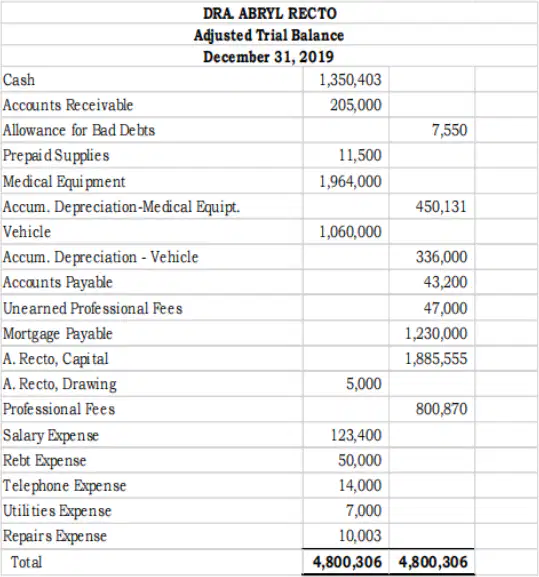
Given Medical Equipment 1,964,000 and Accum. Depreciation–Medical Equip. 450,131, what is book value for this asset?
2,414,131
450,131
1,964,000
1,513,869
Which step logically follows preparing an adjusted trial balance before producing financial statements?
Prepare financial statements
Record accruals for next period
Prepare closing entries
Post reversing entries
What is the primary purpose of reversing entries mentioned in the topic?
Simplify recording in the new period
Create additional contra-liability accounts
Eliminate permanent accounts balances
Increase reported income immediately
In the adjusted trial balance, Unearned Professional Fees appears. How is it classified?
Current liability
Revenue account
Owners' equity
Intangible asset
Which statement best defines a reversing entry in the accounting cycle?
A mandatory closing entry for all temporary accounts
An optional entry that repeats prior adjustments
An entry at the beginning opposite to prior adjustment
An entry made to correct prior period errors
What is one primary purpose of preparing reversing entries?
To avoid preparing adjusting entries
To simplify bookkeeping in the next period
To increase reported net income
To eliminate permanent accounts entirely
Which adjustment is commonly reversed at the beginning of the next period?
Bad debt write-off using direct method
Accruals of expenses or income
Inventory shrinkage recognition
Depreciation of fixed assets
Under the expense method of recording, which item may require reversal?
Prepayment recorded fully as expense
Inventory purchases on account
Prepaid expense recorded as an asset
Unearned income recognized as revenue
Under the income method of recording, which item may require reversal?
Accrued revenue recorded as receivable
Sales returns recorded contra revenue
Pre-collected cash recorded as income
Revenue recorded as earned upon delivery
Why are reversing entries considered optional in the accounting cycle?
They always decrease net income significantly
They are only required for service businesses
They delay revenue recognition to later periods
They do not change reported financial amounts
A company accrued salaries expense at year-end. What reversing entry on the first day of the new period is appropriate?
Debit Salaries Expense; Credit Cash
Debit Salaries Payable; Credit Salaries Expense
Debit Salaries Expense; Credit Salaries Payable
Debit Salaries Payable; Credit Cash
Which outcome is most consistent with using reversing entries for accrued revenue?
Avoid double recognition when billing occurs
Increase the trial balance debit totals
Reduce allowance for doubtful accounts
Eliminate the need for posting cash receipts
Choose the best reason for reversing entries when prepayments are recorded under the expense method.
To allocate prepaid amounts across multiple assets
To restore the prepaid asset for future recognition
To capitalize all future routine expenses
To accelerate expense recognition for tax
Unearned income recorded under the income method at period-end should be reversed to achieve what effect?
Prevent understatement of liabilities
Restore liability to match revenue timing
Avoid duplicate recognition when service is provided
Convert income to comprehensive income
Which account is debited to recognize interest earned but not yet received at year-end?
Interest Income
Cash
Interest Receivable
Unearned Revenue
When accruing interest expense at year-end, which credit entry is appropriate?
Interest Expense
Notes Receivable
Accounts Payable
Interest Payable
Which pair represents the reversing entry for an accrued interest receivable recorded on December 31?
Debit Interest Income; Credit Interest Receivable
Debit Interest Receivable; Credit Interest Income
Debit Interest Expense; Credit Interest Payable
Debit Cash; Credit Interest Income
Taxes and Licenses recorded as an adjusting entry at year-end would most likely be:
Debit Prepaid Taxes; Credit Cash
Debit Accrued Taxes; Credit Unearned Revenue
Debit Taxes & Licenses Expense; Credit Taxes & Licenses Payable
Debit Taxes & Licenses Payable; Credit Taxes & Licenses Expense
Prepaid Insurance adjustment at year-end typically records:
Expiration of insurance for the period
Purchase of new insurance coverage
Refund of insurance premium from insurer
Transfer of insurance to fixed assets
Which description best explains the entry: Debit Salaries Expense; Credit Salaries Payable?
Accrual of unpaid salaries at year-end
Payment of current period salaries in cash
Reversal of prior salaries accrual
Deferral of prepaid salaries for next month
Recording accrued interest income at year-end uses which description line?
To record accrued interest at year-end
To record unearned interest for next period
To adjust prepaid interest to expense
To capitalize interest into the asset
Which accounts appear in the adjusting entry for office supplies used during the period?
Office Supplies and Accumulated Depreciation
Office Supplies Expense and Accounts Payable
Office Supplies and Cash
Office Supplies Expense and Office Supplies
Depreciation at year-end is recorded with which normal credit?
Accumulated Depreciation
Depreciation Expense
Equipment
Retained Earnings
Unearned Rent Revenues credited in an adjusting entry indicates:
Rent receivable written off as bad debt
Rent expense prepaid for future occupancy
Rent earned but not yet collected in cash
Rent collected in advance to be earned later
Which statement best distinguishes a merchandising business from a service business?
Merchandisers sell goods to earn profit
Merchandisers provide legal advice to clients
Merchandisers charge professional service fees
Merchandisers only collect cash without sales
In a merchandising business, what is reported when merchandise is sold?
Gross profit and ending cash balance
Service revenue and collection income
Fees earned and operating expenses
Sales revenue and cost of merchandise sold
Which item appears on a merchandising income statement but not on a service income statement?
Cost of goods sold
Operating expenses
Net income
Sales revenue
Gross profit is calculated by subtracting which component from sales?
Beginning inventory
Operating expenses
Cost of goods sold
Accounts receivable
Merchandise inventory at period end is reported as which classification on the balance sheet?
Noncurrent investment
Owner’s equity
Long-term liability
Current asset
Which sequence correctly outlines the operating cycle of a merchandising business?
Purchase goods, sell to customers, collect cash
Receive cash, spend on operations, record profit
Collect cash, purchase goods, pay suppliers
Sell services, pay expenses, record fees
Why do retailers generally have shorter operating cycles than manufacturers?
Retailers buy finished goods ready for sale
Retailers produce goods in-house
Retailers extend longer credit terms
Retailers record higher operating expenses
Which store is most likely to have a longer operating cycle?
Jewelry store
Grocery store
Convenience store
Consumer electronics kiosk
If cost of goods sold increases while sales remain constant, what happens to gross profit?
Gross profit decreases
Gross profit increases
Gross profit stays unchanged
Gross profit becomes operating income
A statement claims: “The operating cycle begins with receiving cash and ends with spending for the business.” How should this be evaluated?
False, it begins with selling services to clients
True, spending occurs after cash collection
True, cash receipts start the operating cycle
False, it begins with spending then ends with collection
Which step directly follows "Render Service" in a service business operating cycle as shown in the diagram?
Ordering materials for resale
Recording inventory movement
Collecting cash from customers
Billing the customer for service
In the merchandising business operating cycle, what activity occurs after collecting from customers?
Cash is received and recorded
Accounts receivable increases
Sales discounts are calculated
Inventory is purchased on credit
Which statement best explains profit margins for businesses with longer operating cycles, using the examples provided?
They typically operate below 5% margins
They often price 30%–50% above cost
They mainly rely on discounts to drive sales
They usually price near cost to sell fast
Grocery stores make up for very small profit margins primarily by doing which practice?
Extending credit terms widely
Selling products more quickly
Raising prices frequently
Reducing operating expenses only
Given the pro-forma statement, what is Net Sales if Sales are ₱100,000 and total sales contra accounts equal ₱25,000?
₱60,000 net sales
₱70,000 net sales
₱75,000 net sales
₱80,000 net sales
Using the statement, compute Gross Profit if Net Sales are ₱75,000 and Cost of Sales is ₱60,000.
₱10,000 gross profit
₱12,000 gross profit
₱15,000 gross profit
₱18,000 gross profit

Which item is classified under Operating Expenses in the statement shown?
Cost of sales account
Sales returns account
Inventory purchases
Freight-out expense
If Operating Expenses total ₱8,000, what is Net Income given Gross Profit of ₱15,000?
₱7,000 net income
₱5,000 net income
₱8,000 net income
₱9,000 net income
Match each activity group to its primary examples shown in the statement.
Selling Activities include sales returns
Purchasing Activities include cost of sales
Operating Activities include salaries expense
All of the above statements
A business wants higher profit margins similar to jewelry stores. Based on the material, which strategic choice aligns with that goal?
Eliminate accounts receivable entirely
Price products significantly above cost
Focus only on reducing freight-out expense
Shorten the operating cycle to sell faster

