
 Worksheets
Religious Groups in Jesus' Day Quiz 1
Total questions: 26
Worksheet time: 39mins

Read the overview explaining that Jewish society in Jesus' day included several distinct religious factions with different beliefs about Scripture and Israel. Which groups are named as key players shaping Jewish life during this period? Choose all that apply.
Pharisees
Sadducees
Zealots
Essenes
Samaritans

According to the overview, why is learning about these religious groups important for understanding Jesus' time?
It helps us understand the world Jesus lived in and the challenges he faced.
It proves all groups agreed on every part of the Bible.
It shows that Jewish society was a single unified community.
It explains why Rome conquered Israel without resistance.
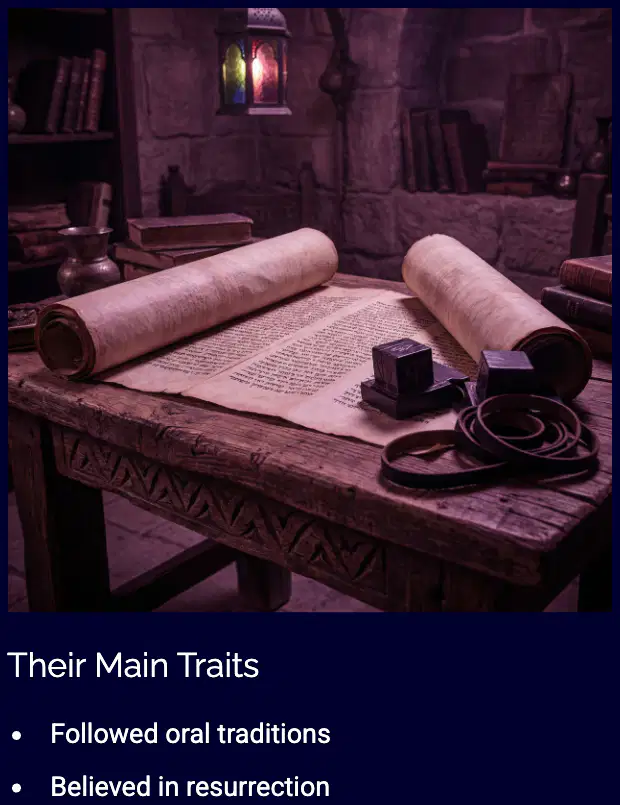
From the Pharisees section, which beliefs are attributed to the Pharisees? Choose all that apply.
Belief in life after death, angels, and spirits
Rejection of any afterlife or spiritual beings
Following both the written Torah and oral traditions
Only following later prophets while ignoring the Torah

What regular practices did the Pharisees emphasize in daily life? Choose all that apply.
Being ritually clean and giving offerings
Observing the Sabbath
Teaching in synagogues and promoting religious education
Encouraging armed resistance against Rome

Which statement best describes the Pharisees' social standing?
They were popular with regular people and active in local synagogues.
They were wealthy Temple aristocrats who controlled worship in Jerusalem.
They lived apart in desert communities and practiced communal living.
They formed a militant group focused on guerrilla attacks.

According to the Sadducees section, what scriptures did the Sadducees follow?
Only the written Torah (first five books of Moses)
The written Torah plus oral traditions
Later prophets but not the Torah
All Hebrew Scriptures and oral traditions equally
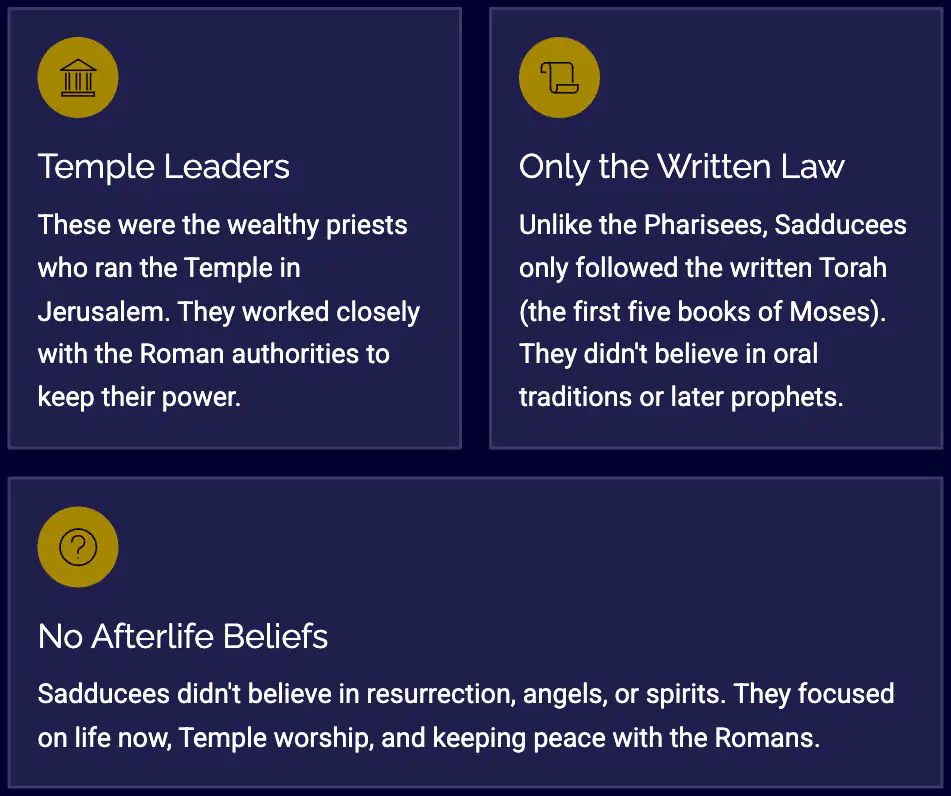
How did the Sadducees maintain their position of power?
By working closely with Roman authorities who governed Judea
By organizing desert communities away from cities
By leading guerrilla resistance against taxes
By publishing ancient scrolls discovered at Qumran

Which major historical outcome is linked to Zealot rebellion?
It sparked the Jewish–Roman War (66–73 CE), leading to the Temple’s destruction in 70 CE.
It resulted in peaceful reforms that strengthened Temple worship.
It established desert communities that preserved ancient texts.
It unified all Jewish factions under Pharisee leadership.
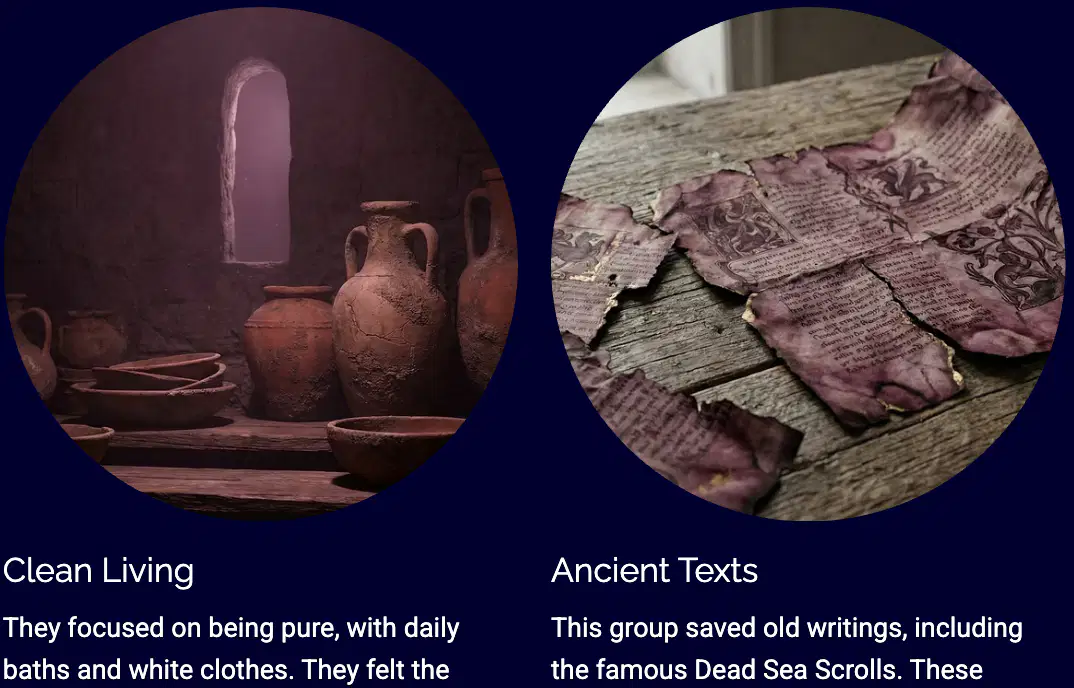
Based on the Essenes section, which practices and lifestyle choices are associated with the Essenes? Choose all that apply.
Living apart in desert communities like Qumran with shared meals
Emphasizing purity through daily baths and white clothing
Saving and preserving ancient writings such as the Dead Sea Scrolls
Cooperating closely with Roman authorities to control the Temple

Which statement best connects the Essenes to ancient texts?
They preserved writings known as the Dead Sea Scrolls, which teach about Jewish beliefs from that time.
They wrote the Roman tax code used in Jerusalem.
They compiled the written Torah during the first century CE.
They destroyed Temple records to protest corruption.
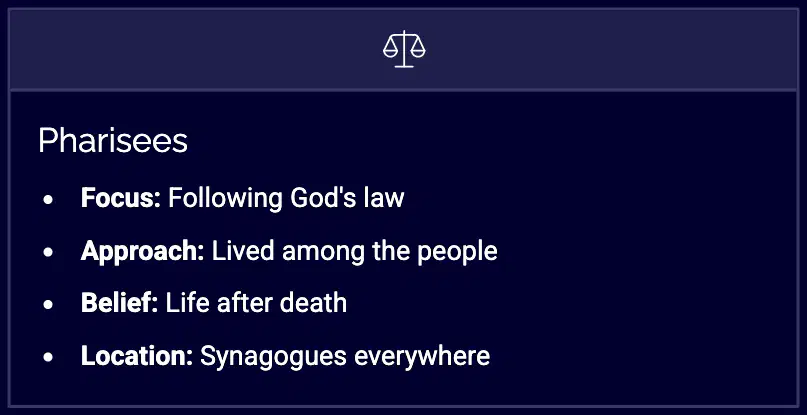
Based on the comparison chart of four Jewish groups during Roman rule (Pharisees, Sadducees, Zealots, Essenes), which group’s focus was following God’s law?
Pharisees
Sadducees
Zealots
Essenes
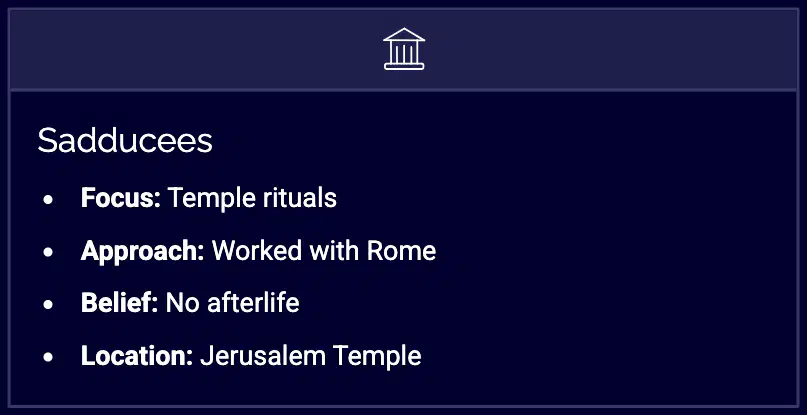
According to the chart, which group believed there was no afterlife?
Pharisees
Sadducees
Zealots
Essenes
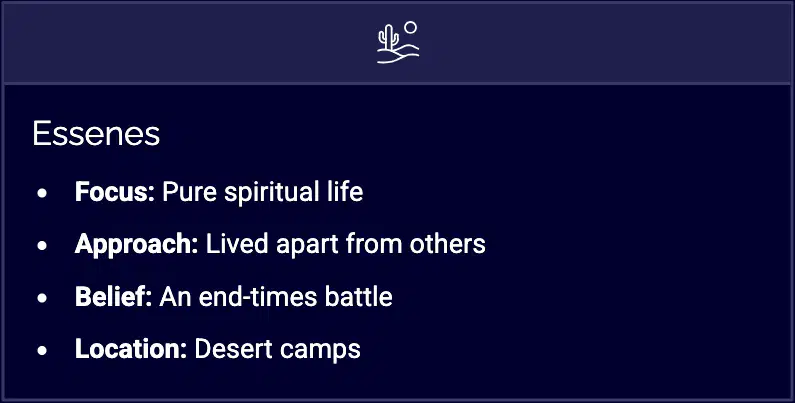
Which group’s approach was to live apart from others, according to the chart?
Pharisees
Sadducees
Zealots
Essenes
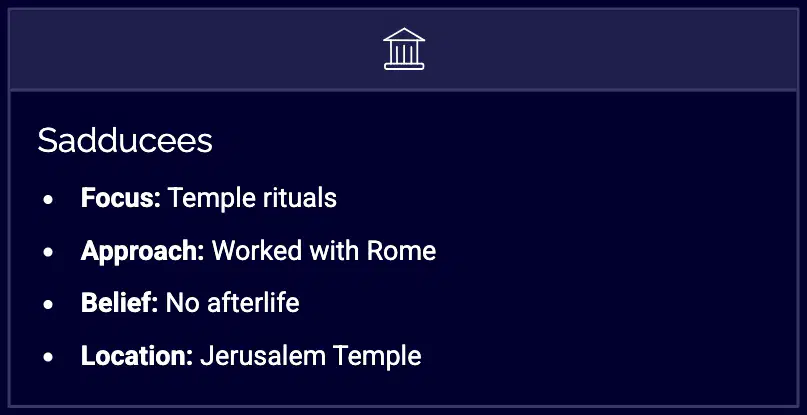
According to the chart, which group was located at the Jerusalem Temple?
Pharisees
Sadducees
Zealots
Essenes
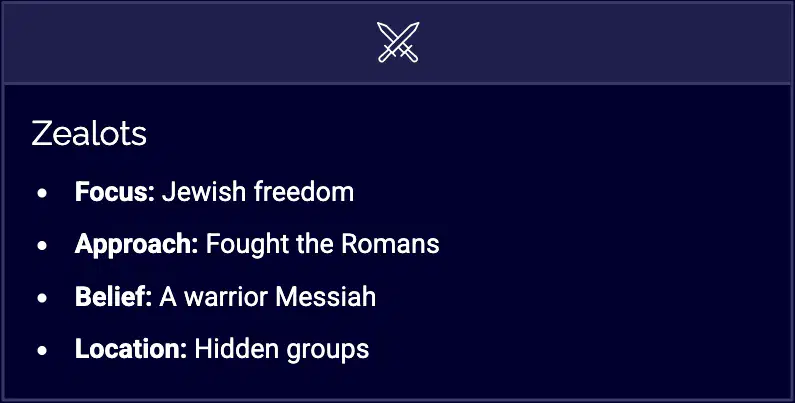
Which group’s approach was to fight the Romans?
Pharisees
Sadducees
Zealots
Essenes
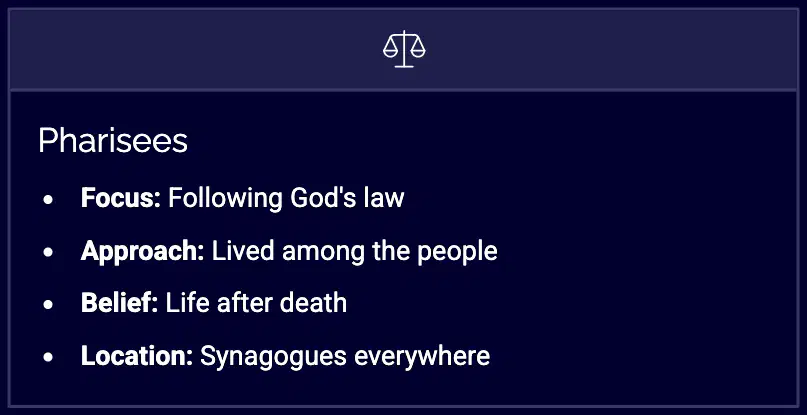
Which group believed in life after death, according to the chart?
Pharisees
Sadducees
Zealots
Essenes
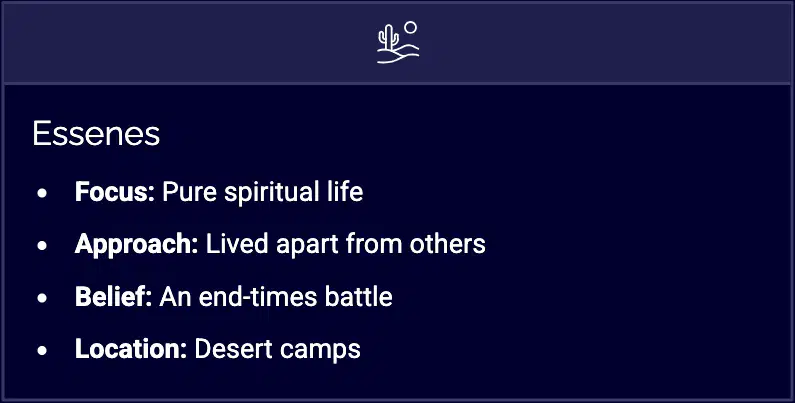
According to the chart, which group’s location is described as desert camps?
Pharisees
Sadducees
Zealots
Essenes

Which group’s focus was temple rituals?
Pharisees
Sadducees
Zealots
Essenes
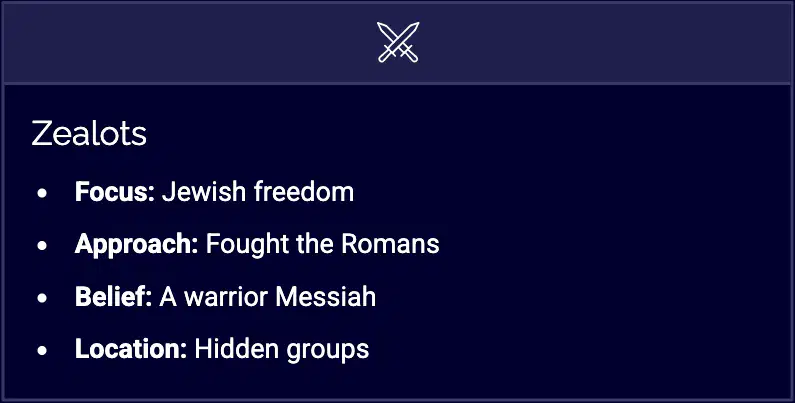
According to the chart, which group’s focus was Jewish freedom?
Pharisees
Sadducees
Zealots
Essenes
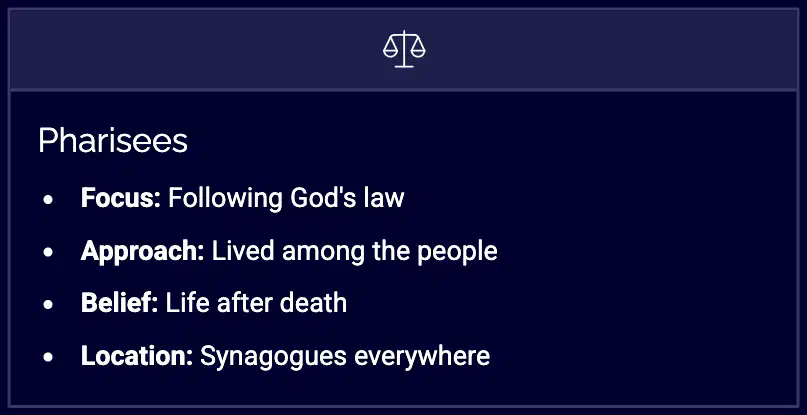
Which group’s location is described as synagogues everywhere?
Pharisees
Sadducees
Zealots
Essenes
From the passage on Jesus’ context, what topic did Jesus debate with the Sadducees?
Life after death
Temple taxes
Roman civil law
Dietary rules
Which statement best describes Jesus’ relationship to the Zealots, according to the passage?
He led them in a revolt against Rome.
He was not the military leader they hoped for.
He joined their hidden groups in the desert.
He worked with Rome alongside them.
According to the passage, which emphasis best captures Jesus’ message compared to power, strict rituals, or rigid rules?
A fresh focus on God’s kingdom, love, and inner change
Greater political power over Rome
Stricter temple rituals
More rigid rule-keeping
How did Jesus respond to Essene concerns, according to the passage?
He agreed with some worries about corruption but chose to stay engaged with society.
He moved to desert camps to live apart from others.
He rejected every Essene concern as false.
He focused on temple rituals with them.
With which group did Jesus challenge on rules, according to the passage?
Pharisees
Sadducees
Zealots
Essenes
Knowing about these groups helps reveal what about Jesus’ message, according to the passage?
It was radical compared to the religious world around him.
It was mainly about political revolution.
It was focused on strict rituals like the Sadducees.
It matched the Zealots’ call for armed resistance.

