
Font size
 Worksheets
7.8 Mass Atrocities After 1900
Total questions: 8
Worksheet time: 20mins

Which idea is best illustrated by the banner "Work Sets You Free" over the camp entrance?
Deceptive propaganda masking brutality
Religious freedom guaranteed by authorities
Legal rights for imprisoned workers
Economic recovery through labor reforms

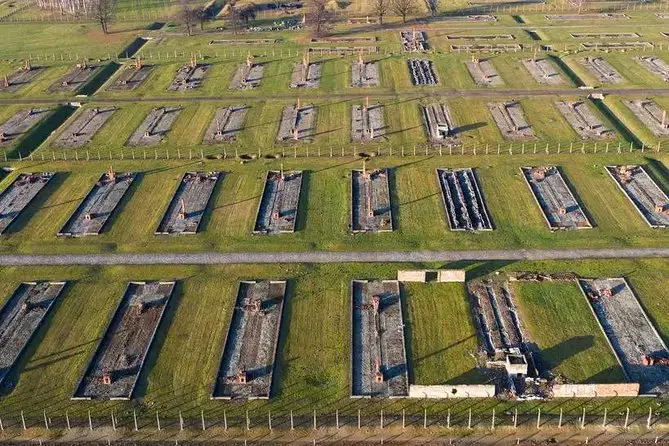
How does the photograph convey the industrial scale of genocide at Auschwitz-Birkenau?
Handwritten sign made by prisoners
Single cart pathway used infrequently
Small guarded courtyard with no buildings
Railway access enabling mass transports
Which core element of Nazi ideology is reflected by the camp and its practices?
Cultural exchange and diversity
Pacifism and nonviolence
Democratic pluralism and tolerance
Racial purity and antisemitism
Which group’s revolution sought a society without cities, money, religion, or family?
Bolsheviks in Russia
Khmer Rouge in Cambodia
Young Turks in Turkey
Red Guard in China
Approximately what fraction of Cambodia’s population perished under the Khmer Rouge?
One twentieth of the population
One half of the population
One tenth of the population
One quarter of the population
Which individuals were targeted by the Khmer Rouge as enemies of the revolution?
Foreign tourists and traders
Artists and athletes
Farmers and factory workers
Intellectuals and former officials
Which statement best connects mass atrocities of the 20th century?
Natural disasters caused mass deaths
Foreign invasions triggered the killings
Tribal warfare escalated uncontrollably
State-directed policies led to attempts of extermination
Source: Henry Morgenthau, Sr., the U.S. Ambassador to the Ottoman Empire, in his memoir written for an American audience to expose the atrocities he witnessed and to advocate for U.S. intervention in World War I, 1918.
When the Turkish authorities gave the orders for these deportations, they were merely giving the death warrant to a whole race; they understood this well, and, in their conversations with me, they made no particular attempt to conceal the fact. ... I am confident that the whole history of the human race contains no such horrible episode as this. The great massacres and persecutions of the past seem almost insignificant when compared with the sufferings of the Armenian race in 1915. The killing of the Armenian men was a comparatively small part of the tragedy. The real horror was in the treatment of the women and children. They were driven from their homes, and they were forced to march for hundreds of miles, over mountains and deserts, without food, without water, and without shelter. They were robbed, they were raped, and they were murdered. They were sold as slaves in the markets of the interior. They were left to die of starvation and disease. It was a campaign of race extermination...
Ambassador Morgenthau's Story
Identify a claim made by the author in Passage 1.
Identify a claim made by the author in Passage 2.
Explain ONE difference between the Armenian and Cambodian genocides.

