
Font size
 Worksheets
Ancient Greek Art
Total questions: 15
Worksheet time: 4hrs 15mins
The timeframe for Ancient Greek art in this course spans which dates?
c. 900 BCE to 31 BCE
c. 1200 BCE to 146 BCE
c. 776 BCE to 323 BCE
c. 500 BCE to 200 CE
What is the central Big Idea guiding Ancient Greek art introduced here?
Pure imitation of Egyptian conventions
Idealized naturalism and lasting standards
Chaotic expression and personal symbolism
Rigid abstraction and temporary fashions

Which greek architectural order contains acanthus leaves?
Doric
Ionic
Corinthian
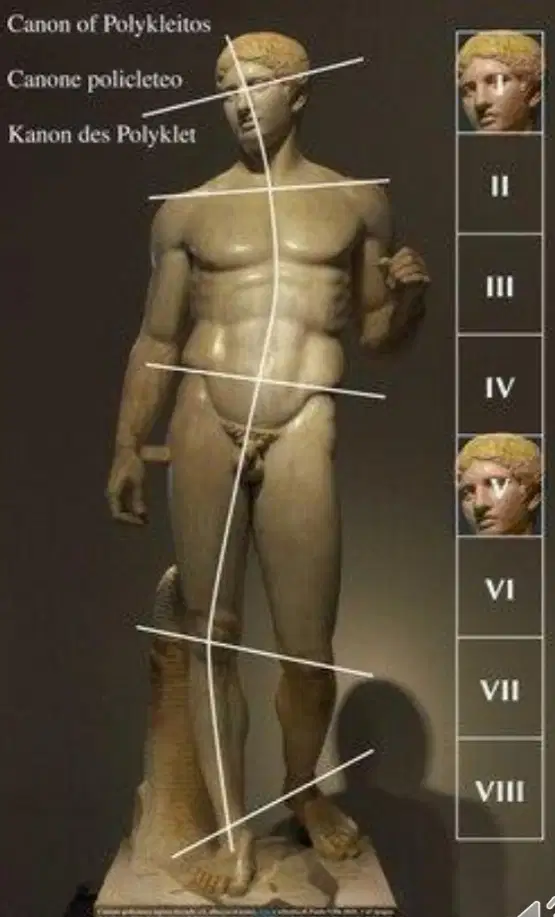
What is the primary purpose of using mathematical ratios and contrapposto in Greek art as shown?
To emphasize stiff and symmetrical poses
To suggest movement, balance, and ideal proportion
Which statement best distinguishes red-figure pottery from black-figure pottery in Ancient Greece?
Red-figure avoided showing movement in painted scenes
Red-figure limited anatomical detail and rigid poses
Red-figure showed red figures with dark backgrounds
Red-figure kept figures dark with red backgrounds
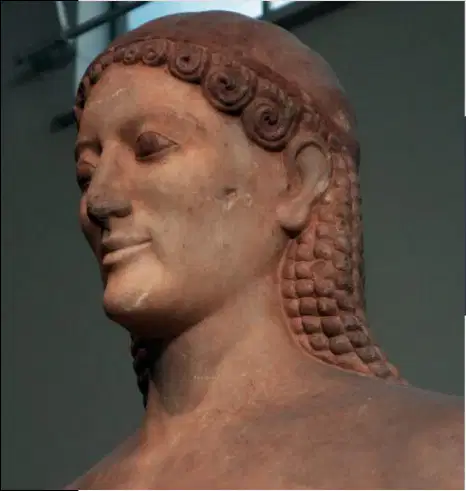
Which feature best distinguishes the Anavysos Kouros within the Archaic period?
Dynamic contrapposto with relaxed standing leg
Front facing, rigid pose and archaic smile
Naturalistic portrait with individualized features
Draped female figure with painted surface
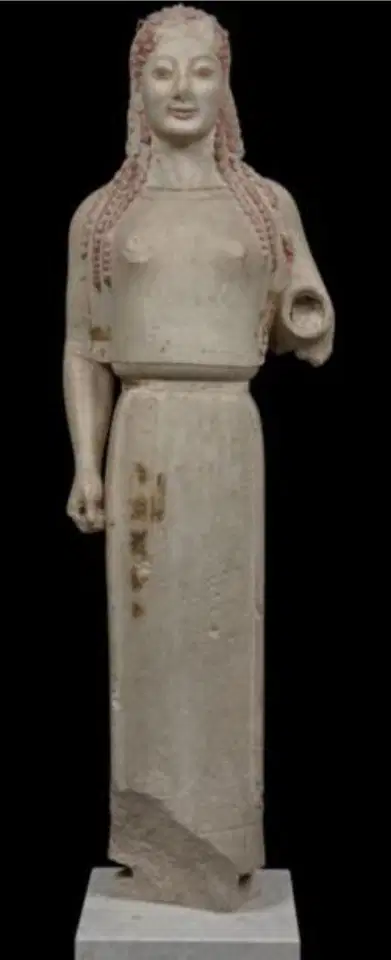
Comparing the Peplos Kore and Doryphoros, which statement best explains a key stylistic evolution from Archaic to Classical sculpture?
From clothed, static figures to balanced contrapposto realism
From grave markers exclusively to purely decorative statues
Which description best identifies the Parthenon’s architectural order and material?
Ionic temple built of limestone blocks
Composite shrine carved from sandstone
Doric temple constructed from marble stone
Tuscan colonnade assembled with granite
Corinthian basilica using terracotta tiles
What purpose do the Parthenon’s optical refinements primarily serve?
They symbolize divine perfection through geometry
They correct visual distortions for human sight
They reinforce columns against earthquake shocks
They channel rainwater away from the stylobate
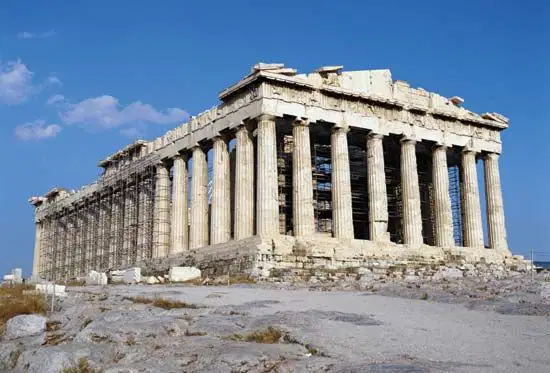
How does the Parthenon frieze reflect Athenian society beyond religion?
It glorifies only mythic gods and goddesses
It documents trade routes across the Aegean
It records military tactics with detailed plans
It intertwines civic ritual with political identity
It portrays private portraits of noble families
Which sculpture best exemplifies Early Classical balance in depicting movement through a poised athletic pose?
Discobolos by a discus thrower depiction
Nike of Samothrace with windblown drapery
Laocoön and His Sons in violent struggle
Pergamon frieze with dramatic combat
Both Nike of Samothrace and Laocoön and His Sons showcase Hellenistic dynamism. Which feature most directly conveys this shared quality?
Minimal drapery and simplified anatomy
Emotion-charged bodies and swirling motion
Strict symmetry and calm expressions
Static front-facing stance with poise
Which statement best describes a lasting impact of Greek art shown in the visual?
It replaced Roman innovations with purely new styles
It discouraged naturalism in later European artworks
It ended medieval approaches to manuscript painting
It formed foundations for Western art traditions

From Archaic to Hellenistic Greek sculpture, which change is most accurate?
Mt. Vesuvius erupted in 79 AD and buried these two cities in volcanic ash.
Helena and Athens
Naples and Rome
Pompeii and Herculaneum
Florence and Caprese

