
 Worksheets
Page 1
Total questions: 150
Worksheet time: 1hrs 15mins
Which theme title is highlighted in the material for this unit?
Tantangan Pembangunan Indonesia
Sejarah Kolonial dan Kemerdekaan
Perubahan Sosial Indonesia Modern
Geografi Regional Asia Tenggara
Which Indonesian government eras are mentioned for studying development over time?
Masa Kerajaan dan Masa Kolonial
Orde Lama, Orde Baru, Orde Reformasi
Era Reformasi dan Demokrasi Liberal
Kabinet Parlementer dan Kabinet Presidensial
What is the first topic students will explore in this theme?
Dampak globalisasi terhadap budaya lokal
Perbandingan negara maju dan berkembang
Pembangunan di Indonesia dari Masa ke Masa
Strategi kampanye menuju negara maju
In this unit, what does "Tolok Ukur Pembangunan" refer to?
Slogan nasional untuk pembangunan
Indikator keberhasilan pembangunan negara
Rencana lima tahun pemerintahan
Program wajib kerja bakti komunitas
Which activity are students invited to do at the end of the theme?
Debat tentang kebijakan luar negeri
Aksi kampanye upaya pembangunan Indonesia
Simulasi pemilihan umum nasional
Kunjungan lapangan ke situs sejarah
What is the broader subject and grade level of the book indicated at the top?
Pendidikan Pancasila kelas X SMA
Bahasa Indonesia kelas VIII SMP/MTs
Matematika kelas VII SMP/MTs
Ilmu Pengetahuan Sosial kelas IX SMP/MTs
Which institution is credited as publisher at the top of the page?
Badan Perencanaan Pembangunan Nasional
Lembaga Ilmu Pengetahuan Indonesia
Kementerian Pendidikan, Kebudayaan, Riset, dan Teknologi
Kementerian Keuangan Republik Indonesia
Which potential theme outcome is emphasized for Indonesia?
Menjadi eksportir terbesar di Asia
Menjadi negara dengan populasi terbesar
Menjadi negara maju di dunia
Menjadi pusat budaya regional

What visual is shown beneath the theme title?
Industri dan infrastruktur dengan lampu malam
Gedung pemerintahan dengan bendera berkibar
Pertanian padi di pedesaan malam hari
Peta politik provinsi Indonesia
Which of the following best describes the focus of the "Gambaran Tema" section?
Biografi penulis dan fotografer
Daftar istilah teknis pembangunan
Ikhtisar topik dan alur pembelajaran tema
Ringkasan metode penelitian lapangan
Which statement best describes a key learning goal related to social change in the contemporary era?
Memorize dates of ancient world civilizations
Understand ongoing social change trends globally
Practice only individual financial budgeting
Focus solely on local folklore traditions
What economic focus is highlighted for analysis in the digital era?
Growth of the digital economy
Decline of medieval trade routes
Fixed gold standard policies
Barter systems in rural villages
Which action shows students contributing positively to global society?
Copying reports without sources
Criticizing peers during presentations
Avoiding discussions of public issues
Participating in relevant social actions
What simple research activity are students expected to perform?
Conduct basic social investigations
Write only personal diaries
Collect random internet memes
Translate novels into English
Which learning indicator involves describing historical development efforts in Indonesia?
Explain development efforts since independence
Predict sports results for local teams
List popular tourist destinations
Compare recipes from regional cuisines
Which indicator best matches evaluating local development processes?
Assess development activities in the community
Calculate classroom seating capacity
Measure rainfall during monsoon seasons
Estimate ages of historical artifacts
Which item is a benchmark used to gauge development success?
Development indicators or metrics
Number of school holidays yearly
Amount of celebrity social media posts
Count of traditional festivals held
What strategic task involves analyzing challenges and national potential?
Practice only basic arithmetic operations
Study obstacles and Indonesia’s potential to advance
Memorize provincial capital cities
Design costumes for cultural parades
Which campaign purpose aligns with the learning goals?
Promote ignoring community development issues
Encourage abandoning environmental protection
Support Indonesia’s path to becoming a developed nation
Advocate reducing education opportunities
Which key question guides student reflection about their role?
Which celebrity should lead national policies?
What is the tallest mountain’s precise elevation?
What contributions can we make to Indonesia’s development?
How many islands exist in the archipelago exactly?
In 2045, Indonesia will mark 100 years of independence. What is a commonly used term for this milestone age?
Century maturity period
Golden age of a nation
Post-independence transition
Millennial renewal era
Which factor is expected to help Indonesia face global economic challenges around 2045?
High elderly population share
Large productive-age population
Declining urbanization rates
Reduced infrastructure spending
The government’s Visi Indonesia 2045 primarily aims to position Indonesia as:
An agricultural exporter only
A regional tourism center
A major advanced country
A leading cultural hub
By 2045, Indonesia is predicted to have completed foundations for which two development areas?
Agriculture and maritime logistics
Tourism and environmental conservation
Infrastructure and human resources
Defense and foreign policy
A demographic bonus occurs when about what share of the population is in productive ages?
Around 90 percent
Around 70 percent
Around 50 percent
Around 30 percent
Which group is identified as key to carrying Indonesia toward becoming a major economy by 2045?
Foreign expatriate workers
Productive-age residents
Retired senior citizens
Primary school students
Which statement best explains why 2045 is considered a special momentum for Indonesia?
It introduces a new currency
It coincides with a royal coronation
It marks a century of independence
It is the end of a five-year plan
Which concept refers to improvements in education, health, and standard of living mentioned as key terms?
Balance of Payments
Gross Domestic Product
Human Development Index
Comparative Advantage
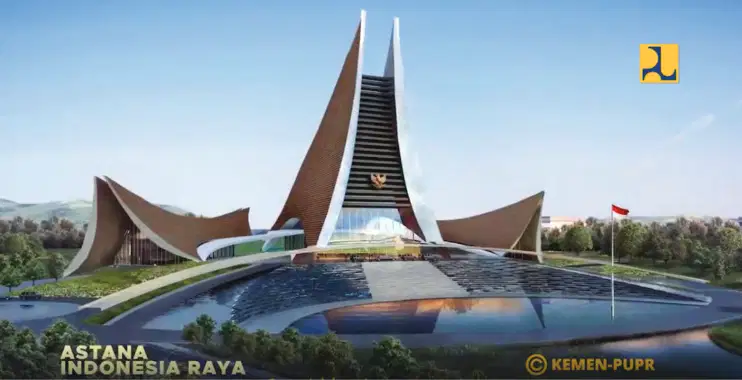
Looking at the depicted national complex labeled Astana Indonesia Raya, which development priority does it symbolically emphasize?
Rural irrigation networks
National infrastructure prestige
Small-scale cottage industries
Traditional village governance
Which outcome is most aligned with a successful demographic bonus for Indonesia?
Shrinking human capital
Expanded productive workforce
Higher dependency ratio
Reduced labor participation
Which statement best defines national development in a country?
A planned effort improving life quality across sectors
A spontaneous growth of cities without government role
An increase in exports while households remain unchanged
A focus on military expansion above social programs
Which example shows physical or infrastructure development?
Publishing a novel about national heroes
Organizing a traditional dance competition
Creating poetry clubs in local schools
Building railways, roads, and power plants
What is one purpose of Indonesia’s national development policies?
Reduce education access for rural citizens
Protect all Indonesian people and territory
Prioritize elite interests over public welfare
Expand borders through regional conflicts
Which national goal aligns with advancing general welfare?
Cutting community programs nationwide
Improving public services and social prosperity
Restricting healthcare to urban residents
Limiting infrastructure to capital city only
Which activity reflects Indonesia’s role in global order per national aims?
Supporting war to expand economic markets
Imposing tariffs to punish neighboring states
Withdrawing from all international forums
Promoting peace and social justice worldwide
Why are development projects described as planned efforts?
They rely exclusively on private charities
They are designed by government and society
They occur randomly without coordination
They depend solely on foreign investors
Which statement distinguishes physical development from other fields?
It builds infrastructure like dams and airports
It focuses on private consumption habits
It only improves arts, culture, and literature
It changes voting rules and party systems
How does national development relate to constitutional mandates from 1945?
It focuses solely on market liberalization
It aims to protect, prosper, educate, and foster peace
It requires heavy taxation without social benefits
It mandates cultural uniformity above diversity
Which outcome best illustrates educating the life of the nation?
Closing public libraries in rural districts
Expanding access to quality schools and learning
Banning scientific research in universities
Reducing teacher training and school funding
Which statement best describes development as a social change process mentioned in the text at the top of the page?
An unpredictable, cyclical, seasonal community effort
A planned, long-term, continuous national process
A short, spontaneous, unplanned local activity
A sudden, temporary, isolated government project

The images labeled Masa Kolonial, Orde Lama, Orde Baru, and Reformasi primarily illustrate which idea?
Population change by island and province
Development across different government periods
Cultural festivals during national holidays
Trade routes between Southeast Asian ports
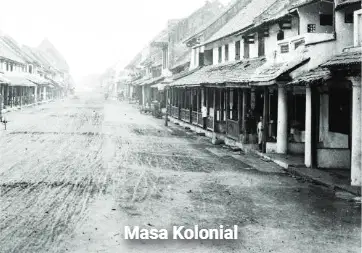
During Masa Kolonial, which development pattern is most evident from the black-and-white street image?
Limited infrastructure and sparse motorized transport
High-rise skyline with multilane expressways
Advanced highways with dense private vehicles
Modern public transit and organized bike lanes
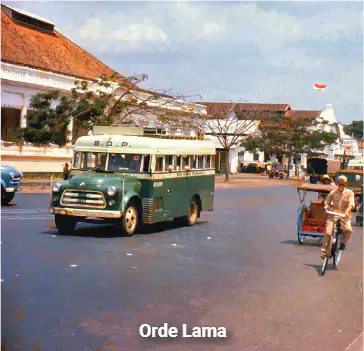
In the Orde Lama photo with a bus and bicycle rickshaw, what does the scene suggest about urban transport at that time?
Dominance of private cars over all other modes
Fully electrified bus rapid transit corridors
Exclusive reliance on high-speed rail services
Mix of basic motor vehicles with nonmotorized modes
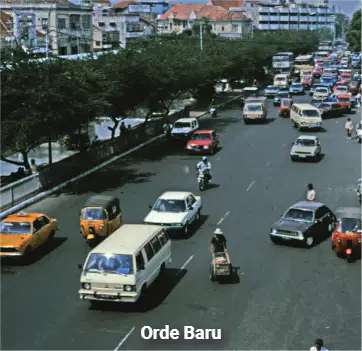
Which feature in the Orde Baru image indicates challenges typical of rapid urbanization?
Traffic congestion with many private vehicles
Abandoned streets lacking public activity
Empty highways with minimal car presence
Rural dirt roads with horse-drawn carts
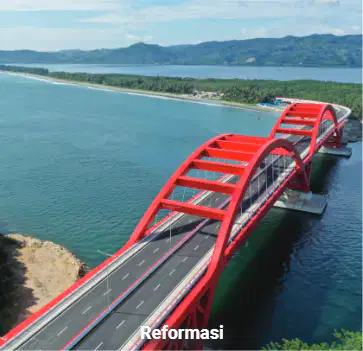
The Reformasi image with a red arch bridge most directly represents which aspect of development?
Replacement of all roads with waterways
Decline in transport connectivity nationwide
Return to colonial-era architecture styles
Large-scale modern infrastructure investment
Place the eras in chronological order from earliest to latest, based on the captions.
Reformasi, Orde Baru, Orde Lama, Masa Kolonial
Orde Baru, Masa Kolonial, Reformasi, Orde Lama
Orde Lama, Masa Kolonial, Reformasi, Orde Baru
Masa Kolonial, Orde Lama, Orde Baru, Reformasi
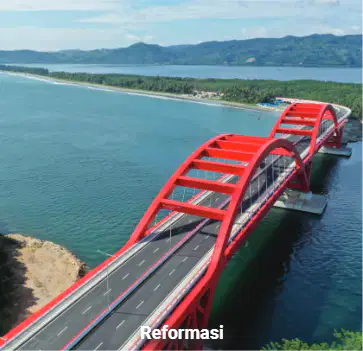
If a city plans a bridge like the one in the Reformasi photo, which long-term goal does this most likely support?
Improving regional connectivity and economic growth
Reducing all travel to nonmotorized transport
Ending government involvement in planning projects
Eliminating urbanization and population density
Which misconception about development is challenged by the text’s description?
Development only happens in one government era
Development happens as a sustained, planned process
Development occurs instantly without planning
Development is random and short-lived changes

Looking at the four images together, which pattern best reflects Indonesia’s development trajectory?
From limited infrastructure to modern connectivity
From advanced highways to rural dirt roads
From dense private cars to animal-drawn carts
From modern bridges to abandoned city streets
When did the Old Order period in Indonesia begin?
27 December 1949 transfer
1 October 1965 movement
11 March 1966 decree
17 August 1945 proclamation
Until around what year did the Old Order last before transitioning to the New Order?
Around 1966
Around 1950
Around 1962
Around 1971
Which statement best describes Indonesia’s security conditions during the Old Order?
Peaceful after foreign recognition
Unstable due to internal conflicts
Calm because strong institutions
Stable with minimal conflict
Which external factor contributed to instability in early independence?
Famine caused by drought
Trade embargo by the US
War against the Netherlands
Border disputes with Malaysia
What major sectors were prioritized for development during the Old Order?
Agriculture and health
Politics and economy
Education and culture
Tourism and defense
Why did Indonesia’s economy lack optimal national strength during the Old Order?
Overdependence on tourism
High oil prices globally
Inherited colonial structures
Excessive taxation policies
Which misconception about the Old Order economy is most accurate to refute?
It had fully modern institutions
It inherited colonial networks
It was entirely privatized
It relied mostly on tourism
What was a key internal issue mentioned that affected political stability?
Mass immigration flows
Regional autonomy reforms
Ideological clashes and rebellions
Rapid industrialization policies
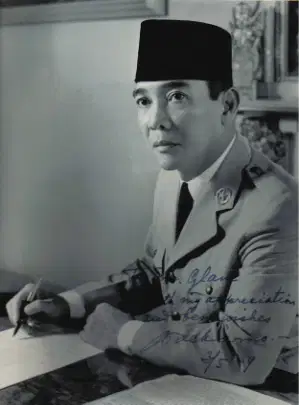
Identify the figure shown in the photograph’s caption.
Leader of Dutch forces
Prime minister of Malaysia
Second vice president
First president of Indonesia
Which question would help explore causes of the 1966 transition to the New Order?
When did tourism expand?
Who won the 1945 election?
What sparked internal conflicts?
Why were taxes increased?
Which political system did Indonesia follow during the Old Order era?
Federal monarchy led by regional kings
Parliamentary democracy with president and prime minister
Military junta with appointed governors
Presidential democracy with no parliament
In the Old Order system, what was the president’s primary role?
Speaker of parliament leading sessions
Chief justice overseeing courts
Head of state representing the nation
Head of government managing daily policy
Who led the cabinet and coordinated ministers during the Old Order?
President acting as cabinet chair
Prime minister as cabinet head
DPR chairperson with committees
Chief of police with security council
Why were cabinets often named in a particular way during the Old Order?
After the military branch funding them
After the prime minister who led them
After the president’s official residence
After the province where they met
Which pair correctly identifies Indonesia’s top leaders early in the Old Order?
Sukarno as prime minister, Hatta as speaker
Hatta as president, Sukarno as prime minister
Suharto as president, Djuanda as vice president
Sukarno as president, Mohammad Hatta as vice president
During the Old Order, how many prime ministers served overall?
Five prime ministers across the era
Ten prime ministers across the era
Twenty prime ministers across the era
Fifteen prime ministers across the era
Which statement best describes the division of roles between president and prime minister in the Old Order?
President led parliament; prime minister led judiciary
Prime minister led state; president led courts
Both jointly led state and courts
President led state; prime minister led government
What responsibility did the prime minister have toward the DPR during the Old Order?
None; only the president answered to DPR
Leading DPR sessions as chair
Accountability for cabinet policies to DPR
Appointing DPR members directly
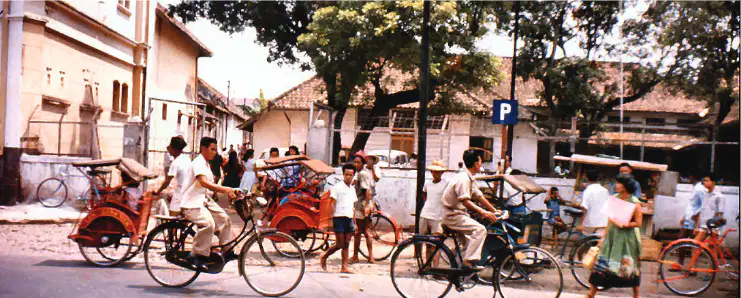
In the image of Jakarta during the Old Order, what everyday urban feature is most evident?
Skyscrapers with modern highways
Suburban malls with parking lots
Heavy use of bicycles and rickshaws
Electric trams on elevated tracks
Mohammad Hatta served as vice president until 1956. Which event is linked to that date?
Military appointment announced on 1 December 1956
Impeachment trial completed on 1 December 1956
Election victory declared on 1 December 1956
Resignation formally submitted on 1 December 1956
Which leader served as prime minister immediately after Sutan Sjahrir’s term ended on 3 July 1947?
Mohammad Natsir
Amir Sjarifoeddin
Mohammad Hatta
Wilopo
During which dates did Mohammad Hatta serve as prime minister?
29 January 1948–6 September 1950
3 July 1947–29 January 1948
6 September 1950–21 April 1951
1 April 1952–30 July 1953
Who held the prime minister role from 6 September 1950 to 21 April 1951?
Mohammad Natsir
Djoeanda Kartawidjaja
Sukiman Wijosandjojo
Boerhanoeddin Harahap
Which cabinet leader’s term ended on 30 July 1953?
Wilopo
Ali Sastroamidjojo (I)
Sukiman Wijosandjojo
Boerhanoeddin Harahap
Arrange these leaders by start date, earliest to latest: Ali Sastroamidjojo (I), Boerhanoeddin Harahap, Djoeanda Kartawidjaja.
Ali Sastroamidjojo (I), Djoeanda Kartawidjaja, Boerhanoeddin Harahap
Djoeanda Kartawidjaja, Boerhanoeddin Harahap, Ali Sastroamidjojo (I)
Boerhanoeddin Harahap, Ali Sastroamidjojo (I), Djoeanda Kartawidjaja
Ali Sastroamidjojo (I), Boerhanoeddin Harahap, Djoeanda Kartawidjaja
Who served as prime minister from 24 March 1956 to 9 April 1957?
Djoeanda Kartawidjaja
Ali Sastroamidjojo (II)
Boerhanoeddin Harahap
Wilopo
Which leader’s term began on 9 April 1957 and ended on 9 July 1959?
Djoeanda Kartawidjaja
Ali Sastroamidjojo (II)
Boerhanoeddin Harahap
Sukiman Wijosandjojo
Sukiman Wijosandjojo served between which dates?
26 April 1951–1 April 1952
6 September 1950–21 April 1951
1 April 1952–30 July 1953
12 August 1955–24 March 1956
Which statement best describes a trend in the Old Order prime ministerial tenures?
Only one leader served during the 1950s
Terms always began on the first of the month
Consistently long and stable administrations
Frequent leadership changes over short periods
Which leader concurrently served as president during his listed term from 9 July 1959 to 25 July 1966?
Wilopo
Sukarno
Mohammad Hatta
Ali Sastroamidjojo
Which major international event hosted by Indonesia in 1955 aimed to unite newly independent countries?
Bali Pacific Security Forum
Jakarta Non-Aligned Congress
Bandung Asian-African Conference
Geneva Summit of world powers
What domestic achievement occurred in Indonesia in the same year as the Asian-African Conference?
Adoption of a new national flag
Establishment of the Supreme Court
First nationwide census conducted
First General Election successfully held
The 1959 Presidential Decree primarily changed Indonesia’s political system from
military junta to civilian rule
federal to unitary confederation
presidential to constitutional monarchy
liberal parliamentary to guided democracy
After the 1959 decree, who concurrently served as President and Prime Minister?
Ali Sastroamidjojo as cabinet chief
Sukarno holding both positions
General Nasution appointed interim
Mohammad Hatta in dual roles
During Guided Democracy (1959–1966), which cabinet was formed to unite political forces?
Cabinet Reformasi Rakyat
Cabinet Gotong Royong
Cabinet Pembangunan Mandiri
Cabinet Persatuan Nasional
What was the purpose of the Nasakom campaign promoted in the early 1960s?
Join the Western defense pact promptly
Privatize state industries fast
Fuse nationalist, religious, communist ideologies
Expand military rule nationwide
Which challenge eventually undermined the unity achieved under Sukarno’s leadership?
Complete economic self-sufficiency
Persistent crises triggering major conflict
External invasion from neighbors
Severe drought and famine only
Why did governments struggle to last long before 1955, according to the passage?
Absence of a written constitution
Frequent natural disasters nationwide
Clashes among political ideologies
Lack of international recognition
Which statement best describes Indonesia’s political progress in 1955?
Military-led governance replaced elections
Both domestic and international achievements
Only foreign diplomacy advanced
Domestic reforms stalled entirely
What major transition followed the late period of Sukarno’s rule?
Formation of the Non-Aligned Movement
Return to Dutch colonial rule
Rise of the New Order government
Creation of a federal monarchy
Which constitutional documents were adopted in Indonesia after 1945 during the early post-independence period?
Federal Act 1955 and UUD 1960
UUD 1930 and Charter 1942
UUD RIS 1949 and UUDS 1950
Jakarta Charter 1945 and UUD 1959
During the Old Order, Indonesia changed from which state form to which?
Republic to monarchy
Federation to unitary
Monarchy to republic
Unitary to federation
What was the primary impact of changing the state form on Indonesia’s legal framework?
Taxes were abolished nationwide
The constitution also changed
Provincial borders were removed
Military ranks were standardized
When was the Badan Perancang Ekonomi established to begin economic planning?
17 August 1945
1 January 1950
19 January 1947
12 April 1947
Who initiated the creation of the Badan Perancang Ekonomi?
Minister of Prosperity A.K. Gani
President Sukarno
Vice President Mohammad Hatta
Minister of Industry Sumitro
What was the planning horizon of the Badan Perancang Ekonomi?
Single-year rapid recovery
5 years with yearly reviews
2–3 years within a 10-year span
20-year long-term vision
Which committee, led by Mohammad Hatta, strengthened the economic planning efforts in April 1947?
Panitia Pemikir Siasat Ekonomi
Dewan Perancang Negara
Biro Perancang Negara
Panitia Perdagangan dan Industri
What was the main task of Panitia Pemikir Siasat Ekonomi?
Negotiate foreign loans with allies
Set provincial tax rates nationwide
Collect data and study development strategies
Train military officers for logistics
What foundational document did Panitia Pemikir Siasat Ekonomi produce?
Piagam Perdagangan dan Industri
Rencana Pembangunan Pendidikan Nasional
Pedoman Politik Luar Negeri Indonesia
Dasar-dasar Pokok daripada Plan Mengatur Ekonomi Indonesia
Why couldn’t Panitia Pemikir Siasat Ekonomi perform optimally?
The committee faced natural disasters
Political situation was uncertain
Members lacked any economic training
Funding was unlimited and misused
Afterward, which institutions continued national economic development work?
Foreign Embassies; UN Missions; Private Firms
Provincial Assemblies; Farmer Cooperatives; Trade Unions
Ministry of Defense; National Bank; Supreme Court
Kementerian Perdagangan dan Industri; Dewan Perancang Negara; Biro Perancang Negara
Which institution was established in 1963 to coordinate national development planning in Indonesia?
Badan Perencanaan Pembangunan Nasional
Dewan Perancang Nasional Indonesia
Kementerian Keuangan Republik Indonesia
Badan Tenaga Nuklir Nasional Indonesia
During the Old Order, which sector involved building and renovating roads, bridges, terminals, stations, and ports?
Transportation infrastructure sector
Fiscal and monetary sector
International trade sector
Higher education sector
What was a key communication initiative undertaken during the Old Order government?
Introducing satellite internet services
Launching nationwide television cable
Privatizing telecommunication firms
Expanding radio and postal networks
Which facilities were developed to support public health during the Old Order?
Herbal medicine markets
Mobile vaccination vans
Community clinics and hospitals
Private pharmacies and labs
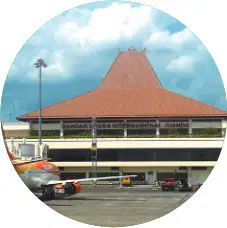
Which example of infrastructure from the Old Order is highlighted with an image on this page?
Stasiun Bandung in West Java
Bandar Udara Djuanda in Sidoarjo
Pelabuhan Tanjung Priok in Jakarta
Jembatan Ampera in Palembang
What primary purpose did Djuanda Airport serve when first built during the Old Order?
Training school for civil aviation pilots
Military airbase supporting Irian Barat campaign
Commercial hub for domestic tourism growth
Cargo center for international trade routes
Which area of policy was mentioned as part of the Old Order’s programs besides infrastructure?
Agricultural land redistribution
Universal suffrage expansion
International trade initiatives
Judicial court reforms
What role did Ir. Djuanda hold during the airport’s development process?
Chief of the armed forces logistics
Governor of East Java province
Minister of transportation and logistics
Deputy prime minister overseeing projects
Which education-related development occurred under the Old Order?
Creating private tutoring networks
Eliminating national examinations
Mandating online learning platforms
Building schools and universities
Which technological institution’s development is noted for the Old Order period?
Badan Komunikasi Nasional in media
Badan Statistik Nasional in data
Badan Energi Terbarukan in renewables
Badan Tenaga Nuklir in technology
Which river does the Ampera Bridge cross in South Sumatra?
Sungai Musi
Sungai Kapuas
Sungai Citarum
Sungai Mahakam
In which years was the Ampera Bridge constructed and inaugurated?
Built 1960, opened 1963
Built 1964, opened 1966
Built 1962, opened 1965
Built 1957, opened 1967
What name was initially given to the bridge at its opening ceremony?
Jembatan Orde Baru
Jembatan Djuanda
Jembatan Ampera
Jembatan Bung Karno
Why was the bridge’s name changed during the New Order era?
Political rebranding policies
Structural renovation needs
Local referendum results
International naming standards
Where is the Jatiluhur Dam located?
West Java
South Sumatra
East Kalimantan
North Sulawesi
Which river is held back by the Jatiluhur Dam?
Batanghari River
Brantas River
Musi River
Citarum River
What is the approximate height and length of the Jatiluhur Dam?
90 meters high, 1.50 km long
96 meters high, 1.22 km long
75 meters high, 2.10 km long
120 meters high, 0.80 km long
What major purposes does the Jatiluhur Dam serve for Indonesia?
Irrigation and hydropower
Flood control and tourism
Navigation and aquaculture
Drinking water and recreation
Which statement best describes the scale of water storage at Jatiluhur?
Capacity in tens of billions cubic meters
Capacity under one million cubic meters
Capacity around one billion cubic meters
Capacity a few hundred thousand cubic meters
Who initiated the construction of the Ampera Bridge before receiving central support?
Community volunteer groups
National military engineers
Private foreign investors
Local regional government
Which period marked the start of Sukarno’s Guided Democracy in Indonesia?
1957 after regional rebellions
1959 at the shift to Guided Democracy
1963 during the GANEF0 celebration
1955 in early parliamentary era
What was the primary focus of Mercusuar foreign policy under President Sukarno?
Trade liberalization with industrial powers
Alignment with Western military blocs
Participation in world political affairs
Isolation from global politics
Why did Sukarno promote Mercusuar politics internationally?
To secure loans from industrialized countries
To reduce domestic infrastructure spending
To show Indonesia could lead emerging nations
To diminish Indonesia’s role in Asia
Which statement best describes Indonesia’s intended role under Mercusuar politics?
A neutral state focused only on trade
A major nation capable of leadership
A regional follower of major powers
A minor player avoiding global conflicts
How did Mercusuar politics influence domestic policy during Sukarno’s era?
It cut public works to fund defense
It halted industrial projects nationwide
It spurred large-scale infrastructure building
It privatized transportation and utilities
Which goal did the infrastructure projects aim to support under Mercusuar politics?
Reducing Indonesia’s participation abroad
Tourism-only development around beaches
Exclusive military expansion in rural areas
Various agendas in international engagement
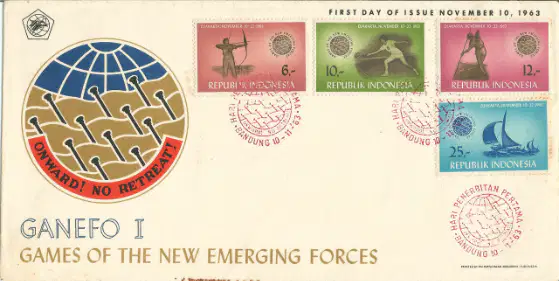
The envelope shown marks the celebration of what event in Indonesia?
Asian Games inauguration ceremony
GANEF0: Games of the New Emerging Forces
Independence Day postal commemoration
Bandung Conference of Non-Aligned Movement
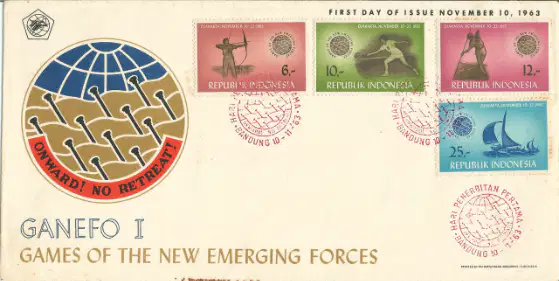
Which year appears on the commemorative item related to GANEF0?
1965 above the red stamp
1963 on first day of issue
1961 written in violet ink
1959 printed near the globe
What collaborative theme is highlighted at the top of the activity sheet?
Pancasila (five principles)
Gotong Royong (mutual cooperation)
Revolusi Mental (mental revolution)
Bhinneka Tunggal Ika (unity in diversity)
If you were researching Sukarno-era infrastructure, which two types of projects would best align with Mercusuar goals?
Monasteries and historical archives
Village art centers and poetry clubs
Ports and national sports facilities
Private malls and luxury resorts
What event marked the transition of leadership from Sukarno to Soeharto in the late 1960s?
General Election consolidation nationwide
Surat Perintah Sebelas Maret issuance
Foreign aid agreement with the IMF
Formation of regional development councils
In which year was the Surat Perintah Sebelas Maret (Supersemar) given to Soeharto?
1965
1966
1968
1967
Who officially appointed Soeharto as president in 1968?
National Election Commission
Majelis Permusyawaratan Rakyat Sementara
Supreme Court of Indonesia
Cabinet Presidium of Indonesia
What was the primary reason Supersemar was issued to Soeharto?
To sign international trade treaties
To secure the nation amid crises
To reorganize provincial boundaries
To expand cultural exchange programs
During the early New Order, what was the first focus of government action?
Establishing new national universities
Privatizing state enterprises extensively
Stabilizing politics and economy
Implementing universal suffrage nationwide
Which policy approach did the New Order government use to maintain political stability?
Decentralizing power to villages broadly
Promoting multi-party mergers rapidly
Expanding public political freedoms greatly
Restricting certain political activities
What consequence did limiting political activities aim to achieve in the New Order period?
Reduce literacy rates in rural areas
Prevent dissent and maintain order
Increase foreign tourism arrivals
Strengthen cultural festivals nationwide
By 1968, what had happened to Sukarno’s power and Soeharto’s strength?
Both leaders resigned simultaneously
Sukarno weakened as Soeharto strengthened
Both leaders maintained equal influence
Sukarno strengthened while Soeharto weakened
Why did the government seek political stability before focusing on economic development?
To comply with international law changes
To prepare for natural disaster responses
To meet sports competition requirements
To enable sustained national development
What broader context surrounded Indonesia in 1966 prompting the Supersemar?
Peaceful multi-party collaboration era
Successful agricultural surplus period
Severe political and economic crises
Rapid technological innovation nationwide
How long did the New Order era in Indonesia last?
Approximately 28 years total duration
Approximately 32 years total duration
Approximately 36 years total duration
Approximately 40 years total duration
Who served as vice president of Indonesia from 24 March 1973 to 23 March 1978?
Adam Malik served in that timeframe
Hamengkubuwono IX served in that timeframe
Umar Wirahadikusumah served then
Soedharmono served in that period
Which vice president’s term directly followed Adam Malik’s tenure ending on 11 March 1983?
Soedharmono took office next
B.J. Habibie took office next
Try Sutrisno took office next
Umar Wirahadikusumah took office next
What were the start and end dates of Umar Wirahadikusumah’s vice presidency?
11 March 1993 to 11 March 1998
23 March 1978 to 11 March 1983
11 March 1998 to 21 May 1998
11 March 1983 to 11 March 1988
Which leader served as vice president from 11 March 1988 to 11 March 1993?
Adam Malik served those years
Hamengkubuwono IX served those years
Try Sutrisno served those years
Soedharmono served during those years
Who was vice president from 11 March 1993 until 11 March 1998?
Hamengkubuwono IX did then
Try Sutrisno held that office then
Umar Wirahadikusumah did then
Soedharmono held that office then
Which vice president had the shortest listed term on the page?
B.J. Habibie served the shortest term
Adam Malik served the shortest term
Soedharmono served the shortest term
Hamengkubuwono IX served the shortest term
What event is mentioned as occurring after elections during the New Order era?
A period of cabinet reshuffling occurred
Provincial borders were changed
A national referendum was held
A new constitution was drafted
Which statement best describes presidential selection during the New Order?
Presidents rotated annually by law
Military councils selected all presidents
The same president was repeatedly appointed
Presidents were chosen by public referendum
Why is political stability considered important for a country’s development?
It guarantees rapid population growth
It eliminates all economic inequality
It supports consistent policy implementation
It ensures cultural uniformity nationwide

